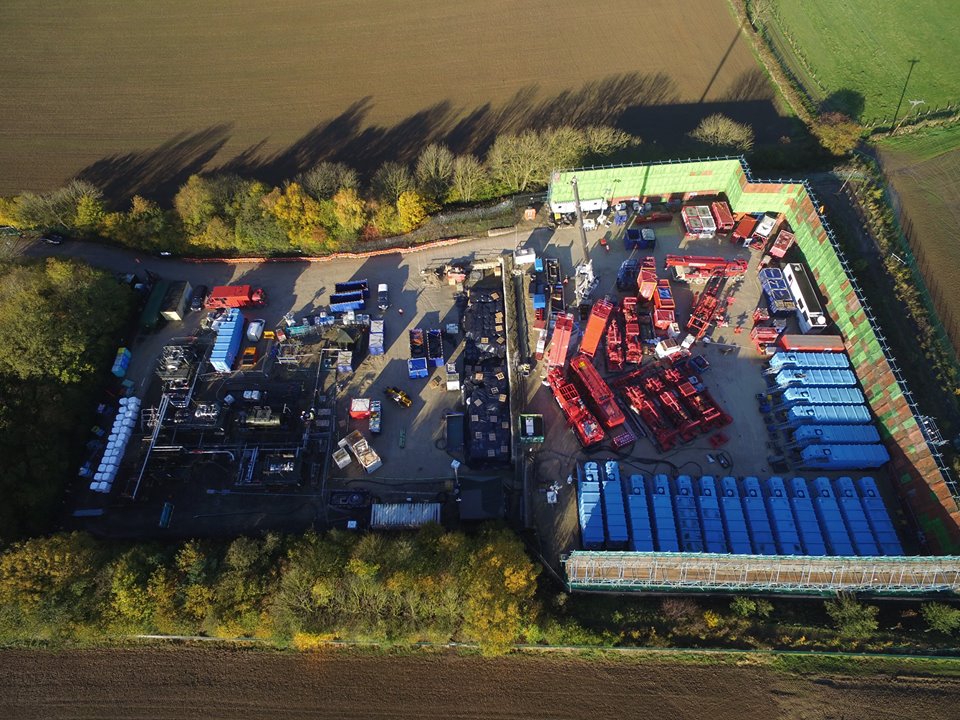
Drone image of Third Energy’s KM8 site at Kirby Misperton, 5 November 2017. Photo: Eddie Thornton
As Third Energy prepares to start fracking in North Yorkshire, new research warns against bringing new sources of gas into production if Europe is to meet its climate targets.
The study by the Tyndall Centre for Climate Change Research and Teesside University published today concluded that Europe must stop using gas within 18 years. Even short-term use of gas was incompatible with EU commitments under the Paris climate agreement.
The study found that under current emissions, the EU had just nine years left in a fair carbon budget required to limit warming to well below 2oC. Even with a managed phase-out, gas must go by 2035.
The research, commissioned by Friends of the Earth, comes as the Business Secretary, Greg Clark, is considering whether to approve fracking at Third Energy’s Kirby Misperton site. If permission is granted, this will be the first high volume hydraulic fracturing in the UK since 2011. Other companies are preparing plans to sink shale gas exploration wells across the East Midlands and northern England.
The fracking industry has promoted shale gas as a “clean fuel” and a bridge to a low carbon future. It has predicted that gas will remain part of the UK energy mix until 2050 and beyond.
But the authors of the new study, Professor Kevin Anderson and Dr John Broderick, said fossil fuels, including natural gas, had no substantial role in an EU 2oC energy system beyond 2035.
They said:
“Within two decades, fossil fuel use, including gas, must have all but ceased, with complete decarbonisation following soon after.
“There is categorically no role for bringing additional fossil fuel reserves, including gas, into production.
“An urgent programme to phase out existing natural gas and other fossil fuel use across the EU is an imperative of any scientifically-informed and equity-based policies designed to deliver on the Paris Agreement.”
Professor Anderson, deputy director of the Tyndall Centre for Climate Change Research, said:
“If the EU is to transform its energy system to align with the Paris temperature and equity commitments, it cannot continue with business as usual and must instead initiate a rapid phase out of all fossil fuels including natural gas. This needs to begin now and be complete within the coming two decades.”
Friends of the Earth fracking campaigner, Rose Dickinson, said:
“This report is stark: Europe needs to cut gas use fast to play its part in avoiding catastrophic climate change. The UK also has a key role to play, and starting up a whole new fossil fuel industry in England would make this much harder. It’s another compelling reason why Energy Secretary Greg Clark must not allow fracking to go ahead in Ryedale, North Yorkshire. Rather than get locked into more fossil fuels, we must prioritise energy saving and renewable energy – that’s the only way to deal with the climate crisis”.
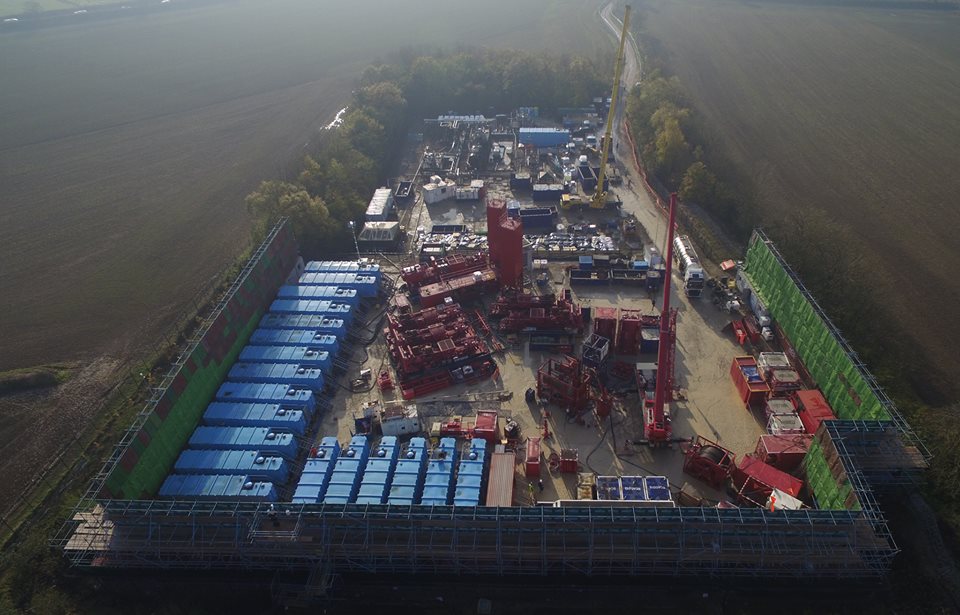
Drone image of Third Energy’s KM8 site at Kirby Misperton, 5 November 2017. Photo: Eddie Thornton
Climate talks
Publication of the research coincides with the start of new UN climate talks in Bonn. For the next two weeks, negotiators from around the world will be discussing how to implement the Paris Agreement.
One of the key issues is likely to be what would be a fair rate for reducing emissions for different regions of the world.
EU member states are in the final stages of agreeing a 40% domestic emissions reduction by 2030, compared to 1990 levels.
But a review by global civil society organisations suggests this isn’t a big enough cut to reflect Europe’s responsibility for climate change and capacity to tackle it. The review calculates that to be fair, the EU should be doing nearly five times more to mitigate climate change.
In their report, Professor Anderson and Dr Broderick spell out what the EU would have to do to meet its fair share of a 2oC target. They say the EU must begin immediately to cut emissions by 12% a year – much faster than the 40% reduction by 2030.
The authors argued that the long-term use of gas and oil had been supported because climate models relied too much on what are known as negative emissions technologies, such as bioenergy with carbon capture and storage. This has had the effect of closing down what the authors described as “more challenging but essential debates over lifestyle, profound social-economic change and deeper penetration of genuinely decarbonised energy supply.”
Their study also concluded that methane emissions were at dangerously high levels. Methane emissions from human sources, including the gas industry, were likely to add 0.6oC to global warming, they estimated. They also said the transport of liquefied natural gas (LNG) increased its climate change impact by an average of 20% and by up to 134%.
Recommendations
Friends of the Earth is recommending:
- The EU’s energy system must be rapidly transformed to be fossil fuel free by 2030
- The EU should immediately end all fossil fuel subsidies, including grants or loans to gas infrastructure projects
- The EU and member states should stop support for all fossil fuel projects, stop any new exploration for oil, gas and coal and ban unconventional fossil fuels, including shale gas.
Links
Can the climate afford Europe’s gas addiction? Briefing by Friends of the Earth Europe
Natural Gas and Climate Change report by Professor Kevin Anderson and Dr John Broderick
Categories: Research

 DRILL OR DROP?
Sanity at last. Will Britain rise to the challenge? Let’s hope so, but where is the leadership going to come from I wonder.
In the 1760’s James Watt and Matthew Boulton made Great Britain the front runner in the global industrial revolution. When the diarist James Boswell came to look at their production facility in Birmingham, a prototype factory that became the model for many to follow, Boulton said to him “I sell what all the world desires to have – Power”. Their new steam engines offered around 2000% better efficiency of the earlier models. The rest is history – largely a fossil fuel powered one. Now we’re at the butt end of this 250 year arc of fossil fuel dependency and the chickens are coming home to roost in the form of this dirty unnecessary fracking business. Wouldn’t it be great if Britain became one of the world leaders again, as good global citizen, helping to steer the world away from O&G and the greenhouse effects that threaten a climate catastrophe along, with the suffering that ensues for many people (already beginning).
[Typo corrected at poster’s request]
“The research, commissioned by Friends of the Earth” C’mon, Ruth, did you expect us to read anything after this sentence? Seriously?
No, I doubt she expected *you* to Peeny with your famously open mind.
Anyway you are probably to busy with “anonymously” (oops! 😂) setting up web sites for another mining operation. How did “Environmentalists for Don Diego” pan out for you in the end?
Not very well, Hobbit. But I’m not sure that has anything to do with this discussion. Indirectly I could draw certain parallels but I don’t think anyone here would be much interested to read about them.
If a study support fossil fuel funded by the industry then it is called biased by the activists. And if a study calling to ban fossil fuel funded by an anti-fossil fuel lobby group then the result is called science by the anti frackers.
Go and figure.
So which particular conclusions of this report wouldn’t you agree with here TW and why?
Of course the big difference is that the industry gets to make $billions for themselves and the anti fossil fuel group gets a planet we can all live on.
Well said Helen.
TW, exactly like Refricktion has just done but from the opposite point of view. The difference is that the Tyndall Centre does not have a vested interest where they stand to gain financially if fossil fuels and fracking continue. That is why Exxon Mobil is currently under investigation and is accused of suppressing climate change science for decades which has misled shareholders. Other fossil fuel companies, including some British, have also funded anti climate change science, whilst publicly stating they support tackling climate change. And Furthermore, the Tyndall Centre is in line with the vast majority of scientists on this issue, it was not a mere oversight as to why BEIS did not mention Fracking in their Clean Growth Strategy.
All this nonsense claimed by industry about 40 years worth of gas being beneath our feet is meaningless. Even if the gas could be extracted, it cannot be burnt. The government has finally admitted that the UK has energy security for 20 years, without the need of unconventional gas. All those “keep the lights on claims” and “lower energy prices” have been shown to be nothing more than the propaganda we knew them to be.
New technology is rapidly advancing and carbon free energy will be heating buildings, the last gasp justification by the fracking industry, far quicker than the industry would like. With an abundance of cheap hydrocarbons already available and avoiding catastrophic climate change being the global agenda, there is no place for fracking. The powerful fossil fuel industry is lobbying governments and has delayed the transition but as polluted air increases and the earth’s temperature continues to rise, this is a fight they have already lost.
https://www.theguardian.com/environment/2016/dec/16/centrica-has-donated-to-us-climate-change-denying-thinktank
http://www.independent.co.uk/news/business/news/rex-tillerson-used-fake-name-wayne-tracker-climate-change-exxon-mobil-secretary-of-state-a7628611.html
Fire Brigade support anti fracking protectors at Kirby Misperton.
Not Friends of Fracking
Hmmmm, that is interesting word association? Not Any Friends Of Fracking Fanatics.
= NAFOFF Ha! Ha!
Always a pleasure guys.
And TW, if independent scientific bodies say that fracking can be undertaken safely, they are ignored by the fracktivists.
Did we suddenly vote again? I thought we were out of the EU March 2019? No mention about the big protest in Germany against their renewed use of coal. 2500 protestors battling riot police-now, that is a proper protest.
Gas will be part of the UK energy mix past 2050? Obviously will. Transport of LNG increases it’s climate change impact? Obviously does.
The EU has some serious issues regarding energy use and energy security. It is their problem to sort. Meanwhile, UK should maximise gas production, within sound economics and safety considerations. North Sea oil/gas was developed around that principle, Scotland referendum was based around that, Norway economic boom is based around similar and yet some would say further opportunities should be denied! Funny how you never see any recognition about potential to decarbonise gas and oil within these “studies”, yet research is ongoing and trials planned. Suspect that was outside the FOE brief. Wonder why.
Wrong on most counts Martin. And whether the govt will survive the Brexit farce remains to be seen.
LOL. Ah these greeny gangsters and their Santa list aye.
Meanwhile back to the real world why doesn’t FoE concentrate solely on improving the energy efficiency in what were previously known as Third World countries, China and the US. Oh and have a word with Germany and their coal whilst you’re at it.
What about the Peeny Gangsters – The “Mentalists for Don Diego”? How did that go? Any more sites to share with us?
No other sites at the moment, Hobbit. But I’m happy to educate you with respect to that cause if it’s something in which you have interest.
No.
Wrong, in your opinion PhilipP, but factually correct in my statements. I recommend it. Just about sums up the antis approach-not just ignore facts but claim that the facts don’t exist. Meanwhile the globe continues to revolve, and some yachts head off west from UK and come back later from the east.
The globe? We thought you were all frack earthers?
Martin et al. Sorry to burst your bubble again but your ‘facts’ are devoid of context. The temporary upswing of German coal usage was entirely down to the early decommissioning of nuclear power generators on both side of the German and French borders (shut down for testing in the French case) in the wake of Fukushima. But it’s great that the protestors want them to move ahead on that front as well – the delays to coal divestment are becoming a real problem – but a stopgap measure and not a renewed investment in coal as you’d rather put it. We have been over that many times – is it a memory or reading issue on your part?
Sadly your church of misinformation (aka the fossil fuel lobby) relies on cherry picked ‘facts’ and leaving out contextual information that gives the whole picture. Regarding the other ‘fact’, that the UK will need gas as part of the energy mix past 2050, there is not enough information there to say how bigger part it will play. All going well it could be a very small part. To roll out a whole new fossil fuel industry however just turns that prediction into a self-fulfilling prophesy, cranking up the dependency on the new infrastructure whose investment cycle would demand a 30plus year commitment. The same applies to the issues of imports (LNG) being less carbon friendly than a whole new home grown industry. You’d need the context and sums involved – to prove that adding 1000s more wells will not be more environmentally polluting and GHG emissive than using the declining years of FF dependency to run on existing supplies which will undoubtedly be dumped on the market at cheaper and cheaper rates while the world turns to renewables.
Masters of our own demise, and the demise of life on Earth! Money,money,money, but we will all be poorer for the ruination of our planet.
More biased reporting from fracking’s apparently independent “journalist”. I mean give it a rest, Ruth. This report poses problems, not solutions. Can tell you’re getting desperate as we approach the first fracking activity as your reporting has become more tediously activist as the months have rolled by. Tragic.
More fake id’s peeny? That Ignoravirus will only provoke more anti bodies you know.
And it’s getting extremely tiresome when you are attacking our hosts like this isn’t it?
Oh, I see PhilipP. You are now part of the “1000s more wells” faction, and not the “shale gas production in the UK will not be economic” faction! It is nearer to fiction, than fact. Figures!
By the way, stopgap is NOT a fact. It is PR, which may, or may not, become the reality.
Anyone can look those figures up Martin, including the coal curves for Germany.. 1000s of wells (here) is the ultimate reality when major investment stakeholders and lobbyists talk about the overall recoverability of shale gas for the UK – at measures that would make sense of those self sufficiency or energy independence claims, precisely the arguments used to justify the political measures taken. Have you slept through all that? It’s nothing to do with factions.