

Live updates from the debate between Thirsk and Malton MP, Kevin Hollinrake, and oil and gas industry engineer, Mike Hill.
Mr Hollinrake (left) is proposing the motion: This house believes that UK regulations make fracking safe”. Mr Hill (right) puts the case against. The chair is the Right Reverend James Jones. formerly Bishop of Liverpool and Bishop of Hull and chair of the the Hillsborough Panel supervising disclosure of documents relating to the football stadium disaster.
The two-hour debate has been organised by Kirkbymoorside Town Council and aims to inform councillors and citizens about fracking. It comes as Third Energy, which wants to frack the local KM8 well at Kirby Misperton, has said the operation will be delayed until the autumn (see DrillOrDrop report).
Reporting from the debate has been made possible by donations from individual DrillOrDrop readers.
8.53pm: Vote on the motion
Bishop James puts the motion to the audience. It is overwhelmingly lost.
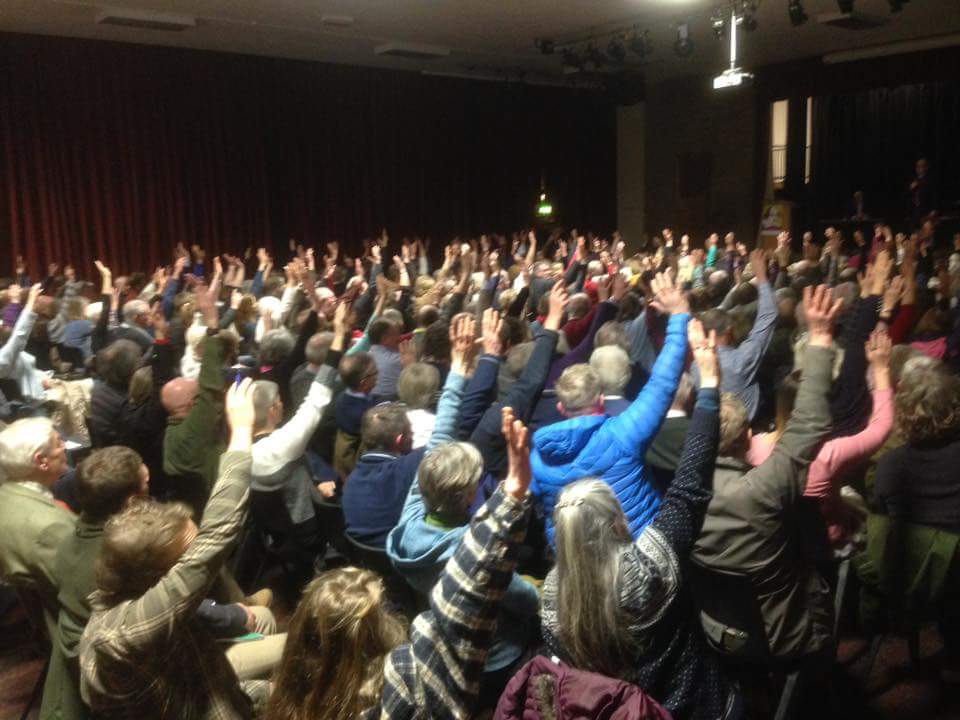
Vote against the motion. Photo: Eddie Thornton
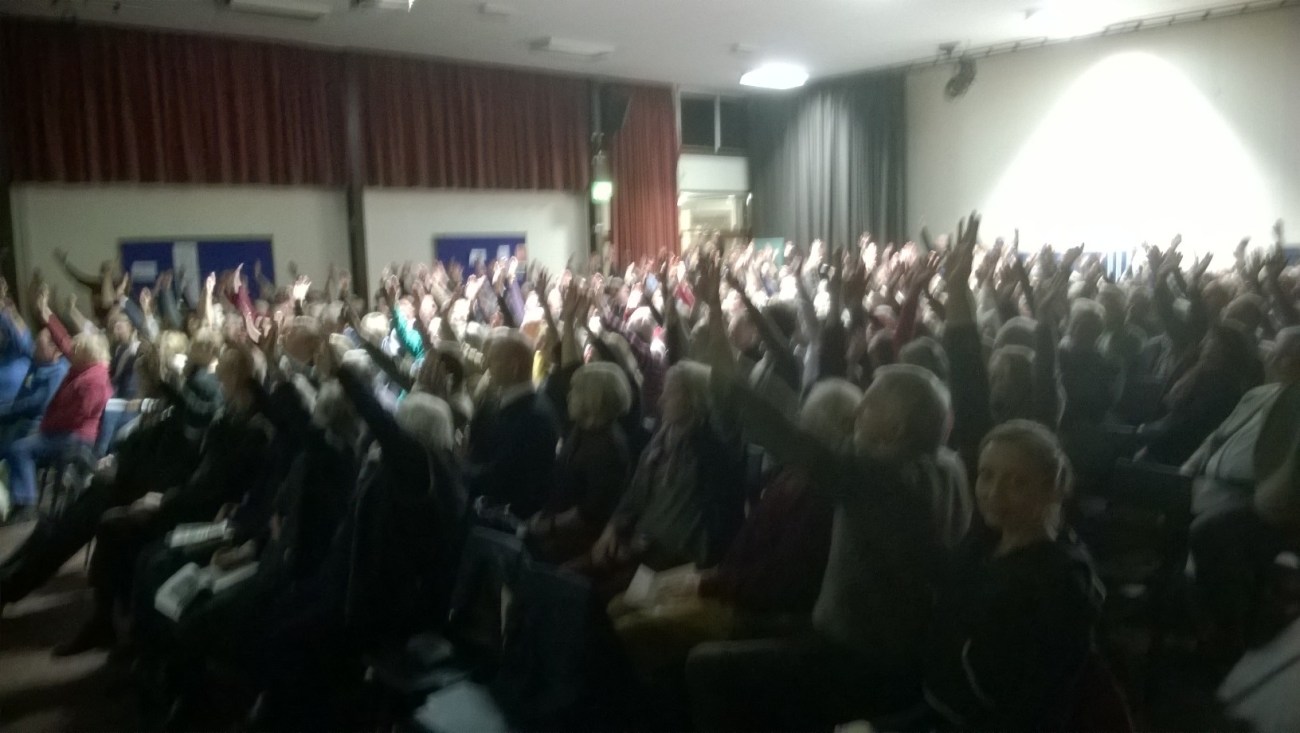
Vote against the motion. Photo: DrillOrDrop
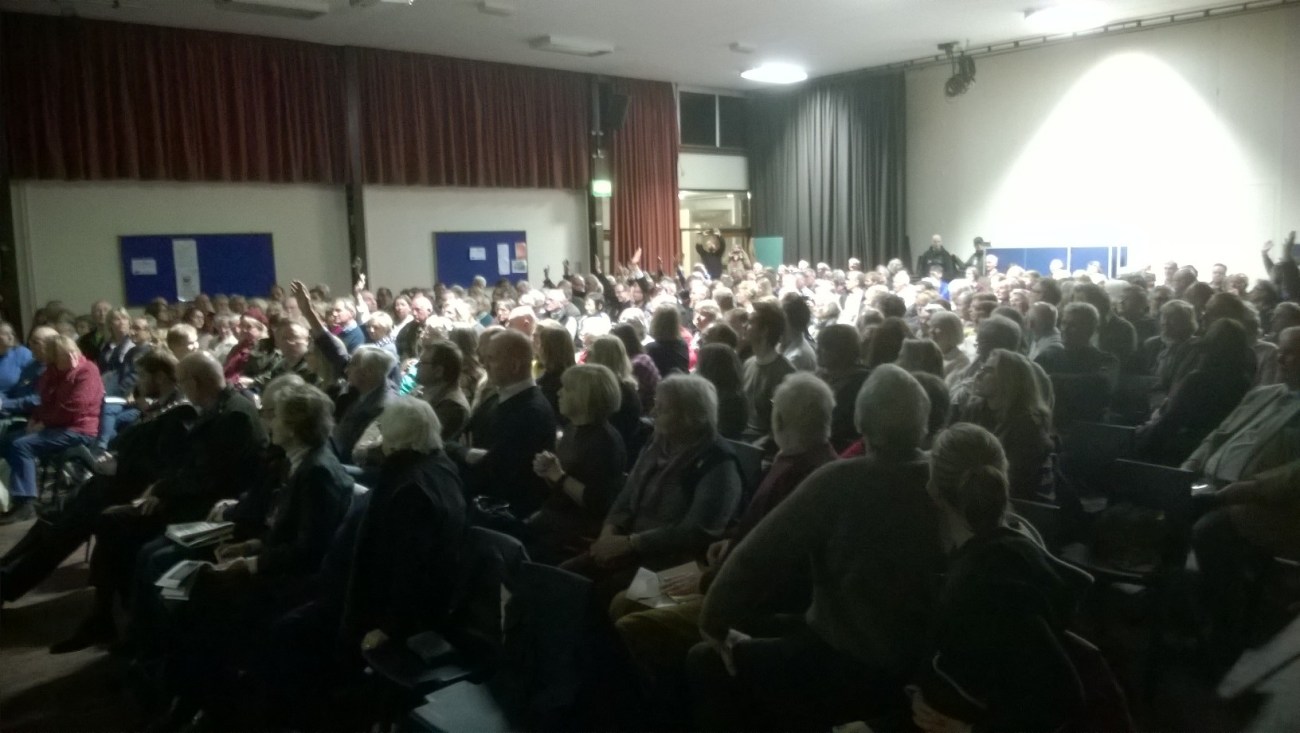
Votes for the motion. Photo: DrillOrDrop
Bishop James Jones says:
“People responsible for regulation nationally and locally need to take note.”
8.39pm: Panel summing up – Mike Hill
Mr Hill says there are now 800 studies coming out of the US which predict deaths. One of them says fracking causes cancer. That causes death, he says.
The EA has not fully implemented regulations, he says. You are not independent of the operators if you take money from them, he says.
It is self-regulated with a woeful inspection strategy, a civil servant, says, Mr Hill reports.
The UK has a good record offshore, Mr Hill says. Onshore: only one well has been fracked onshore and that had problems.
On goal setting, Mr Hills says the words were from the HSE not from me.
On chemicals, Mr Hill says what comes back is more important than what goes down.
It is insulting to say that fracking is no big deal, he says. It will be a very big deal for the farming industry.
People may be prepared to move out of their homes if there is an emergency. People need to know what the evacuation policy is. You can’t be serious to rely on a telephone tree, Mr Hill says.
On the issue of previous concerns, you haven’t lived through this before, Mr Hill says. There has been only one high volume hydraulically fracked well at Preese Hall.
To say let’s have a cautious start, not with my family’s health you don’t.
The audience has weaknesses with the system. On the pro-side it shows that they are not listening to you, he says.
Shale gas is a bridge to nowhere. It is a bridge to nowhere. Fugitive emissions are running at 9% in the US on average. If you care about the planet, you should burn coal with fugitive emissions from shale gas above 4%. I know it is a lie to say it is a bridge to a low carbon future.
A government report says we are secure without shale gas for the next two decades, Mr Hill. Government figures show imports from Russia and some other countries is 3%. This is scaremongering, he says.
To get a small amount of gas out of the ground will need thousands of wells. This is not conventional gas. This is like getting gas out of a balloon. Shale gas is like getting gas out of granite. The permeabilities are so low. Richard Davies from ReFine says something are very similar.
On jobs, the Institute of Directors said 64,000 jobs could be created from shale gas. They were very blissful. It is likely to be 15,000 at the height of fracking if we let them drill thousands of wells. Set that against job losses in farming, food and tourism.
What price your health and that of your children’s. Fracking will leave vast quantities of toxic waste underground. This dwarfs plastic pollution. Is this the legacy we want to leave our children and grandchildren. Are you happiest that people will think of our generation as the dirtiest ever?
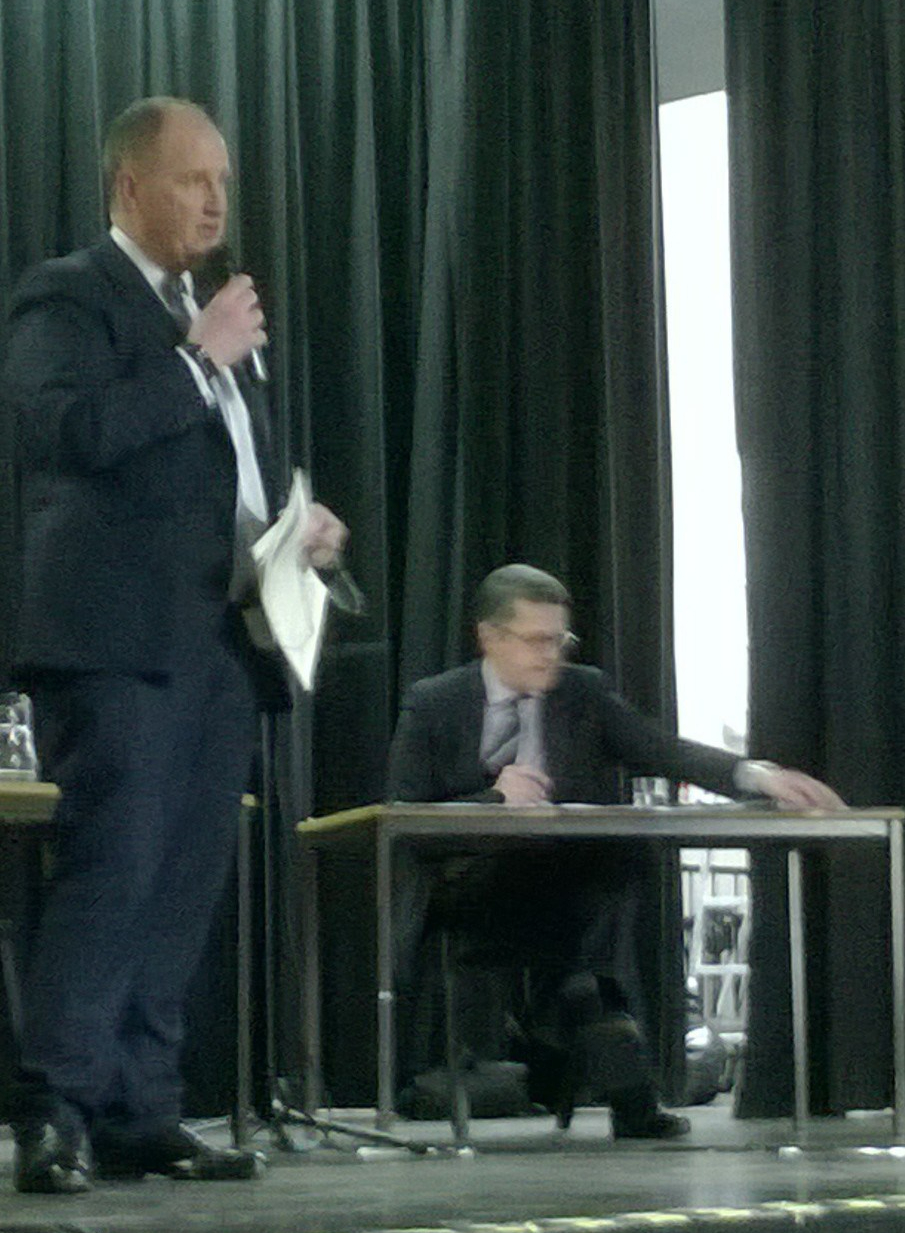
Photo: DrillOrDrop
8.24pm: Panel summing up – Kevin Hollinrake MP
Mr Hollinrake recommends people should put their faith in engineers who wrote the Royal Society report.
I have lived here all my life, there is no way in the world, I would take an irresponsible risk and put the lives of my family in jeopardy, he says.
I have a concern about the capacity to regulate at scale. But we have one well and that well won’t be fracked until October. The roll-out will be very slow, he says, because of the regulation and planning.
The key issue is what enters the water courses and the air and affects the seismicity. If materials do not enter these channels then we are not at risk. H2S is not to do with fracking, it is conventional gas.
We import 45% of our gas now, 70% by 2030. Our energy security is important. We have taken LNG from Russia. Centrica has signed a gas contract taking 9% of our gas by 2021. We also import from Qatar and Norway. There is an energy security issue that we need to solve.
Well density is being considered in the minerals plan for North Yorkshire. If the inspector does not support that, I will not support it. I think there should be national limits.
At the moment, we are guessing about is this worthwhile. We should take a cautious step forward.
Is INEOS going to buy their way into the government. I am not the government, he says. I am not for sale, nor would I ever be. I want to make things better, not for personal gain.
I do not believe there will be devastation. There have been various studies on the impact of fracking that have found no evidence of water contamination. Every US presidential candidate, except Bernie Sanders, supported shale gas continuation. Do we really believe the US president would support something damaging?
The water problems in the US were in one town. It is contested what happened. I am willing it could have been poor practice. I do not believe it would happen in the UK.
In the UK, the producer would pick up the tab if there was contamination. If they went bust, there is a producer fund.
Government overruling local decisions is how planning works. Local decisions have to meet national policy. In Lancashire, planners had recommended approval. You cannot isolate national from local need, either as a parliamentarian or local council.
The decision on fracking was taken in parliament. He says there is a shale gas licence in his village.
If producers don’t meet their obligations, should they be fined or shut down, Mr Hollinrake asks. Absolutely he says.
We should move away plastics, But most of us use plastics in our lives. If there is no demand, there will be no plastics.
Ethane for plastic is from 0-20% of what comes out of the ground. The rest goes into the commercial market.
On Scotland, Mr Hollinrake says the decision had more to do with politics than science.
On sustainable development, Mr Hollinrake says the UK is pushing ahead with renewables. We are phasing out coal probably by 2020. The reality is that only 15% is from renewables. Fossil fuels will remain in the mix for several decades. Gas is the cleanest fossil fuel.
We need to look at the science. We have monitoring going on. It looks air, water and seismicity. If it can’t be regulated, I will be the first to call for a moratorium.
8.22pm: Speaker against the motion
The speaker asks about sustainable development. One of the key principals, supported by all political parties, is the precautionary principal. We may not need to take the risk of shale gas fracking. The scope of renewable energy and energy conservation are growing. Why do we need to take the risk. It is against the precautionary principal. It breaches our sustainability agenda.
8.21pm: Speaker against the motion
The speaker asks if the regulations are so robust, why has Scotland, Ireland and Wales said no to fracking.
8.18pm: Speaker for the motion – Alan Linn, Third Energy
Alan Linn, of Third Energy, is given the chance to speak again. There is no difference in the gas, whether it is fracked or not. The fracked gas is deeper. The conventional gas contains H2S, it always has, he says. We also know the fracked gas has zero H2S.W
I have worked in the industry for many years, he says, including the US. The regulations in the UK are the strictest. It is our intention to be a good neighbour. It is not our intention to blow Ryedale up. That is the worst thing we could do. Doing things unsafely is not sustainable. We want to do things safely.
Everyone on site at Kirby Misperton wears an H2S detector. The concerns can be put to rest.
8.16pm: Speaker against the motion
The speaker says the greatest regulation is paying for mistakes. The government of Pennsylvania told us last year the average fine against violations was about $5,000. A third of the active wells had problems and no-one was being punished.
The speaker also says the people who bought licences in the Pickering area want the gas to make plastics – not for home heating. There is no shortage of plastic, the speaker says.
8.13pm: Speaker against the motion
The speaker welcomes the debate. But he says actions matter more than words. He says the Bishop said the debate was evidence of local democracy. Tell that to the people who were overruled by the Conservative government, he says.
The speaker says he was more impressed by Mr Hill.. There is evidence across the world, he says, of the dangers of fracking. He asks how do you regulate a well 1km underground. You cannot regulate what is going on underground at that depth.
He says Mr Hollinrake’s presentation is weak – if we are to rely on that it is a none starter.
8.11pm: Speaker for the motion- Sir James Bevan, Environment Agency
Sir James Bevan. Photo: DrillOrDrop
Sir James Bevan says he as been to Preston New Road and talked to communities. I don’t think it is fair to accuse us of being absent. People working for the agency in Lancashire are passionate about the environment. They are absolutely committed to protecting the environment they serve.
8.10pm: Speaker against the motion – Gayzer Frackman
Photo: DrillOrDrop
Gayzer Frackman says he has witnessed in Lancashire at Preston New Road a lack of enforcement, breaches on an almost daily basis.
We have no faith in the Environment Agency or the HSE because at Preston New Road you are proven to be ineffective, he says. My community bear witness.
The EA nor the HSE did not attend the public inquiry on Preston New Road. Will you turn up at the Roseacre Wood inquiry to answer questions about our supposed regulators, he asks.
8.09pm: Speaker against the motion
The speaker asks what regulation can the government put in place as insurance in perpetuity for protection against problems.
8.07pm: Speaker for the motion- Tony Almond, HSE
Tony Almond is invited to speak again to defend the HSE. He says the goals are set in the health and safety regulations. One of the key one is no unregulated releases. When we have talked about regulations, we have talked about the agencies. We haven’t talked about how the regulators work together. The EA and HSE has had a working together agreement since 2012.
8.05pm: Speaker against the motion – David Lloyd Williams
Former county councillor, Mr Lloyd Williams, says the regulation of the conventional industry was as good as it could be. When something goes wrong, when there is an accident, what regulator can prevent what happen underground. Can this house really support the regulation we asked tonight, I fear not, he says.
8.04pm: Speaker for the motion
The speaker says the debate has not discussed the good that would come from fracking and the benefits to the economy. The US shale industry meant everyone was better off and no-one suffered.
The regulations sound extremely good, he says.
8.03pm: Speaker against the motion
The speaker says fracking is indisputably unsafe so regulation cannot make it safe. Who would go to prison if fracking when something goes wrong, he asks.
8.01pm: Speaker for the motion – Sir James Bevan, Environment Agency
Sir James Began is given another two minutes to address criticism. He says he doesn’t recognise the alleged failings of the EA. If there were an expansion of fracking, I am confident my agency would be able to robustly regulate the industry, he says. This is because he cares about regulating and because the funding would come from permit funds.
7.59pm: Speaker against the motion
Photo: DrillOrDrop
The campaign 20 years ago against the generating station was nothing compared with what INEOS will bring to North Yorkshire, the speaker says.
INEOS is a big company. We need to be aware what the government is allowing to happen. If Kevin Hollinrake has any influence he needs to make sure we are not sold down the river. We have to stop thinking that this is like the generating station. Ordinary gas is one thing. Shale gas is another matter.
7.58pm: Speaker in favour of the motion
The speaker said he remembered concerns that turned out to be unfounded about the generating station. I think this may happen again, he says. There is a case for doing an exploration well, to make the evidence, to allow people to make conclusions. At the moment we are all guessing.
7.56pm: Speaker against the motion
Photo: DrillOrDrop
The speaker says there is no legislation that require a distance between homes and shale gas sites or a maximum limit on the density of well pads.
The speaker adds that the operator of a UK oil well, monitored by the EA, did not carry out baseline checks and yet still received an environmental permit.
7.54pm: Speaker in favour of the motion – Lorraine Allanson
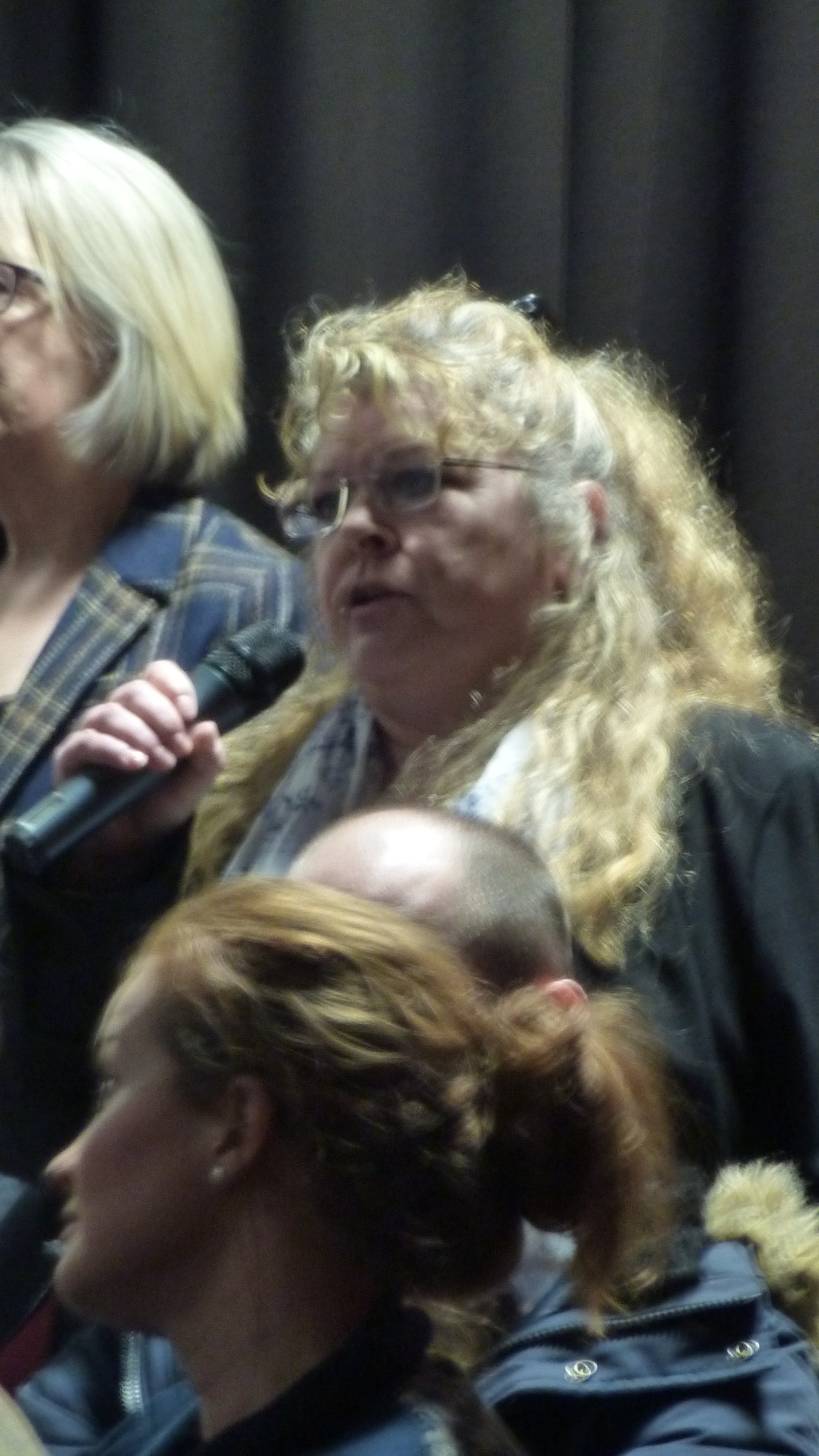
Lorraine Allanson. Photo: DrillOrDrop
Ms Allanson says everyone has survived the scares of hydrogen sulphide at the Knapton Generator Station. She says there have been zero deaths from fracking, despite more than 2 milliion frack jobs.
30,000 people die from fuel poverty. Seven people an hour died from fuel poverty in the previous cold spell. It is a disgrace that these people cannot afford to live, she says. How are we going to look after those people. How do you regulator for fuel poverty.
7.50pm: Speaker against the motion
Photo: DrillOrDrop
The speaker says she has been examining regulations at Kirby Misperton and other sites. Hydrogen sulphide gas has leaked from this site twice. The EA has one monitor on the Kirby Misperton site. The reason the EA could not detect hydrogen sulphide because the wind was blowing in the wrong direction. How is that gold standard regulation, she asks.
She says she has been in touch with 10 agencies about emergency evacuation plans. She is still waiting, after 2 months of asking. Third Energy says it has a telephone tree. Is that gold standard regulation, she asks.
The fire service has no scope to deal with unexploded gas. The fire service have a very small number people who will be able bring out staff on the site and the local community. What is the plan for Third Energy in the event of a hydrogen sulphide gas leak? What is the explanation for the leaks.
7.48pm: Speaker in favour of the motion- Alan Linn, chief operating officer of Third Energy
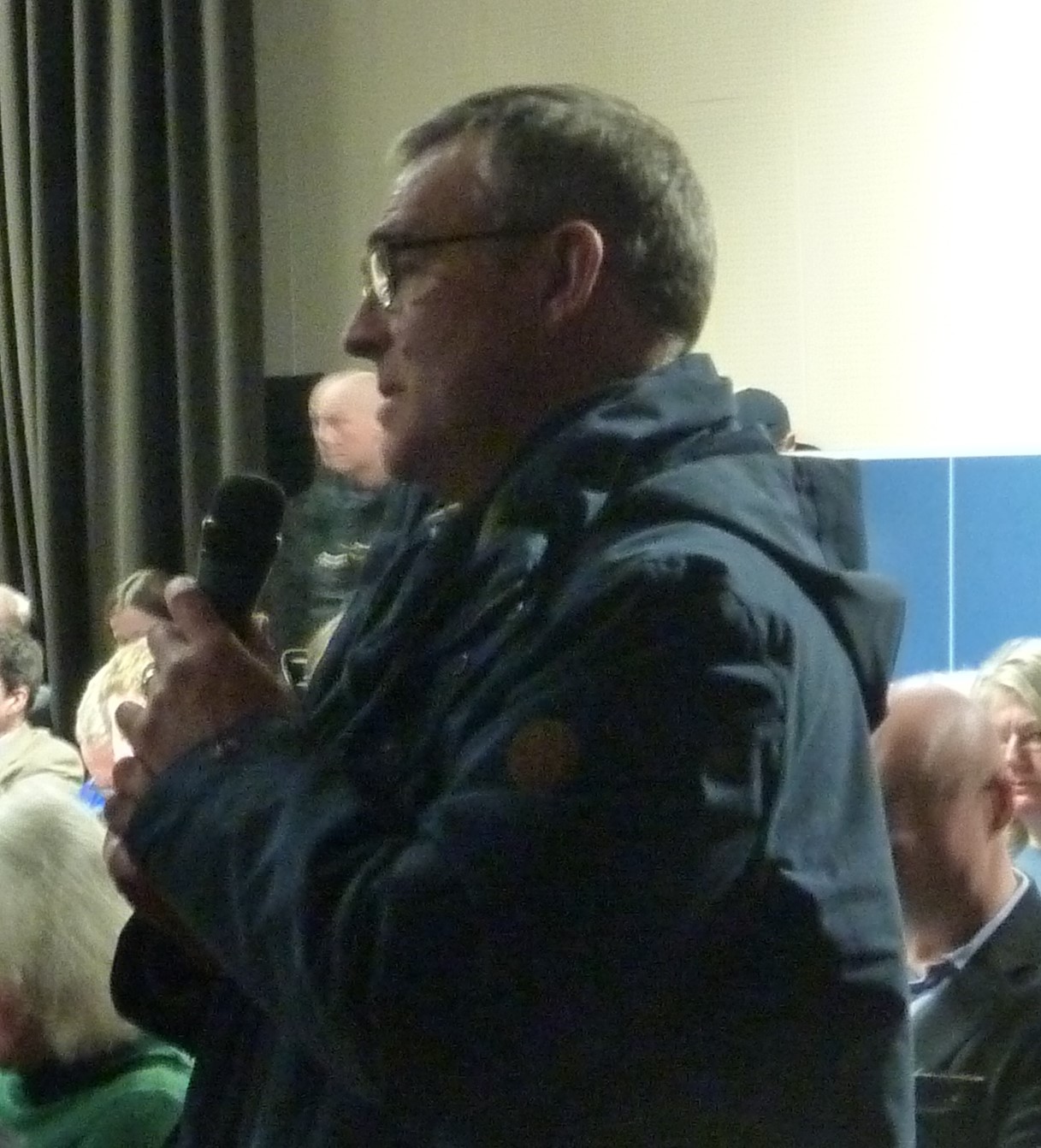
Alan Linn, chief operating officer for Third Energy. Photo: DrillOrDrop
Mr Linn says biocides are not used in fracking. They are used in other parts of business but not in fracking. What we use in fracking are chemicals that are safe for human consumption, he says.
The regulations are very, very strong, he says.
Another set of regulation introduced by the government to check everything. We do not mark our own homework. They don’t always let us know they are coming. We have been operating in the Vale of Pickering for 20 years. Fracking is not a big deal.
7.45pm: Speaker against the motion – Roderick Robinson
Mr Robinson says he has been working for 40 years on pesticides. He has worked with the EA. I have a severe problem with fracking because of real legal issues. It has a risk of breaking the law. He is prevented by law from applying biocides to fractured geology. Why is the fracking industry allowed to do this, he asks.
Triocene, a biocides, is planned for Third Energy’s well. Mr Robinson said he did research on this and it has been banned. Another chemical is registered as a lubricant when it is a biocide. How do the regulators work with the situation in which the companies are breaking the law.
7.44pm: Speaker in favour of the motion – Tony Almond, Health and Safety Executive
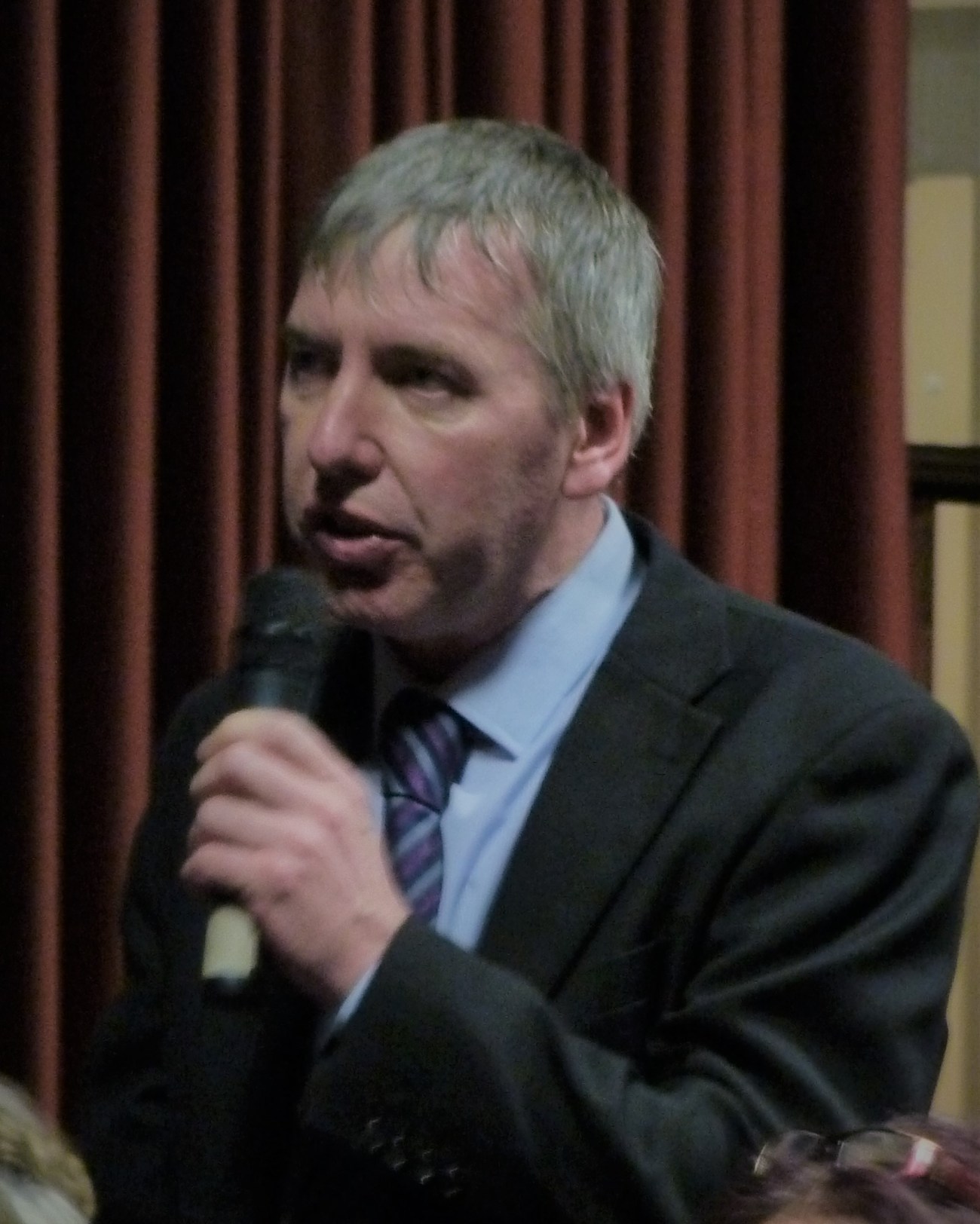
Tony Almond. Photo: DrillOrDrop
Mr Almond says experienced engineers regulate on and offshore wells. We have a strong regulatory regime. Read about all of the regime, he says.
7.42pm: Speaker against the motion
The speaker says it comes down to a matter of trust. If I have to choose between a politican and a chartered engineer it is no contest.
The best regulations in the world are useless unless they can be checked. Is the government capable of ensuring that checking can be done. In my view it is not. We will have to rely on self regulation and look what happened with the banks.
7.40pm: Speaker in favour of the motion – James Bevan, Environment Agency chief executive
Mr Bevan says regulation for fracking is safe. If you want to frack you have to show it will not affect soil, air, water, wildlife. If you can’t you will not be allowed to frack, he says.
We will monitor and check, he says. We do not allow people to mark their own homework. We have done 15 inspections of the Kirby Misperton site. If people do not abide by the conditions, they will be required to put things right.
I believe frackng regulation is safe is because of the people who work for the Environment Agency
What motivates them is the desire to keep people safe.
Photo: DrillOrDrop
7.38: Bishop Jones
Bishop Jones asks people to say who wants to comment or ask a question.
Around 20 people raise their hands.
7.21pm: Presentation by Mike Hill
 Mr Hill, a chartered engineer, says he has no career interests in fracking. He says he has a duty to inform the debate and answer questions as honestly as he can. He urges people to verify facts and come to an opinion on the facts.
Mr Hill says the Royal Society report made 10 recommendations which he agrees with. Only one out of 10 had been implemented, he says. The government has accepted all 10 but that is not implementation.
The government is not listening, they overrule democracy, they smear whistleblowers and they push things through, Mr Hill says.
There will be deaths from this industry, he says. The Infrastructure Act made it easier to frack and not safer for the public.
Fracking is re-starting. Now is the time for action. The coulds, shoulds, have not happened.
We need an independent inspection strategy, Mr Hill says.
He quotes the Environment Agency that flowback fluid will be recycled. There will be no limits for the reuse of the flowback fluid, the EA says.
Analysis of the contents of flowback fluid from the Preese Hall well found contaminants at many times the level of safe drinking. That had not been recycled.
The EA gets the operator to mark their own homework and that is a conflict of interest, Mr Hill says. The EA at Preston New Road says there is no way for the fracking waste to get up to the aquifer.
Mr Hill fracking requires the drilling of thousands of boreholes. The only thing that prevents contamination of aquifers is well integrity.
The EA have minimal experience of fracking. They are behind the curve, Mr Hill says. They are reliant on residents to monitor, he adds.
So much for a robust Environment AGency.
The Health and sAfety Executive says the operators are responsible for managing risks and setting goals and that makes regulation robust, Mr Hill reports.
The HSE has made no unannounced visits to eight shale gas sites in Lancashire. The HSE has made two announced visits in 13 months.
The US has a much stricter regime than the UK. The HSE still relies on operators to mark their own homework. Well reports are faxed by the operator once a week, Mr Hill.
Damage to the Preese Hall well was not reported to the HSE, Mr Hill says, because it was not a notifiable incident. So much for a robust regime.
On the Oil and Gas Authority agreed it should have a strategy. It still in draft form. The onshore strategy should focus on viability, Mr Hill says. It should concentrate on safety, Mr Hill. It is an absolute disgrace, he says.
The Cullen Report into the Piper Alpha disaster recommended breaking the link between the industry and its cheerleader. There is a conflict of interest between the OGA and the industry, Mr Hill says.
The British Geological Survey is not a regulator, although it is referred to as one. The work in North Yorkshire study is not a baseline and is not a regulatory requirement. This is their own words, Mr Hill says.
The baseline in the Vale of Pickering, cannot be relied on.
Jobs: Mr Hills questions the estimate of 64,000. He asks how much gas is imported from Russia. He asks whether there is an evacuation plan.
In conclusion, he says, this is not robust regulation. The government’s arguments on regulation in tatters. This is putting people’s lives at risk.
7.04pm: Presentation by Kevin Hollinrake MP
 Kevin Hollinrake says fracking has been a key word in his life since being elected as the local MP.
He says there was cross-party support for fracking in a debate in the Infrastructure Act.
He says there are several regulatory agencies responsible for fracking: the Environment Agency, the Health and Safety Executive, mineral planning authority (North Yorkshire County Council) and the Oil and Gas Authority.
Mr Hollinrake says there are nine well pads in Ryedale and there have been decades of experience of oil and gas exploration.
There are permits that have to be met, he says, with limits on the depth of fracking, rules on casings, what chemicals can be used (which have to be disclosed), disposal of waste water.
There are national regulations on air and water quality and seismicity before shale gas exploration can start.
Mr Hollinrake says he is not a scientist but it is important that we look at the science. The scientists say it is quite clear that this can be done safely.
The Environment Agency said “We believe the Environment Agency has the right regulatiory controls to regulate the sector”.
The Royal Society report of 2012 said shale gas can be operated safely if best practices are enforced through regulation, Mr Hollinrake.
A book from the British Geological Survey says “if scientists are listened to and the results are there to see we get the best of both worlds”.
A report for the Scottish Government says the regulatory framework is in place.
Mr Hollinrake says if we cannot carry out this operation in a way that protects the environment I would be the first to oppose it.
“I have tried to make sense of all the different arguments. I have not simply taken the government line.
“I have also fought for additional protections”.
Mr Hollinrake says fracking must be compatible with the beauty of Ryedale and its industries.
He describes how he went to shale gas areas in Pennsylvania. He says the industry in the US got ahead of the regulators at the beginning. Where things went wrong was because the regulations were not in place.
He says he has written a report, posted on his website, which looks at every single aspect of fracking, allowing readers to experience what he saw and heard.
Looking at everything we saw in Pennsylvania convinced us that we could regulate fracking safely, Mr Hollinrake says.
Open ponds allowed in the US would not be allowed in the UK. In the US, fracking is allowed at any depth. The minimum is 1km in the UK. We don’t allow reinjection of waste water. There is no maximum proliferation of wellpads in the US. You could see them every hundred yards, Mr Hollinrake says.
In the UK, I have championed independent monitoring by the BGS at Kirby Misperton. Ryedale will not look like Texas, Mr Hollinrake. We have a maximum of 10 for every 100 square km. One well pad every three miles is what we have now. We will not see industrialisation of Ryedale.
I believe it is safe. I have an open mind. If my position changes I would be the first to say this should not happen in Ryedale.
7pm: Sell-out debate begins
The chair of the debate, Bishop James Jones, congratulates Kirbymoorside Town Council on putting on the debate. He says it shows that local democracy is not dead.
6.45pm: Hall almost full
Almost a full house with 15 minutes to go before the start.
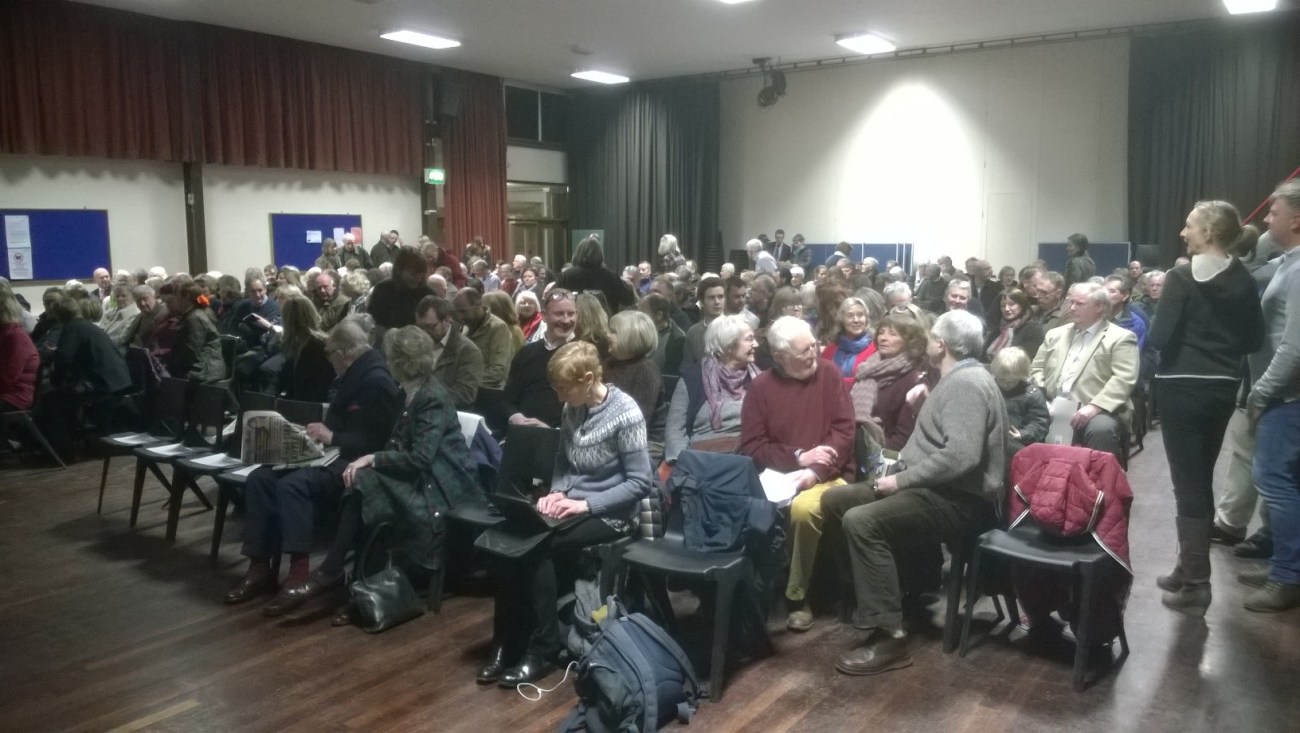
Photo: DrillOrDrop
6.30pm: People beginning to arrive at the debate
Half an hour before the debate, at Lady Lumley School in Pickering, the audience begins to arrive.
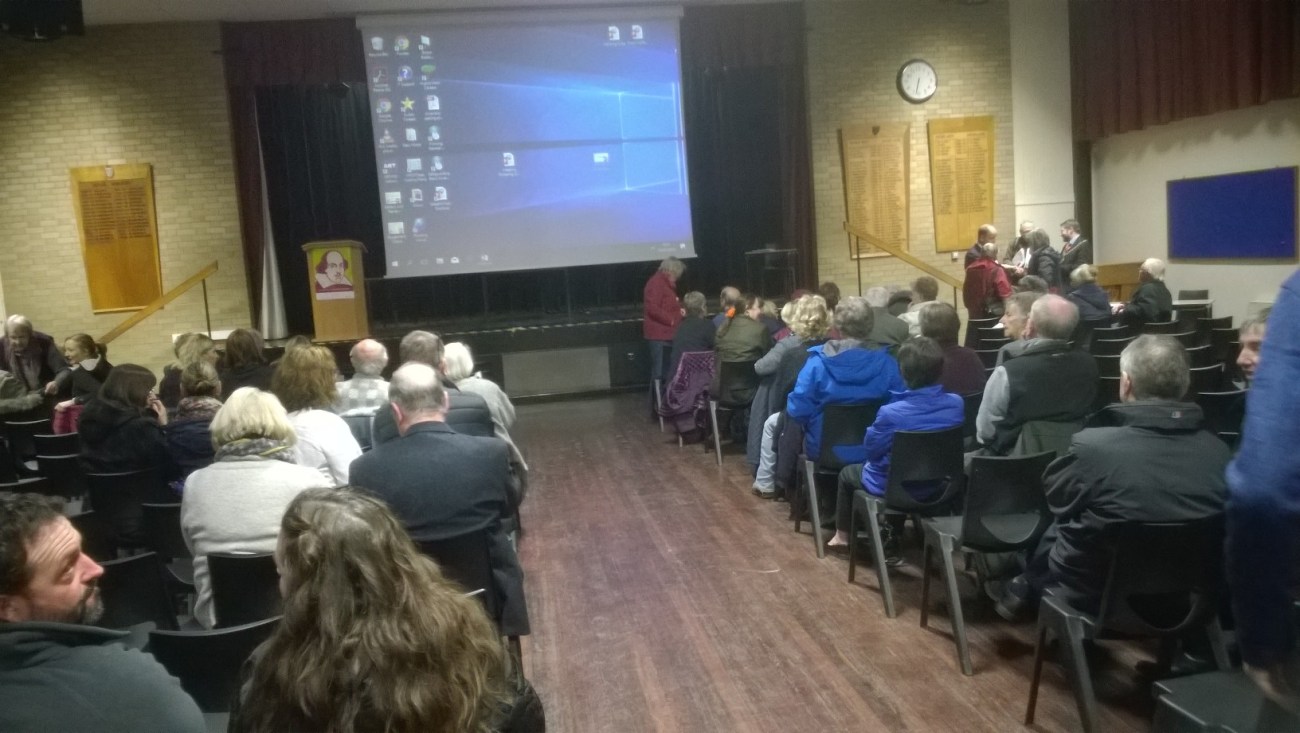
Photo: DrillOrDrio
Reporting from this event was made possible by individual donations from DrillOrDrop readers.
Categories: Regulation

 DRILL OR DROP?
Doesn’t make any difference to people with set views.Fracking bad don’t know why but it must be I saw something on YouTube.Thats as must science most of the nimby would know.
http://concernedhealthny.org
Ian – you’ve just demonstrated the perfect example of a preset view (your own).
Thanks for all your hard work in taking this down and transcribing it Ruth.
I don’t think we all appreciate enough the sheer amount of dedication you put into these reports?
It will take a lot of absorbing.
Thanks again.
Can we have that in English when you’ve sobered up Ian?
Golly gosh but they are wheeling out the big guns tonight! They must be rather keen to avoid another Harrogate style debacle!
It was supposed to be a local debate, Ryedale residents only I believe. Bit of a farce if you ask me.
“Mr Linn says biocides are not used in fracking.”
Really – perhaps Mr Linn isn’t aware of Cuadrilla’s Response To Huw Irranca-Davies MP
“Other than water and sand, the fracing (sic) fluid Cuadrilla is using at its sites contains:
a friction reducing compound commonly found in contact lenses, cosmetic face creams and in soil sealant at construction sites
a biocide used at this very low concentration. This will be used if and only if the domestic water from United Utilities is not pure enough. But if it is sufficiently pure the biocide will not be used
a weak hydrochloric acid to help open the perforations to initiate frac fluid injection and again will only be used if needed. This is the same acid that can be used in „drinking‟ water wells to stimulate water production, and in some cases used in swimming pools. Hydrochloric acid is also known as the European food additive E507, commonly used in UK food products.”
Refraction
Do Third Energy use Biocides? I think Mr Lynn was referring to Third Energy.
Maybe they do.
I think Mr Lynn said “biocides are not used in fracking” not “third energy don’t use biocides”. Nice try though.
Refraction
The reporting is not verbatim, so a bit of leeway may be required. Mind you if he did mean that globally no biocides are used in fracking then he would be wrong. And indeed, how would he know?
Why so many regulators and industry speaking at a local debate? And why is the CEO if the EA permitted to speak twice? And why are the candidates on the stage not being questioned? Doesn’t seem like a debate to me.
Kat T
Reading the report it seems that there were a large number of issues raised relating to the EA and the HSE.
If run properly, each question, outwith the initial presentations should have been addressed to those best to answer it. In which case the and the HSE would be busy on the night.
In addition, the questions should have related to the material in the presentation first, with open questions after, and questions to both parties.
At the Eckington presentation, presentations were given by Tom Pickering ( INEOS ) and David Kesteven ( Green Party ). The question session was primarily questions, most of which were directed to Tom Pickering.
Hence he got to speak a lot.
This debate seems to have been primarily people saying why they do not like it or do, I see few of any questions in the text, outwith rhetorical ones that is.
Thanks for your comment Ian. I could understand it and appreciate it and did not need to make a point through personal insult.
They don’t like it up ’em, do they?
“They don’t like it up ’em, do they?”
You have seen the result by now Martin? You may be right 😂
As per the other day Martin still thinks we are still at war with the Bosch. I have to say his attitude reminds me more of Captain Mainwaring than Corporal Jones though. “Stupid Boy!”
What do you fear KatT? Surely there should be no limit regarding information? It is to—inform. Whether people want to accept that information is up to them, but earlier today there were comments from Rotherham that there had been limited community contact. Seems some want it both ways.
I don’t fear anything Martyn. But this was supposed to be a debate and quite clearly it isn’t. What is the point of having experts on the stage if they are not questioned or debating? And it was billed as a local debate, yet industry and regulators are speaking repeatedly. Is it because there are so few supporters in the room? I don’t know I’m not there. But this is a very poor event, not what was proposed, not a debate at all.
Sir James Bevan has no relevant qualifications he is not appropriately qualified to represent the EA on regulations.
Good point……so do you think Frackman, Josh Fox and the likes are qualified to make comment or advice general public or dictated these issue5and national policy.
Are the only ones in favour the industry and regulators, it seems they are being allowed to speak repeatedly. I thought the Bishop might have done a better job. Glad I’m not there.
How many antis have relevant qualifications KatT? Yet, they proclaim to be experts on all matters, not only in this country, but worldwide. Mr. Frackman’s expertise doesn’t seem to have passed the scrutiny of the legal profession either. I suspect people can take that on board, or not, as they prefer.
Martyn I wish you wouldn’t make such irrelevant comments just to score a point or wind people up. You are clearly intelligent and therefore can appreciate Bevan is representing the EA, when he will have far more qualified staff to deal with any comments/questions. He is not qualified to represent the EA in a forum like this. Simple fact.
Kat, I would like Mr Hill to present his views/credentials to the Society of Petroleum Engineers. They are the experts about the engineering of hydrocarbon wells & professional accreditation. Did anyone ask him whether that professional body recognises him as an expert? See http://www.spe.org/training/certification.php