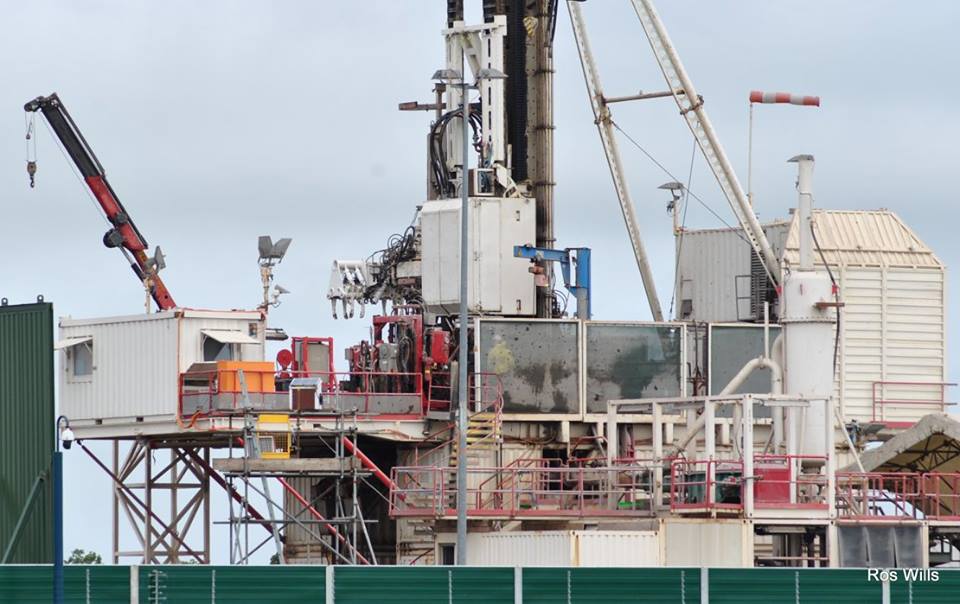
Cuadrilla’s Preston New Road fracking site near Blackpool, 19 June 2018. Photo: Ros Wills
A report relied upon by the Government in its support for shale gas extraction is to be updated.
The Royal Society confirmed to DrillOrDrop that it planned to publish a new report on hydraulic fracturing this winter.
The new review, to be carried out with the Royal Academy of Engineering, will look at international evidence on fracking published in the past six years.
The news came as £7.6m of funding for research into UK fracking was confirmed. 17 research institutions will share the money for studies into the risks of fracking, distribution of shale gas, socio-economic impacts, public attitudes and participation and the UK shale gas landscape. (See £7m+ research projects in the second half of this post)
2012 review
 The previous review by the Royal Society and Royal Academy of Engineering, Shale gas extraction in the UK: a review of hydraulic fracturing, was published in 2012.
Commissioned by the Government and led by Professor Robert Mair, this report concluded that the risk of fracking was
“very low provided that shale gas extraction takes place at depths of many hundreds of metres or several kilometres”.
It stated:
“The health, safety and environmental risks associated with hydraulic fracturing (often termed ‘fracking’) as a means to extract shale gas can be managed effectively in the UK as long as operational best practices are implemented and enforced through regulation.”
The terms of reference of the original report were to look at the major risks of hydraulic fracturing to geology and environment and assess whether and how they could be effectively managed. The study did not look at the risk to the climate or health or the use made of shale gas.
The conclusions are quoted regularly by ministers and supporters of fracking as evidence that shale gas can be produced safely in the UK. It was referred to in the key 2015 Written Ministerial Statement on Shale Gas and in Government guidance on fracking. It is also used by local authorities in information about fracking and was quoted earlier this year by the Environment Agency in its report: The State of the environment: water quality.
The 2012 report made 10 main recommendations. These comprised more than 25 individual actions, including the establishment of a single body to lead the regulation of a UK fracking industry – something which has yet to happen.
A traffic light system to respond to seismic activity during fracking has been implemented. Other recommended actions included:
- Minimising the use of water and recycling of waste water
- Methane monitoring before, during and after shale gas operations
- Disposal of waste fluids planned from the outset
- Arrangements developed for monitoring abandoned wells
- Guidelines clarified to ensure the independence of well examiners from the site operator
- Comprehensive national baseline study of methane in groundwater
- National study of faults in UK shales
The 2012 report said regulation must be fit for purpose and attention paid to the way in which risks scale up if the industry developed. There should also be further research into the carbon footprint of shale gas extraction, the report concluded.
There has been disagreement between supporters and opponents of shale gas extraction about the number of recommendations that have been implemented.
Hywel Thomas

Hywell Thomas. Photo: Royal Society
The new review is to be led by Professor Hywel Thomas, a member of the previous working group and a fellow of the Royal Society since 2012. He is Professor in the School of Engineering at Cardiff University.
He is known for research into the behaviour of excavated and compacted soil. His work is said to have improved understanding of how liquids and gases move through soils, including pollutants in landfill sites.
DrillOrDrop asked the Royal Society about the parameters of the new study.
A spokesperson said:
“The Academies wish to determine to what extent international research into shale gas exploration and extraction has developed since 2012, and will produce a report considering the quality and relevance of this research, and any further research needs based on this evidence. We expect to comment during winter 2018/19.”
The 2012 working group was briefed by experts. One of eight previous evidence-gathering sessions was with non-governmental organisations. Sir Robert Mair said:
“We consulted widely with academia, government, industry and environmental groups such as Friends of the Earth, Greenpeace and WWF-UK.”
The new study seems unlikely that it will seek public submissions. A spokesperson said:
“As this is an analysis of published research already in the public domain, this piece of work is not suited to a broader call for evidence.”
Welcome

Emeritus Professor Peter Styles
The news has been welcomed by one of the academics who established a link between the Blackpool earthquakes and the UK’s first and only high volume hydraulic fracture by Cuadrilla at Preese Hall in 2011.
Emeritus Professor Peter Styles said research in the UK since then has either used data on US fracking or based on models of predicted seismic activity.
He warned that UK and US continental geologies were not the same.
“Caution should be exercised in simply deriving direct analogues between American experience and predicted British geological behaviour.”
Professor Styles has recently published a report on the dangers of fracking in former coal-mining areas, highlighting the increased risk of seismic activity in areas that are already stressed by mining. DrillOrDrop report
He said:
“The data which are probably most pertinent to an appraisal of the likely response of the Bowland Shale (and other likely unconventional oil and gas formations) to changes in stress, comes from analysis of the extensive catalogue of coal mining induced seismicity and its relationship to small-scale fractures which has been mapped in high detail during extremely intensive coal mining beneath Yorkshire, Nottinghamshire, Lancashire and Derbyshire where the main prospectivity for shale gas lies.”
Campaigners against fracking have been calling for the update of the 2012 review, along with other reports on the health impacts of fracking (Public Health England, 2014) and potential greenhouse gas emissions (Professor David MacKay and Dr Timothy Stone, 2013). Several campaign organisations welcomed the news.

Joe Corre, of Talk Fracking pictured with Bianca Jagger, said:
“I am pleased they are reviewing this report. It is way out of date.
“It has become an embarrassment to the standing of the Royal Society.
It is almost as if they have been dragged, rather than gone voluntarily. But I am glad they are doing something about it.”
A spokesperson for the umbrella network, Frack Free United, said:
“While we welcome the news that the Royal Society are reviewing their desperately outdated report on fracking, we are concerned that this review appears to be taking place in secret, and all other academics, scientists and community groups are being prevented from submitting evidence for inclusion.
“This ‘behind-closed-doors’ approach is unlikely to win the trust of those communities currently threatened by fracking, and could allow the Royal Society to cherry-pick any reports to support the government’s pro-fracking agenda – as appeared to be the case when their first report was published in 2012 – while ignoring evidence that highlights the real and present dangers of shale gas production in the UK.
“We urge the Royal Society to open up the process and allow submissions of relevant research from other interested parties, or run the risk of their review being seen as another government-orchestrated fluff piece for the benefit of their friends in the fracking industry.”
£7m+ research projects

Anti-fracking campaigners outside the inquiry into Ineos shale gas plans at Marsh Lane in Derbyshire. Photo: DrillOrDrop
A total of 26 fracking research projects, worth more than £7.6m, were confirmed yesterday.
The projects cover seven main areas:
- Assessing and monitoring the UK shale gas landscape
- Assessment of UK shale resource distribution and analysis of shale mechanical and fluid properties
- Impact of hydraulic fracturing on the overburden of shale resource plays
- Assessment of shale gas risk and pathways
- Public attitudes to shale gas
- Socio-economic impacts
- Effective participation
Four individual projects are based at the Natural Environment Research Council (NERC)/British Geological Survey (BGS). Newcastle and Bristol Universities have three projects each, while Durham and Manchester are hosting two projects.
Newcastle University has received the most funding at £1.35m, followed by NERC/BGS (£1.195m), Bristol (£0.8m) and Exeter (0.5m).
The largest sum (£1.794) goes to projects looking at risk and pathways, divided between eight institutions. A similar amount (£1.767m) goes to the seven institutions looking into the distribution of shale gas.
The grants have been distributed by the Natural Environment and the Economic and Social Research Councils. They said the research programme aimed to:
“Provide an independent scientific evidence base to understand potential environmental and socio-economic impacts of unconventional hydrocarbon extraction.”
They said:
“NERC and ESRC recognise that unconventional hydrocarbon extraction is a complex issue requiring a holistic approach, encompassing knowledge from both the environmental and social sciences. Seven multi-institution consortium projects will be funded and will commence in summer 2018.”
Categories: Research

 DRILL OR DROP?
I think this comment from Frack Free United says it all:
“While we welcome the news that the Royal Society are reviewing their desperately outdated report on fracking, we are concerned that this review appears to be taking place in secret, and all other academics, scientists and community groups are being prevented from submitting evidence for inclusion.
“This ‘behind-closed-doors’ approach is unlikely to win the trust of those communities currently threatened by fracking, and could allow the Royal Society to cherry-pick any reports to support the government’s pro-fracking agenda – as appeared to be the case when their first report was published in 2012 – while ignoring evidence that highlights the real and present dangers of shale gas production in the UK.
“We urge the Royal Society to open up the process and allow submissions of relevant research from other interested parties, or run the risk of their review being seen as another government-orchestrated fluff piece for the benefit of their friends in the fracking industry.”
Too little, too late, too restrictive, too narrow, and too secretive.
Open it up to all those who could contribute and it might just retrieve some credibility, otherwise it’s just an extension of the well established narrow focus rubber stamp ideology.
Surely in the meantime a STOP notice should be issued on existing and planned fracking activities?
Otherwise the Government are gambling ‘blind’ with the health and safety of the residents of the areas currently affected!
A duty of care and assumption of harm must be the primary consideration in all of this!
Wondering how this announcement has affected the financial standing of Cuadrilla and their backers?
You Obviously missed the bit that said Updated. that does not imply the current report is not still relevant.
Interesting that there seems to be a “fear” that a report from the Royal Society might be biased!
Much better to get FOE to add a contribution? Oh, were they not hauled over the coals by the ASA for not being able to support claims they made? Maybe the SNP could add their own slant upon the semantics?
No, sorry, call me old fashioned but I will look forward to the Royal Society report. If others want to produce their own reports, fine-and then they can stand by them rather than utilise the Royal Society as a screen.
I don’t think Shirley quite heard that suggestion Peter! (I know it is an old joke, but your suggestion did remind me of it.)
lol
What is it? 80% of known fossil fuel reserves will have to be left where they are if we’re to avoid catastrophic climate change and yet we’re investing countless millions into searching for and mining more of the stuff.
There are no words to describe how moronic this is.
Future generations, if there are any, will look back upon us as the most idiotic iteration of humanity that ever existed.
Those with horses in London said very similar about the introduction of the smelly new mode of transport, Francis.
Meanwhile, another price increase from a UK domestic energy supplier this week, using the “excuse” of a 22% rise in wholesale energy prices since March THIS YEAR.
Germany pushing for a nice gas pipeline from Russia, so they can supply revenue for Russia to further modernise their armed forces, whilst they expect US to protect them from those armed forces!
More of the stuff? Well, I thought INEOS (for example) were currently utilising the stuff, but importing it from overseas. Perhaps you believe UK production will be so much more economic that they will use more? You need to get some of your buddies in agreement on that.
I thought David Cameron had also been ruled against by the ASA when he claimed that shale gas would lower energy prices, or something along those lines? I can’t imagine that many gas producers in the world will not sell gas for the highest price they can. I also don’t know whether INEOS will use any gas extracted by them for their own purposes first and before offering gas to the markets? And hasn’t the closure of Rough created the gas market we are currently operating within, i.e no capacity to buy gas when prices may dip and store gas for periods of heavier demand, thus making UK gas prices more volatile? I am by no means an expert on such matters but have read, probably like most people, several articles by people that do, so would welcome your comments Martin on this and also from others too. Thanks.
Very welcome, but it should be open and transparent. And all exploration and fracking planning applications and permits should be put on hold until the report has been published and assessed.
In the meantime let’s continue to insulate, be more energy efficient, maintain our UK downward trend of energy use, and halt the decline in investment in renewable energy.
I wonder why it is that campaigners feel a scientific inquiry should seek public comment. This seems to me unusual.
Yes, welcome, David-I agree. But, this is an up-date, much the same as up-dates are done in many other areas and no need to put anything on hold.
Nobody stops doing things waiting for an up-date, unless that in existence is known to be flawed. (Take that up with the Royal Soc. if you like.) They might do things a little better, or more efficiently after an up-date, so yes, welcomed.
Hmm this should be an interesting update. The antis seem to think it’ll favor their myths around fracking however, it is widely known that advances in technology have made the practice continually safer and less hazardous. I therefore look fwd to a positive read.
more bullshit GBK; change the record.
Moderator is foul language allowed on this board?
‘Usage: Bullshit was formerly considered to be taboo, and it was labelled as such in older editions of Collins English Dictionary. However, it has now become acceptable in speech, although some older or more conservative people may object to its use’
Strange if the process is getting less hazardous how the List of the Harmed keeps getting bigger?
Now stands at over 210 pages of mult-incident multi-victim reports!
Now residents of soon to be fracked communities really should demand a STOP to fracking activity until the truth is established once and for all!