An official report by UK Oil & Gas plc reveals why it gave up a licence to develop hydrocarbons in parts of Surrey and West Sussex.
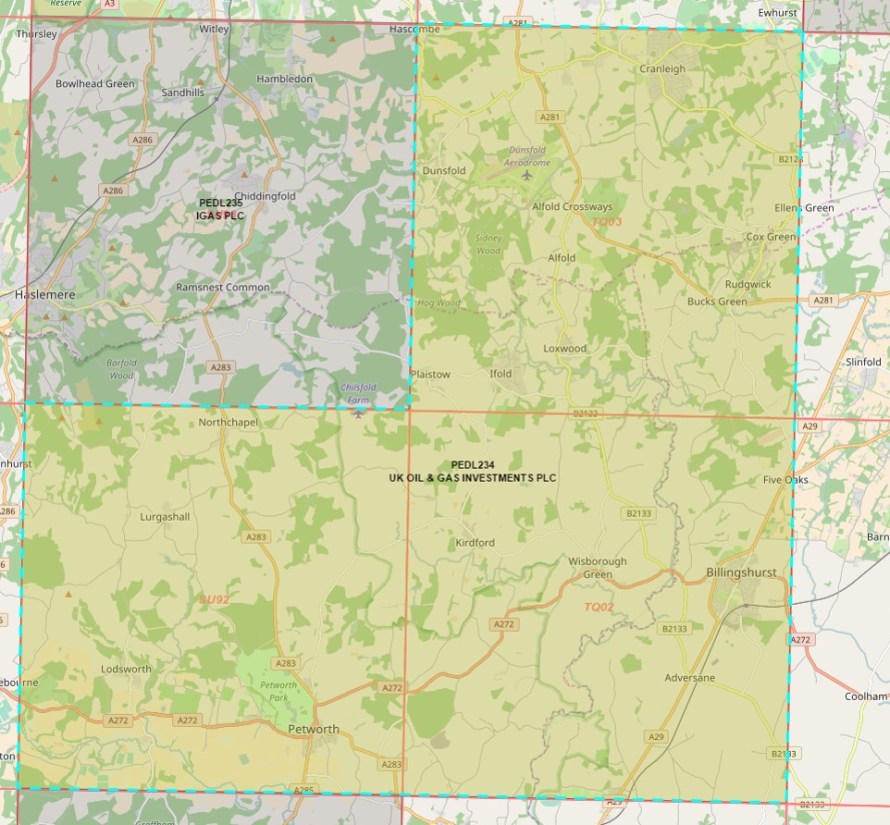
The relinquishment report for licence PEDL234 was published earlier this week by the industry regulator.
The reports are formal documents in which oil and gas companies are required to explain the reasons why they surrendered a licence and set out what work has been carried out.
But one local opposition group has commented that what was not said in the PEDL234 report was “probably more significant” than what was included.
PEDL234 had been held by a UK Oil & Gas (UKOG) subsidiary since 2017 and was relinquished in June 2025.
The licence area had a drilled oil site, at Broadford Bridge, near Billingshurst, in West Sussex. Oil flow rates were considered “uneconomic” and the site was suspended. It is now the subject of planning enforcement action.
PEDL234 also contained the proposed gas site at Loxley, near Dunsfold in Surrey, which had planning and environmental consents. But UKOG had failed to find a farm-in partner to do the work.
UKOG said in the relinquishment report the decision to surrender PEDL234 was made because of “financing and regulatory issues”.
The company said there was “remaining potential” in the licence. But it said:
“the fiscal and permitting landscape brings significant risk to the project.”
“This, together with unsuccessful marketing of a Loxley farmout, are ultimately why UKOG has decided to relinquish the licence.”
The PEDL234 relinquishment report included gas estimates in the Upper Portland Sandstone based on analysis from three abandoned wells: Godley Bridge-1 and 2z and Alfold-1.
The report also detailed risks for the Loxley-1 well:
- commercial flow rates would depend on the height of the gas column and reservoir properties
- no other infrastructure nearby to treat fluids so facilities would have to be built on the site, with a 6.6km pipeline to join the asset to the gas pipeline system.
UKOG had agreed a work programme with the regulator, the North Sea Transition Authority, to drill an appraisal well at Loxley by 30 June 2025. The work was not carried out. If the appraisal well had been successful, a second production well would be drilled by the end of 2029, the company agreed.
The campaign group, Protect Dunsfold, which opposed the Loxley site, told Drill or Drop:
“In our view, what is not said in the Report is probably more significant than what is said.”
The group gave several examples:
“There is no mention of the commercial risk introduced by uncertainties in the mapping of the Loxley Portlandian structure due to an absence of seismic data covering the eastern flank of the structure as mapped by UKOG and the risk of near-surface velocity anomalies impacting the seismic data quality and the depth conversion
“There is no reference to the fact that it is already known that the gas discovered at Loxley is sour, with an elevated H2S (hydrogen sulphide) content.
“There is no mention that the inferred gas accumulation in the Loxley structure is dependent on the petrophysical re-interpretation of the well logs from the Alfold-1 well, which was deemed not to have encountered hydrocarbons when it was abandoned by Conoco in the 1980s.”


