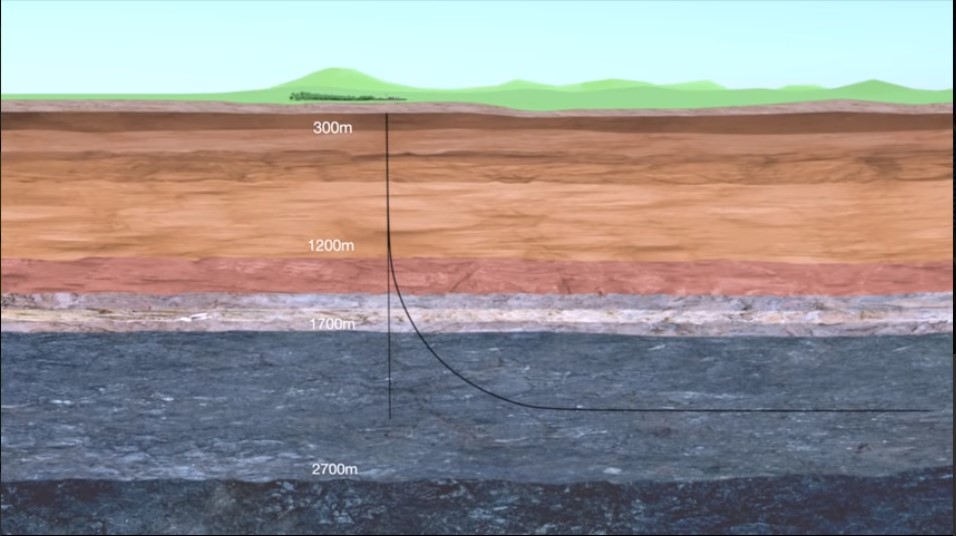
Graphic of drilling through an idealised shale rock layer. Source: Cuadrilla Resource
In the past few years, the locations of geological faults and even whole rock strata have moved as we learn more about the geology below Cuadrilla’s Lancashire fracking site.
In this guest post, Fylde geologist Trina Froud reports on why this matters and warns that regulators could have been “working blind” because of a reluctance to share data.
There are a number of knowns and unknowns surrounding the exploration of a shale gas pad.
The knowns include change of use of land, noise, light, trucks, concerned residents. The unknowns include questions about long-term well integrity and the geology – what does the subsurface look like and how will it behave?
To explore for shale gas, a company needs to have a picture of the subsurface to find out where the shale is, and how best to access it. In a new area the company would normally conduct a 3D seismic survey to find out.
A number of professional geologists consider that survey data should be openly available but, under the licence system in the UK, it has been commercially-confidential in Cuadrilla’s Fylde licence area for more than five years. So:
- What do we know of the survey results?
- What confidence can we place in Cuadrilla’s interpretation?
- Why does it matter?
- What can be done about it?
Shale, surveys and a slipping fault
Cuadrilla is searching for shale gas in the Bowland Shale. The rock formation has had quite a complex geological history in the area. This explains why the rocks are 2km underground in the Fylde, but 17 miles away in the Bowland Fells they are found at the surface.
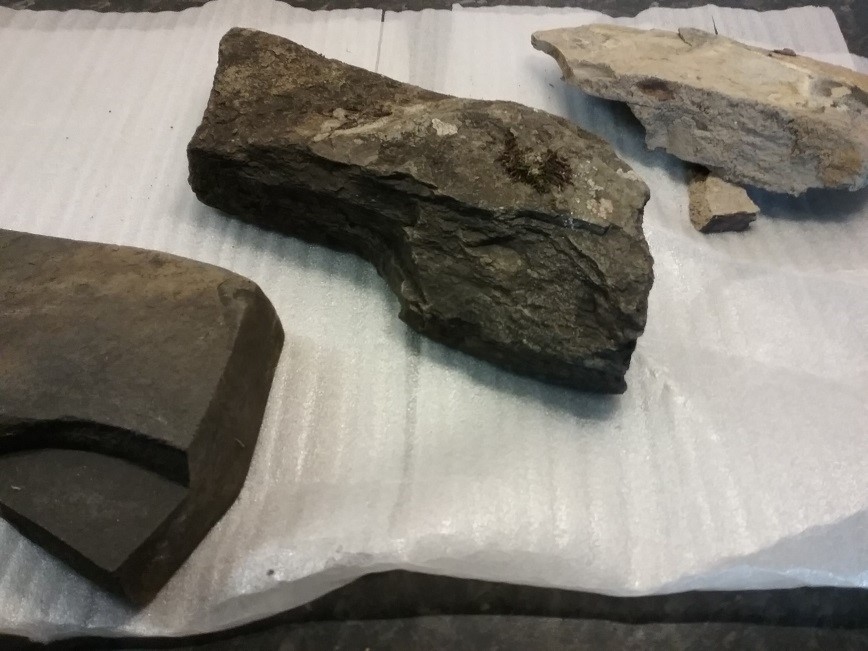
Shale rocks (from left to right): Lower Bowland Shale from dense tough bed of black cherty/siliceous limestone; Lower Bowland Shale showing layers of mud; Upper Bowland Shale, very flaky, weathering to a lighter colour on the surface. Photo: T Froud
Before Cuadrilla drilled and fracked at Preese Hall in April/May 2011, Professor Peter Styles, then at Keele University, advised the company to do a new seismic survey and install local seismic monitoring. The company didn’t.
Cuadrilla relied on an older 2D seismic survey that was offset to the planned well. This meant that it had an incomplete picture of the subsurface. During operations, fluid migrated into a fault which then slipped, caused more than 50 tremors (including one months later in Aug 2011) and deformed the well over a significant interval.
The consequences, apart from loss of the well, were a moratorium, a series of reports, reviews and studies, a growing public awareness of fracking ….. and a pause of 7 years.
The lesson learned could be summed up:
“A survey is expensive but drilling in the wrong place is a jolly sight more expensive”.
What surveys show …
A seismic survey indicates the type, thickness and depths of rock layers below the surface. It also shows the structure, such as the folds and faults resulting from geological upheavals.
Subsequently, during drilling, core samples can be taken and instrumentation used in the well to gather information about the rocks, and all this data is used to correlate with the survey results.
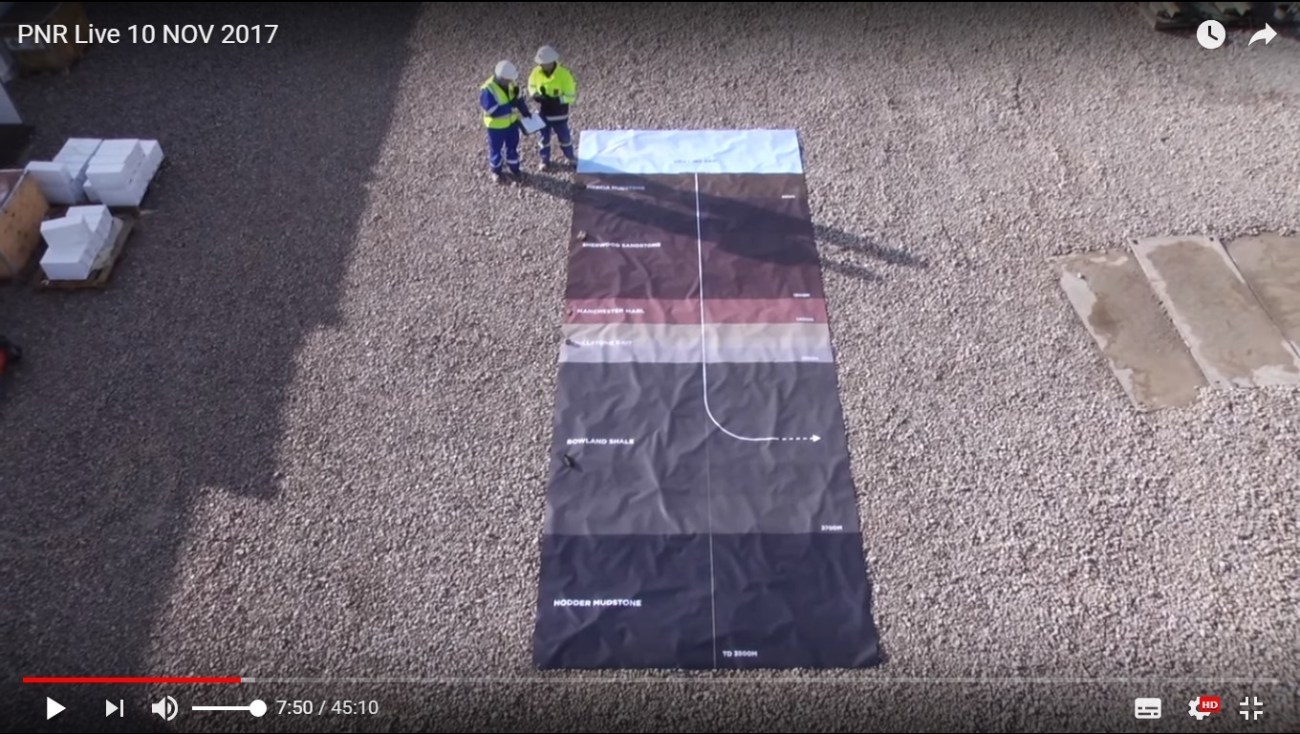
The ideal geology would be like a neat layer cake or the banner produced by Cuadrilla:
But when Cuadrilla carried out a seismic survey in 2012, the picture was rather different. The Environmental Statement for the proposed Roseacre Wood site depicted the subsurface like this:
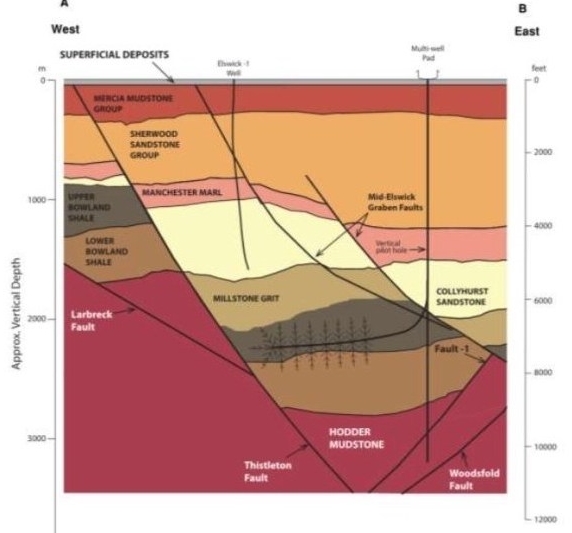
Graphic included with Cuadrilla’s environmental statement for its Roseacre Wood site. Source: Cuadrilla Resources
Cuadrilla’s 3D seismic survey was due to be released in January 2018, but was not authorised for release until September 2018. This was too late to be reviewed by the wider scientific community, because all the permissions had been given to frack the first well at Preston New Road by that time.
So the only access that academics and independent geoscientists have had, is to tiny seismic slices and equally limited coloured interpretations of the geology, shown in the planning applications, and more recently, in the Hydraulic Fracture Plans (HFP) submitted by site operators to the regulators.

… and how the picture changed
An HFP ought to contain data that can be obtained only from drilling, and that point is made in the HFP for Kirby Misperton. However, Cuadrilla issued its HFPs before or just as it started drilling.
Cuadrilla’s HFP for its first well – PNR1/1z – went through several iterations before it was finally accepted and now includes data gained during drilling.
You can compare the graphic (immediately below) in the original HFP for well 1, pre-drilling and based only on the 3D survey, with the second graphic produced after drilling in the revised and longer HFP:
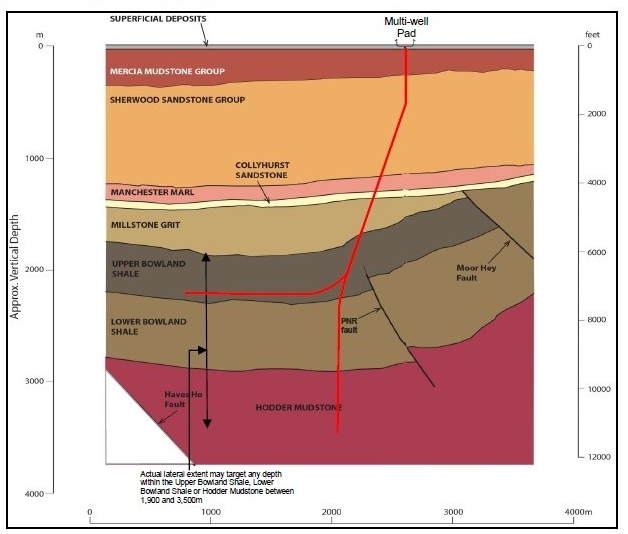
Graphic in the Preston New Road HFP pre-drilling and based only the 3D seismic survey. Source: Cuadrilla Resources
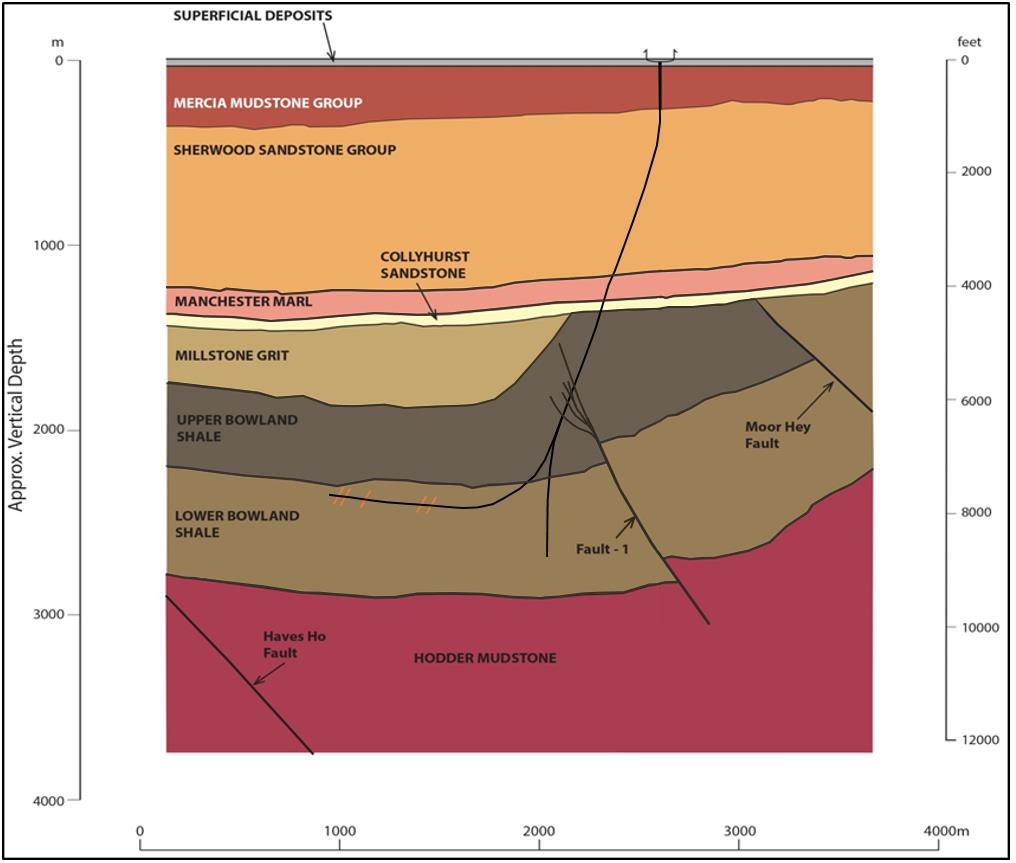
Graphic in the Preston New Road HFP produced after drilling. Source: Cuadrilla Resources
There are several differences between the two graphics:
- the vertical pilot hole does not go below the Lower Bowland Shale as had been proposed
- the lateral was drilled into the Lower Bowland Shale rather than the Upper Bowland Shale
And the geological interpretation has changed:
- the band of Millstone Grit Icoloured light brown) that Cuadrilla predicted from their 3D seismic survey, was simply not present at the location of the pilot well
- Fault-1 extends much higher and is now portrayed with a splay of smaller faults towards the top in the Upper Bowland Shale
- Crucially the well is drilled through the fault
Now compare this to the graphic in the HFP for well 2, issued after drilling that well.
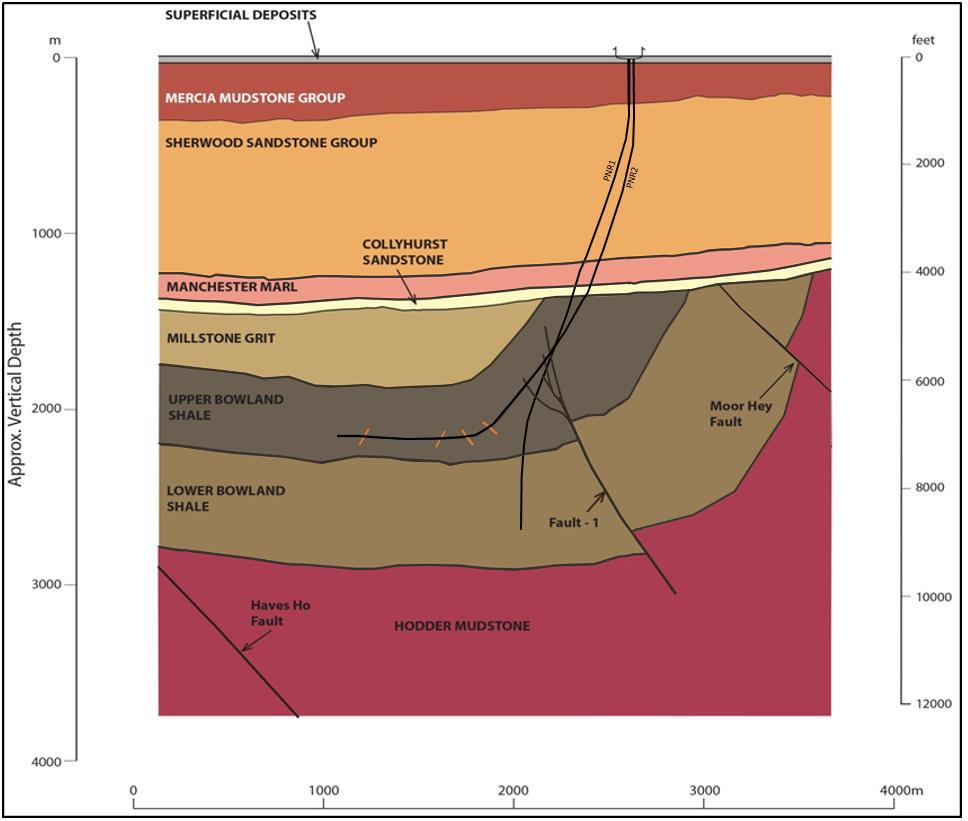
Graphic produced for the Preston New Road second well (PNR2). Source: Cuadrilla Resources
Further changes have been made. The geological interpretation close to the Moor Hey fault has changed, even though neither well was drilled nearby and no further survey has been carried out in that area.
The whole picture is very different from the graphic in the planning application made to Lancashire County Council in 2014:

Graphic in Cuadrilla’s planning application to Lancashire County Council in 2014. Source: Cuadrilla Resources
Should we trust the graphics?
Both the way the survey is carried out (the data acquisition), and the way the data is processed, can affect the results of the subsequent interpretation.
In Cuadrilla’s licence area, PEDL165, the seismic survey and the data processing were carried out by CGG Veritas, and the subsequent interpretation was by Cuadrilla.
Emeritus Professor David Smythe, formerly of Glasgow University, has had concerns for several years about the interpretation of the seismic survey, particularly the faults. He raised these issues with Lancashire County Council’s planning officers in 2014 and 2015. He discusses the issue further in this recent article.
The changes to the graphics over the last four years, show that the Cuadrilla has not found it easy to interpret the results of this 3D seismic survey.
Millstone Grit and Shale are very different rocks, and have different characteristics. Therefore, it is rather surprising to me that they expected to find 1,000ft of Millstone Grit at the location of the pilot hole, which actually turned out to be shale.
The latest HFP states:
“At the Preston New Road Site, the Millstone Grit overlies the Upper Bowland Shale. Observations in section t “Well Observation” identify the Millstone Grit to be absent at the PNR1 well pilot hole location, however 3D seismic data shows the Millstone Grit present vertically above the lateral well (PNR 1z).”
Given that this same survey data was misinterpreted at the pilot hole location, what level of confidence can the regulators have that it has now been correctly interpreted elsewhere?
And does it matter?
A full understanding of the structure of the subsurface is important. It is a necessary precursor to, and underpins the ‘safety’ of, any unconventional hydrocarbon development, because the behaviour of that structure is even less well understood.
- Faults can slip causing tremors and/or damaging well
- Faults can transmit fluids in the horizontal direction
- Faults can transmit fluids upwards
We know that a fault slipped at Preese Hall and caused deformation to the well. Professor Richard Davies, of Newcastle University and the Research in Fracking in Europe project, has raised concerns that these PNR wells are drilled through a fault, and that “if it slipped there will be a well integrity issue”.
We know that the EA analysis of the flowback fluid from the Preese Hall well showed that it contained a wide range of salts, heavy metals, low level radiation, all of which came from the shale. Some of these substances were at many times the concentrations found in the drinking quality water that was used to frack. We also know that Cuadrilla’s former Technical Director Andrew Quarles said in 2015:
“We have been estimating we will get back 40% of flowback. There are lots of theories. No-one knows exactly what is going on or where the water goes or where the final resting place is.The water could go into the fractures created by fracking or it could be absorbed into the shale formation”
We know from Cuadrilla’s geologist, Huw Clarke that the Morecambe Bay gas fields were formed when Bowland Shale gas migrated up through faults in the Manchester Marl, collecting in the Sherwood Sandstone Group.
The mechanism of induced seismicity is not fully understood and is the subject of current research. The effect of faults on the compartmentalisation of groundwater is also a current research paper.
A group of geoscientists from Durham and Newcastle Universities have said:
“The shale formations that are currently targeted by fracking in England are highly (naturally) faulted. … The new challenge, however, is working out how stressed these faults are.”
Commenting on the recent tremors, Professor Stuart Haszeldine, at the University of Edinburgh, said:
“The practical significance is … in the potential to damage the borehole, and the potential to create gas pathways from the shale towards larger faults, towards shallower aquifers, and to the surface”.
There are a lot of unknowns and yet academic recommendations to minimise the risks – for example by maintaining a respect distance from faults proposed by Professor Styles – have not been heeded.
The risks of delayed data release
I have no doubt that interpreting the results of a 3D seismic survey is a specialist skill, and clearly Cuadrilla experienced difficulties.
I observe that the company had five years to study the data. If the results were not sufficient to assess properly the subsurface at Preston New Road, the company had the option to re-run a limited survey for these wells or reprocess the data in that area. This is particularly important when drilling proved that the Millstone Grit was not present.
Cuadrilla’s 3D seismic survey was due to be released under the terms of their licences (for PEDL 165, EXL 269), in January 2018, but Cuadrilla asked the industry regulator, the Oil & Gas Authority to withhold it.
If the data had been released in January 2018, independent scientists would have had time to assess these interpretations and raise any concerns about, for example, the position of faults relative to the wells or the location of British Geological Survey (BGS) groundwater monitoring stations relative to the faults.
To the best of my knowledge, neither Liverpool University, which has been working on triggers of induced seismicity, nor the Durham/Newcastle and ReFINE geoscientists working with Professor Davies, have seen the data. When last I asked, the BGS had not seen the data either, and of the three regulators, only the OGA has had access.
The issues that concern Fylde residents near the well sites are not about seismicity that can be felt on the surface. They are all about what is happening subsurface and which could have long-term consequences.
Exploration for hydrocarbons should be conducted with the stewardship of the environment in mind. The subsurface and its behaviour are unknowns, and fracking is such a controversial topic, that the survey data needs to be viewed by the other regulators and examined by independent experienced scientists before any further exploration is carried out.
In particular, it is of deep concern to me as a resident, that regulators who are making crucial decisions about fracking, are doing this ‘blind’.
Categories: guest post

 DRILL OR DROP?
What a great article! very interesting. So basically Cuadrilla use ‘science’ as a reason to carry out fracking, but, when it comes to actually frack, they throw all the rules of scientific methodology out the window.
Thank you for an excellent and informative post Trina Froud,
Your opening and concluding statements remind me of something the United States Secretary of Defence Donald Rumsfeld said to a question at a U.S. Department of Defense (DoD) (another DoD i might add!) news briefing on February 12, 2002 about the lack of evidence linking the government of Iraq with the supply of weapons of mass destruction to terrorist groups.
And we all know what happened about the truth, or otherwise of WoMD dont we?
Donald Rumsfeld (another Donald i might add!) stated:
“Reports that say that something hasn’t happened are always interesting to me, because as we know, there are known knowns; there are things we know we know. We also know there are known unknowns; that is to say we know there are some things we do not know. But there are also unknown unknowns – the ones we don’t know we don’t know. And if one looks throughout the history of our country and other free countries, it is the latter category that tend to be the difficult ones.”
Quoted from the text above:
“Cuadrilla’s 3D seismic survey was due to be released under the terms of their licences (for PEDL 165, EXL 269), in January 2018, but Cuadrilla asked the industry regulator, the Oil & Gas Authority to withhold it.
If the data had been released in January 2018, independent scientists would have had time to assess these interpretations and raise any concerns about, for example, the position of faults relative to the wells or the location of British Geological Survey (BGS) groundwater monitoring stations relative to the faults.
To the best of my (Trina Froud) knowledge, neither Liverpool University, which has been working on triggers of induced seismicity, nor the Durham/Newcastle and ReFINE geoscientists working with Professor Davies, have seen the data. When last I asked, the BGS had not seen the data either, and of the three regulators, only the OGA has had access.”
So it appears that rather than releasing data for an independent analytical study by geologists, Cuadrilla actually asked…..(instructed?) the EA to withhold the seismic geological data, thereby committing the same crime as Donald Rumsfeld made, that of acting on false assumptions rather than first having a proper investigation and before obtaining sufficient evidence as to the efficacy, if not accuracy, or indeed the truthfulness of the assumptions had been reached or even approached?
Five wasted years of prevaricating and obfuscating ensued instead of empirical assessments made on the available seismic geological data.
The evidence so far indicates quite conclusively that Cuadrilla were, and are still, working in the realms of Donald Rumsfeld’s “unknown unknowns” and apparently intend to remain so.
This is one for Paul Tresto [edited by moderator], do you recall all the invective and accusations ensuing from you and your esteemed colleagues made about my suggestion that fluids can and do travel upwards against gravity?
To quote Trina Froud again:(Apologies again Trina)
“A full understanding of the structure of the subsurface is important. It is a necessary precursor to, and underpins the ‘safety’ of, any unconventional hydrocarbon development, because the behaviour of that structure is even less well understood.
Faults can slip causing tremors and/or damaging well
Faults can transmit fluids in the horizontal direction
Faults can transmit fluids upwards”
That faults can transmit fluids sideways and downwards with gravity, and upwards against gravity.
This is fun isnt it?
Always a pleasure.
Have a nice Sunday.
Transmit or convey? Faults can provide a conduit. Who said they couldn’t? That wasn’t the point we were discussing. Sealed faults do not provide a path for fluids. Fluids will move upwards with a pressure differential which permits this providing there is permeability and somewhere for the fluids to go. Open / porous faults which end in an impermeable formation do not conduct fluids.
One of the reasons exploration / appraisal wells are called “exploration / appraisal” wells is to determine the stratigraphy and calibrate the seismic model. The model will have been updated with the information from the four bore holes drilled at PNR; two vertical and two horizontal. Please let me know of a post drilling well geological section that fits the seismic pick geological section in an exploration well such as the two at PNR? If lithology and stratigraphy could be picked accurately from seismic then there would be no need to drill wells to calibrate the seismic.
Do you know what a checkshot survey / VSP is for?
It would appear the author has no professional experience working in G & G / subsurface in the oil and gas industry but happy to be corrected? What kind of Geologist?
[Edited by moderator]
This US geologist also has concerns about the geology of the Fylde Paul, not simply those opposed to fracking.
https://drillordrop.com/2016/09/13/fylde-doesnt-look-promising-for-fracking-veteran-us-geologist/
Hi Kat C. I agree the geology is complex, it usually is. My point is that you need to drill wells to calibrate seismic i.e. confirm the geology and the model. The more wells you drill, the better the geophysical and geological model. You also need to drill, frack and test shale wells to assess the stimulation techniques and well productivity, and ultimately determine reserves and commerciality. Not possible from seismic alone, even with a couple of wells, the target shales are very extensive laterally.
“Fluids will move upwards with a pressure differential which permits this providing there is permeability and somewhere for the fluids to go.”
“Faults can slip causing tremors and/or damaging well
Faults can transmit fluids in the horizontal direction
Faults can transmit fluids upwards”
That’s what i said originally Paul, and that is what initiated the attempted vitriolic diatribe, sorry to burst your bubble Paul, but perhaps if you dont go off half cocked so often, maybe we might agree about something for once, contrarian rhetoric is fun but ultimately self defeating.
Like i said, have a nice relaxing Sunday.
[Edited by moderator]
There seems to be a growing list of people who are experts in their field (Fylde) who are being denigrated and attacked simply for speaking their minds from their expertise and experience and provide a great deal of detailed accounts and reasoning to back that up.
Yet all the anti anti rhetoricals can dredge up is a personal diatribe and an attempt to denigrate the person and their colleagues simply because they put forward an entirely reasonable argument that is not following the industry imposed gobspell, and never once mention anything that is said or put up a reasoned argument to counter it?
If the anti antis have so much, what was it? “professional experience working in G & G / subsurface in the oil and gas industry ” of which you could probably count on one hand with two fingers crossed behind your back, why do we not hear a perfectly reasonable contrarian argument to counter the issues raised?
But we dont seem to get that in any degree whatsoever do we, and if any such minimum response of copying and pasting from oil and gas manuals and unspecified sources, does eventually, after the streams of rhetoric, appear it is inevitably filled with the the usual diatribe and personal attacks and invective that totally negates any actual technical validity?
And so it has been from the industry hacks for a couple of years now, so much so that the “answers” have become formulaic, obviously read from the same gobspell course treatise on “how to totally negate any contrary argument to any question by personally attacking the writer and never actually answering the question”
Politic speak and question time style pre prepared answers that totally ignore the question seem to be the only permitted industry policy to date.
So just to illustrate how easy and lazy it is to denigrate personalities rather than actually address the subject in any technical detail and adult reasoning, lets try to descend into the industry attrocious practice for a second shall we? Before we feel too contaminated i will be brief:
Perhaps the sacrificial spokesperson Natasha Engel or her carefully withdrawing boss Claire Perry, or her illusive boss Greg Clark could enlighten us from their ever more bizarre travelling circus?
You see how easy and how lazy that is? Fun, but ultimately ineffectual and unrewarding, adults could and should do better.
Raise your game guys and gals, your (technical) slips are showing…….
[Edited by moderator]
Asking what kind of Geologist Trina Froud is is an obvious question when the author tries to write an article on sub-surface Oil & Gas issues but doesn’t appear to have experience in this field but the article (and all the Public Inquiry submissions etc etc) note she is a Geologist. She has a Degree in Mathematics and Earth Sciences so clearly is a Geologist? But in what area?
Re fluids / faults / pressures etc. Not what you said originally Phil C; perhaps what you have come round to now or what you tried to say in your long essay originally. But now we appear to be in agreement let’s move on….
By the way you didn’t tell us what a checkshot survey / VSP are for?:
“A type of borehole seismic data designed to measure the seismic traveltime from the surface to a known depth. P-wave velocity of the formations encountered in a wellbore can be measured directly by lowering a geophone to each formation of interest, sending out a source of energy from the surface of the Earth, and recording the resultant signal. The data can then be correlated to surface seismic data by correcting the sonic log and generating a synthetic seismogram to confirm or modify seismic interpretations. It differs from a vertical seismic profile in the number and density of receiver depths recorded; geophone positions may be widely and irregularly located in the wellbore, whereas a vertical seismic profile usually has numerous geophones positioned at closely and regularly spaced intervals in the wellbore.”
You need to drill a well to get this data to calibrate the seismic to correct the model.
The original comment Paul was in answer to one of your esteemed colleagues claiming that fluids do not move upwards against gravity, and that it was “magic” not physics, my reply proved that to be incorrect, that it is indeed physics, and that elicited the vitriolic diatribe response.
So we agree now? Fluids can and do move upwards against gravity? That was indeed all that was about. I am glad we are in agreement on that and can move on.
I don’t know why the photo was removed, but the new regulations for the ultimate control and censorship of free speech on the internet are attempting to prevent unauthorised quote or publishing of non permission of articles to be deleted.
We live in interesting times (not The Times, that wasnt a quote!) and i feel that is a contravention of freedom of speech under basic human rights to quote without such impossible authorisation, perhaps such “regulations” are now being applied?
Perhaps DoD Paul (not the USA Department of Defence) could explain?
Thanks for the info on checkshot survey / VSP, interesting, however, but i dont see any comfort, specified blanket or otherwise, in the fact that exploration can and does still fail and it seems that Cuadrilla are still unable to continue under their own agreed TLS regulations. The theory appears good on the surface (no pun intended) but the practice seems to be more problematic and complex? Perhaps there are elements of operational complexity and geological complications, as Trina Froud has so eloquently stated?
Again we hit the “shale wall” of no comment on the provided weekend long read?
That’s it, I’m off for lunch now, Have a good fifth fracking Sunday with family and friends folks, tomorrow. as they say, is another day?
The point about gravity is that this is a two phase system – even if there was a pathway right to the surface very little water would make it there. This is because of gas is present it would have a much higher mobility than brine so would preferentially flow. Secondly, if not had was present then brine is so incompressible that pressure would become hydrostatic after only a very small proportion of fluid had moved upwards.
But fluids do move upwards against gravity Judith, and it is not magic, but physics, there, that wasn’t so hard was it? So we agree on that don’t we?
I do agree with Judith Green explanation. Gas is much much lighter and will migrate upward more likely than water.
Phil C, gas will flow mainly under the influence of gravity. Brine will flow depend on the hydrodynamic gradient. You are trying to suggest that there could be significant flow of brine vertically. However, as explained above, this will not occur due to the incompressibility of the shale, the incompressibility of the brine and the fact that methane has a higher mobility ratio, which will leading to fingering of the methane through the brine column. I’m sorry that doesn’t fit in with your little narrative about subsurface brines being a significant danger to the surface environment but that is the science I’m afraid.
These guys should be politicians PhilC – never an admission of the truth and constant sidelining; no straight answers here – usually means they ‘don’t know’ or ‘won’t know’. 🙂
Sherwulfe – I gave a very simple reply – brine will not be forced to the surface due to damage to the borehole – do you understand that?
Hi Sherwulfe, this is fun isnt it? Are Sundays always this excitable?
Yes you are right Sherwulfe, its the same process we talked about earlier, the politicians response to an unanswerable question by implied lack of understanding in a subject and a pre prepared irrelevant reply.
I am afraid Judith Green it is you who fails to understand what is being said, clearly there is a fear of admitting that fluids can, and indeed do travel upwards against gravity, particularly in naturally pressurised systems at depth, or by artificially pressurised and pumped and compressed systems at depth.
I can only guess that is because such an admission opens a can of technical worms that must not be allowed to be discussed, hence the accusatory attempt to squash the topic in empty rhetoric rather than address Trina Frouds guest post here.
I always find it interesting how this, and other long established scientific facts of life accrues so much desperate opposition on these pages, but as you say, Sherwulfe, we have become accustomed to the standard politicians strategy of attack attack attack and deny deny deny response.
Tora Tora Tora perhaps? (i shall resist the political allusions)
Lets see what we get from this shall we?
“gas will flow mainly under the influence of gravity.” not so at all, gas tends to flow from higher pressure zone to the lower pressure zone, that can be as just much upwards against gravity or downwards with gravity. or sideways, gas also flows in convection and temperature differentials, and will creep along electrostatic surfaces, up down or sideways, the distance depends upon the natural or artificial pressure differentials, temperature and electrostatic differentials and natural, or induced fractures and faults.
“Brine will flow depend on the hydrodynamic gradient. You are trying to suggest that there could be significant flow of brine vertically.” Fascinating, actually i didnt say that, but a hydrodynamic gradient can be vertical can it not? Of course it can. If the hydrodynamic gradient is moving from a natural or artificial hydrostatic pressure zone it will naturally travel, transmit, or any other word you care to choose, to a lower pressure state. Fluids will indeed flow upwards against gravity, it is the very incompressibility of fluids that enable the fluids to be pumped upwards or compressors would not move fluids upwards to the pressure head?
After all, what is the hydro-artesian effect if not upwards against gravity?
“However, as explained above, this will not occur due to the incompressibility of the shale, the incompressibility of the brine and the fact that methane has a higher mobility ratio, which will leading to fingering of the methane through the brine column”
it is the very incompressibility of fluids and gases that enables fluids to be pumped or compressed such that the fluids and gasses move in a pump or compressor, so i am afraid that argument does not hold water, excuse the pun. That flawed reasoning displays an astonishing lack of understanding of fluid mechanics and fluid dynamics in differential pressure systems.
I return this and reverse it to you Judith:
“I’m sorry that doesn’t fit in with your little narrative about subsurface brines (not) being a significant danger to the surface environment but that is the science I’m afraid”
The fact that you did interpret that as a statement that fluids and gasses can indeed move upwards against gravity is revealing of a fear of that subject and that must not be allowed to be said Judith, since it indicates a high degree of over-sensitivity to the implication of the very thing you seek to deny? That is very sad, i am almost sorry to prove you wrong, but as you say, that is indeed science, or more accurately physics?
Just like Cuadrillas utter failure to release the geological data taken from seismic studies to independent study, and incorporate into their designs and operations, any cognisance of the implications and inevitable conclusions that a detailed study by independent expert analysis would have revealed. That there seems to be a very over sensitive knee jerk raw nerve that attempts to nullify any such suggestion of complicit behaviour and operation in ignoring such a purely physical truth from being admitted by the fracking industry?
We can see why that is, it is obvious that nothing must be admitted by the industry, and that in itself a very revealing situation.
PhilC – your last post both misquotes me and shows your lack of understanding. I never mentioned the inconpressibility of gas because gas is compressible. You claim that fluids flow from high to low pressure – so would you expect high pressure water to move from the ocean bottom to the ocean surface? It think what you are missing is potential energy. [edited by moderator]
“your last post both misquotes me and shows your lack of understanding. I never mentioned the inconpressibility of gas because gas is compressible. You claim that fluids flow from high to low pressure – so would you expect high pressure water to move from the ocean bottom to the ocean surface?”
Ooops! Big mistake! Have you never heard of convection currents and mid and deep ocean currents, of many types including surface currents and rip currents, there are oceanic currents and are caused by the temperature, pressure and density, salinity and coriolis, tidal and the ocean/land interface. There are temperature and pressure synclines in the upper and mid and lower oceanic depths, also water flows under the oceans and does indeed move from higher pressure to lower pressure zones, the oceans are a dynamic system and not a fixed in place static system, look it up if you dont believe me.
“Deep ocean currents
Differences in water density, resulting from the variability of water temperature (thermo) and salinity (haline), also cause ocean currents. This process is known as thermohaline circulation. In cold regions, such as the North Atlantic Ocean, ocean water loses heat to the atmosphere and becomes cold and dense. When ocean water freezes, forming sea ice, salt is left behind causing surrounding seawater to become saltier and denser. Dense-cold-salty water sinks to the ocean bottom. Surface water flows in to replace the sinking water, which in turn becomes cold and salty enough to sink. This “starts” the global conveyer belt, a connected system of deep and surface currents that circulate around the globe on a 1000 year time span. This global set of ocean currents is a critical part of Earth’s climate system as well as the ocean nutrient and carbon dioxide cycles.”
“It think what you are missing is potential energy. If you read a few basic books on petroleum engineering or fluid dynamics you might get a grasp of this subject – it really isn’t too difficult”
Sorry that is wrong Judith, i mention no such thing, that is your diversion away from the subject, do try to stay on topic, potential energy is just that, potential until acted upon by an external force, that being in this case, high pressure unconventional hydraulic fracking.
As for reading i have read more and applied more expertise on fluid mechanics and fluid dynamics than i would guess you have had hot dinners, it was my special post degree subject and used extensively here and abroad.
Try reading that for size and perhaps do some of your own research, its really isnt too difficult……
[edited by moderator] you don’t seem to have much understanding of mobility ratio in a two phase system. It also seems that you didn’t understand the mathematics of it when you compare ocean currents to the type of fluid flow that would occur in a microannulus. The fact of the matter is that there hasn’t been brine leakage to the surface caused by borehole deformation in an unconventional reservoir. That is the great quality of unconventionals – they are particularly safe due to the low permeability and low compressibility of the formation.
In your post above you state that:-
Faults can slip causing tremors and/or damaging well
Faults can transmit fluids in the horizontal direction
Faults can transmit fluids upwards”
However this should be qualified by:
Faults can slip causing tremors and/or damaging well – but the well damage is very localized and doesn’t provide a conduit for fluid toflow to the surface.
Faults can transmit fluids in the horizontal direction – but this is only when they are dilatant and their is a horizontal potentiometric gradient.
Faults can transmit fluids upwards – but this is only when they are dilatant and the fluid has immiscible and lighter than a non-wetting phase present or that there is a significant potentiometric gradient. The latter is unlikely in a shale gas well due to the low permeability of the shale and the small volumes of fluid that are pumped into the rock.
Overall, you don’t seem to have presented any evidence that; (I) well bore deformation in unconventional wells is likely to allow leakage of brine to the surface; (ii) there has been significant leakage of brines into the drinking water or the surface as a result of fracking; (iii) a realistic physical mechanism that would allow significant quantities of brine to move from hydraulic fractures to the surface as a result of well bore deformation. It appears that you have some sort of odd model in your mind as to how fluids flow and how boreholes deform that isn’t backed up by any observational data or numerical model. In many ways, it’s like people believing Elvis lives on Mars
And the industry keeps telling us to “trust the science”!
Phil C, all I have to say is thrust!
Is that enough “thrust” Paula? Or am i misreading something?
Another expert that is a pal of Mike Hill and [Professor David] Smythe [edited by moderator]
Thank you Trina. An excellent article using Cuadrilla’s own data to highlight the serious risks associated with trying to extract natural gas from the Bowland shales.
For JMNS
https://drillordrop.com/2016/09/13/fylde-doesnt-look-promising-for-fracking-veteran-us-geologist/
The article doesn’t highlight any serious risks. Despite the massive amount of drilling for shale gas there isn’t any evidence of deaths or injuries to the public. Essentially, the risks to the public are closer to zero than just about any other industry you can mention.
Except for the effect on the climate from another fossil fuel, perhaps? A mere billions of people affected including premature death and, oh yes, mass extinction…….
Sherwulfe- at least you are addressing the only significant issue with fracking. However, I would disagree with your analysis. Firstly, fossil fuels have saved more lives than they have taken. Secondly, there is no evidence to suggest that producing shale gas will increase the amount of GHG emissions that the UK will ultimately make. Fossil fuel usage has to stop before it is all used so not pushing ahead with fracking just means less gas we have to buy from abroad
‘Sherwulfe- at least you are addressing the only significant issue with fracking’ – nope, one issue of many.
‘Firstly, fossil fuels have saved more lives than they have taken’ – evidence please; don’t forget to include casualties of ‘conflicts’ over oil and gas resources [smoke screened as clearing oppressive regimes] including the death and maiming of children.
‘there is no evidence to suggest that producing shale gas will increase the amount of GHG emissions that the UK will ultimately make’ – sigh
‘Fossil fuel usage has to stop before it is all used so not pushing ahead with fracking just means less gas we have to buy from abroad’ – bigger sigh
Judith, you have clearly swallowed the industry blurb, predicatively as you work for the industry? Sometimes you’ve got to stand outside of your belief system to realise it is not valid.
Sherwulfe – sigh and bigger sigh – those are such well argued points. [edited by moderator]
Yes well argued and dismissed as crap [academic description of industry hyperbole]; tedious, hence the sigh.
[edited by moderator]
Sherwulfe – you seem very reluctant to share with everyone your great insight as to why we are going to use more gas if we produce it rather then buy it from abroad. The key point is that we need to reduce consumption. However, that is quite difficult to do compared to sitting in the bell mouth at PNR and telling everyone how bad fracking is. Never mind, you’re just one of those people who is too lazy to actually do anything that will make a difference – an armchair critic
Tut tut Judith; sticks and stones and all that; first I mustn’t study, then I’m lazy; how misinformed you are……
Note carefully what Dr Christoper A Green, Professor Peter Styles, and Dr Brian J Baptie of the BGS state in their review of the Preese Hall report. No maybes, no possibles, just was.
“We agree with the conclusion that the observed seismicity was induced by the hydraulic fracture treatments at Preese Hall”
“The earthquake activity was caused by direct fluid injection into an adjacent fault zone during the treatments. The fluid injection reduced the normal stress on the fault, causing it to fail repeatedly in a series of small earthquakes”
Regarding future fracking
“However, we are not convinced by the projected low probability of other earthquakes during future treatments. We believe it is not possible to state categorically that no further earthquakes will be experienced during a similar treatment in a nearby well. The analyses failed to identify a causative fault, and detailed knowledge of faulting in the basin is poor. In the present state of knowledge it is entirely possible that there are critically stressed faults elsewhere in the basin. It is possible that a 3-D seismic reflection survey could help better characterise faulting within the basin”
The 3D survey at PNR shows that this technology cannot be relied on to identify fault positions or accurately predict size or location of different formations.
So every frack could repeat the failings of Preese Hall or trigger a larger event.
Risks being closer to zero. Not according to the evidence to date.
So are you saying the authors of the report could actually see what had happened underground? They could not – their theory about fluid going into a fault is just that – a theory
…read ‘does not fit in with the Cuadrilla PR’; am afraid you just shot yourself in the foot Jackie Matty – if you had bothered to read the article you may have possibly noticed that Cuadrilla’s science is as useful as a chocolate teapot!
If you understood anything about the subject, you might understand that the seismic isn’t great quality due to lack of impedance contrast between the different lithologies in the Bowland and that the interpretation of Cuadrilla is as good as any give the data. You also seem to have no knowledge of the scientists being employed by Cuadrilla – I do and know that they are the best in the world
‘You also seem to have no knowledge of the scientists being employed by Cuadrilla – I do and know that they are the best in the world’ – so far, no evidence of this hero worship; or perhaps you refer to yourself amongst this team?
The bit above it is rubbish, it doesn’t even make sense…..
Why has this geologist got no credibility? What are your qualifications to make such a criticism? It seems a number of other geologists that are very well respected, including Prof Peter Styles and Prof Richard Davies have also raised a number of concerns and have recommended an 850m setback from faults. Further, some time ago it was reported in DoD that a US geologist with a huge amount of fracking experience and employed by INEOS, informed Parliament that in his professional opinion the geology of the Fylde is complex, heavily faulted and not favourable in terms of fracking. Perhaps you would like to publish a report Jackie Matty Neil Stewart on your interpretation of the seismic data and explain why you disagree with Ms Froud and Professors Styles and Davies?
Excellent article, thank you Trina Froud (and D or D of course).
Thank you Trina for sharing your expertise. An excellent evidence based appraisal of our geology and how Cuadrilla are getting things very wrong.
Nobody knows but Haythornthwaite at AFC Fylde said to me that ‘it is a risk worth taking’!
[Edited by moderator]
This gamble is like putting the welfare of 250000 people as stake money on a rank outsider in the London Marathon!
The anti’s seem to be loving this article despite the fact that the writer has significant gaps in their knowledge and understanding of the subject.
The article starts by suggesting that “The rock formation has had quite a complex geological history in the area. This explains why the rocks are 2km underground in the Fylde, but 17 miles away in the Bowland Fells they are found at the surface.”. However, anyone with a solid knowledge of geology wouldn’t jump to a conclusion that 2km difference in burial depth is evidence of complex geology. A slow angle dip of the bedding would cause such an observation but one would hardly classify that has complex geology.
The author claims that “During operations, fluid migrated into a fault which then slipped, caused more than 50 tremors (including one months later in Aug 2011) and deformed the well over a significant interval.”. However, there is no strong evidence to suggest that this was the main reason for seismicity. Faults can reactivate as a result of stress transfer – there is no need for fluid to have entered a fault.
The author seems to be suggesting that had a 3D survey been conducted then the seismicity at Preese Hall would have been avoided. However, unless the author has compared the 2D and 3D surveys then there is no reason to suspect that the new survey provides information that would have allowed seismicity to be avoided. Even with high resolution modern surveys, parts of the subsurface are very difficult to image particularly as in the case of the Bowland sequence where there is little impedance contrast between horizons.
The author states that “The changes to the graphics over the last four years, show that the Cuadrilla has not found it easy to interpret the results of this 3D seismic survey. Millstone Grit and Shale are very different rocks, and have different characteristics. Therefore, it is rather surprising to me that they expected to find 1,000ft of Millstone Grit at the location of the pilot hole, which actually turned out to be shale.” Millstone grit and shale are indeed different rocks however that doesn’t mean they can’t have similar properties. In particular, it would be totally expected that they could have similar vertical P-wave velocities and porosities. This would mean that they would have the same P-wave impedance, which would mean that no reflection would occur at the interface of these two rocks. Ultimately, this explains why the Millstone grit wasn’t mapped accurately by Cuadrilla but also means that others wouldn’t be able to have done a better job.
The author states “We know that a fault slipped at Preese Hall and caused deformation to the well. Professor Richard Davies, of Newcastle University and the Research in Fracking in Europe project, has raised concerns that these PNR wells are drilled through a fault, and that “if it slipped there will be a well integrity issue”.” However, there is no evidence to suggested that even complete shearing of faults at depth affects overall well integrity. There are many fields around the world in which wells experience significant deformation. However, this doesn’t lead to leakage of fluids to the surface because cement higher up the well prevents such leakage. Later in the article the author provides a quote from Stuart Haszeldine about well bore integrity without pointing out to the readers that Prof Haszledine had no expertise in either geomechanics or well bore integrity.
Like many anti’s the author seems to over interpret the statement made by Andrew Quarles (i.e. “We have been estimating we will get back 40% of flowback. There are lots of theories. No-one knows exactly what is going on or where the water goes or where the final resting place is. The water could go into the fractures created by fracking or it could be absorbed into the shale formation”). Andrew meant that there is discussion as to whether the fracking fluid is imbibed into the shale or remains in partially dilated fractures at depth. He did not imply that our knowledge is so poor that they could come back to the surface – they could not.
The author states that “We know from Cuadrilla’s geologist, Huw Clarke that the Morecambe Bay gas fields were formed when Bowland Shale gas migrated up through faults in the Manchester Marl, collecting in the Sherwood Sandstone Group.” However, this is a theory of Huw’s and not fact. There are many ways gas can migrate from its source to the reservoir that do not involve faults.
The author then goes on to claim that Cuadrilla haven’t attempted to stay away from faults but provides no evidence to back up such an assertion.
The author then goes on to criticize Cuadrilla for not releasing seismic data. In other words, the author is suggesting that Cuadrilla should abandon what is industry practice of keeping seismic data confidential just so a few retired and unqualified geoscientists can pass comment. The fact is that Cuadrilla have extremely good staff and consultants so really don’t need the help of the self-appointed seismic interpretation experts in the anti-fracking community. I should however point how that Cuadrilla have let other academics view the seismic data – however, those viewing the data are experts on the subject and not the type who feel the need to get their name in the press every other day.
The author then goes on to make the remarkable statement that “In particular, it is of deep concern to me as a resident, that regulators who are making crucial decisions about fracking, are doing this ‘blind’.”. It seems very clear that the author has never chatted with the regulators as they are doing nothing blind. They have seen a large amount of data, they have consulted with experts who have seen all the data and they are pretty knowledgeable about the subject.
Overall, the author seems to have attempted to paint a picture of Cuadrilla being incompetent. But in doing so has only highlighted their own lack of understanding of the subject.
Judith – thank you for your comments above. Good to have someone who understands the subsurface G & G issuescommenting on this article. Even to someone from the “dark side” like myself ( O & G upstream engineering and operations) it is clear that the article is a classic anti attempt to attack Cuadrilla and the Authorities without any substance. Still waiting to find out what kind of Geologist the Author actually is?
Paul, can you explain to all of us non-geologist, ‘must be thick and cannot understand anything’, mere mortals why Cuadrilla either did not or could not interpret the results of their own surveys? Why, against all the science on the table, they still drilled through a fault, triggering more seismic events and have now stopped drilling?
Judith
‘ However, there is no strong evidence to suggest that this was the main reason for seismicity. Faults can reactivate as a result of stress transfer – there is no need for fluid to have entered a fault’ so why did the BGS conclude that the seismic events were likely triggered by the drilling; why, when looking at the BGS last 50, now 100 events in the UK, does Blackpool not feature until there is drilling in the area?
Both of you try to dis any other geologist who does not agree with your pro-shale stance; these individuals seem to be more polite and do not attack your input, but on reflection, I would rather trust Prof Smythe and co. than a retired O & G upstream engineer and a chemist.
Sherwulfe- you seem to have difficulties reading. I didn’t write anything to say that the tremors were not caused by fracking – I simply wrote that the mechanism proposed (water injected directly into a fault) is not necessarily correct and could have been caused by other processes. Its a shame other scientists don’t have your faith in [Professor David] Smythe [edited by moderator]
So the quote began ‘during operations’ – which of course means fracking unless we are now transported into a hospital? I love the way you try to squirm out of what you have said….too defensive JG. I wonder how many academic journals have your publications?
Wow the pro-frackers are obviously worried about this as we can see from their ad hom attacks on Trina Froud.
Mind you I would be too, in their position, given that their inability to control the seismicity looks as though it may be strangling the fracking baby at birth (to borrow Mr Egan’s own metaphor).
This wouldn’t look QUITE so bad for Cuadrilla if they hadn’t refused to provide the data as was originally required by the regulators last January.
Not long to go now.
I’ve not seen ad hom attacks on Trina – just people questioning her knowledge of the subject.
Yup – attacking her credentials rather than her arguments – an old trick Judith. We see it too often in this arena.
Questioning someones knowledge is quite different to questioning their credentials
Quite
So where did I attack her credentials – from what I can see I only attached her knowledge – or lack of it
I didn’t say YOU did Judith – the lady doth protest too much methinks.
Paul certainly did
“Asking what kind of Geologist Trina Froud is is an obvious question when the author tries to write an article on sub-surface Oil & Gas issues but doesn’t appear to have experience in this field but the article (and all the Public Inquiry submissions etc etc) note she is a Geologist. She has a Degree in Mathematics and Earth Sciences so clearly is a Geologist? But in what area?”