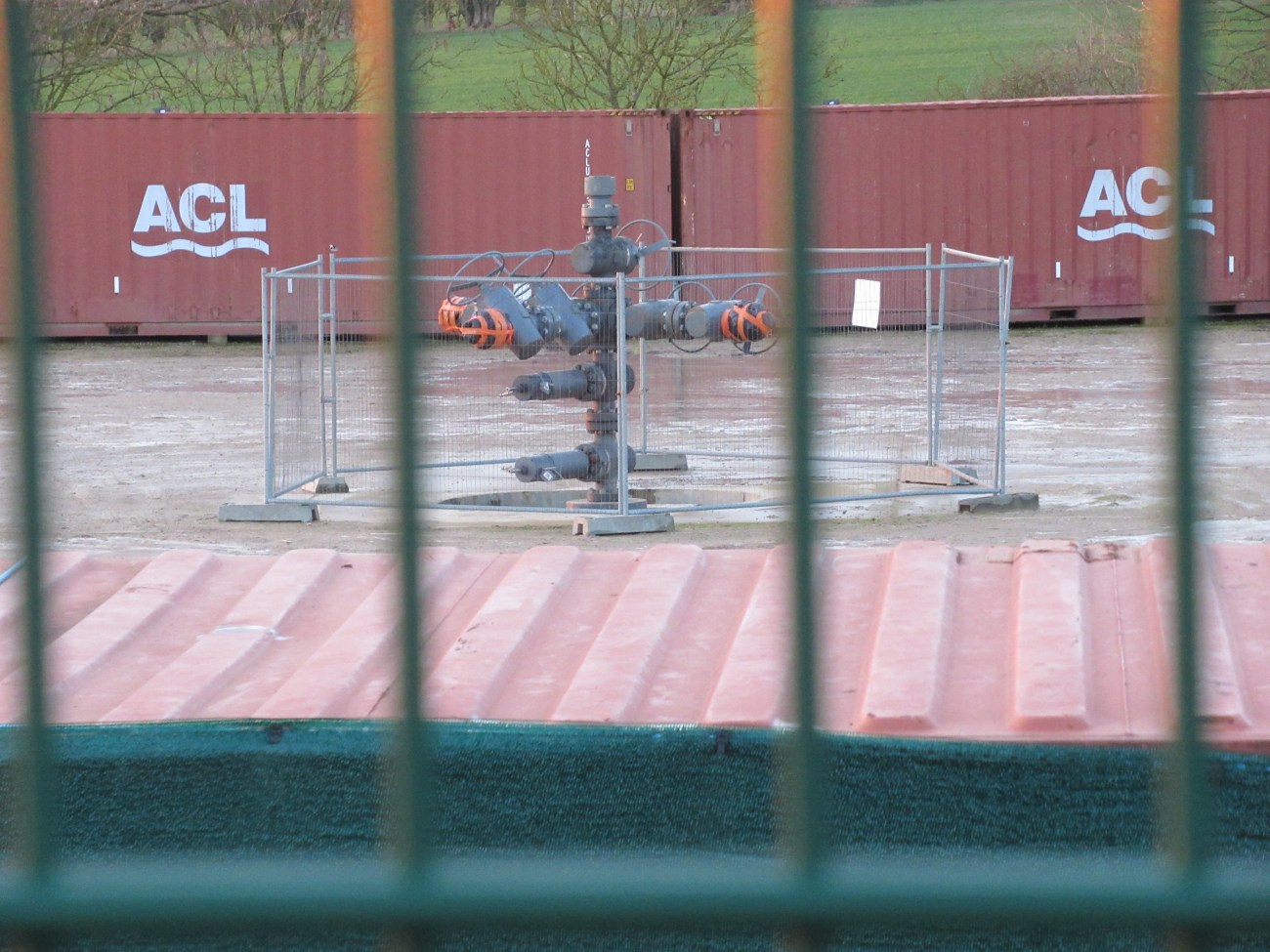
Third Energy’s fracking site at Kirby Misperton, North Yorkshire, 10 April 2019. Photo: Hazel Winter
The regulator of the oil and gas industry has no power to secure decommissioning of onshore sites, the High Court heard today.
The Oil & Gas Authority (OGA) said there was detailed legislation for the clean-up of the offshore industry. But there was no equivalent for onshore wells.
The OGA was defending a legal challenge which alleged its handling of the sale of Third Energy last year increased the risk that the taxpayer would have to pay to decommission well sites in North Yorkshire.

Eddie Thornton at Westminster rally, 5 March 2019. Photo: DrillOrDrop
The case, brought by anti-fracking campaigner Eddie Thornton, accused the OGA of failing to comply with legislation and its own guidelines. He wants the OGA to consider whether to revoke Third Energy’s gas production licence.
Third Energy, previously owned by a subsidiary of Barclays Bank, was taken over by York Energy, a company incorporated just five months before the deal was completed. York Energy had no experience in the UK onshore oil and gas industry and had share capital of just £10.
“Flex statutory muscles”
Marc Willers QC, for Mr Thornton, said the OGA should have “flexed its statutory muscles” and ensured that York Energy set money aside to meet its decommissioning commitments.
He said this would have demonstrated that the OGA had complied with its duty under the Energy Act to “have regard to minimising future public expenditure”.
But Kate Gallefant QC, for the OGA, replied:
“The OGA is not responsible for securing oil and gas decommissioning onshore.
“We have no function in relation to site restoration – that is for the mineral planning authority.
“The OGA does not have the power to require the setting aside of money for decommissioning.”
Mr Willers said securing decommissioning was within the OGA’s remit because of its duty under the Energy Act.
Ms Gallefant described this as “a very bold submission”. She said:
“Section 8 of the Energy Act cannot effect an obligation to secure decommissioning.”
There was no legislation for the onshore oil and gas industry which gave responsibility for clean-ups to the OGA, she said.
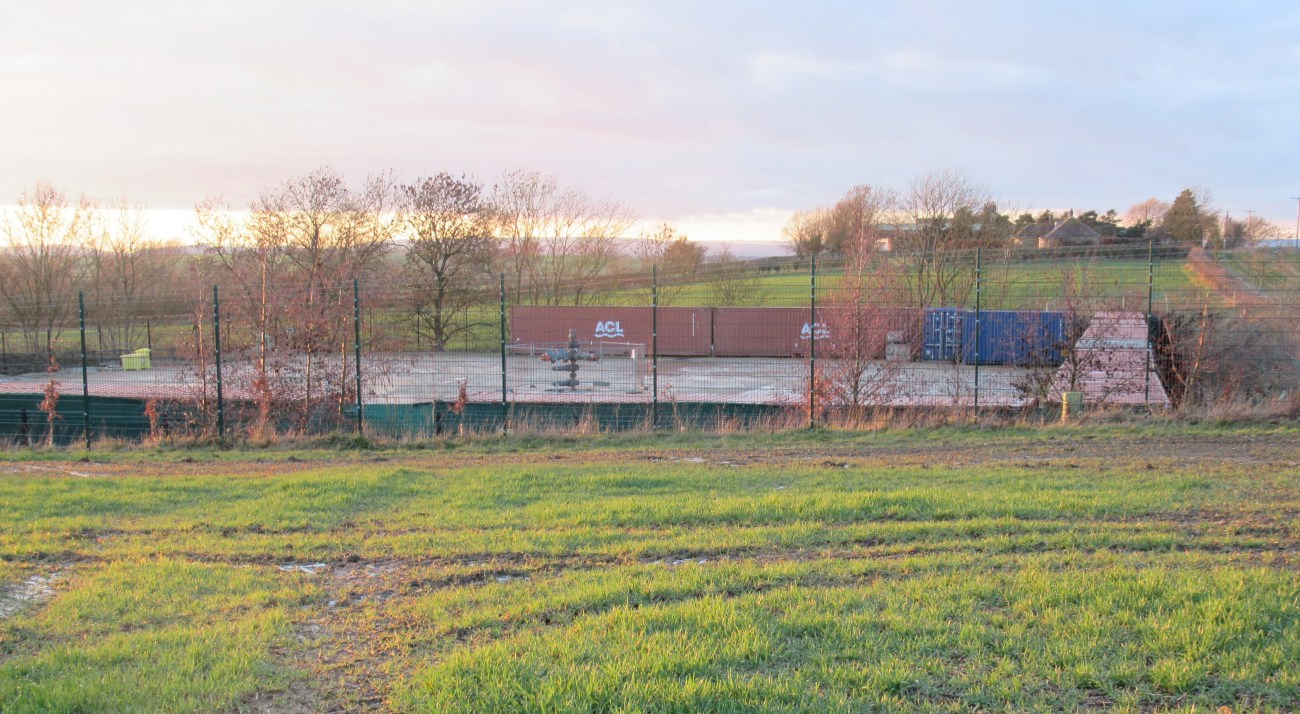
Third Energy’s fracking site at Kirby Misperton, North Yorkshire, 10 April 2019. Photo: Hazel Winter
“Liability will trickle down”
Ms Gallefant said the OGA had considered the risk that Third Energy would not be able to meet its obligations and concluded there may be “some impact on the public purse”.
But she said Tom Wheeler, the OGA’s director of regulation, had correctly decided that the Energy Act duty on minimising public expenditure was “not directly engaged”.
She said he had explained to the Department of Business, Energy and Industrial Strategy (BEIS) that liability for decommissioning would begin with Third Energy Gas, the holder of the gas production licence.
If the company went out of business, liability would “trickle down” and the costs would fall on the landowner. Only if the landowner also became insolvent would the liability reach the government and the public purse, she said.
“All that is fairly and squarely put before BEIS so that they understand there could be a call on public expenditure at the end of the day.”
“Least-worst solution”
The court heard that the takeover had been brokered at discussions “at ministerial level”.
For the deal to go through, York Energy insisted on support from the OGA through a letter of comfort.
Mr Willers argued that the OGA could have refused this.
But Ms Gallefant said OGA officials had concluded that if the takeover did not go ahead the Third Energy group was likely to become insolvent imminently. She said:
“The OGA was looking for the least-worst solution”.
“The choice was allowing the transaction to go ahead or not – neither were very appetising.
“One was more appetising than the other and hoped to avoid insolvency of the Third Energy group.”
The court heard that Barclays had agreed to write off £80m of Third Energy’s debt and add £9m to company’s balance sheet for developing its North Yorkshire gas fields.
Mr Willers said the OGA should have balanced whether Third Energy was more likely to meet its commitments under Barclays or York Energy.
Ms Gallefant said Barclays was under no obligation to Third Energy so the balance was “irrelevant”. She said:
“We did what the claimant argued we should have done. We considered whether the transaction would put the licensee in a worse position.
“We refute the suggestion that we failed to take into account a mandatory material consideration. We applied our policy and considered the question they said we failed to consider.
“Mr Wheeler considered there was an increased prospect of Third Energy meeting some of its commitments if the transaction went ahead.”
“No red flags”
OGA financial guidance on newly-incorporated companies, like York Energy, says assessments should consider in detail the track record of directors and the firm’s financial capacity.
Mr Willers said the information provided on York Energy directors was “little more than a company profile”.
Ms Gallefant replied:
“The information provided did not raise any red flags.
“There is no evidence that the OGA failed to consider the financial capacity.”
Advanced permission
The two sides also disagreed over whether York Energy should have sought advanced written permission from the OGA for the takeover.
Ms Gallefant said this requirement applied to assignments of licences, not change of control.
Mr Willers said the OGA had misinterpreted its licensing rules and should have insisted on giving written permission. He said there should be an order declaring that the OGA’s written consent should have been obtained before the sale went ahead.
Mr Willers also asked the court to declare the OGA’s financial analysis had failed to take account of material considerations.
The judge Robin Knowles reserved his ruling to a future date.
DrillOrDrop report from Day 1 of the case

 DRILL OR DROP?
Neither does the OGA have the authority to reduce the amount of benefits received by claimants. Oh to be middle class & privileged, Most don’t know they’ve lived!
Wouldn’t like to be [edited by moderator] owners of the fields rented by failed test fracking outfit Cuadrilla, the way this legal action seems to be going.
Mind you these risks to them were well documented from experiences in older onshore oil and gas operational areas.
Blinded by greed I’m afraid.
Where have Cuadrilla NOT fulfilled their re-instatement responsibilities, Peter??
Last time I looked, there was a lot of fuss about whether nesting birds should be disturbed to allow compliance, but compliance did occur.
Same with UKOG. Lots of fuss about a delay, but compliance did occur.
Over the same period there have been far more significant issues regarding who picks up the tabs for failed alternative operations.
“Blinded by greed”. Have they told you that, Peter? Or just some more fabrication.
[Edited by moderator]
Cuadrilla restored previously after their failures at Singleton, Anna’s Road and PreeseHall because they always targeted Preston New Road as the cash cow and needed to comply with decommissioning requirements for it to stand a chance of getting approved.
After all Cuadrilla’s problems at PNR the last few years that ended in Industry closure I doubt they’ll be applying for any more fracking permissions in the UK.
[Edited by moderator]
In my ACTUAL experience, Peter, I found very few farmers who did not know how to arrange a contract, and what the small print stated-and researched what it didn’t.
They do it all the time, and are pretty good at it.
They have to be, Peter, because the miserable public expect them to work 24/7 in all weathers, often in dangerous circumstances, to supply them with a wholesome product, often below the actual cost of production. Try it. If you didn’t manage to make a go at it, then I hope you would not join the extreme level of suicide that bedevils the farming community, for that very reason.
If Mr. Wensley was only motivated by “greed”, he could have covered his land at the appropriate time with wind turbines and trousered £150k/year PROFIT-EACH, whether the electricity produced was utilized, or not. Mind you, doing so would probably have had a larger negative impact upon his stock than the antics of the antis and less good for the wildlife that farmers often spend a great deal of time encouraging!
For someone who moans about the risk to agriculture in The Fylde, you seem to have very little respect for those who are involved. Maybe your idea of agriculture and farmers is just that?
I don’t moan about things Martin I make sure that the public are aware of issues.
Farmers are one of the backbones of our wellbeing and without their very strong and caring work ethics we’d all starve.
However the actions of the Wensleys firstly leasing out their farmland to the filthy frackers and then boasting about their anticipated wealth are simply disrespectful to their neighbouring residents.
It is a startling admission by the OGA that if a company fails the landowner is responsible. And should the landowner fail, then it falls to to the public purse. I wonder how many landowners were made aware of this when they leased parts of their estate for what, £30,000 to £50,000 per annum? That they could be facing £millions in clean up costs?
The finances of Third Energy and York Energy are precarious to say the least. Apologies if I’m mistaken, but I recall Third Energy was left with about £12m after the sale. This might not cover it’s existing liabilities. The other issue is how the company has been structured, the part for instance that York Energy plays, with it’s £10 share capital. If the company is structured in such a way that the contract terms are too remote, if Third Energy failed, legally it might not even be possible to get access to monies held by Third Energy and certainly not the assets of the parent company. This is why due diligence is so important when overseeing transactions like this.
Whatever the outcome of this case, it is clear that if the company fails, landowners are on the hook when it comes to onshore clean up costs and that there is a lack of due diligence and accountability. Unless a landowner can get an operator to place a sum to cover the cleanup costs, in for example an escrow account, something an operator is unlikely to agree to, then they remain at risk for the full cleanup costs. And the difficulty mineral planning authorities have had obtaining upfront payments and the inadequate amounts paid demonstrates the reluctance of the operators and is yet a further example of the completely inadequate and unacceptable processes in operation.
KatY
It’s a good question so I trudged off to speak to a land owner with multiple oil wells on his land. He said …yes, he knew all about it.
However, that’s only one so maybe all other landowners do not know. All we need to do now is ask more ( or invite them to comment on here or be contacted by DoD for comment.
Some old oil wells are tourist attractions.
https://www.tripadvisor.co.uk/Attraction_Review-g1024697-d12422621-Reviews-Hardstoft_Oil_Well-Tibshelf_Derbyshire_England.html
Regarding our past experience of Cuadrilla fulfilling stated responsibilities:
”On the day fracking started at Preston New Road began, Francis Egan said he could “absolutely guarantee” there would not be another earthquake as a result of fracking for natural gas.”
https://drillordrop.com/2018/10/28/the-shadow-of-preese-hall-over-uk-fracking-regulations/
Res ipsa loquitur ?
What has that to do with the subject of re-instating sites? Hence a moratorium. (Simply highlights the lack of an answer to my question.)
Deviation.
Next poster has 30 seconds left.
Martin,
Dr. Rugman is simply reminding us that in his opinion, mine also by the way, Cuadrilla’s main propagandist like our present and most previous Prime Ministers are not in his opinion people of integrity.
I fully remember Egan boasting that he and his family would be happy to live in the middle of the Preston New Road fracking site from a safety point of view. I am still waiting for that to happen!
Peter:
I could refer to Dr. Crippen, Dr. Jekyll and Dr. Shipman to name but a few.
HOWEVER, that does not adjust my faith in my GP.
But, I thought we were discussing re-instatement of sites, where I don’t believe Cuadrilla have shown any lack of integrity. And neither you or Dr. Frank have been able to show different. Indeed, with their ability now to extract some gas and (maybe) make a profit, that should ENHANCE that when time comes for them to do so.
I note KatT’s horror regarding liability. Well, no different to some alternatives in that respect. You can try and make out on shore oil and gas is the exception, but it is not. You can try and make out there is a history of failure to re-instate on shore oil and gas sites, but there is not.
Was there any damage to the PNR fracking site, Peter? Is Mr. Wensley still extracting his cattle from sink holes? Don’t think so. Perhaps you should toss a coin with Mr. Egan for a portacabin as that site “seems” to have been much safer than some miles away!
Martin,
If you want to house your family close downwind of an operational fracking flarestack that’s up to you.
Really good move, especially if there is only a light breeze blowing over your new home, the onsite workers and security staff.
Regarding site clean up and restoration, Cuadrilla had to comply with the earlier cleanup obligations at their failed sites in order to be allowed to continue to their main objective the now also failed PNR Superpad.
These costs were met from investors not from earnings, neither of which are now are going to materialise! In my opinion that is but I hope I’m to be proved incorrect.
As summarised here, the position of the OGA seems a little confused. On the one hand it is arguing that its authority at assignation of license is the same as that of change of control. On the other hand it is arguing that although in both cases financial capacity is a material consideration, different criteria can be used in the two different circumstances.
The OGA also seems to accept that although it could have thwarted the change of control , it allowed York Energy to take hold of the reins as being the lesser of two evils. Despite the fact that York Energy would have failed the test of financial capacity by a country mile had it been applying for a License, the OGA nevertheless transferred responsibility for five Licensed areas to a fledgling enterprise with no track record and no money.
It is also interesting that the OGA submitted that Barclays were under no obligation to Third Energy. The accounts for Third Energy always identified Barclays PLC as its Ultimate Parent Group. In the 14th allocation of PEDLs , this was an important consideration and was material to Third Energy successfully increasing the number of Licenses it was awarded by the OGA in 2014.
An appraisal of Guarantors and an assessment of Commitment are clearly explained in the OGA’s Financial Guidance of August 2018. Also explained is the OGA’s remit at change of control. Only the most perverse interpretation of the Guidance could conclude that a new controlling party – with £10 of capital – had sufficient financial resilience to enjoy exclusive rights of petroleum exploration. And remember, these five Licensed areas had been obtained by an Operator with backing from Barclays. Or had they ?
Regrettably, the OGA’s legal rep is correct regarding the chain of responsibility (pass the parcel) for remediation. However, the Mineral Planning Authority does have the opportunity at planning stage to require the explorer / operator to enter into a S106 as a condition of planning, and remediation could be included under S106. I believe Notts County Council required Igas to do this for the Springs Rd site at Misson, Notts – specified sum involved, plus annual RPI uplift.
Philip Tate’s take on OGA’s responsibilities re the respective finances of Third Energy and York Energy is bang on – great summary of the situation. OGA’s weasel words are an absolute disgrace, but no surprise given its track record in turning a blind eye to sick balance sheets.
Martin
Wind far operators and land owners were shaking in their boots no doubt when the case below was settled.
Unlike the odd shake from Cuadrilla, wind turbines destroyed people’s health for life ( when the wind blows), or so it was alledged. The issue was compounded by an uncaring wind farm company who rode roughshod over etc, etc. ( so it says )
https://www.telegraph.co.uk/news/earth/environment/8925467/Couple-settle-with-wind-farm-operators-over-unbearable-hum.html
Not to worry, BEIS consider that the tax payer could be on the hook for Billions when Offshore wind farms need to be decomissioned ( having run off with the subsidy, or handed it to shareholders maybe).
Operators think they will have the cash ( see page 25 of the report ) of course…, but if they go bust, as old wind farm companies are traded away to low cost operators, then the gov is on the hook.
https://www.gov.uk/government/publications/decommissioning-off shore-wind-installations-cost-estimation
For Third Energy Case tho..
Perhaps the gov approach to onshore oil and gas of trousering the cash now and then stiffing the landowner later has worked so far ( and examples of where it has turned out badly seem few and far between).
But as few onshore oil companies were backed by Barclays then I think it’s a case hanging off the fracking debate as a means of support.
hewes62:
Yes, alternatives are so “clean” because their issues are stuffed under the carpet! Lift the carpet, and there they are.
See Mr. Musk is a bit fed up with Germany and looking at UK now. Has he re-instated that forest he trashed in Germany PRIOR to even having the permission to proceed? If not, then, of course he should not be allowed into the UK.
But he will be.
In relation to re-instatement of on-shore oil/gas sites then the trail should follow the income trail. If not the operator, then the landowner then whoever trousered the revenue from the sale of the license and the taxation. But, there have not been issues with regard to this previously, so little reason for too much stress about it. £30k to prevent an issue where there has not been one!