People are being asked to comment on plans for oil drilling and production near a rare chalk stream in the Lincolnshire Wolds Area of Outstanding Natural Beauty (AONB).
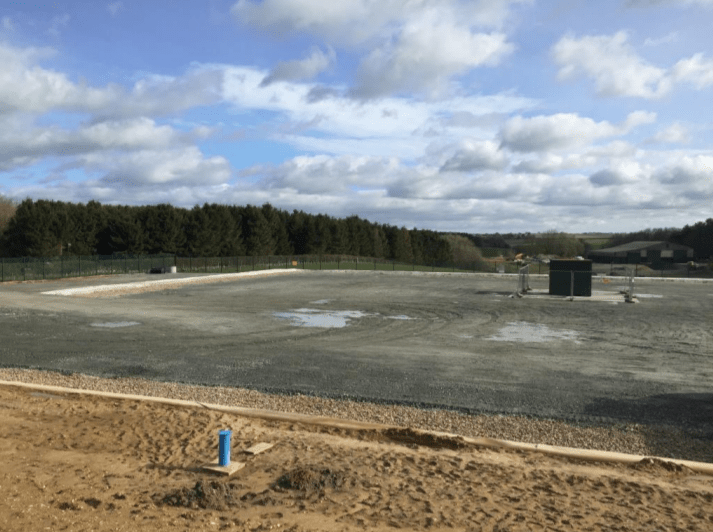
The planning application, at Biscathorpe, near Louth, seeks to drill and test a new well and produce oil for 15 years.
It is the second recent planning application for oil operations in an AONB in England.
Last month (March 2021), councillors in West Sussex refused permission to test an oil well at Balcombe in the High Weald AONB.
The consultation on the Biscathorpe application runs until 23 April 2021.
“Highest protection”
AONBs have the highest level of landscape protection in UK law, along with National Parks. Local authorities should give great weight to conserving their scenic beauty when deciding planning applications.
Oil production and drilling at Biscathorpe is considered to be a ‘major development’. Under planning law, major developments should be permitted in an AONB only in exceptional circumstances.
The oil company behind the Biscathorpe scheme, Egdon Resources, said “exceptional circumstances have been demonstrated and the development is in the public interest”.
Egdon said the wellsite, known as Biscathorpe-2, could “make a contribution to helping maintain the UK’s security of energy supply”.
It said Biscathorpe-2 could help to reduce oil imports, benefit the local economy and meet “the continuing need for oil” as the UK moved towards a low carbon economy.
A partner in the scheme described the Biscathorpe area as “one of the UK’s largest onshore un-appraised conventional hydrocarbon licences”.
At the time of writing, none of the public online responses to the scheme support it.
Donington-on-Bain Parish Council said the application represented “a significant industrialisation of the Lincolnshire Wolds within the AONB”. It said it would jeopardise the local plan which said “the highest level of protection” would be given to the AONB.
The parish council also said there was no benefit to the national interest because Egdon’s estimated production from Biscathorpe was less than 0.03% of UK consumption.
The council added:
“We do not see any benefits to our local economy or community from this operation, rather we fear considerable potential risks from oil and contaminated run-off water to the River Bain, one of the world’s rare chalk streams which runs through the centre of our community. This further poses a threat to our communities’ health and prosperity from local tourism.”
Other public responses so far included:
“Industrial oil production to be completely at odds in an area that is currently celebrated for its pristine beauty which we should all cherish.”
“The damage to the environment in a designated AOB far outweighs any benefit from the oil extracted.”
“This site was, until Egdon came along, totally unspoilt. It’s a natural haven for wildlife, and amazing piece of Lincolnshire countryside. It has a chalk stream, rare and beautiful. This place should be protected not drilled for oil.”
Site history
Egdon’s interest in the Biscathorpe area dates back more than a decade.
It was granted a licence to explore for oil in 2008. Most of the licence area, known as PEDL253, is in the Lincolnshire Wolds AONB.
The company received planning permission for a single well in March 2015 and was granted more time to carry out the work in May 2018.
It began drilling the Biscathorpe-2 well in December 2018 but announced two months later that the target formation, the Basal Wesphalian sandstone, was poorly developed.
Egdon now estimates that the Westphalian reservoir has a mean resource volume of 3.95m barrels and the deeper Dinantian carbonate has 24.4m barrels of oil in place. It believes this could be extracted by a side-track off the Biscathorpe-2 well.
The planning application said Egdon had already spent about £3.5m on the Biscathorpe-2 site. It said the cost of developing a new wellsite outside the AONB, which may not be successful, “weighs in favour of continued use of the existing site”.
Climate change
Donington-on-Bain Parish Council said it was “perplexed by the unsustainable nature of this development in the light of current national policies” on developing renewables and achieving net zero carbon emissions by 2050.
It said 15-20 years of oil and gas exploration in the Lincolnshire Wolds AONB was “incompatible” with Lincolnshire County Council’s policy to “play a full part in delivering on our collective responsibility to reduce carbon emissions.”
Other online responses described the application as “unnecessary and outdated” and a “massive step backwards”
Egdon said in its application the Biscathorpe plans were “consistent with current government policy on climate change and the adoption of a net zero target.” It said:
“There is no evidence that increasing indigenous oil and gas production will lead to higher levels of oil and gas consumption.”
It also said:
“Decision making of applications for appraisal and production should only consider the potential impacts on climate change directly arising from the proposed development from the emission of greenhouse gases, rather than any consequential impacts arising from the ultimate use of the oil and gas that potentially could be extracted.”
This issue is to be challenged at the Court of Appeal in a case brought by Sarah Finch against Surrey County Council.
Chalk stream and other impacts
Local people were concerned about the potential impact of oil production on a nearby chalk stream. One person said:
“One of the rarest type of waterways potentially will be altered/destroyed just for monetary gain and the gratification of shareholders that will neither see or care about this important ecological area.”
Another said:
“Risk of contamination to the local chalk streams could have a knock on effect on local fauna and flora and this is in an area of outstanding natural beauty that needs the strongest protection.”
Egdon said in its application:
“there will be no significant adverse effects as a result of the proposed development on hydrogeology, hydrology and flood risk receptors”.
The Environment Agency has not objected to the application. There were also no objections from Lincolnshire Police and the county’s highways officials.
Other local objections included concerns about traffic, methane emissions and noise.
Egdon said the application complied with local and national policy. The impacts were considered acceptable, it said. The application included the following conclusions on impacts:
Landscape: “no significant effects on landscape character or visual amenity occurring from the proposed development at any stage”.
Biodiversity: “there will be no significant adverse effects on ecology features as a result of the proposed development”.
Traffic: “The overall impact of the Site in terms of traffic and transportation are considered negligible.”
Noise: “Noise emissions can satisfactorily be controlled by planning conditions”. The company said the proposals complied with national and local planning policy
Lighting: “there will be some significant adverse effects as a result of the proposed development relating to lighting, specifically in relation to sky glow and glare. Due to the short-term nature of lighting used for Phases 1 – 3 and the controlled use of light during Phase 4, the effects are not considered to pose a long-term negative impact on residential or ecological receptors.”
Dust and air quality: “there will be no significant adverse effects as a result of the proposed development in relation to dust. The assessment of combustion related pollutant emissions has concluded that the total concentrations of all pollutants remain well below environmental standards and therefore the predicted effects are not significant.”
Accidents: “the proposed development will not have a significant effect in relation to the potential for major accidents and disasters.
- DrillOrDrop will report on this application as it continues through the planning system.
Key facts
Application number: PL/0037/21 Link to Lincolnshire County Council planning register
Application details: side-track drilling operation, associated testing of two formations and long-term oil production for 15 years.
Applicant: Egdon Resources UK Limited
Site address: High Street, Biscathorpe
Location: 300m west of Biscathorpe and 10km from Louth
District council: East Lindsey
Site size: 2.4ha
Closest homes: 360m
Landscape designations: Entirely in the Lincolnshire Wolds Area of Outstanding Natural Beauty (AONB) and the Lincolnshire Wolds National Character Area
Natural conservation: 2.1km from Withcall and South Willingham Tunnels Site of Special Scientific Interest, a nationally-important bat hibernacula for five species; 400m from the River Bain local wildlife site (LWS) and within 2km of 13 other LWSs
Heritage: 4 scheduled monuments within 1km, including a Neolithic long barrow
Water environment: within the headwaters of the River Bain, a tributary of the River Witham
Site facilities: These are expected to include:
- 6 sleeper units
- 1 toilet block
- 1 office
- 2 canteens
- 1 fuel tank
- 1 generator
- Water bowsers if required
Project investors: Egdon Resources (35.8%), Montrose Industries (19.2%), Union Jack Oil 45%)
Proposed operations
Phase 1: sidetrack drilling
Duration: 6-8 weeks including mobilisation
Rig height: Up to 50m
Well: about 1,200m long and about 2,100m vertical depth
Working hours: 24 hours
Deliveries: 7am-7pm Monday-Friday; 7am-1pm Saturdays
Lorry numbers: 209 in total
Employment: 36 drilling, service and security jobs. 7 part-time roles.
Estimated cost: £2.8m
Phase 2: workover and well testing
Duration: up to 2-3 months
Equipment: workover rig, beam pump, separator, flare, storage tanks
Working hours: 24 hours
Deliveries: 7am-7pm Monday-Friday; 7am-7pm Saturdays
Lorry numbers: 178
Employment: 8 service and 6 security staff. 5 part-time roles
Estimated cost: £0.45m
Phase 3: installation of production facilities
Duration: 4-5 weeks
Operation: Installation of concrete-reinforced storage tank bund, concrete plinths, surface water interceptor and outfall (to manage clean surface water run-off)
Working hours: 7am-7pm Monday-Friday; 7am-1pm Saturdays
Deliveries: 7am-7pm Monday-Friday; 7am-1pm Saturdays
Lorry numbers: 115
Employment: Up to 12 full-time jobs and 6 security staff. 4 part-time roles
Phase 4: long-term production
Duration: up to 15 years
Equipment: storage tanks, beam pump or surface pump, separator, ground flare, generator to produce electricity if gas is in sufficient volumes
Working hours: 24 hours
Deliveries: 7am-7pm Monday-Friday; 7am-7pm Saturdays
Lorry numbers: 3/day for up to 15 years
Employment: 7-8 site, haulage and ground staff. 6 part-time roles
Business rates: estimated at £50,000-£100,000
Community support fund: about £50,000 per year
Phase 5: well decommissioning and site restoration
Duration: about 6 weeks
Working hours: 7am-7pm Monday-Friday; 7am-1pm Saturdays
Deliveries: 7am-7pm Monday-Friday; 7am-1pm Saturdays
Lorry numbers: 369
Employment: 12 full-time jobs and 4 security staff. 6 part-time roles
Categories: Regulation, slider

 DRILL OR DROP?
There’s no exceptional circumstances that justify a few barrels of sludge from an AONB . I hope that Balcombe decision has given the council the balls to refuse this .
Have any statutory consultees objected? The parish council and the usual nimbys are not relevant in planning terms. Even jono uses oil. But he / she would prefer to import it? AONBs are designated for landscape quality. Better a temporary oil rig Derrick than 20 years of wind turbines.
Great idea. Go ahead.
Any issues regarding chalk streams?
Nope.
Stockbridge, next to the R. Test, has shown that is a non issue for many years.
Perhaps “local people” should do a bit of research? They could be in for a shock, though. The R. Itchen was polluted, not by fossil fuel but from a salad processing factory! Don’t expect the Greenies will mention much around that, expecting that some people will not do any research..
Martin
That will be ‘some locals’ or ‘a local’. The Lincolnite often says …locals are against ( or for ) something so one has to write to them in the hope they correct the mistake. One report of local objection was 5 villagers and a parish council planning committee vote. In all 0.4% of the village was ‘up in arms’ about the issue at hand.
Look at Wressle, refused on popularity/political grounds against proper advice and it cost the tax payer an extra £140k+ in the long run and still went ahead. Could have employed a teacher in the local school for 5 years for that. It only costs more in the long run.
Dan
yep …£400k plus to the stretched tax payer. https://drillordrop.com/2020/05/13/council-pays-403000-costs-over-wressle-planning-dispute/
I took a walk down Frodingham Road prior to attending an appeal session. I recommend it to anyone …good breakfast and when i asked about Wressle you would think i had just stepped off the bus from the planet zog. But it did not look like a place with £400k to spare.
Yes, hewes62, same around here.
I did note the nice tidy picture though at the top-with the very large farm building in the background! Maybe a few up in arms about that, but the wider good won through. So, now that agricultural building can (maybe) have the opportunity for locally sourced red diesel to facilitate local food supply, and all the locals also get £50k per year for up to 15 years. That is a lot of nest boxes! Or a few up in armers can try and preclude that and probably cost all the locals at least another £400k, as at Wressle.
For the few who have not looked into the chalk stream issue, then if there is all that oil just sitting there under that stream, then best to extract it so it has less chance of contaminating said stream. I believe it is called the precautionary principle. Who knows where seismic activity could strike next, so best to pump it out and avoid such a risk!
Keeping Lincs chalk streams in good fettle. https://www.lincswolds.org.uk/chalk-streams/projects/previous-projects. Good stuff tho banning farming near them is not an option. The storage of fuel on farms has improved over the years so although oil demand in the AONB may not be met by the well, good to see the area working towards self sufficiency.
What a county to be in! Not only seeking to be self sufficient in onshore oil, but cracking on with a number of low carbon initiatives.
Not sure how much jet fuel the good residents of lincs need, but i am sure they are prepared to share it around? https://www.enzygo.com/enzygo-secures-planning-permission-waste-to-jet-fuel/. Lets hope the weald follows suit.
I think its a good idea and will help the economy and 15 years isn’t a long time so I say let’s get on with it because renewable isn’t viable on its own which is why the country is investing in more dangerous nuclear power stations which produce more harmful waste
Nick, Hewes 62 , Martyn [edited by moderator]
It is possible to live locally to a site of proposed development and have a perfectly reasonable objection to it. It is the easiest trick in the book to disparage a view that is unsupportive simply by saying it is ” NIMBY”. The next thing is to further trash it by remarking that it is merely one voice and to assume that the rest of the neighbourhood is fully up to speed and is wholly behind the project.
At the risk of putting words into your mouth, can I assume that you regard AONBs as a bureaucratic stupidity that should be ignored if a development might compromise the environment it was established to protect ?
And while you all wish to forge ahead sucking oil out of the ground wherever it can be found it in the UK, any suggestion as to which country should be forced to leave theirs where it is in order to reduce global consumption ?
philip Tate
Thanks for the thoughts
1. [Edited by moderator]
2. Yes, I agree, it is possible to live locally to a site of proposed development and have a perfectly reasonable objection to it. Never said otherwise. Not mentioned NIMBY, and noting that only a small % of the village are against it does not trash the objections. It does mean, however that you need to do some door to door sampling or other methods (surveys) to determine what the local feeling is. Hence my reference to the main street on Scunthorpe (you may live there – what did you learn when you went there and asked?). I was of the opinion that the village here was against further housing development, but after many vox pop (asking people – lots around in lockdown) what they thought I was surprised to find it was a marmite issue. about half virulently against and half virulently for (and also split on new estates similarly). So – do the footwork. Trust is good but checking is better.
3.The next thing is to further trash it by remarking that it is merely one voice and to assume that the rest of the neighborhood is fully up to speed and is wholly behind the project. Nope – see above.
4. At the risk of putting words into your mouth, can I assume that you regard AONBs as a bureaucratic stupidity that should be ignored if a development might compromise the environment it was established to protect ? You have – you are wrong. I often walk in the AONB and in particularly around Donnington on Bain which has a footpath density that supports shorter walks that suit the older in laws. Lots of long bike rides and 30 years of driving though it and 66 years of travelling across it (and some on trains that no longer run) I do not see the well as a major issue – it will be a nodding donkey – its not a wind farm or massive mirror array (but I support the siting of wind turbines across the AONB while ever humans need the energy.) I support solar panels along the Lincoln – Humber outcrop – many are against them – look ugly (NIMBYS – yes).
5. Nope, suck oil out of the ground where people use it – if not, do not do it – you do not need it. Country – any that exports oil oil or gas (Kuwait maybe?) But that does not address consumption issues. See Chinese coal consumption – but they are net importers, so keeping theirs in the ground while allowing Australia to trouser vast amounts of cash is – er – naughty. Better to reduce consumption, and hence, look forwards to Donnington on Bain being self sufficient in oil – keep it local.
6.[Edited by moderator]
[Edited by moderator]
I am still awaiting YOUR suggestions about how stopping UK oil production is supposed to stop UK consumption. It certainly does not for other items, so why oil? And, how?
Once again, you have to make a nonsense out of the maths. to try and get a point across, but it still produces fantasy not reality. Neither would global consumption of oil be reduced if all UK on shore oil production was halted. Which just shows again that you are happy to use fake arguments to support your views. Maybe the locals to Biscathorpe will look into such, find the truth, and come to their views accordingly?
AONBs are NOT supposed to exclude all development. Neither do chalk streams, or rivers. It is not impossible to find even within the UK good examples of existing on shore oil sites that have lived side by side with chalk streams and/or within areas of sensitive landscape for decades very successfully. But, thanks for highlighting that issue, otherwise some might have been lead by some others to believe that was not the case. It is the case.
I think you will also find that views are being sought!
Jono provided his/hers, we are doing the same. At the same time, views are only part of the consideration. If planning was only about views of locals then very little would ever be built, but things are built because planning is also required to be a process that is equitable and does consider the rights of the applicant also. Otherwise locals can be out of pocket to the tune of £400k! Maybe there are some locals who like the idea of plus £50k each year for 15 years, rather than minus £400k in one year when they look at their local service provision? A great deal can be done for £750k, a great deal can be cut to recover £400k. Perhaps there may even be significant numbers of locals who have an awareness of existing UK on shore sites, or research them, and then decide that is no bad thing to have locally now they can see the sort of benefits outlined? I certainly know of a few, and one of them who was totally unaware they had such a site locally until it was pointed out to them, and responded, “why should I be worried about that, which I drive past every day on the way to work and wasn’t aware of it until now.” The same lady was horrified to consider that a whacking great, noisy, wind turbine might find it’s way into her neighbourhood.