Campaigners have won a pivotal legal challenge at UK’s highest court on the climate impact of fossil fuels.
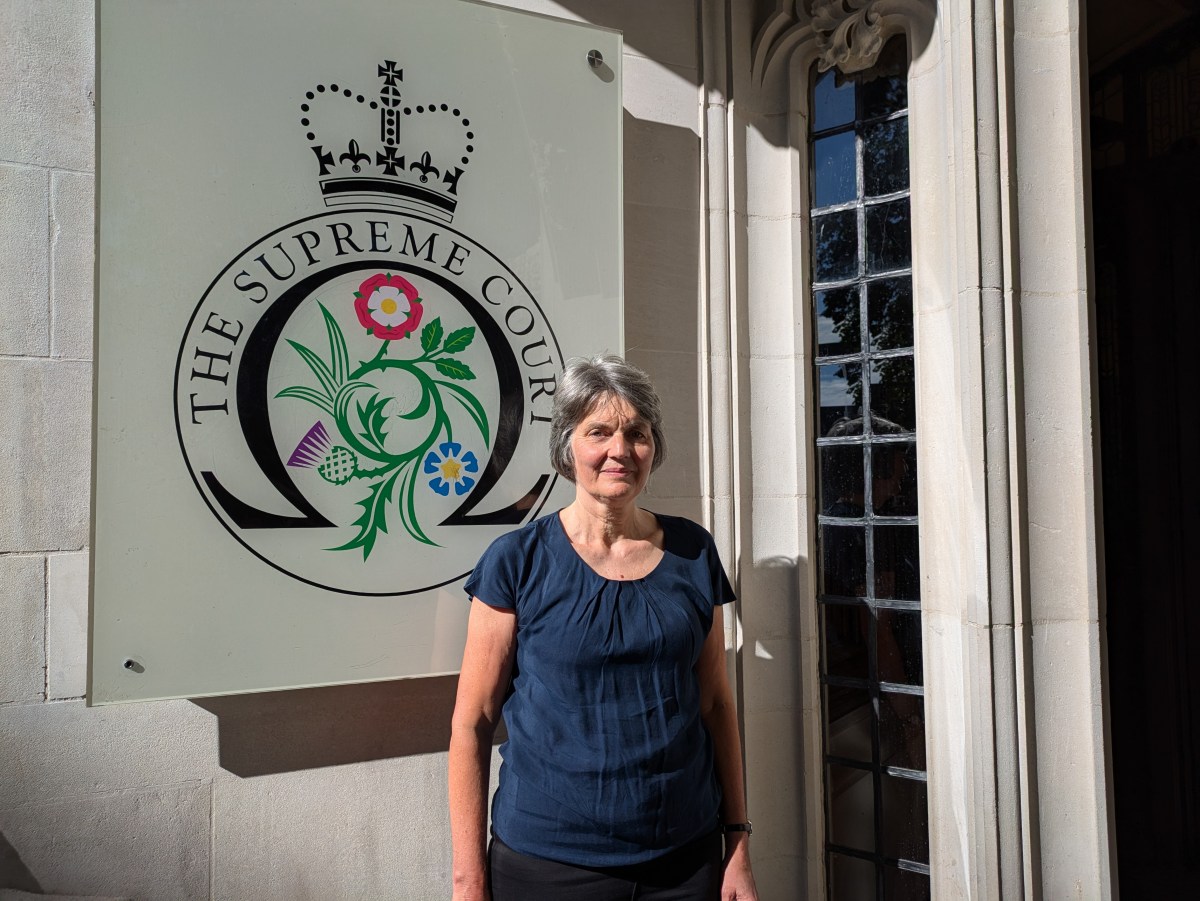
This morning, a majority of three to two Supreme Court justices ruled that greenhouse gas emissions from the use of oil – known as downstream emissions – should be taken into account in planning decisions.
The majority judgement concluded that Surrey County Council acted unlawfully in approving long-term onshore oil production from Horse Hill, near Horley, without requiring an assessment of the downstream emissions.
The decision to grant planning permission at Horse Hill should be quashed, the court said.
The case, brought by campaigner Sarah Finch is one of the first climate cases to go before the Supreme Court.
It is so significant that the government defended the case, alongside Surrey County Council and the Horse Hill operator. There were also court interventions from both sides of the argument, including, for the first time, the official environmental watchdog.
Today’s judgement is likely to have major implications for fossil fuel developments across the UK. This could include onshore oil and gas projects, new fields in the North Sea and new coal mines.
It could set a precedent in legal challenges to oil production at Biscathorpe in the Lincolnshire Wolds, the new coal mine near Whitehaven in Cumbria and to Shell’s Jackdaw project and Equinor’s Rosebank developments in the North Sea.
Key arguments
The case, heard at the Supreme Court almost exactly a year ago, centred on what should be included in environmental impact assessments (EIAs) that are part of planning applications.
Surrey County Council decided the EIA needed to consider only the emissions from drilling and extracting the oil at Horse Hill, known as direct or scope 1 and 2 emissions.
The council said the directive, which sets the rules for what should be in an EIA, did not require emissions from use of the oil to be taken into account.
Ms Finch said the biggest climate impact from Horse Hill would be when the oil was burned, estimated at 10 million tonnes of CO2 equivalent.
If councils excluded downstream emissions from EIAs there was “no hope of staying within safe climate limits”, she said.
Judgement
Today’s judgement ran to 100 pages.
Lord Leggatt, with whom Lord Kitchen and Lady Rose agreed, allowed the appeal, saying:
“The council’s decision to grant planning permission for this project to extract petroleum was unlawful because (1) the EIA for the project failed to assess the effect on climate of the combustion of the oil to be produced and (ii) the reasons for disregarding this effect were flawed”.
Lord Leggatt said:
“In my view, there was no basis on which the council could reasonably decide that it was unnecessary to assess the combustion emissions.”
He said:
“Given the agreed fact that all the oil produced would be refined, I see no reason why environmental impacts resulting from the process of refining the oil should not in principle fall within the scope of the EIA for the project of extracting the oil.”
He explained:
“The emissions that will occur on combustion of the oil produced are ‘effects of the project’ because it is known with certainty that, if the project goes ahead, all the oil extracted from the ground will inevitably be burnt thereby releasing greenhouse gases into the earth’s atmosphere in a quantity which can readily be estimated.”
Lord Leggatt said:
“It is not disputed that these emissions, which can easily be quantified, will have a significant impact on climate. The only issue is whether the combustion emissions are effects of the project at all. It seems to me plain that they are.”
Lord Leggatt also said the reasons accepted by the council for excluding the combustion emissions from consideration and assessing only direct greenhouse gas emissions from within the well site boundary were “demonstrably flawed”. He said:
“Unless there is some other reason not given in the environmental statement or the council’s review of it which required the EIA to exclude combustion emissions, it follows that the council’s decision was unlawful.”
Lord Sales, with whom Lord Richards, agreed, dismissed the appeal. Lord Sales said:
“In the present context, the EIA Directive … has a valuable role to play in relation to mitigating greenhouse gas emissions associated with projects for which planning permission is sought but it should not be given an artificially wide interpretation to bring all downstream and scope 3 emissions within its ambit as well.
“That has not been stipulated in the text of the EIA Directive, is not in line with its purpose and would distort its intended scheme”.
Eight-year campaign
Sarah Finch’s challenge, on behalf of the Weald Action Group, dates back to 2018, when Horse Hill Developments Limited (HHDL) applied for planning permission to Surrey County Council to drill four more wells and produce oil from Horse Hill for 20 years.
Council planners initially recommended the Horse Hill EIA should include downstream emissions from use of Horse Hill oil but it later changed its mind.
In September 2019, councillors voted by five to two to grant planning permission.
Ms Finch failed to overturn this decision at the High Court, which rejected her case in December 2020. It ruled that the council was not required to consider the climate effects of burning Horse Hill oil.
In February 2022, appeal court judges were divided two-to-one against allowing her challenge. But the majority ruling did accept that it was up to the county council to decide whether to consider downstream emissions.
The Supreme Court hears only cases where there is an arguable point of law of general public importance.
In the Horse Hill case, it considered interventions from Friends of the Earth, Greenpeace UK, the watchdog, the Office for Environmental Protection and West Cumbria Mining, the would-be operator of the new Whitehaven coalmine.
- Reaction to the ruling: campaigners and case defendants
Key DrillOrDrop articles about the case
Application published for Horse Hill production and drilling plans, 21 December 2018
Surrey County Council planning decision, 11 September 2019
High Court hearing day 1, 17 November 2020
High Court hearing day 2, 18 November 2020
High Court decision, 21 December 2020
Court of Appeal hearing day 1, 16 November 2021
Court of Appeal hearing day 2, 17 November 2021
Cout of Appeal decision, 17 February 2022
Interview with Sarah Finch, 15 August 2022
Key facts about the Horse Hill case, 14 June 2023
Why the case is important, 21 June 2023
Supreme Court hearing day 1, 21 June 2023
Supreme Court hearing day 2, 22 June 2023
DrillOrDrop has closed the comments section on this and future articles. We are doing this because of the risk of liability for copyright infringement in comments. We still want to hear about your reaction to DrillOrDrop articles. You can contact us by clicking here.

 DRILL OR DROP?