The campaigner who won a landmark legal victory at the Supreme Court over the climate impact of burning oil and gas has warned that the judgement is “vulnerable”.
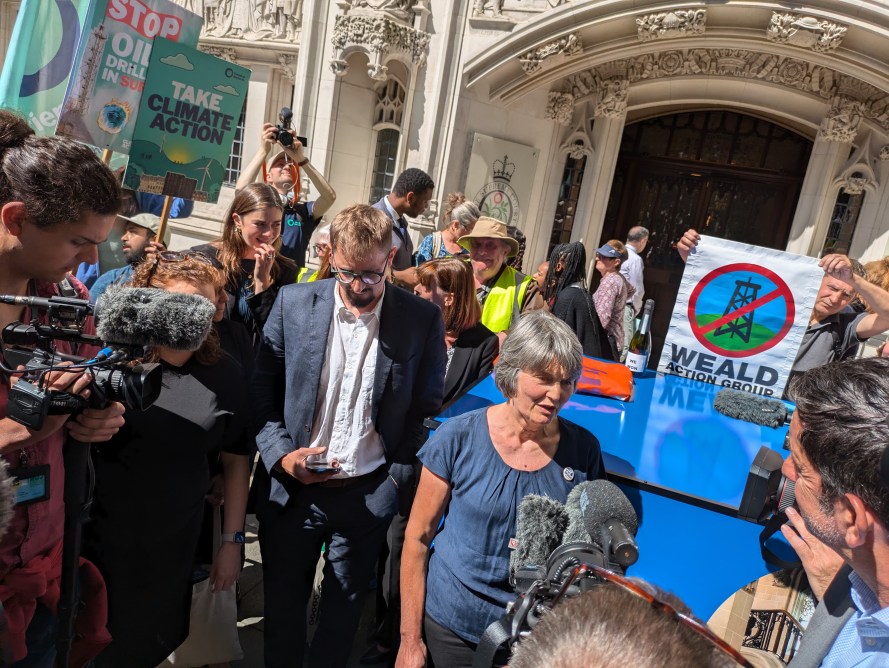
Sarah Finch told an environmental law conference:
“It is a huge victory but it is very vulnerable and we have to defend it.”
In a majority ruling almost a year ago, the court said decisionmakers considering production applications should take into account the carbon emissions from burning fossil fuels.
Previously, they took into account only the emissions from the extraction process.
The judgement led to the quashing of planning permission at the Horse Hill oil site in Surrey, which was at the centre of Ms Finch’s case.
Consent for other projects were later ruled to be unlawful, including the Biscathorpe site in Lincolnshire, Wressle in North Lincolnshire, the Cumbrian coalmine and Rosebank and Jackdaw offshore fields.
The government is now drawing up new guidance for the oil and gas industry on how to assess the environmental impact of combustion emissions, also known as downstream or scope 3 emissions.
Ms Finch, who took her case on behalf of Weald Action Group, told yesterday’s conference:
“The big victory that we’ve had on Horse Hill, a huge victory for the lawyers and everyone who worked on it, is not safe if the government is listening to other voices.
“On net zero and climate, they seem to be very concerned about the right-wing climate sceptic voices.”
Estelle Dehon KC, the barrister who presented Ms Finch’s case at the Supreme Court, told the conference she was “most worried” about the test of the significance of scope 3 emissions to be included in new guidance.
“Now that there has to be a number that is provided, in order to say that this is the extent of the emissions, it is all about that test about whether there will be significant harm, or not, or whether there will be a major adverse effect.
“What that guidance says about the test of significance is going to be very, very important.
“Unless it says something very sensible about that, every project from the smallest to the very largest is just going to assert that it is not significant as a climate impact, and it will be death by a thousand cuts.”
Campaigners against UK onshore oil and gas see decisions at Biscathorpe and Wressle as their new frontline on climate emissions.
At Biscathorpe, in Lincolnshire, the first formal assessment of scope 3 emissions has been submitted. But campaigners criticised the methodology as “flawed”, “misleading” and “unlawful”.
Planners in North Lincolnshire have ruled for a second time that plans to drill two new oil production wells at Wressle, near Scunthorpe, do not need an environmental impact assessment. This means that the company does not need to do a detailed environmental study and decisionmakers would not need to take into account scope 3 emissions.
Egdon Resources, the operator of both sites, said the likely scope 3 emissions were “not significant” in the face of the UK climate budget.
Sarah Finch said:
“There needs to be serious wording [in the new guidance] where operators need to compare emissions with all other consented projects and the remaining space in the carbon budget, of which there is very little.”
Another key decision will be on the giant Rosebank oilfield off Shetland.
In January 2025, the Court of Session quashed the development consent for both Rosebank and the smaller Jackdaw gasfield.
But Equinor, the company behind the Rosebank plans, has said it would reapply. This means the government will need to redetermine the consent, taking into account scope 3 emissions.
Ms Finch said of the government:
“They’ve done a U-turn on the winter fuel allowance. We have to make a big issue of the importance to them that they must not make a U-turn on oil and gas. We have to make them see that approving Rosebank is tantamount to climate denial.”
The government previously said it intended to publish supplementary guidance on environmental impact assessments in Spring 2025 alongside the response to its consultation. Publication will allow offshore development and production projects, that have been on hold since last year, to be submitted.

 DRILL OR DROP?