No new onshore oil and gas licences will be issued in England, the government announced today.
The news followed a speech to the Labour conference in which the energy secretary confirmed his commitment to ban fracking.
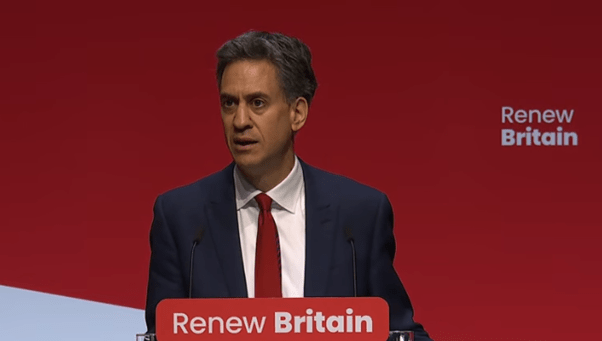
In a reference to pro-fracking Reform UK, Ed Miliband told delegates this morning:
“I say let’s ban fracking and send this bunch of frackers packing too”.
He said fracking would “trash our climate commitments” and would “not take a penny off bills” or “create long-term sustainable jobs”. Fracking would also be “dangerous and deeply harmful to our natural environment”, he said.
This afternoon, a statement from Mr Miliband’s department said:
“The Energy Secretary … confirmed plans to bring forward legislation to end new onshore oil and gas licensing in England, including new licences that could be used for fracking. This will help make Britain a clean energy superpower to protect current and future generations.”
Some campaign groups have reacted cautiously to the announcements because of the lack of detail.
Despite a manifesto promise to ban fracking, the government has not confirmed which operations would be outlawed. It is also unclear about what would happen in already-licensed areas.
The current moratorium on fracking in England has a presumption against operations that use more than 1,000m3 of fluid per fracking stage or 10,000m3 in total.
Fracking with lower volumes of fluid is currently allowed. There are plans to use it at oil and gas sites in England, at Burniston in North Yorkshire, Wressle in North Lincolnshire and West Newton in East Yorkshire.
Campaigners have described the fluid limit as a legal loophole and called for lower-volume fracking to be included in the moratorium and a future ban.
Companies need to hold a licence, as well as various permissions, to be able to explore or produce oil and gas. The most recent licences were issued by the then Conservative government in 2015. There are currently 77 onshore licences in England. Most are in the north-west, Yorkshire, the east midlands and the south.
Reaction
Steve Mason, of the anti-fracking network, Frack Free United, said today:
“Ed Miliband’s announcement comes as a welcome, but somewhat misguided intervention. Banning fracking is a clear signal of intent but this is not that. The devil is in the detail.
“This announcement opens the door to fracking on existing licences.”
He also called for more clarity:
“What is the definition? Is it just shale? Is it still specific volumes? Is it pressures? Or nothing different to what the de facto ban has included since 2019? This is important.
“Closing the loopholes being exploited must happen for there to be a true ban. The easiest way is to simply ban onshore extraction going forward.
“Labour must be very clear on this. There is no place for onshore fossil fuels extraction in communities. The social costs are too high to justify any further extraction. Labour simply can’t talk about a ‘Just Transition’ whilst allowing drilling to be imposed on communities.
“There is still no relief for thousands of people living under the threat of the industry.”
Nick Danby, of Frack Free Lancashire, which campaigns against Cuadrilla’s shale gas operations in Lancashire, said:
“From the initial announcement, the details are scant. Any half-measure is simply not good enough. Communities in Lancashire and across the country have fought too hard and too long to be fobbed off with loopholes and weak promises.
“Fracking is a dirty, destructive technology that has no future. It’s time for the government to slam the door shut once and for all.
“Anything less than a cast-iron, permanent ban risks letting this industry sneak back in through the side door.
“The only way forward is to bury fracking in the past and invest in the clean, safe energy future Britain deserves.
Cuadrilla is seeking permission to extend the life of its mothballed shale gas site at Preston New Road, near Blackpool.
Mr Danby added:
“Given this announcement, there can be no further justification for Cuadrilla’s continued presence at Preston New Road, and Lancashire County Council can have no reason for allowing any further extension.
“Cuadrilla need to clear up their mess, pack their bags and get out of town. It is utterly disgraceful that the community has had to live with this completely unwelcome neighbour for so long.”
A YouGov poll last month found that 50% of people thought Britain should not start extracting shale gas. 25% supported the process and 25% said they didn’t know.
Friends of the Earth published new analysis today which reported that more than 180 constituencies across the UK were in potential shale gas areas. These include parts of Scotland, the northern England, the Midlands and the South.
Responding to Mr Miliband’s speech, the organisation’s chief executive, Asad Rehman, said:
“Fracking is and always has been unpopular, both with people facing it off locally and the wider public. The government must now translate its plans to ban fracking permanently into policy, alongside closing a loophole in planning law that still allows it to happen by the backdoor.
Angharad Hopkinson, of Greenpeace UK, said:
“The Government is absolutely right to ban fracking for good.
“After years of hype, all this industry has brought to the UK are earthquakes and a couple of holes in a muddy field in Lancashire.
“Fracking is polluting, deeply unpopular, and even if it could be made to work in the UK, it’ll do nothing to lower energy bills.
“[Reform UK] has seriously miscalculated if it thinks people will lie down and accept such a deeply unpopular policy”.
Veronica Hawking, campaigns director at the campaign group, 38 Degrees, said of the fracking ban:
“What an amazing result for our environment, our local communities, and the thousands of committed people and groups right across the country who’ve spent years fighting for fracking to be banned for good.
“Not long ago, it felt like fracking might make a comeback, with Reform UK pushing to put it back on the agenda. But thousands of us stood up, demanded a permanent ban, and made our voices impossible to ignore.”

 DRILL OR DROP?