Residents in a North Yorkshire village where there are plans for lower-volume fracking have called on the energy minister to apologise over claims he made about the process.

Photo: Gov.uk
Michael Shanks said in a letter to the local MP last year that lower volume fracking was “commonplace” in the water industry.
The letter has been widely quoted by Europa Oil & Gas, the company behind the plans at Burniston.
But research by campaigner, Dennis May, reported by DrillOrDrop last week, revealed that 15 water companies and the Environment Agency either had no records of the process – or had not used it on water wells in the past 20 years.
Today, the local campaign group, Frack Free Coastal Communities (FFCC), accused the minister of using wording to make the proposed fracking at Burniston “seem benign”.
Professor Chis Garforth, chair of FFCC’s steering group, told DrillOrDrop:
“It’s now time for Mr Shanks to apologise for giving misleading information and to tell us the source and basis of his claims.”
Mr Shanks’ department withheld the information behind the claim, in response to a Freedom of Information request last month. It said releasing the information was “likely to have an adverse impact on the quality of decision making”. A formal challenge has now been made about the refusal to release the information.
Professor Garforth said:
“We look forward to Mr Shanks finally acknowledging that his 2024 letter – widely cited by Europa – was based on inaccurate information.
“Sadly, these latest revelations do little to assuage concerns that government policy around fossil fuels continues to be heavily influenced by the interests of the industry itself rather than the legitimate concerns of those who must suffer the consequences.”
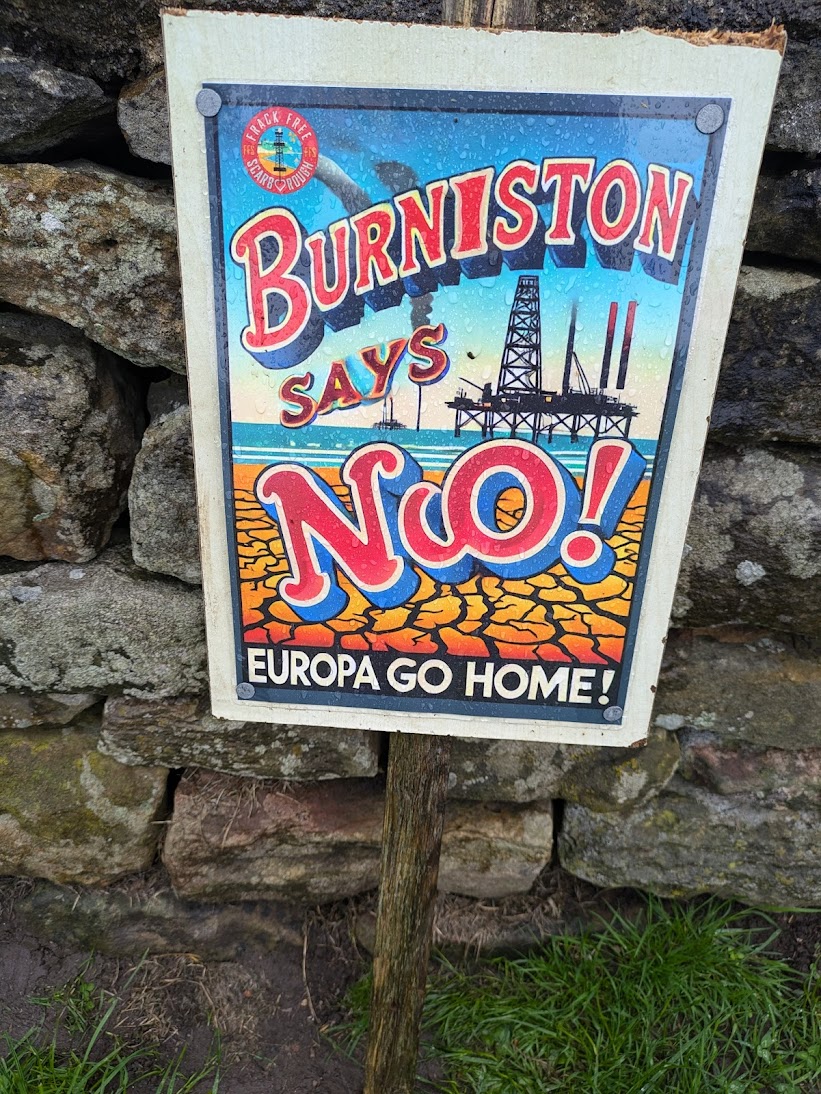
More than 1,500 formal objections have been made to Europa’s planning application, expected to be decided by North Yorkshire Council by the end of the year.
Burniston Parish Council, which unanimously objected to the application, said:
“It is interesting to note that no water company uses this process, some appear to have never used it, others have not used hydraulic fracturing in the last 20 years.
“Perhaps the potential dangers around hydraulic fracturing was understood by the individual water companies a long time ago.”
Despite Mr May’s evidence, the Department of Energy Security and Net Zero (DESNZ), told DrillOrDrop last week:
“Low volume hydraulic fracturing has been used in water, geothermal and oil and gas operations.”
Mr May said today:
“It is of note that the Department of Energy Security and Net Zero has now resorted to reframing the fracking of water wells in the past tense, which abjectly fails to align with Mr. Shanks’ claim of such activity being current i.e. ‘commonplace’.”
He said:
“It is not unreasonable to expect that the management culture of a government regulatory body would support the identification and acceptance of mistakes, as opposed to continuing the descent into a spiral of denial.”
He added that the department’s response “reflected the ethos of the oil and gas sector”. He said:
“Industry claims of ‘rigorous regulation’, along with ‘open and honest communications’ have repeatedly been proven mythical by communities it has inflicted itself on.”
“Proppant squeeze = fracking”
Europa has described its planned fracturing process at Burniston as a “proppant squeeze”. It has repeatedly denied that it proposes to frack at Burniston.
But local people have argued that Europa’s planned process is fracking. They point to the North Yorkshire minerals plan, the policy which shapes decisions on oil and gas. This defines hydraulic fracturing as the process that forces liquid under pressure into rock strata to create or enlarge fractures, regardless of volume.
Alison Hume MP, the recipient of Mr Shanks’ letter, told a public meeting in September 2024:
“If it looks like fracking and it walks like fracking and it quacks like fracking it may just be fracking.”.

Burniston Parish Council told DrillOrDrop today:
“we believe that, for clarity, it is time to acknowledge that the phrases fracking and proppant squeeze are the same, both are hydraulic fracturing.
It said:
“fractures created using low volume are no different to fractures created using high volume – hydraulic fracturing is hydraulic fracturing.”
Professor Garforth said the term proppant squeeze had been first used by Europa and Egdon Resources, its partner at Burniston, in the mid-2010s. He said:
“It has no technical or scientific definition in any body of research or operational literature. They [Egdon and Europa] used the phrase in their planning application to develop an oil well at Wressle in North Lincolnshire.
“It was – and remains – a cynical attempt to divert attention from what they proposed to do: pump fluid and sand under sufficient pressure to fracture rocks in the hope that hydrocarbons will be squeezed out – i.e. fracking.”
He added:
“Ever since they first engaged with the communities above the proposed gasfield on Yorkshire’s Heritage Coast, Europa has been putting pressure on the bedrock of the English language, forcing cracks to open up through which their dissembling and misinformation can flow more freely.”
He said the chief planner at the North York Moors National Park Authority had publicly refuted Europa’s assertions that the Burniston wellsite had been chosen on the advice of the National Park.
The company had to remove a display panel from an information event because it referred to support from the Duchy of Lancaster, which had not been given, he said.
Profess or Garforth said Europa had also claimed that the Petroleum Act defines fracking. In fact, the act solely defines associated hydraulic fracturing, a process that uses more than 1,000m3 per fracking stage or 10,000m3 in total.
“Close the loophole”
A moratorium on fracking in England has a presumption against associated hydraulic fracturing.
But the moratorium does not include lower volume fracking, despite calls from campaigners and communities.
DESNZ has said it plans to ban fracking but it has not defined what it means by the process.
Alison Hume said in a Facebook post at the end of the 2025 Labour conference earlier this month:
“Fracking has been repeatedly shown to be dangerous, unsafe and harmful to the environment. The last time fracking was tried in the UK, at Preston New Road in Lancashire, it resulted in nearly 200 earthquakes in less than a year.
“My job is to ensure the ban includes ‘small-scale fracking’.”
She previously said:
“I am campaigning hard for the Government to extend the moratorium on fracking to include ‘proppant squeeze’, so that we close this loophole and ban fracking for good.”
Burniston Parish Council said:
“The current moratorium, whilst welcome, does not go far enough and leaves our environment at risk from a process that has been shown to be potentially dangerous, with risks that no community should be subjected to.
“There is a serious loophole that has been left open to exploitation by the Oil and Gas industry.”
Professor Garforth said people objecting to Europa’s plans were “concerned about the impact of fracking on the land, water, ecology and air that they depend upon”. He said:
“They present reasoned argument, based on scientific data and expert analysis, to show how risky and ill thought through Europa’s plans are.”

 DRILL OR DROP?