Advice has been reversed on whether expansion of the Wressle oil site in North Lincolnshire needs a detailed study of the environmental impacts.
North Lincolnshire planners had been advised twice that the proposal did not require an environmental impact assessment (EIA).
But the author of the advice, an official at Surrey County Council, has now changed her mind.
The U-turn by Dr Jessica Salder, follows a challenge to her advice from the local campaign group, Fossil Fuel Free Lincolnshire.
Now Dr Salder has advised the council:
“I recommend amending your position on the proposal’s EIA status.”
She said:
“Classing the scheme as ‘EIA development’ will enable your Authority to consider all pertinent environmental information, including that offered by statutory and other consultees, when determining the application.”
Dr Salder also referred to the government’s proposed changes to the National Planning Policy Framework.
Fossil Fuel Free Lincolnshire has greeted the U-turn:
“It is welcome — if overdue — that the Council’s advisor, Dr Jessica Salder, of Surrey Council, has revised her earlier advice and now agrees with us that this development should be screened in for an Environmental Impact Assessment (EIA).
Delays and landmark Supreme Court ruling
The proposals to expand the Wressle oil site date back to October 2023.
At the time, Wressle had recently begun formally extracting oil and was the UK’s second largest onshore producing field, after Wytch Farm in Dorset.
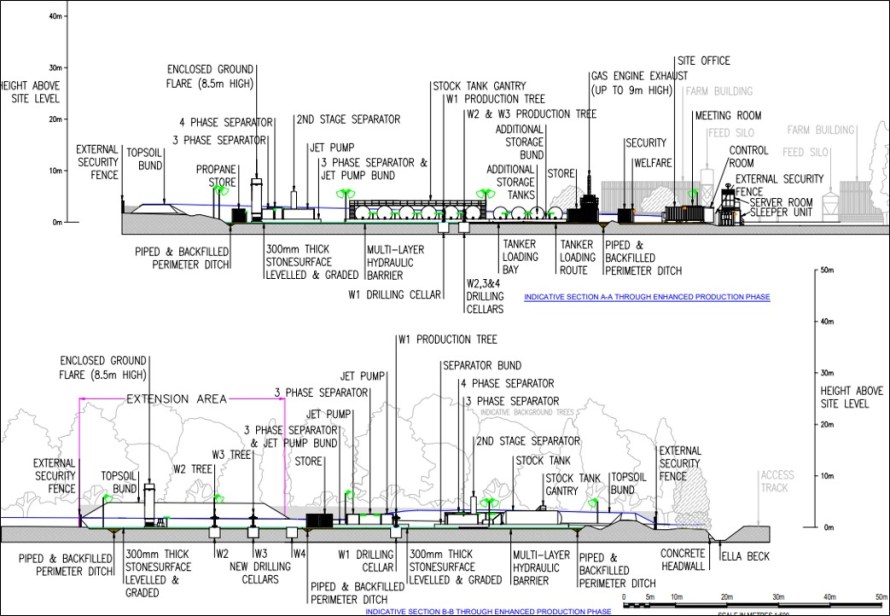
In March 2024, the Wressle operator, Egdon Resources, submitted a planning application to drill and carry out lower-volume fracking on two new wells targeting both oil and gas.
The company also sought permission for:
- long-term oil production
- one-third increase to the site footprint
- new processing equipment
- underground gas pipeline
But the planning process became delayed by the successful Supreme Court challenge over onshore oil EIAs, brought by the campaigner, Sarah Finch. The court ruled in June 2024 that decisionmakers must consider the impact of carbon emissions from combustion of UK onshore oil production.
In September 2024, planners at North Lincolnshire Council, using delegated powers, granted planning permission for the Wressle expansion. Their decision, just three months after the Supreme Court ruling, did not consider the likely carbon emissions from combustion of Wressle oil because there was no EIA.
Two months later, in November 2024, the planning permission was quashed following the threat of a legal challenge by environmental campaigner, Sandie Stratford. North Lincolnshire Council did not contest the case.
In March 2025, Dr Salder first advised North Lincolnshire that an EIA was not needed.
The planners took her advice and in May 2025, they ruled again that the Wressle proposal would not need an EIA, even though they acknowledged the scheme would contribute to climate change.
In June 2025, campaigners restarted a legal challenge against the council. They argued in a pre-action legal letter that the impact of greenhouse gas emissions from an expanded site would be significant and should not be dismissed.
Dr Salder, a key witness for the losing side in the Supreme Court case, issued her second advice to North Lincolnshire Council on 20 November 2025. She said then:
“it is unlikely that EIA should be required in this case”.
She said the proposal did not meet the EIA criteria. Along with other committed and projected developments, Wressle would not prevent the achievement of the UK’s target of net zero greenhouse gas emissions by 2050, she said.
Fossil Fuel Free Lincolnshire challenged Dr Salder’s advice on 8 December 2025. It said the council’s previous EIA decision was unlawful and should be withdrawn.
The group described Egdon’s greenhouse gas assessment for Wressle as “flawed and simplistic”. The assessment failed to consider the worst-case scenario or the cumulative effects of Wressle along with other committed oil and gas production, the group said.
The group also said Egdon had failed to take account of supplementary guidance from the government.
The greenhouse gas effects from Wressle could be significant and an EIA would enable decisionmakers to consider them in detail, the group added.
Fossil Fuel Free Lincolnshire said today:
“Even before the Finch ruling in June 2024, the serious climate harm caused by fossil fuel developments was undeniable.
“Since that judgement, there is simply no excuse for planning authorities to ignore it – particularly in this case where we have repeatedly raised these concerns with the Council over the past year or more.
“Hopefully, North Lincolnshire Council will now act accordingly by reversing its flawed negative Screening Opinion and ensuring that the greenhouse gas emissions from this development are properly assessed and subjected to full public scrutiny.”
DrillOrDrop asked North Lincolnshire Council whether it had changed its EIA ruling on the Wressle expansion following Dr Salder’s latest advice. The council has not responded.

 DRILL OR DROP?