The appeal against a rejection of gas drilling and lower-volume fracking in North Yorkshire should be decided by a full public inquiry, local people have said.
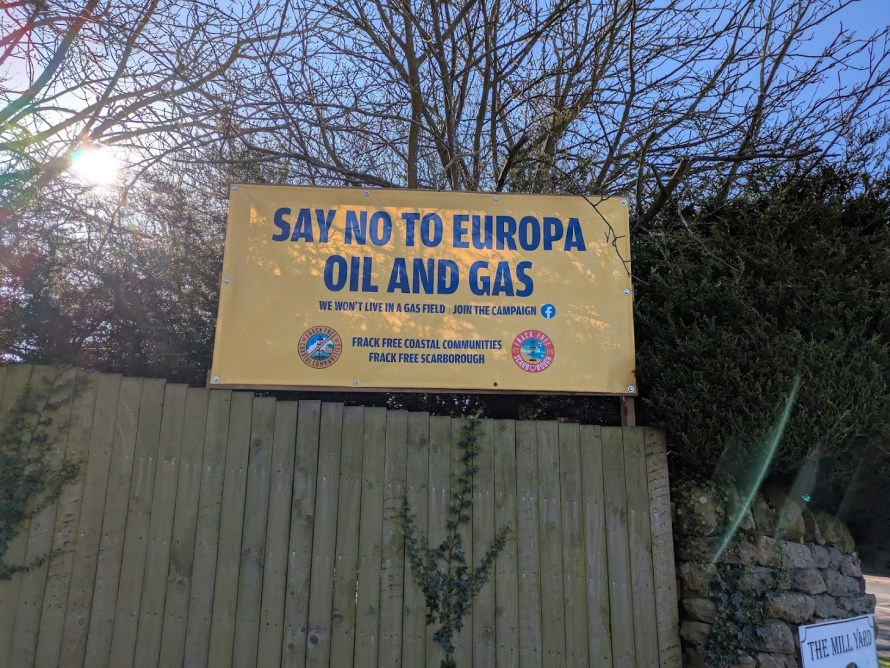
Europa Oil & Gas announced earlier this month that it would challenge the refusal of planning permission for a gas appraisal site at Burniston, near Scarborough.
The format of the appeal will be decided by the Planning Inspectorate. It could be by written representations, a less formal hearing or a full public inquiry.
A public inquiry would allow witnesses to be cross-examined. It also gives campaign groups and parish councils the opportunity to play a full role in the inquiry.
Burniston Parish Council said it would fight the appeal, no matter which process is chosen. But it said:
“we firmly believe that a public enquiry would be the best way to ensure an open, fair and thorough examination of the highly complex facts.
“As such we have written to North Yorkshire Council [NYC} to ask them to formally notify the Planning Inspectorate that a Public Enquiry is required and that we wish NYC to strongly defend the refusal.”
The council urged residents to do the same.
The local MP, Alison Hume, said this evening she supported “any call for a public inquiry”.
“Full glare of public scrutiny essential”
The local campaign group, Frack Free Coastal Communities (FFCC), has also told North Yorkshire Council that there should be a public inquiry.
It said:
“A public inquiry is the only means by which the company’s evidence in support of their appeal can be challenged through expert witnesses and cross-examination.”
FFCC said there was “considerable public interest” in the proposal by Europa Oil & Gas and widespread support for North Yorkshire Council’s decision to refuse planning permission.
The group said the five grounds for refusal were “soundly based in local and national planning policy and regulations”. The appeal would be a “significant further test” for the Minerals and Waste Joint Plan, the status of the heritage coast and North Yorkshire Council’s commitment to its climate and net zero goals and the tourist economy in the area.
FFCC said:
“Our experience of the past two years of addressing Europa’s misleading and selective information, including in the documentation submitted in support both of their planning application and their environmental permit application to the Environment Agency, tells us that the full glare of public scrutiny is essential to ensure a transparent, evidence-based process to determine their appeal.”
The group added:
“since the decision was taken to refuse Europa’s planning application, new information has come to light which casts doubt on, inter alia, the applicant’s characterisation of the geological formations they propose to fracture.
“Far from being a conventional gas reservoir, the four strata they wish to fracture are shale-enclosed tight sands with very low permeability, putting them squarely within the industry and scientific definition of ‘unconventional’. This has implications for their assertions about the safety of the proposed ‘proppant squeeze’.”
All the democratically elected organisations and individuals which expressed an opinion opposed the Burniston proposals. They included the constituency MP, North Yorkshire Council as the Minerals Planning Authority, Burniston Parish Council, Cloughton Parish Council, Newby and Scalby Town Council and Scarborough Town Council.
The chair of FFCC’s steering group, Chris Garforth, said:
[this] “is a further reason why the fullest opportunity should be given for local voices to be heard in the appeal process. A public inquiry would enable local groups to seek Rule 6 status and thereby to challenge and cross-examine expert witnesses put forward by Europa.”
He added:
“If the Planning Inspectorate opts for anything less than a public inquiry, we will tell them why we believe an inquiry is the only way to ensure local voices are heard and able to challenge Europa’s assertions.”
North Yorkshire Council’s head of development management, Martin Grainger, told DrillOrDrop:
“The Planning Inspectorate will determine the most appropriate appeal procedure after considering the views of all parties.
“In response, we will reflect the significant public interest in the proposal and will robustly defend our decision to refuse planning permission regardless of the appeal format chosen.”
Categories: Opposition, Regulation, slider