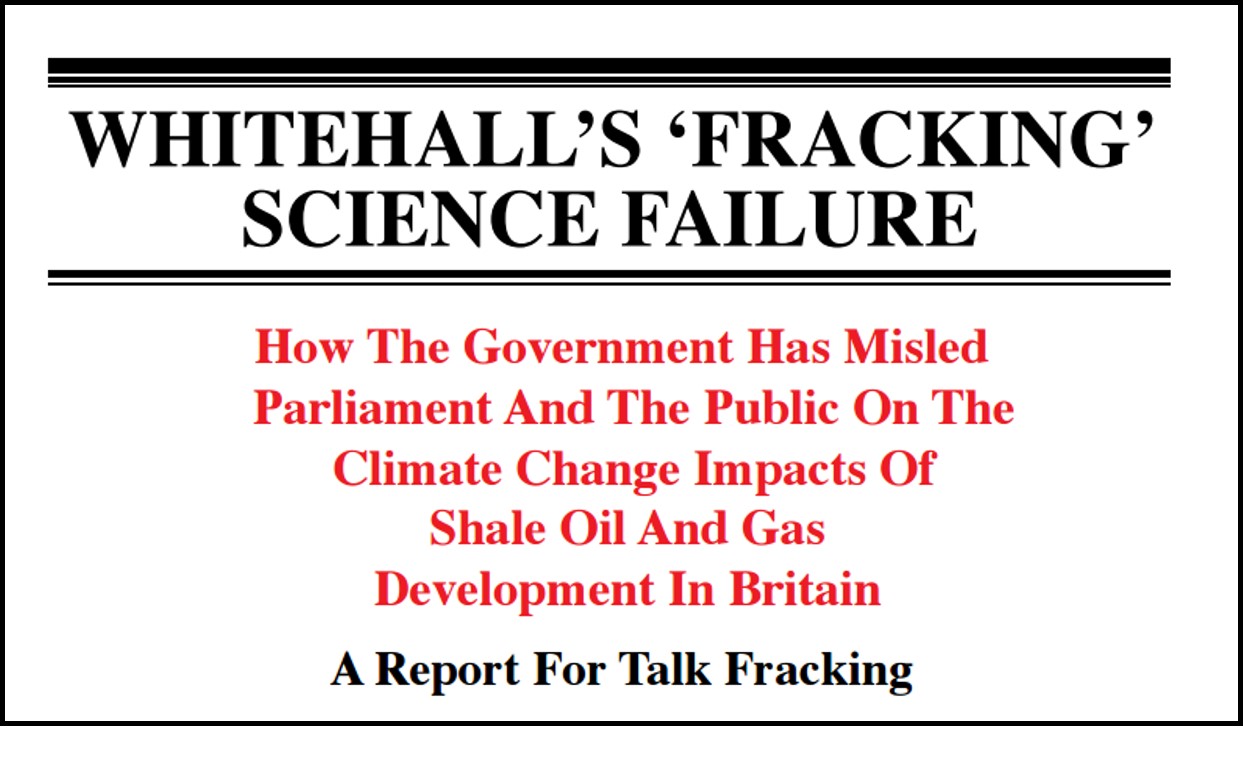
 The government misled parliament and the public over the climate change impacts of shale gas, according to new research. It suggests that ministers may even have breached their code of conduct by giving MPs inaccurate information.
The conclusions, by environmental investigator Paul Mobbs, centre on the government’s use of a report to portray shale gas as a bridge to a green, low carbon future.
The report on shale’s greenhouse gas emissions was commissioned by the then Department of Energy and Climate Change (DECC) from David MacKay and Timothy Stone and published in 2013.
Professor MacKay, DECC’s chief scientific advisor, and Dr Stone, a senior ministerial advisor, said:
“With the right safeguards in place, the net effect on UK GHG [greenhouse gas] emissions from shale gas production in the UK will be relatively small.”
But Paul Mobbs, in a paper launched today by the campaign group, Talk Fracking, said there could be “little faith in the accuracy” of MacKay and Stone’s findings because of problems in the data they selected and the analysis.
Mr Mobbs said:
“The problem for the MacKay -Stone review, and for the UK Government in general, is that the benefits claimed in the report cannot be supported when we look at the latest research on the emissions from shale oil and gas production.”
He said ministers at DECC, its successor department Business, Energy and Industrial Strategy (BEIS) and at the Department for Environment used the report to “mislead members of Parliament and Parliamentary committees into accepting shale gas exploration”.
“In quoting the report, especially after the shortcomings of the report were repeated[ly] expressed by other bodies from early 2014 onwards, ministers have misled Parliament and arguably breached the Ministerial Code.
“No minister can quote its conclusions without demonstrably misleading MPs and the public as to their current state of the science relating to ‘fracking’ and climate change.”
Mr Mobbs added:
“It is not simply that more recent research has invalidated the report. At the time of its publication it was not possible to state the conclusions of that report with such certainty – and at no point did DECC ministers properly communicate those uncertainties when making their statements.”
Ministers including Michael Fallon, Andrea Leadsom and Amber Rudd have referred to MacKay and Stone in parliamentary answers to defend government policy.
The MacKay and Stone findings were referred to in government guidance issued in January 2017 and by the Church of England in its briefing paper about shale gas and fracking in December 2016.
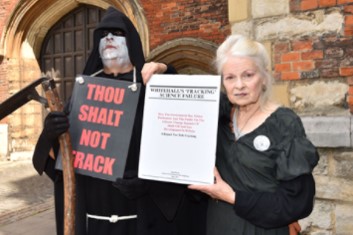
Today, Dame Vivienne West, accompanied by “a grim reaper” presented Mr Mobbs’ investigation to the Archbishop of Canterbury. She said:
“The MacKay-Stone report must now be considered wrong and fatally flawed. Furthermore, the evidence now suggests that shale gas and oil extraction could be considerably worse than coal in terms of its effect on climate change and global warming”.
A spokesperson for BEIS said :
“The Mackay-Stone report was peer-reviewed by experts outside of government. We regularly assess new evidence on shale gas and its implications.”
Moratorium and withdrawal of report
Mr Mobbs called today for a moratorium on fracking operations and the withdrawal of the MacKay and Stone report.
He also said there should be an immediate government review of the policy of unconventional gas and oil, taking into account all available research.
In addition, parliament must review the use of the MacKay-Stone report in recent decisions on oil and gas extraction policy, he said.
Data decisions
MacKay and Stone said they used data from US studies to estimate the potential fugitive emissions from shale gas in the UK and its potential impact on UK climate change objectives.
Mr Mobbs said:
“The result of MacKay and Stone’s decisions on their use of data is to improve the case for shale gas over other energy sources.”
He said they failed to represent the range of data available. They excluded particular reports which recorded high shale gas emissions but relied on another, over which there were concerns about sampling and equipment.
Mr Mobbs added:
“More critically, because they [MacKay and Stone] failed to address the uncertainties involved in producing the data, using different methodologies, the way they express their results tends to improve the case for shale gas relative to other fossil fuel sources.”
Mr Mobbs said MacKay and Stone based their estimates of emissions on what are called “bottom-up inventory studies”. These are studies which assess leaks from oil and gas operations by testing small parts of equipment in labs or on test rigs. Bottom up studies often record lower emissions than what are called “top-down” studies, which measure emissions in shale production areas.
He also criticised MacKay and Stone’s failure to consider the short-term impacts of methane. They looked at its global warming potential over 100 years, rather than 20 years. This gave a lower overall result because it excluded short-term effects.
MacKay and Stone used a very large figure for gas production, Mr Mobbs said, but their figures for fugitive emissions were based on lower well production data, artificially reducing the impact of shale gas.
Mr Mobbs concluded:
- MacKay and Stone’s figures for emissions were “perhaps half, or less” what is being observed from actual shale gas and oil operations
- Their figures for gas production were roughly twice that found in the US
- Their results under-estimated the impact of shale gas production by a factor of four
Committee on Climate Change guidance
Last year, the Committee on Climate Change concluded that shale gas exploitation on a significant scale would not be compatible with UK carbon budgets unless three tests were met.
The third test was a reduction in consumption elsewhere in the economy to “make space” for shale gas production.
Mr Mobbs said:
“Given our currently available knowledge of the scale on emissions, we must be extremely sceptical of the Government’s ability to meet ‘test 3’.”
Assessment of government policy
Mr Mobbs called for “a full and transparent assessment” of Government’s policy, taking into account the latest available research.
“Until such a review takes place, UK policy on on-shore oil and gas will remain demonstrably flawed, and an arguable danger to human health and the local/global environment.”
Links
Whitehall’s fracking science failures by Paul Mobbs
Church of England briefing paper on shale gas and fracking
Categories: Research

 DRILL OR DROP?
Mr Mobbs didn’t do too well with his end of fracking and peak oil prediction in 2015:
http://www.resilience.org/stories/2015-05-06/beyond-petroleum-fracking-s-collapse-heralds-the-arrival-of-peak-oil/
MacKay and Stone selective reporting. No surprises there. Whatever next? The Institute of Directors report claim of 64,500 jobs turning out to be nonsense?
Some work for printers producing fictional reports.
It was 74,000 from the IoD – and yes , it was nonsense
http://www.refracktion.com/index.php/74000-jobs-from-fracking-theyre-having-a-laugh/
If anyone is guilty of misleading anyone it is Mr.Mobbs. Not on a technicality, but on basic common sense. Like many antis he quickly jumped in when fracking dipped in US and suggested that was the end to it. That’s just like someone saying the first motor cars would be the last because their speeds were so limited by the red flags!
New technology is introduced and is then refined. It’s called DEVELOPMENT. Exactly what has happened with fracking in US so now they are considering halving the strategic reserve of oil (earlier post by myself) and saving $16 billion.
Bit of credibility to be rebuilt by Mr. Mobbs I would suggest.
‘New technology is introduced and is then refined’
https://www.gov.uk/government/publications/preese-hall-shale-gas-fracturing-review-and-recommendations-for-induced-seismic-mitigation
Appears that the company who claims years of experience in fracking and therefore must have applied the newest refined technology can’t get it right.
An industry with provable zero credibility.
Is his claims analysis peer reviewed and reproducible? If not then his report is just an option piece with a personal biased view.
Mr Robbs is right. The charlatans and money men will keep manipulating the facts, basically downplaying the emissions issue. Then there are people like Paul Tresto and Martyn Collyer trying to change the subject. The government should be forced to come clean on this. What are the odds on the rush for Brexit having something to do with escaping the EU clean air and other regulations before the big fracking push I wonder?
Perhaps you could entertain us as to how the gas will leak? See my comment below about the N Sea. Thats the trouble with people who are ignorant of the processes passing comment on matters they do not understand, such as Mr Mobbs, and your good self.
If there are so many methane leaks, perhaps Mr Mobbs, (who has no industry experience) could explain why the N Sea has produced the same gas for years on gas tight rigs with no explosions?
The UK system of dealing with returned fluids (containing gas) is totally enclosed by using steel tanks, unlike in many US states. This is required by the Environment Agency. Venting of gas is only permitted in an emergency, by the regulator. After that it goes into the same gas system that has powered the UK for 60 years with few issues.
It seems the pro-frackers on this page are rather rattled by this report
Ken wasn’t Piper Alpha in the North Sea?
John, you should read the Piper Alpha accident investigation report to find out what actually happened. Not relevant to these discussions but you are correct in that there was a series of explosions. There was also a significant incident with the Arco operated Ocean Odyssey in the late 1980s :
https://www.energyvoice.com/oilandgas/43727/ocean-odyssey-almost-uks-second-piper-alpha/
Not rattled, but amused by the report. A quick Duckduckgo search (I have stopped using Google as it is has become very irritating and PhilC has advised against it) on the author and it is clear to me that this is anti propoganda.
The fugitive emissions issue in modern wells, including shale wells, is a red herring. As we have discussed on this BB before, we would be better off culling all our livestock to reduce methane escapes into the atmosphere.
Welcome back Phillip P (or have you always been with us under a different name??).
Right Ken – Like flaring is 100% clean burning. !00s of aerial shots of gas flaring on North Sea rigs available for anyone to see. Some look pretty dirty. IR cameras show methane seeps from all kinds of steel tanks pipes and infrastructure in the States. Industry men of course deny what other experts see with instruments you never use. Methane is colorless and odorless so why should you care. I can understand why you’d get irritated though when scientists and environmental consultants get on your case.
Again you show ignorance of the processes permitted Philip. Only enclosed burners are permitted and green completions should be the norm. That means no gas will be released. Enclosed burners are VERY clean burning. See pages 30 to 34 of https://www.gov.uk/government/uploads/system/uploads/attachment_data/file/545924/LIT_10495.pdf
Why mention the US? This is the UK and it has strict regulations. Do we have leaking gas pipes as a matter of course? If you recall gas is a major explosion risk, as occasional headlines show. Piper Alpha was a production cock up, and lead to major revamping of H and S regulations, and it was 30+ years ago.
Methane burns clear, oil burns black, the white is steam from the cooling spray. The black looking flares you refer to are oil dominated.
Another nice stereotype for us to remind us not to take the babbling brigade seriously. Westwood presenting the evidence in person….wooooo. You mean a biased report that no one will take remotely seriously. You gotta try a lot harder than that my green friends.
[Comment removed at poster’s request]
See also – http://www.open-intelligence.co.uk/environmental-change-monitor/fracking-blog/category/impacts/emissions/
So apart from the fact that we have Ken bizarrely trying to claim that everything involved in the process is gas tight and that even the bottom up inventory method relied upon by Allen et al and McKay and Stone must therefore be logically disregarded, all we have here so far is the usual shills playing the man (and woman if we add Ms Westwood) and studiously avoiding the ball. Situation normal then.
In what context am I trying to change the subject?
What I have posted is on subject ie. Mr.Mobbs was totally incorrect in his previous comments about US fracking. You only need to look at the current struggle OPEC is having to try and force oil prices up, against the “flow” of US shale production, who are likely to add part of their strategic reserve into the mix. We no longer talk about whether oil will reach $110/barrel, but half of that, $55/barrel. At last there seems to be an answer to the worst cartel controlling a global commodity, which just happens to be the control lever on the world economy. You can howl at the moon that should not be the case, but it is, and will continue to be so for the foreseeable future.
Against these FACTS we have a number of doom merchants pontificating that fracking has no economic benefit, and when that is shown to be TOTALLY incorrect, they try the alternative that it is UNSAFE, although they have problems with substantiating that, beyond there being a requirement for normal production controls. So, then there is decline into Giggle, false advertising, numerous failed legal challenges, dirty tyres, lids off skips and very dubious “peaceful” protesting. What is there to worry about?
No doom about my message at all. There are far better, cleaner ways of sorting human power needs than the highly contestable and dirty means that is fracking. This is now proven. It’s clearly hard for some when there is a major paradigm shift going on, and now that renewable energy is undercutting O&G for price, even harder. But the smart money is moving away from fracking, oil and gas…. shouldn’t worry too much though, there will be a ‘long tail’ to those requirements in the following years.
Pushing fracking now in the UK though is just insane. Short term economic benefits (if any) will be more than offset by the legacy issues, the climate (and water management) impacts and the disgrace that England will find when all its competitors have forged ahead with cleaner smarter more sustainable power generation and distribution methods.