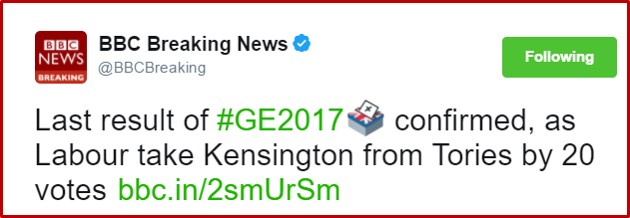
The Conservatives lost Kensington to Labour by 20 votes in the past hour in the final seat to be declared following yesterday’s general election.
The result puts the Tories on 318 seats, eight short of the 326 needed for an overall majority. The party is now reliant on the parliamentary support of 10 MPs from Northern Ireland’s Democratic Unionist Party.
The full results
Conservative 318 (down 12)
Labour 262 (up 30)
SNP 35 (down 21)
Lib Dem 12 (up 4)
DUP 10 (up 2)
Other parties 13 (down 2)
What happens now?
Political commentators have questioned how long an arrangement with the DUP would last. They’ve raised the prospect of the Prime Minister being politically vulnerable in the House of Commons to just a handful of rebels.
The BBC’s assistant political editor, Norman Smith, suggested this evening that with the Brexit negotiations and the Great Repeal Bill on the parliamentary agenda “other parts of the Tory manifesto that are remotely contentious may be ditched”.
The Conservatives and UKIP were the only parties to support fracking. Labour, Lib Dems and Greens promised a ban or opposition.
The Tory manifesto committed the party to a change in the planning laws in support of the shale gas industry. This included changing non-fracking drilling to permitted development so that planning applications would not be required and deciding permission for major fracking schemes centrally.
Based on past performance, the DUP is likely to back this support for fracking but there’s a question over whether a Conservative government now has the will or the stamina to deliver on its promise.
What does the DUP think about fracking?
There was nothing specific about shale gas or onshore drilling in the DUP manifesto and it did not use the words “fracking”, “shale” or “hydraulic fracturing”.
The party said it would “carry out a “fundamental review of energy policy to ensure that consumers and businesses have a secure energy supply that moves ever closer to the EU median price”.
But in 2016, its former Treasury spokesperson, Sammy Wilson, backed Theresa May’s proposal to make direct payments to households in fracking areas. At the time, he told the Belfast Telegraph:
“The UK needs to exploit fully the natural resources available to it.
“The impetus which gas from fracking has given to the US economy should not be spurned in the UK and hopefully the incentives being promised to households in affected areas will counter the influence of the green activists who descend on areas where projects are planned claiming to be representative of local residents and then preventing firms from going about their legitimate businesses. The Government proposal will focus local residents on the personal losses which they face by the invasion of eco warriors.”
Mr Wilson was returned as MP for Antrim East yesterday with a majority of nearly 16,000 and 57.3% of the vote.
Any deal with the Conservatives will be done by the DUP leader, Arlene Foster, who, as Minister of Enterprise for the Stormont Government, allocated licences for onshore oil and gas exploration in Northern Ireland.
Industry view
The industry has not responded yet to the election result. But Rigzone, the oil and gas news website, reported that hung parliament in the UK can only lead to the potential for further uncertainty in the oil and gas industry.
It quoted Michael Burns, oil and gas partner at law firm Ashurst:
“This will be particularly felt in the UK’s shale gas industry, which will be watching carefully as the inevitable political ‘moving and shaking’ over the next days, weeks and months will be key to its near and longer-term prospects.”
Shares in IGas closed down nearly 6% on the day and UK Oil and Gas Investments plc fell nearly 2%.
Green view
John Sauven, executive director of Greenpeace UK said:
“The outcome of this election leaves no room for a divisive and partisan approach to addressing the challenges Britain faces, starting with Brexit. A minority government will have to listen to the majority of UK people and build consensus around the values most of us share. And Theresa May should start by listening to her own voters, the vast majority of whom want our environmental laws to be improved not scrapped.
“Solar and wind power are incredibly popular, yet the government has been dithering over seriously backing both industries. It has overruled local councils to impose unpopular fracking on communities in Lancashire and Yorkshire. Concerns about air pollution have been first ignored, then thrown the sop of a toothless action plan.
“The Conservative manifesto promised global leadership on climate and a healthier environment for the next generation. Since these goals are shared by nearly all other parties, this is something the government can and must deliver on. We’re going to hold the prime minister to her word. “
Voting patterns
Supporters of fracking suggested on social media that the increased share of the vote for pro-fracking Conservatives in two key constituencies showed that the anti-fracking movement had failed to have an impact on the election.

But there’s no clear story from the results.
 The Conservative, Mark Menzies, certainly increased his share of the vote in Fylde, the Lancashire constituency where Cuadrilla is preparing to drill shale gas wells. His share was up by 9.7%. But the Labour candidate, Jed Sullivan, increased his share by 14.6% and the Conservative majority of 11,805 was down from 13,224 in 2015. Observers reported some of the anti-fracking vote going to Labour.
 In Thirsk and Malton, in North Yorkshire, where Third Energy has permission to frack its well at Kirby Misperton, the sitting MP, Kevin Hollinrake, increased his share of the vote by 7.4%. But again, the Labour candidate increased his party’s share by more, at 10.6%. Kevin Hollinrake still had a huge majority of 19,001. But it was down by more than 400 votes on 2015.
In other shale gas constituencies, there was no clear pattern.
In South Yorkshire, where the entire area is licensed for oil and gas exploration, Labour had all 14 seats. But not all these elected MPs have opposed fracking in the past and some have supported it.
The Conservatives took two shale gas constituencies in the East Midlands: North East Derbyshire and Mansfield. But in North East Derbyshire the Conservative candidate, Lee Rowley, had opposed INEOS plans for exploratory drilling in the constituency, while Labour’s Natascha Engel, who won in 2015, had supported the scheme. Before the election she had predicted to DrillOrDrop this could be electorally damaging.
In Mansfield, where INEOS has an exploration licence for shale gas, the situation was reversed with the losing Labour candidate, Sir Alan Meale, had said he “totally against” fracking, describing it as “dirty…dangerous and the science unproven”. The Conservative candidate, Ben Bradley, who took the seat had told the BBC that fracking was “worth exploring in the very least”.
In Chester, it was different again with the anti-fracking Labour candidate, Chris Matheson, increasing his majority over the Conservatives from 93 to more than 9,000. And in Warrington South, the pro-fracking Conservative, David Mowat, lost the seat after seven years to Labour’s Faisal Rashid. He told the Warrington Guardian today: “I did not see it coming to be honest”. His vote went up by 1,000 but Labour’s rose by more than 6,500
 Reflecting on the result tonight, the Green Party candidate for Fylde, Tina Rothery, a veteran anti-fracking campaigner, said:
“Labour is the only party that can ban fracking.
“Now the issue is in the manifestos, we really need to see positive and immediate actions by Labour and their local parties in licensed areas, to support the anti-fracking movement on the frontlines and bring this business to an end.”
Updated 10/6/2017 with quote from Greenpeace
Categories: Politics

 DRILL OR DROP?
Is that th Tina who got 2.5 % of the vote or is that another Tina?
As the Greens got 1.63% of the national vote, that’s pretty good going Tina, well done.
If your political manifestos promise the voters that you will save the world from its own undoing and make a better world and your ways are the only way to salvation and yet only 2% voted for your years in years out then clearly there must be something are not credible about your manifestos. But I agree that if you claim the impossible and still got 2% to agree with you then I agree you have done very well.
Yes, well done…. and in Westmorland and Lonsdale, Mr. Fish Finger got 309 votes….
you gotta love British politics 🙂
Minority governments do not have a good history. As May’s party have to rely on 10 DUP with different priorities it is unlikely to hold for long. The priority of Brexit negotiations are likely to divert any attention from bill changes for fracking and planning for the near future, by which time this alliance may collapse and we start the game again….we live in interesting times.
2017 Results
Conservative 318 Net change in seats -13 Votes13,667,213 Vote Share 42.4 Net change in seats +5.5%
Labour 262 Net change in seats +30 Votes12,874,985 Vote Share 40.0 Net change in seats +9.5%
So, 12,874,985 votes gives Labour 262 seats, an average of 49,141 votes per seat and 13,667,213 gives the Conservatives 318 seats, an average of 42,979 votes per seat. This means an extra 792,228 votes gave an extra 56 seats? A similar phenomenon occurred in Lancashire local elections recently again in favour of the Cons. Does it seem to you our system is archaic, bias and misrepresenting of the general population?
Sherwulf
It seems relatively fair in a first pass the post system, given that there were more parties than labour and Conservative. So just looking at the two of them does not highlight where the other votes have gone, nor data on where the big votes were ( i.e., if every seat were won by 10 votes, Con for example, it would look even worse).
Somewhere there will be the ‘ votes for seats ‘ data. For UKIP presumably infinity, and not so good for the greens. But so far, unless you go down the proportional rep route, it looks about fair.
It certainly worked for Tony Blair
fair point
The Tory coalition with the DUP is a dangerous step forward which threatens to undermine and unravel the Good Friday Agreement.
DO YOU HONESTLY THINK that a Tory government joining forces and showing favouritism to one particular party in Ireland will be acceptable to the other parties ???
This coalition, may be the only spark that is needed to ignite hatred, division and mistrust once again.
This may be the catalyst which will see the formation of extreme fringe parties taking up arms again.
Does anyone think this union a good idea, will it work or last ???
Labour’s manifesto commitment on shale gas and fracking was clear and unequivocal: to ban it.
In electing all Labour candidates for the first time in twelve years, South Yorkshire said ‘no’ to fracking.
David. By your logic all elected Tory MPs in Lancashire fracking areas and PEDLs means that Lancashire and Fydle say yes to frackimg. Or do you mean all government policies are now devolved to individual local MPs constituency by constituency.
It is childish to scream democracy when Labour win and undemocratic when your opposition win. This is kind of thinking plus conspiracy theory and opinions are what drive societies in unstable countries in Latin America and Middle East the losing side refuse to accept the results of the democratic process and apply their own rules as they wish by means of disruption or to the extreme intimidating and terrorism. It’s time for a grown up and civilised talk.
Kevin Hollinrake’s constituency was a massive Tory stronghold long before fracking came into the picture. What IS significant is that there was a Labour candidate here at all AND he got 14,571 votes. Back in 2010 Labour didn’t even field a candidate because there seemed little point.
Astonishingly a large number of people in North Yorkshire are still blissfully ignorant of fracking and think it is just like conventional gas extraction – so anyone trying to suggest the increase in votes for Hollinrake was due to support for fracking is delusional. Hollinrake is widely despised for his pro-fracking stance BUT people in Thirsk and Malton would vote anything into Parliament if it had a blue rosette on it and they are so eager to get the foxhunting ban lifted that Hollinrake’s re-election was a foregone conclusion.
There can be no doubt that those who know about fracking here (with the exception of Lorraine Allinson) hold Hollinrake in very low esteem. If the industry is allowed to take hold and Hollinrake continues to be an excuser for it – the next election will not be so comfortable for him.
So widely despised that he won the election by a wide margin. I see. Do you honestly think that people just don’t know about fracking? Seems a bit delusional to me. I think they know about it, don’t much care, and absolutely don’t trust the anti-frackers – for good reason!
Your argument seems to imply that the 14k odd votes the Labour got is due a vote against the evil of fracking. And yet you then claim that the people are ignorant about fracking in North Yorkshire. If they are ignorant about fracking then they wouldn’t have voted against fracking as you claim, wouldn’t they? And those who didn’t vote against fracking by voting for Mr Hollinrake where have they been the past 5 years that they haven’t heard about fracking while living in the same constituency as those who voted against fracking. It is quite a preposterous and patronising claims that people in counties with oil and gas licenses have not heard about the risks of fracking. And if this is what you are claiming then you are practically suggest your anti fracking campaign by FoE and Green Peace have failed miserably.
Interesting that Kensington and Chelsea, the country’s richest constituency, should go with Labour.
Phil P
But not as much as Mansfield going to the conservatives. A century with Labour!
Smelling salts all round at the in laws.
So why would an ex mining town in need of industrial development, not just Sports Direct, go to the tories?
Local speculation is
1. Immigration
2. Fed up with the incumbent.
3. The youth vote. ( they were either not voting or had grown old waiting to vote Tory)
4. The NHS, kings mill hospital is ok maybe.
5. Brexit, they really do want to leave.
Must dig around to find out.
Maybe Kensington and Chelsea were
1. Happy with immigration
2. Fed up with the incumbent
3. The youth vote
4. The NHS
5. Brexit ….they really want to stay
Only guessing
Easy for Champagne Socialists with their multi million pound homes and high standards of living to vote for the Corbinista – a trendy thing to do at the moment. Just like it is easy to win young peoples votes with promises of free everything without their understanding of where the money comes from, how the tax increases will kill off 40% of our small businesses etc.
That said May and her advisors committed electoral suicide.
But nothing will really change as Labour could not form a majority Government even if their friends in Sinn Fein along with the SNP, Lib Dems, Green (s) there is only one, Plaid Cymru joined them.
It is stereotyping of people that probably contributed to the rejection and failure of the Conservatives. People vote for many different and complex reasons. There are Conservative voters that oppose fracking, there are Conservative MPs that oppose fracking.
People have voted for Conservatives in deprived areas, Labour in affluent areas and vice versa. Life is complex.
I also think people underestimate young people, many are far more informed than some give them credit for. And interestingly seeing them being interviewed they stated reasons such as the NHS, public services, the environment etc for voting Labour and not the abolition of tuition fees as some are now claiming. They also were sensible enough to recognise the bias of the Conservative owned media and said they make their own minds up.
And as for friends of Sinn Fein, the government is now propped up by the DUP, which is strongly associated with the terrorist UDA.
http://www.independent.co.uk/voices/dup-conservatives-northern-ireland-coalition-ulster-defence-association-paramilitaries-peace-process-a7782631.html
http://www.belfasttelegraph.co.uk/sunday-life/government-gave-udalinked-groups-5-million-of-taxpayers-money-35121805.html
Kat
I agree that many young people are well informed. But and not sure about media bias being something that anyone who would incur tuition fees would fall for, be it biased Mirror, Guardian, FT, Economist, Big Issue, Times, Sun, Mail and so on. The media battle for the young was fought on Facebook et al in our house, a battle the left won due to better memes I am told ( but said young chap voted Conservative ).
Complex, as you note.
I would not just attribute the ‘tuition fee’ sway to the young; many parents and grandparents who supplement their student members would have taken this into consideration.
Sherwulf
I agree.
SNP are kind of anti fracking and they lost 21 seats. By the logic of most anti frackers this means the public reject anti fracking manifestos and agenda, is that it? If you look at the past 3 elections it is clear fracking is not a pressing or serious national or political issue to most people even to those who live in the affected areas but it is clearly a serious nimby for some local groups.
Ruth, you need to redo your sums. 326 is NOT needed for an overall majority, whilst SF do not take their seats. You need to subtract their seats from 650, divide by two and add one for a majority.
That should give enough time to explain to students that hike the Corporation Tax and those companies that stay slash their graduate recruitment programme and increase prices of the products they produce. Out of work with inflation roaring away-some of us remember it. Shame the Tories forgot to mention it.
Martyn
I certainly remember that.
High corporation tax, high income tax, car industry in crisis, 4 or 3 day week, king coal ( cough cough ), everyone on strike, limits on how much cash you could take abroad ( if you could afford the ferry ), high jnterest rates. Labour government, but a bit of pick and mix through the 70s. Ted Heath did a Theresa (or vica versa), but he really did lose.
But only 10% of us went into further education.
So yup, Tories did not mention it, but neither did anyone else. They are all too young I guess.
Someone did miss a trick though. If you can have QE and pass it to the banks, Zombie companies, deep state institutions, and hence the rich, you could also create cash at the touch of a button and wipe out student debt. Then they all spend more and have spare cash to buy houses etc etc. An extension of helicopter money.
Just one of those ideas floating around.
Reblogged this on andrewjwallwork.
So with one of the worst campaigns in history combined with the opposition promising free stuff for literally everyone in the UK (asides from the wealthy whom everyone apparenty despise) the Conservatives still won with 56 seats over Labour. With a better run campaign the majority would easily have been achieved. It has been a spectacular car crash whilst under the leadership of May but we have kept out the work shy and naive Corbyn and avoided a huge extra amount of debt. The only thing I agree with is the need for a national bank, the rest was pretty much fairytale promises and pledges. One good thing that will come out of it is that the Conservatives will try harder moving fwd. Also it is Corbyn that wants fracking banned and not the Labour party. His honeymoon period will come to an end eventually.
All the Tories have to do is when the boundary changes are applied, raise the voting age to 30! Simples.
Can’t see the anti DUP alliance logic. Labour would have to do it as well to get the numbers.