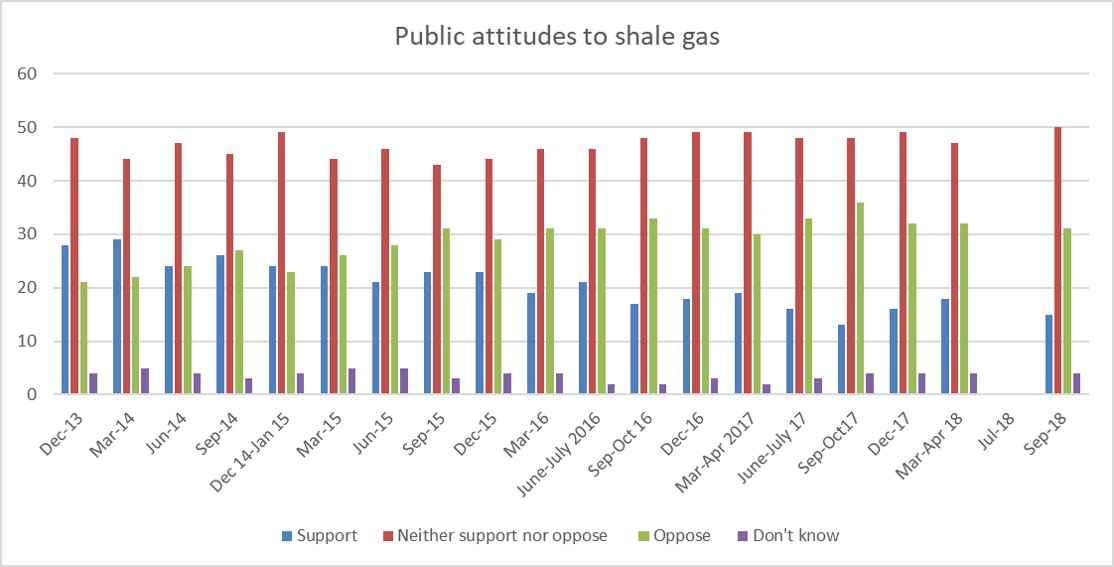
The government has resumed its quarterly survey of public attitudes to fracking and shale gas. The latest results, published this morning, show support for fracking stands at 15%, down 3 percentage points, and opposition at 31%, down 1 point.
The previous Wave tracker survey, published in August 2018, dropped questions, for the first time since 2013, on whether people supported or opposed fracking.
At the time, the Department for Business, Energy and Industrial Strategy (BEIS) said the questions would be asked only annually in future to allow space for “more focused questions” on subjects, such as consumer issues or employment rights.
But BEIS explained last week why the questions were returning:
“With the UK entering a new era of shale gas exploration it is only right that we routinely gauge the opinion of the British public and so the questions on supporting/opposing shale gas development will return to each quarter of the tracker.”
The fieldwork for today’s results was carried out before a series of earth tremors linked to Cuadrilla’s fracking at Preston New Road near Blackpool.
Support


15% of those surveyed said they supported fracking, the second lowest level recorded since the question was first asked nearly five years ago.
The latest figure was down 3 percentage points on the result for March-April 2018 when the question was most recently asked. It was up on the record low of 13% a year ago. Strong support for fracking remained unchanged at 2%.
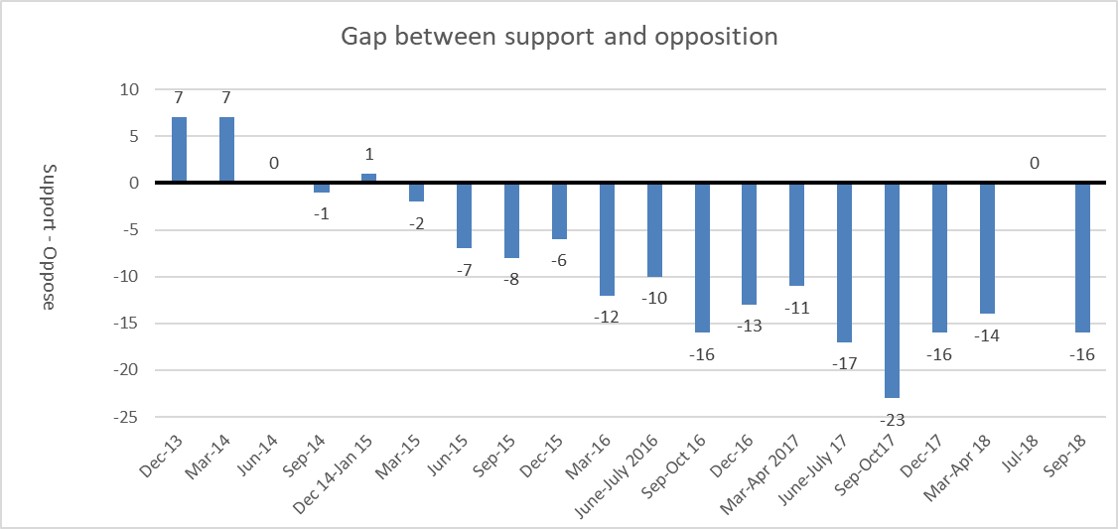
The gap between support and opposition has returned to the level last seen in summer and winter 2017.
Who supports fracking?
BEIS said men were more likely to support fracking than women: 20% compared with 10%. Other groups more likely to support fracking were:
People aged 65 and over (20%) compared with people aged 16-24 (11%).
People with household incomes of £50,000 (21%) compared with people with household incomes up to £16,000 (15%).
People living in the East Midlands (21%) compared with people living in Northern Ireland (6%).
Why support?
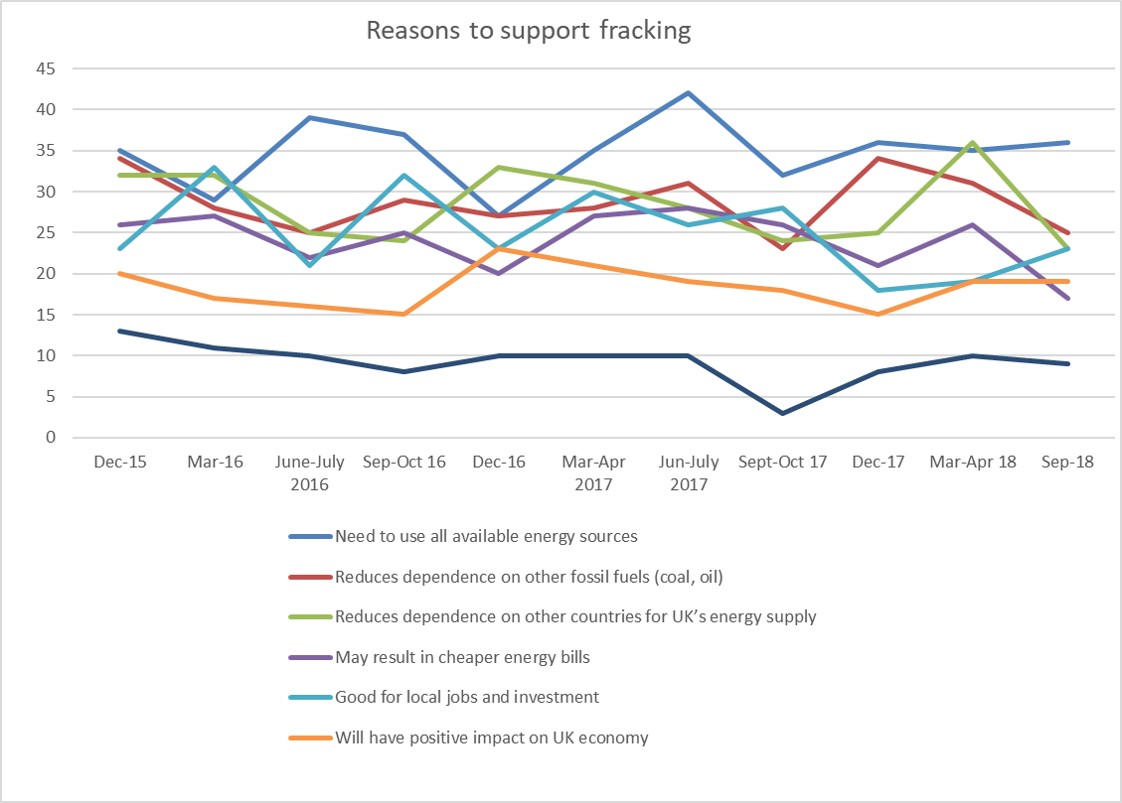
The most common reasons to support fracking were:
- The need to use all available energy sources (36%)
- Reduce dependence on other fossil fuels (25%, down from 31%)
- Good for local jobs and investment (23%, up from 19%)
- Reduce dependence on other countries for energy (23%, down from 36%)
- Cheaper energy bills (17%, down from 26%)
Community benefits and the shale wealth fund were among the least common reasons to support fracking (4% and 1%).
Opposition


31% of participants opposed fracking.
This was down 1 percentage point on March-April 2018 when the question was most recently asked and down from the record high of 36% a year ago. But opposition to fracking has remained about 30% since March 2016.
Strong opposition was down 1 percentage point to 12%.
Who opposes fracking?
The survey found that people in social grade AB were more likely to oppose fracking than people in social grade DE: 39% compared with 25%.
Geographically, the people most likely to oppose fracking, according to the survey, were those living in Wales (41%), the North West (38%) and Scotland (36%).
People who said they knew a lot about fracking were more likely to oppose than support (58% compared 24%).
Why oppose?

The most common reason for opposing fracking were:
- Loss or destruction of natural environment (58%, up from 57%)
- Not a safe process (27%, down from 29%)
- Risk of earthquakes (26%, down from 29%)
- Too much risk and uncertainty (25%, down from 28%)
- Risk of contamination to water supplies (25% down from 31%)
Neither support nor oppose
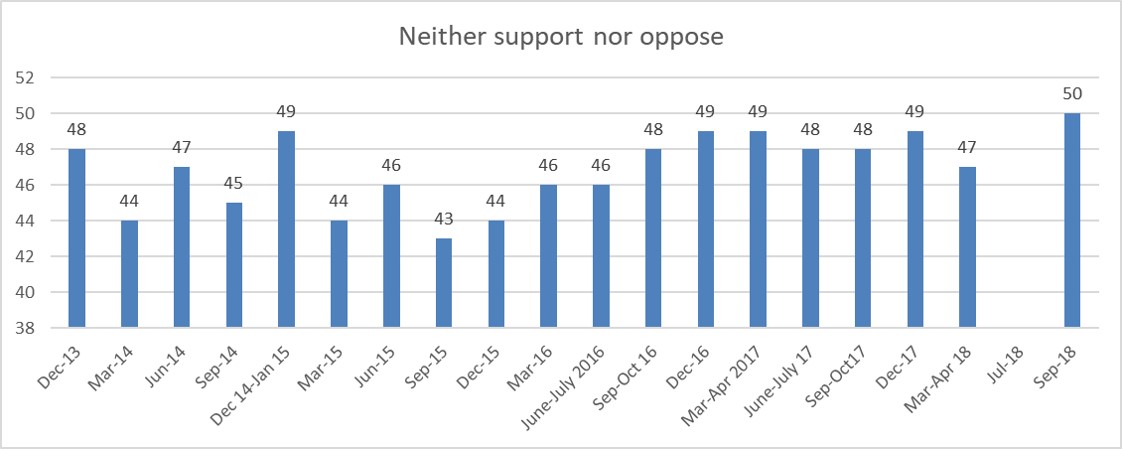
Half those surveyed said they neither supported nor opposed fracking, the highest recorded by the survey so far. This was up slightly on the 47% when the question was most recently asked (March-April 2018).
The main reason for neither support nor opposing fracking was a lack of knowledge about it (77%).
4% said they did not know whether they supported nor opposed, unchanged on the survey when this was last asked.
Awareness

75% of people said they were aware of fracking. This is down slightly on the 78% recorded in the most recent survey and in September 2017.
11% said they knew a lot about fracking, 45% said they knew a little and 19% were aware but did not really know what it was. 25% said they had never heard of fracking.
BEIS said the awareness was higher among people aged 65 and above (86%) than in 16-24 year olds (56%). It was also higher among people in social grade AB (87%) than among people in social grade DE (61%).
Awareness was also higher among people with household incomes of £50,000 and over (89%, compared with 70% among people with household incomes up to £16,000).
People living in the north west and Wales had higher level of awareness (83%) and those living in London (56%).
Reaction
A spokesman for Frack Free Lancashire said:
“The widening gap between opposition and support is hardly surprising and neither is the fact that more than twice as many oppose shale gas as support it.
“This polling clearly shows that acceptance of the industry’s claims for shale gas benefits is vanishing even amongst their supporters.“Support for the idea amongst those backing fracking that shale gas might lead to a reduction in dependence on other countries for UK’s energy supply has collapsed from 36% in March to just 23% in September. Similar falls can be seen for the claims that shale gas will reduce dependence on other fossil fuels (25% compared to a previous 31% ), with the same story for the claim that fracking may result in cheaper energy bills (17% compared to a previous 26% ).
“It would appear that people are at last seeing through the industry’s spin, and once the impact of the recent earthquakes and the IPCC’s warnings regarding climate change filter through we would expect the gap between opposition and support to widen again.”
Methodology
The fieldwork was carried out from 19-30 September 2018 on the Kantar TNS Omnibus. The results of the Wave 27 tracker are based on face-to-face home interviews conducted with a representative sample of UK adults aged 16+. The sample size, of 4,258, was more than double that used when questions about attitudes to shale gas were previously asked (March-April 2018).
Categories: Research

 DRILL OR DROP?
‘People who said they knew a lot about fracking were more likely to oppose than support (58% compared 24%)’.
‘The main reason for neither support nor opposing fracking was a lack of knowledge about it (77%)’.
Says it all……..
Indeed Sherwulfe and not because they are inclined to support fracking or don’t object to it, as Martin frequently claims! Here we have statistics that show the huge and expensive PR campaign propelled by industry and government has failed. And one cannot help but feel that a former MP that lost her seat because of her pro fracking stance and has been employed by INEOS will do any better.
Yeah, you are absolutely right with that Sherwolf, I think the sad fact is that we live in a society that cares little about the environment and bigger picture. However, at least there is growing support in favour of being against the industry, people aren’t buying the idea that it will help energy security which has always been bs that the government and the investors try to spin.
Very interesting reading the varying percentages according to ‘class level’!
It’s of no surprise women are less likely to support as it’s widely known they are more risk-averse hence why financial firms put out adverts specifically aimed at women to take on debt when starting a company-as am example.
Also interesting that Wales and Scotland are both high up the list in fact Wales is higher than N. W. England. Both these countries are growing more left wing and their economys are struggling, I live in Scotland and it’s turning into a real basket case with nothing in place to grow economy.
Also no surprise to see that superficial ‘environmental’ reasons are now the no. 1 reason to oppose with the factual reasons ie earthquakes and water contamination falling away.
To sum it up, wealthy retired people oppose and the report basically says people on lower level of class are not clever enough to have read about fraccing!
I’d suggest they are in reality just getting on with their day to day life and not spending hours reading dross on Google and becoming self certified ‘experts’.
[Image removed over possible copyright issues]
‘The fieldwork for today’s results was carried out before a series of earth tremors linked to Cuadrilla’s fracking at Preston New Road near Blackpool.’
Can’t wait for the next one!!
[Comment removed by moderator]
Sherwulfe, your picture reminds me of the dominican/haitan border pictures. They look exactly like this. Haiti has adopted a “green” political philosophy which has resulted in the denuding of the landscape (trees used as biomass for fuel) massive erosion, and problems with drinking water. Their landscape is barren and brown. Dominica has pursued a more practical alternative, and their landscape is lush and green, just like your picture. They have embraced the usage of fossil fuels and other technologies to keep their environment healthy. You might want to take a look yourself.
nope
Would rather look at the bigger picture and the results of the constant denial by the fossils of this world, which ultimately will take more lives that have been ‘improved’……
Since when was Scotland in the USA Peeny? 😂
Have you thought about self-certifying yourself?
Why, is someone not a well engineer.
John P you missed the badddduuummmtiissshhh from the end of your post 😂
I wish i knew what that meant & I used to be a Well Engineer!
It’s like the bum bum of the base drum when someone tells a joke….
‘To sum it up, wealthy retired people oppose’ Oh really GBK. Not so good with reports or statistics? That’s consistent with most of your comments on DoD. Try reading the section ‘who supports fracking’. No surprise that well heeled old men register highly. I’m alright Jack springs to mind.
I wonder if the question on fracking has returned so the government can monitor whether Natascha Engel is worth spending public money to employ her. I suspect many will already have an opinion on this. I personally consider it is a complete waste of time and money. I do not see her as being credible, certainly not impartial and definitely not independent. The idea the public will ever consider Ms Engel as a trustworthy “go to” in order to answer their questions, to liaise on their behalf with the government is to me quite frankly bizarre.
So, over the year opposition has dropped from 36% to 31%!!!
And all before gas starts to be produced. Looks as if the silent majority is not being moved, and is not becoming excited to be anti.
Meanwhile, listening to the news about the Cumbria nuclear site problems likely to require more use of fossil fuel, unless the tax payer funds it! No chance.
It may be bizarre to you KatT, but I suspect NA will find the silent majority less doubting, and more open minded-especially if/when gas starts to be produced.
‘The fieldwork for today’s results was carried out before a series of earth tremors linked to Cuadrilla’s fracking at Preston New Road near Blackpool.’
I suspect the figures will show a rise in opposition following the events of the late summer including the release of the Frack Free Three who were wrongly sentenced to long jail terms and the starting of fracking at PNR that has led to worrying seismic events. Both events have attracted national press focus. It is of concern that too many people don’t know enough about fracking to oppose or support but the baseline is that twice as many people oppose the industry that supports it.
UK’s power generating capacity is even more difficult now as the government’s new nuclear policy is in tatters. We will definitely need even more gas now & the case for moving ahead with Carbon Capture & Storage is strengthened if we are to get to a low carbon emission future. https://www.bbc.co.uk/news/business-46122255
Energy policy is really important and should not be left to chance.
Nick, energy policy shouldn’t be left to chance, nor should it bend to the whims of public opinion. As we all know, the public doesn’t “like” industrial projects in general. Are people ever in favor of sewage treatment facilities? Chemical plants? High voltage electric lines? Highways? No, all of these things have favorability ratings at or below fracking. Should we then do away with all of these things upon which society relies? If we used public opinion as a measuring stick the answer would be yes. And, BTW, though people are more favorably inclined with respect to “clean” energy, they often respond quite unfavorably when the reality of that clean energy is on their doorstep. A windmill appeals to some people, but if 360 of them (the number required to generate the same energy as a 40 well gas pad) were to be built around your neighborhood, your feelings about “clean” energy would deteriorate significantly.
Bob
Looking back at how we do things in the UK, a coherent energy policy is not likely. A muddled approach that eventually gets close is more likely.
Look at the 1960s and 1970s. Coal mines closing, then the oil shock and the resulting plan for coal, which brought about lots of capital expenditure on pit upgrades, the Selby Coalfield ( short lived ) and the £2 billion white elephant Asfordby Colliery. All spent just as the same oil shock jolted the N.Sea into action ( with all that associated gas to flare or use to generate electricity).
But we can live in hope.
I like the idea of small nuclear … wonder how that is getting on.
https://www.theregister.co.uk/2017/05/24/mini_nuclear_reactors_for_british_power/
“Energy policy is really important and should not be left to chance.”
So then, there’s only one secure way forward – renewables.
But of course the progressive clear-up following the fossil fuel and nuclear party over the last few decades will need attention and much investment.
Muriel, in the long run you may be right, but in the time frame we have to reduce emissions & provide carbon free electricity for surface transport, renewables will not get rolled out fast enough, nor will the energy storage technology to support 100% renewables be in place. In any case with nuclear phasing out and gain in renewables will just back fill the loss of nuclear, by which time we will have to be replacing much of the renewable infrastructure we now have, that will have worn out or be overtaken by better technologies.
Sadly because people like you still support the dirty fossil fuel industry and to add insult to injury,shale gas extraction. We have had every opportunity in the last seven years to ramp up the renewables, instead this blue excuse for a government has supported UK ‘dead duck’ shale.
I notice another rig up – another con to get the poor investors to part with cash on a bet, stretching out the inevitable demise of these ponzi companies, who will close leaving many out of pocket in the very near future……
The government had a carbon capture plan at one point but decided to throw it out due to the cost , a case of doing things back to front isn’t good enough. We wait to see what Cuadrilla’s problems are at PNR , I don’t think Fracking is going to plan so this might all be a waste of time . https://www.bbc.co.uk/news/uk-scotland-scotland-business-34357804
Reblogged this on sdbast.
With due respect GBK ( not that you deserve it ) I think your comments are gross and totally sum you up , of course you live in Scotland where it is banned yet you want to make out its a class issue . Shame you don’t have any .
Support for fracking falling even before the Lancs earthquakes hit the national headlines. Says it all, really.
One notable thing about fracking is that it would only ever affect certain parts of the country – which, if polled in a more targeted way so only areas threatened by fracking were asked, I suspect would be far more opposed than this national average. The main reason why half the country don’t have a view is that they know it’s not going to affect them directly, apart from of course the climate change implications of starting another fossil fuel industry.
OMG, the virtue signalling to counter analysis. Too late Jono. Life is full of views and attitudes some don’t buy into. Your own comments on this site have not exactly been above question, so a sudden conversion to the DoD moral compass is humorous but not convincing.
Richard-I suspect your speculation will not be confirmed. The public who I have spoken to recently were far more aware of some gas being produced than the events you refer to. Perhaps that received media coverage just at the time they were worried about their winter fuel costs? Maybe unfortunate for the antis but maybe that is why it happened when it did?
“The survey found that people in social grade AB were more likely to oppose fracking than people in social grade DE: 39% compared with 25%.”
With lots of caveats, this finding could be interpreted as at odds with the pro-frackers dismissal of antis as Corbyn-loving, unemployed wasters – maybe?