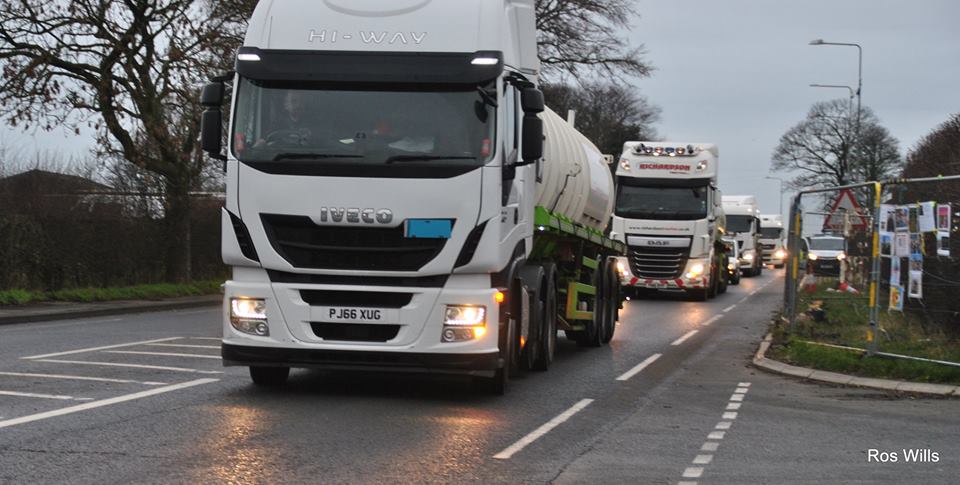
Tankers at Cuadrilla’s fracking site at Preston New Road, near Blackpool, 12 February 2019. Photo: Ros Wills
People have been excluded from a public consultation over fracking chemicals by the use of technical language, an industrial chemist has complained.
Dr Duncan Coppersthwaite, a member of the Royal Society of Chemistry and a chartered chemist, accused the Environment Agency, which organised the consultation, of failing to provide a fair and open process.
His complaint centres on Cuadrilla’s use of the phrase “non-hazardous” for two additives it wants to use in fracking at its Preston New Road site near Blackpool.
DrillOrDrop reported last month that a public consultation was underway on the company’s application to vary its environmental permit.
In the non-technical summary that accompanied the application, Cuadrilla described the substances as “non-hazardous” to groundwater.
Dr Coppersthwaite, who lives in Kirkham, about five miles from the Preston New Road site, said the use of this phrase was “entirely technical”.
It had been used correctly in the context of environmental legislation, he said. But it was not true in the context of potential harm to people and the environment.
Dr Coppersthwaite said:
“People would be forgiven for believing that something that is described as non-hazardous would be safe, benign or harmless and it would be entirely reasonable to conclude that it was incapable of causing harm to people or the environment.”
But he said:
“Under current environmental legislation … it merely means that such a substance does not meet the high levels of toxicity, environmental persistence and bio-accumulation for it to be classified as a hazardous substance.
“This means that a substance classified as non-hazardous in the context of environmental legislation can be extremely harmful to both public health and the environment.”
Dr Coppersthwaite said the hazards listed for one of the proposed additional chemicals included “Toxic if swallowed”, “Causes severe skin burns and eye damage”, “Fatal if inhaled” and “Very toxic to aquatic life”. But he said no such hazards were presented in the application.
He said:
“While Cuadrilla might be forgiven for allowing the public to misunderstand the term non-hazardous in the context of their application, we should all be concerned that the Environment Agency has allowed such an omission to be released for public consultation.
“The Environment Agency has allowed the public to be misled into believing that the proposed additives are safe, benign or harmless and in doing so, has excluded large sections of the public from the consultation process. We should expect much better from the regulator charged with protection and enhancement of the environment.”
Official guidelines say public consultation documents should use “non-technical language as much as possible, avoiding technical terms, detailed data and scientific discussion”.
The audience for Cuadrilla’s permit variation consultation was described as “anyone from any background”.
Dr Coppersthwaite said people were likely to have concluded that the additional chemicals would have no risks and they would be discouraged from commenting on the consultation.
“By allowing Cuadrilla to use the term non-hazardous without defining its meaning in the context of the application, the Environment Agency has excluded large sections of the public from contributing to this consultation and has failed to provide a fair and open process.
“I strongly suggest that the application is rejected and only reconsidered when the non-technical summary is written in language which is accessible to “anyone from any background”.
DrillOrDrop invited the Environment Agency and Cuadrilla to respond to the criticism.
Nick Mace, Cuadrilla’s environment manager, said:
“We are happy that the details included in the documents submitted to the Environment Agency are in line with the regulatory requirement as part of our application to vary the fracturing fluid used at our shale gas exploration site in Preston New Road.”
We’ll update this post any response from the Environment Agency
The consultation closes on 20 March 2019. Documents and consultation form
Categories: Regulation

 DRILL OR DROP?
Nothing less expected from these liars, just ban it now.
Thanks for the alert. At face value it seems to be a potential breach of the Aarhus convention of which the UK is a signatory by using too much technical English. It would be useful to know which chemicals that are of most concern.
Secondly, it is manifestly unreasonable for the Environmental Agency to request and require anyone interested to go to Bamber Bridge if they want to view the documents, and furthermore that a charge may be made for copying of the materials. This may also be a potential breach of the Aarhus convention.
Thirdly, why can’t the EA make one official copy of the documents and make it all freely available on the internet?
Robin Grayson MSc – Liberal Democrat Geologist
Shame the same approach also bans electric or hybrid vehicles!
Oops.
Looks as if reactions diesel should be okay then?
Oh no it wouldn’t. That would need banning also. What happens when diesel enters an aquatic environment?
Oops.
“Anyone from any background”-oh dear.
I think anyone recognises they are in contact with materials every day of the week that are to be used in an appropriate way. Salt on chips is widely enjoyed in Blackpool, but most residents are aware if they were ship wrecked drinking quantities of salt water would be a problem.
Not sure that suggesting PNR locals are incapable of reason and research is a wise move!
Martin, please stay on topic.
Official guidelines say public consultation documents should use “non-technical language as much as possible, avoiding technical terms, detailed data and scientific discussion”. This is an accurate statement. Do you think this statement is incorrect?
The Control of Substances Hazardous to Health Regulations deals with the handling of these substances. Most chemicals can cause harm if not handled correctly. So, do we tell the public about these Regulations as well? Where might the information start and stop? A line has to be drawn somewhere.
It is appreciated that industry / regulators can use terms that they are familiar with and fully understand.
As this is a Public Consultation, it needs to contain language that can be understood by the general public. Where it has a substance listed as non-hazardous, there could have been a footnote explaining the the potential to cause harm under certain circumstances.
I am fed up of being informed that most of these chemicals can be found under the kitchen sink! It is BS. I have looked under our sink. We do not even use bleach because of its harmful affects.
Perhaps you were using it incorrectly, Waffle? That is something quite different.
Hope you lock up the NaCl, behind a sign stating that consumption by the kilo could cause harm..
Maybe it is not too unusual for others to be quite expert at cleaning their patios. Or, how to mix their fuel for their leaf blower, how to operate electrical equipment and their lawn mower.
In my view, the public or unauthorized personnel do not handle or are not allowed to handle these chemical anyway so the risk for them is minimal. Once they are in fracking fluid their concentration reduce significantly and do not pose serious danger.
The anti frackers are trying to make a mountain out of a mole, I think.
The author as an experienced chemist should not the 3 principle of risk classification and management.
1. The level of harm.
2. The length of exposure.
3. The frequency of exposure.
Well Waffle, having seen the nonsense on DoD around selenium, I have much more faith in the public being able to identify and research than some “experts” would suggest. Yes, some comments from some antis would tend to indicate the bar is set a lot lower than that, but that is a different matter.
My new car arrives next week. There will be an operating manual with it. Guess what-it will contain technical info. Where it is too technical for my advanced years I will take a bit of time to decode it. In the process, I will learn a bit more. I think many around PNR are equally capable.
(Now, if it was a Tesla, I wouldn’t have ordered it as the disposal problems for the toxic materials built into it would have horrified me, and the mortality amongst those who helped produce it would also have horrified me! (Factual.))
As a non scientist, all of these comments resonate with me.
It just makes me realise that we (the UK) have again gone with the cheapest option. We have given minimal consideration to future generations and in relative terms, just sought a ‘quick fix’
Anything that creates a potential hazardous risk, also creates a potential profit base to contain the risk.
We need to change the way we think about our future before it’s too late.