Egdon Resources has given formal notice that it intends to apply to extend the life of an oil site in Lincolnshire for a third time.
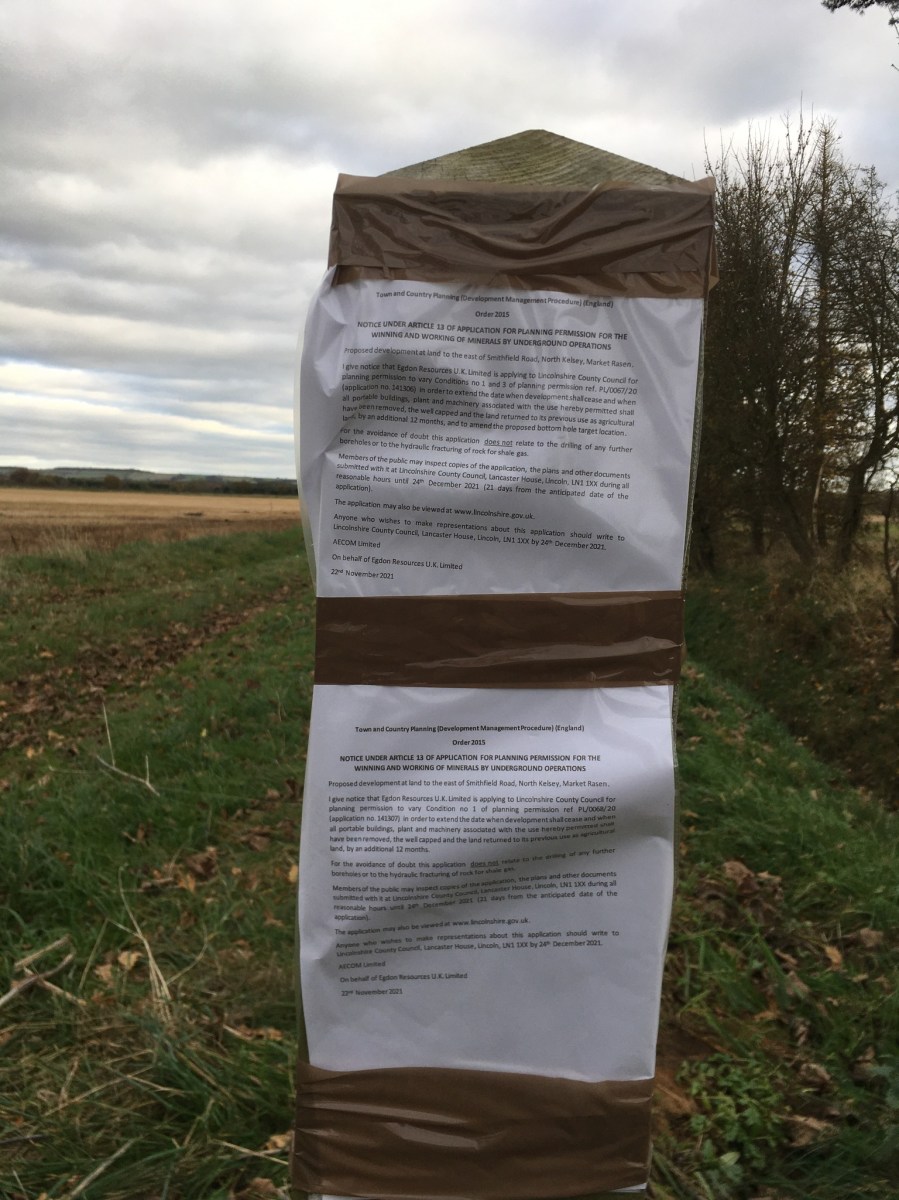
Photo: Used with the owner’s consent
The company posted details this week near its North Kelsey site, four miles from Caister.
It is also seeking consent to change the target for the well.
Planning permission at North Kelsey was originally granted in 2014. But the only work carried out has been on the site entrance and two laybys in the lane nearby. There has been no site construction work or drilling.
Since then, Lincolnshire County Council has allowed an extension of three years in 2017 and another year in 2020. The current permission expires in just over a month at the end of December 2021.
Egdon has previously blamed the lack of progress at North Kelsey on low oil prices, the Covid-19 outbreak, the withdrawal of a partner and delays at another site.
At the 2020 planning meeting, Egdon was accused by councillors of taking “a cavalier approach” with local people. Cllr Daniel McNally said that should be the last extension and the company should “have a very, very good reason to extend it again”.
After that meeting, opponent Amanda Suddaby, who lives next to the site, said:
“I wager that Egdon Resources will come back with another request for an extension and North Kelsey will not be restored by the end of next year.”
New target location for well

Egdon has revealed that it also wants to change the target location for the proposed well at North Kelsey.
The current permission includes a condition (3), which requires the company to comply with 21 technical drawings. They give specific details of issues such as site location and layouts, location of equipment and cabins, and the access arrangements.
Egdon has said it is now seeking to vary condition 3 to “amend the proposed bottom hole target location”.
Formal notice
The formal notice, dated yesterday, is required under planning regulations. It is official notification to owners or tenants of land to which an application for mineral working relates.
Under Article 13 of the Town and Country Planning (Development Management Procedure) Order 2015, the notice must be displayed for not less than seven days in the period of 21 days immediately before the application is made to the local planning authority.
Any representations about the plans for North Kelsey must be made by Friday 24 December 2021 to Lincolnshire County Council. This period does not replace any public consultation period when the application has been submitted and published.
Once submitted, the full application must be validated by Lincolnshire planners before it is posted online and opens for public comments. That consultation usually lasts at least three weeks but can be six weeks or more.
When the application has been published, DrillOrDrop will report on the contents and reaction to it.
Biscathorpe refusal
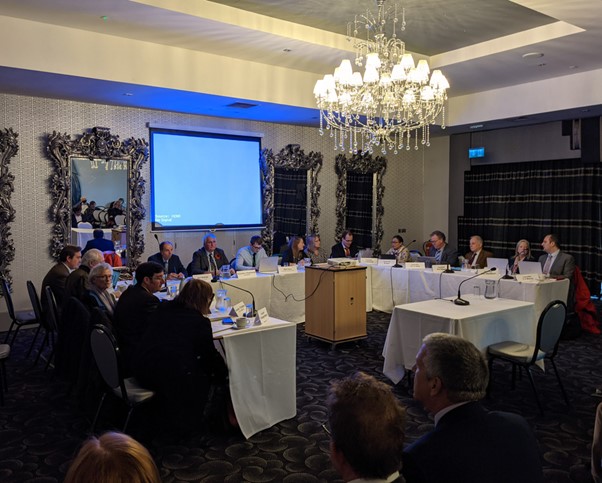
The refusal of planning permission of another Egdon Resources site at Biscathorpe comes back before Lincolnshire County Council’s planning committee next month.
On 1 November 2021, the committee voted to block plans for long-term oil production at Biscathorpe, against the recommendation of planning officers.
Members are expected to vote on the formal reasons for refusal at the meeting on 6 December 2021. The agenda for that meeting is usually published online a week before.
Categories: Regulation, slider

 DRILL OR DROP?
“ We can now say with credibility that we have kept 1.5 degrees alive. But, its pulse is weak and it will only survive if we keep our promises and translate commitments into rapid action. I am grateful to the UNFCCC for working with us to deliver a successful COP26.
From here, we must now move forward together and deliver on the expectations set out in the Glasgow Climate Pact, and close the vast gap which remains. Because as Prime Minister Mia Mottley told us at the start of this conference, for Barbados and other small island states, ‘two degrees is a death sentence’.
(Sharma)
Not as explicit as we might have desired but nevertheless a subtle hint to Lincolnshire Planners to confirm their rejection of the Biscathorpe application, and decisively to reject the North Kelsey extension application.Anything else is madness.
Yes Iaith1720, not only to protect island and coastal communities from suffering the extreme climate fluctuations, also the threat to all life worldwide. Excluding those delegates from the conference was unacceptable, whilst openly inviting the worst polluters to trot out their fake green-washing propaganda was an insult to everyone, not just the useless government of UK. It is a fact that most of the “top five” governments had their own fossil fuel corporation representatives within their own delegations. The subsequent and entirely unnecessary additional invite to the biggest green-washing fossil fuel corporations was just more fake window dressing.
Maybe the fossil fuel corporations think they have gotten away with fake illusions and empty promises. Show them that they have not.
Not only should it be “Keep The 1.5C Alive”.
It should also be “Keep The 1 In 5 Alive”.
The deaths from fossil fuel pollution may well reach 1 in 4 worldwide if nothing is done about reversing climate change, preventing further ecocide, and reversing the destruction of our remaining environments.
An internet conference, maybe called COP26.2 should be implemented as soon as possible to allow all those who were excluded for whatever reason, to have their say.
Ahh, the transport emission lobbyists!
All good, with countries around the world releasing a little of their oil reserves and others like US drilling away, there should be plenty of places to import from. At a price.
Reducing production does nothing to reduce demand.
If we produce less onshore in the UK, we still consume very drop we were doing so before…..only it comes from offshore sources or its shipped in across the oceans from dodgy regimes (all at much higher carbon cost).
We also get to continue exporting £19bn per year to other economies for THEIR hydrocarbons, meaning we have £19bn less to invest in the alternatives to fossil fuels.
The problem with importing offshore is that the virtue-signals can’t drive there to have a self-ingratiating protest so they have to stay at home with the gas-fired central heating on where they continue to miss the point that increasingly oil is not burned, its used to creat all the other things we need in life like medicines…and wind turbines and solar panels.
Meanwhile, hundreds of thousands of UK families find it just that little bit harder to heat their homes and feed their kids this winter……..
Logic is an absolute bitch when you are the only one in a room burdened with it.
Bob-you are not alone!
There are just those who take a post war economic model and try and get the arithmetic to fit-even though it should be obvious to even Ms. Abbott they do not. I know the new investment angle is into warehouses, but I understand they are not full of oil that has been produced somewhere over the horizon and the customer has stopped buying because of moving to a local source. I believe there is this little device called a valve that takes care of that.
Even the Guardian found the, now late, government chief scientific adviser, Prof. Sir David McKay stated:
“There is this appalling delusion that people have that we can take this thing (renewables) and we can just scale it up and if there is a slight issue of it not adding up, then we can just do energy efficiency. Humanity really does need to pay attention to arithmetic and the laws of physics..”
He also continued that full-on investment into nuclear was required to fill the “slight issue”.
That was in 2016. Five years on and the continued bit is becoming pretty obvious, unless fusion kicks on. The arithmetic and the physics have gone backwards.
Unacknowledged misquote. Mackay said: “There is this appalling delusion that people have that we can take this thing that is currently producing 1% of our electricity and we can just scale it up and if there is a slight issue of it not adding up, then we can just do energy efficiency” .
But – six years later, in Quarter 2 2021, renewables’ share of generation was 37.3 per cent.
Mackay (RIP) was also hot on CCS as part of his solution to climate change as he was sensitive to British reluctance to spend money to save the planet. He knew FF production was not a good solution.
Consider this- According to the independent Global CCS Institute (GCCSI), existing installations have the capacity to capture about 31 million tonnes of CO2 per year.
Global CCS Institute estimates that 2,500 CCS facilities would need to be in operation by 2040 worldwide, each capturing around 1.5 million tonnes of CO2 per year.
CCS plus nuclear does not come cheap, but I know that this is irrelevant. The question is, is it the solution? The answer would have to be pretty persuasive if it were to sanction continuing FF development.
Nope, not a misquote. Maybe he said a similar thing on two occasions? Probably did, as the quote I referenced was only 11 days before he died and he knew his time was short, and stated he needed to call a spade a spade. I expect he was quite expecting others to deny him after his death-it is quite common throughout history.
I think the question really is, can renewables do much more without more nuclear? The answer to that is already taking shape, but a long way off delivery.
I recognize that has to be the narrative to avoid people looking at the total cost of electricity and just focusing upon wind, but it will have to surface as 2050 draws closer. Then those others like me who saw the price Paul supplied for a Volvo XC40 EV and can compare to the price of a petrol one (I have one-don’t go there. Volvo have enough electronic problems on their fossil fueled cars. Heavens knows how many recalls to remedy on an electric one!) can be “persuaded” that not only will there be a big difference in purchase price, but a rapid increase in running costs and then the removal of existing EV subsidies to be replaced by surcharges to recover the loss of fuel duty!
I may be wrong, but currently I see electricity provision and costs having to negotiate a lot of mounting issues and mounting costs. I will avoid the siren calls regarding cars, as I see rocks. By the time the siren calls get deafening, then there will be alternative routes, probably hydrogen.
In terms of CCS and storage, I believe it will have a place, but longer term I suspect there will be science which enables carbon usage rather than just capture, and then the arithmetic changes. The two UK trial areas should give some clues to the first bit-some day.
The interview with author Mark Lynas was given 11 days before his death from cancer on 14 April and released with the permission of his wife.
Prof MacKay argued that solar, wind and biomass energy would require too much land, huge battery back-ups and cost too much to be a viable option for the UK.
“There is this appalling delusion that people have that we can take this thing that is currently producing 1% of our electricity and we can just scale it up and if there is a slight issue of it not adding up, then we can just do energy efficiency,” he said. “Humanity really does needs to pay attention to arithmetic and the laws of physics – we need a plan that adds up.”
QED
Interview with Damian Carrington reported in the Guardian
I take your Guardian and raise with the Times!
I could add from his book that he referenced there is no practicable zero-carbon future without full-on investment in nuclear power. Wasn’t something that was acceptable politically only 5 years ago but the penny-many of them-seems to have dropped since.
Really! Times quotation in full, please.
Yes, really. (May 5th 2019)
And sorry, nope,1720.
They have a paywall. I have given you enough on 24th and 25th.
Besides, the two quotations are basically the same and I don’t really think you trying to score some sort of “mine is better than yours” point changes that. It just moves off into attempted deflection. Back in the real world, he cautioned against poor arithmetic and physics (Guardian and Times) and stated quite clearly within his book that large investment in nuclear was required to correct that. That is now starting to emerge as decisions are being taken. I know it is inconvenient when the generation costs are exposed, but they have been and will be going forward. Time ticks by and decisions are made and costs around those decisions become known. Then protests can be made they were the wrong decisions but the consumer will still have to deal with the reality that their electricity prices will be an exercise in arithmetic, ie. the generation cost of nuclear and wind as a sum and then an average of that sum according to the ratio. Probably a little more of an opportunity for the myth peddling about nice cheap wind power with some fiction about huge battery storage, or alternatively people using less energy, before that becomes really obvious, but it will because time does tick by.
On the contrary. On the 24th you produced a part quotation, apparently omitting, as I then demonstrated, material which could undermine your case which was that, according to MacKay, renewables could not hope to provide a greatly improved proportion of domestic energy supply within a relatively short time. My figures suggested he underestimated the bounce back capability of the renewable industry, a point which I suspect he as a man of integrity would have accepted.
You then suggested that MacKay had made the exact statement twice, (!) on one of the occasions however, omitting the crucial figure which he cannot have known would prove overly pessimistic. You then tried to justify this assertion by suggesting that the omission might be due to the fact that one of the statements was made 11 days before his death. I then demonstrated that this was the time when the full statement was made, – qed. Pity about the Times quote: difficult for you to prove your assertion given the paywall.
I am not however inclined to accept that MacKay made (almost) the same statement twice, although I accept that I might be wrong.
The figures furthermore which I adduce concerning CCS are more interesting than you are prepared to engage with.
I shall be silent concerning the rest of your post, as ad hominem as ever, save that they remind me why I took the decision – sadly now temporarily broken – not to engage in discussion with you.
[Post edited at poster’s request]
That is fine, 1720. That’s democracy.
I did actually “engage” with CCS. My last sentence on 25th at 9.32am indicates that I did. I could add that now investment has been confirmed into tidal, the same may apply.
Yes, you might be wrong. Wait a few more months and I suspect you will see the answer as £billions are committed to new UK nuclear, in addition to the development investment recently announced into the mini nukes. Will the generation costs be lower than for the one under construction? I hope I am wrong, but I suspect they will not. If there is a cold spell, the answer may be put out a little earlier, when high pressure has it’s say.
You are aware that new UK nuclear is already under consideration, in addition to current construction and the minis. No question mark, for obvious reasons.
For those interested in CCS, there are two clusters recently announced in UK that will receive £1billion in “Government” support. One in Teeside and Humber and one in East Coast and North West Coast. Suggested up and running by mid ’20s and then two more by 2027.
Not sure if that is the same Government not doing anything, but it just could be.
Linked into the levelling up investment, so unlikely to be allowed to wither on the vine. The mid ’20s may not just be a co-incidence! SNP bit miffed, as always, they didn’t get one in Scotland but the Scottish one is on the reserve list. And, they did get the investment for tidal, but a bit miffed they didn’t get more.
That should enable anyone to DYOR from that point onwards. Will it all work? I will not speculate but just point out there are some pretty significant commercial players involved who have shareholders to consider when making investment decisions, even with that sort of tax payer input.
Those interested in nuclear, see Hinkley Point C and then: “a new nuclear power plant will be announced before the likely 2024 election, as part of the Government plans to bolster low-carbon electricity in UK. Front runner is Sizewell C.” Telegraph-other sources are also out there.
IMHO the announcement will come well before 2024, but time will tell.
In addition to the investment being made regarding CCS that I have just mentioned, then there has since been further news from BP reference investment -shock/horror, it needs to be rejected because British and Petroleum are both in the name-and now investment (from Sir Jim!) into Hiiroc to produce turquoise hydrogen and solid carbon for further use. (Mrs. C. quite interested in that, she has diamonds in mind!)