The climate-damaging gas methane is still being released at English onshore oil sites, a year after researchers revealed the problem.
DrillOrDrop reported in October 2021 that “significant emissions of methane” had been recorded at key onshore sites.
The emissions were detected by the Clean Air Task Force (CATF), an international climate NGO. It used infrared imaging cameras to document the emissions on visits to sites across seven counties.
The organisation recently returned to sites in the Weald basin in southern England and recorded continuing emissions at oil production sites in Hampshire and West Sussex.
James Turito, of CATF, told BBC News today:
“This is absolutely avoidable. The technologies exist to capture the gas that is being vented and emitted from the various equipment that we see on this site.”
Methane often comes to the surface when oil is extracted.
At some onshore sites, the Environment Agency allows methane to be released into the atmosphere (known as cold venting). The gas may also leak from vents, valves or seals, or be fully, or partially, burned in a flare.
Methane from all sources accounts for at least a quarter of global warming since pre-industrial times.
It has more than 80 times the heat-trapping power of carbon dioxide in the short-term, so reducing methane is critical to slowing climate change.
Last year (2021), the UK signed the Global Methane Pledge, an international initiative to cut methane emissions. The launch at the COP26 climate talks in Glasgow targeted reductions in emissions from the oil and gas industry. Signatories committed to reducing total methane emissions by 30% by the end of the decade, compared with 2020 levels.
Also in 2021, the International Energy Agency said cuts to methane emissions from oil and gas sites were vital to limiting global warming to 1.5C.
Most methane emissions from the UK oil and gas industry are from offshore fields.
But official data from the North Sea Transition Authority (NTSA) shows that 1,352m3 of methane gas was vented onshore from a total of 18 onshore oil sites between September 2021-August 2022 (the most recent 12 months for which figures are available).
Data on the volume of vented gas from onshore fields has been published by the NSTA for the past six years.
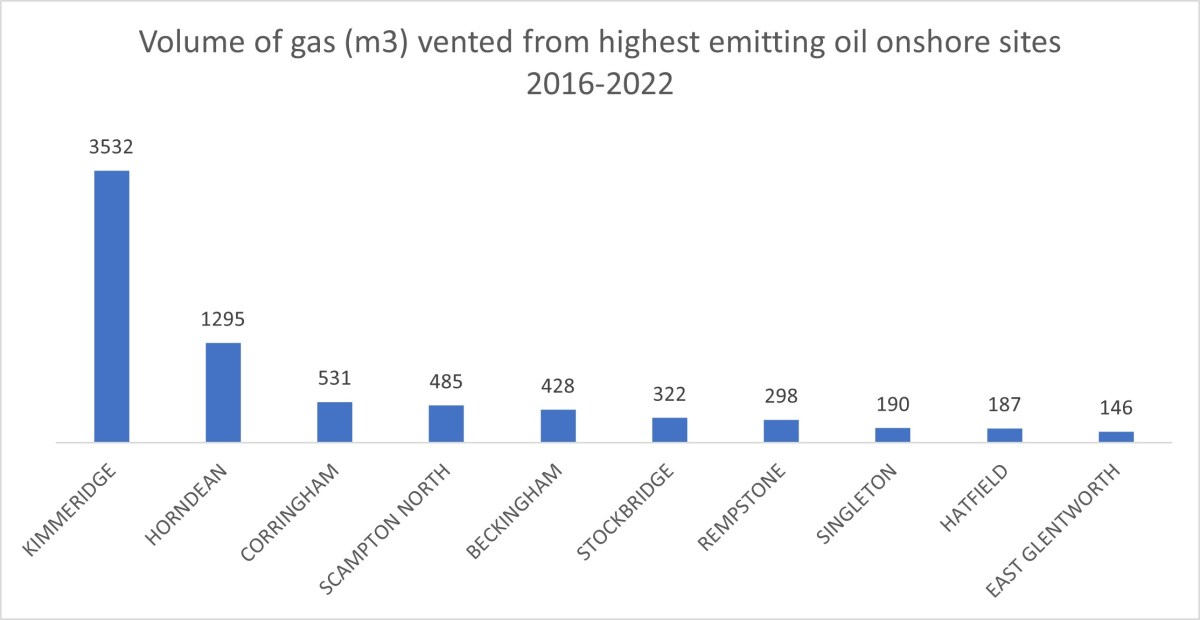
In that time, vented gas was recorded at 26 onshore oil fields. The largest volume was from the Kimmeridge* site in Dorset, at 3,532m3. It was followed by Horndean in Hampshire (1,295m3). According to the figures, the Stockbridge field, also in Hampshire, has vented 322m3 since 2016, while Singleton in West Sussex has vented 190m3.
The industry group, UK Onshore Oil and Gas (UKOOG), says on its website that venting and flaring of gas is “only used when absolutely necessary”. It says:
“The oil and gas industry takes great care to avoid flaring and venting natural gas wherever possible.
“Not only are these harmful to the environment, but natural gas is valuable both economically and as an energy resource. Therefore, it is in the best interests of operators to be as efficient as possible so that they can deliver as much natural gas as possible to their customers”.
But Charles McAllister, of UKOOG, told BBC News:
“Some facilities are quite old. Repurposing these facilities to capture what the Environment Agency would call de minimis volumes of methane – very small amounts – is not economically viable.”
Today the Green Alliance estimated that 750,000 homes could be heated this winter if the UK oil and gas industry (both onshore and offshore) stopped venting and flaring.
Also today, the Environment Agency published a comparison of the best methods to detect methane emissions and onshore oil and gas sites.
The study concluded:
“We found that there is little published data on the accuracy of different measurement methods. To address this, controlled releases should be used to understand the method detection limits and accuracy.
“The application of the selected methods should be standardised and implemented by qualified and experienced staff.”
*DrillOrDrop reported in September 2022 that the Kimmeridge site has installed a flare to burn methane, to replace venting . The operator, Perenco, has also produced plans to compress gas so that it could be collected by tanker and used at a local electricity generation site.

 DRILL OR DROP?
How ridiculous UKOOG sound, defending the indefensible. The technologies exist to reduce these emissions and to only allow flaring in an absolute emergency. All greenhouse gasses contribute to climate change and methane is particularly potent. As the limiting to a 1.5C global temperature increase looks almost out of reach and we are ever closer to climate breakdown, these companies should not be permitted to operate unless they meet the most stringent of standards.
Have I got this right? Between 2016 and 2022 the onshore oil industry produced about 7500 cubic metres of methane.
By comparison one cow produces about 180 cubic metres of methane per year. So between 2016 and 2022 Daisy produced 1080 cubic metres.
So the methane output of 7.5 Daisiy’s = the methane output the whole onshore Oil industry.
There are 5 million cows in the U.K. so the methane output of the U.K. onshore Oil industry = 0.00015% of the methane output of the UK dairy and beef industry.
I’m not great at maths, please check! It can’t be right.
According to the paper linked below a cow can produce 0.25 – 0.5 m3 per day of methane.
Or 90 – 182 m3 a year
So your cow maths is correct shalewatcher. But more cows than your 5 million apparently.
“Increasing atmospheric concentrations of methane have led scientists to examine its sources of origin. Ruminant livestock can produce 250 to 500 L of methane per day. ”
https://pubmed.ncbi.nlm.nih.gov/8567486/
“In 2021, the population of cattle and calves in the United Kingdom was approximately 9.44 million, a slight increase from the previous year. 2020 was the lowest number for the entire period shown in this graph. Despite a small rebound in 2014 and 2015 this constitutes a slow long-term decline of herd sizes.”
https://www.statista.com/statistics/291168/cattle-livestock-population-in-the-united-kingdom-uk/
In the early 1980s we used to cold vent wells flowing 50mmscfd during well tests. Four hours flows = 8mmscf of gas = 226,000 m3
This was just from a single well test. There were 10 of these wells on a single platform. Of course, cold venting is no longer permitted like this.
But, along with the cows, it shows how insignificant and irrelevant this article is.
I note Shell have just invested by buying a company making use of cow’s effluent.
If they expanded to bull’s effluent, they would make a fortune!
It also makes me think if they are spending £billions on this, why would anyone not want them in their pension fund?
Last time I visited Kimmeridge Bay and observed the well site, guess what sort of animal were grazing around it?
BLA BLA BLA – i mean what a load of rubbish – we NEED GAS HEATING – How many houses have boilers in UK – come on tick tock
U cant just drop gas ROFL . Politicans and CLIMATE change fanatics other is no heating for existing houses or ship it in from abroad via LNG – Thats 5 times worse then getting it from UK itself
“not economically viable” for the oil and gas industry to help save lives threatened by the adverse consequences of climate change. No surprise there then!
Malcolm, what about the many live that will be lost this winter due to fuel poverty. Just this week the National Grid was struggling to meet demand and was forced to buy electricity at above £1000 per megawatt hour. Please see the National Energy Action website. Just to repeat in my boring fashion, energy policy has four strands…..
1. Environment – pollution and carbon.
2. Cost – avoid fuel poverty.
3. Reliability – no blackouts
4. Security – protect from external threats.
Fill in the swamps, outlaw rice production, fashion large corks for all those cows and ban volcanoes! Get started Malcolm.
When you have achieved that, perhaps you could use daylight and zero fossil fuel to make your points, whilst the oil and gas industry continue to pay a Windfall Tax to help save lives threatened by an incoherent and ineffective approach on the consequences of climate change?
As far as Kimmeridge goes, there are plans to rectify the situation, previously reported by DoD. The omission of that little detail obviously excited the excitable, but not really reporting the full picture.
Thanks for your comment. You make a very fair point. Please see new footnote. Best wishes, Ruth
Thanks for that, Ruth.
Just one other point regarding Kimmeridge. Is the methane bubbling up in the bay, reported by divers for decades, greater or lower if it was not bubbling up on land!? Perhaps it just finds another outlet?
Could you be more specific, Ruth?
“whilst the oil and gas industry continue to pay a Windfall Tax to help save lives” 😂
https://www.independent.co.uk/news/uk/politics/windfall-tax-hunt-sunak-oil-gas-b2223773.html
https://www.theguardian.com/business/2022/nov/22/bp-declines-reveal-how-much-loophole-saved-windfall-tax
But renewable energy has no such offset from the windfall tax.
https://www.rechargenews.com/energy-transition/uk-renewables-fury-over-inexplicable-fossil-get-outs-as-windfall-tax-hits-green-power/2-1-1356598
Those Wind Turbines are fairly lighting up the Morning Sky KatT!!
https://news.stv.tv/north/fire-crews-called-after-wind-turbine-burst-into-flames-near-mains-of-lauriston-in-aberdeenshire
Just goes to show how important fossil fuels are to UK and the further development of them KatT. Meanwhile, the antis will rely upon the daft arithmetic that more tax out of less activity might work, except it is well proven it does not, ends up with less revenue and more unemployment with less revenue to support. Then, some can moan about those who avoid a UK Windfall Tax, that just happen to have little activity in the UK as it is overtaxed! A spiral of despair. However, it is apparent that someone somewhere who has all his/her fingers and toes has done the arithmetic. Shame the Government doesn’t spend taxpayers’ money on explaining this reality to the consumer whilst they spend taxpayers’ money to tell the consumer to reduce energy use, and waffle on about on shore wind as if no consumer has heard about the efficiencies and economies of scale, now achievable out to sea.
However, KatT, good to see you are back to making use of daylight. Should take full advantage, before that is taxed. I do believe that would not be the first time, either.
I will receive my statement from my energy supplier this week. Another £60+ from the Windfall Tax, and £500 Winter Fuel Allowance to follow. Where is the anti crowd funded contribution? Are the antis returning their dollop? Or are they hypocritically trousering from the fossil fuel industry and doing nothing, apart from using energy in the middle of the night just when the National Grid is discussing what to do about a serious issue with potential supply disruption?
Some good news:
“National Highways said it had secured the civil order to “prevent unlawful protests” on the M25, after a series of actions by the environmental group caused significant traffic disruption.
The injunction, granted on Monday before Mr Justice Soole, will remain in place until just before midnight on 15 November 2023.
It means that anyone entering, remaining upon or affixing themselves to any object or to any structure on the M25 could have proceedings launched against them for contempt of court.
They could face imprisonment, an unlimited fine, the seizure of assets or a combination of these punishments.”
https://www.theguardian.com/environment/2022/nov/28/just-stop-oil-activists-face-new-penalties-if-they-obstruct-m25-motorway
“They could face imprisonment, an unlimited fine, the seizure of assets or a combination of these punishments.”
I think it would be fair then to impose the same to those who have lied about the carbon budget figures.
‘In a landmark judgment in July, the High Court agreed with Friends of the Earth, ClientEarth and Good Law Project that the strategy failed to show how the UK’s legally-binding carbon budgets would be met’
https://drillordrop.com/2022/10/13/government-will-not-appeal-against-legal-ruling-that-net-zero-strategy-is-unlawful/
Get an injunction / civil order then JP? You could crowd fund it?
But we continue to import huge quantities of feed stock GAS to heat us in the winter months, and keep us cooking!!
Where does that GAS GET EXPORTED from?, QATAR, NORWAY AND THE USA!
Oh the Irony!!
KatT
It is an interesting point.
Wind and solar get their feedstock for free, so there will not be a tax loophole for them to use for that. They are pure generators.
The loophole is for feedstock extraction, so I am not sure the generators have reasonable case to complain unless other generators (gas /coal/nuclear) are also disadvantaged.
BP do not run FF power stations in the UK as far as I am aware but will be pure producers when they get the wind turbines up and running. I suspect the tax breaks for BP in that case are exactly the same as those for other renewable energy producers.
The Worlds best scientists have proved that the amount of methane and its affect is so minimal that it is of no consequence. This has been achieved by experiment and by calculation . Consequently just like co2 the amounts per million are not significant and will not cause any significant rise in the earths temperature.