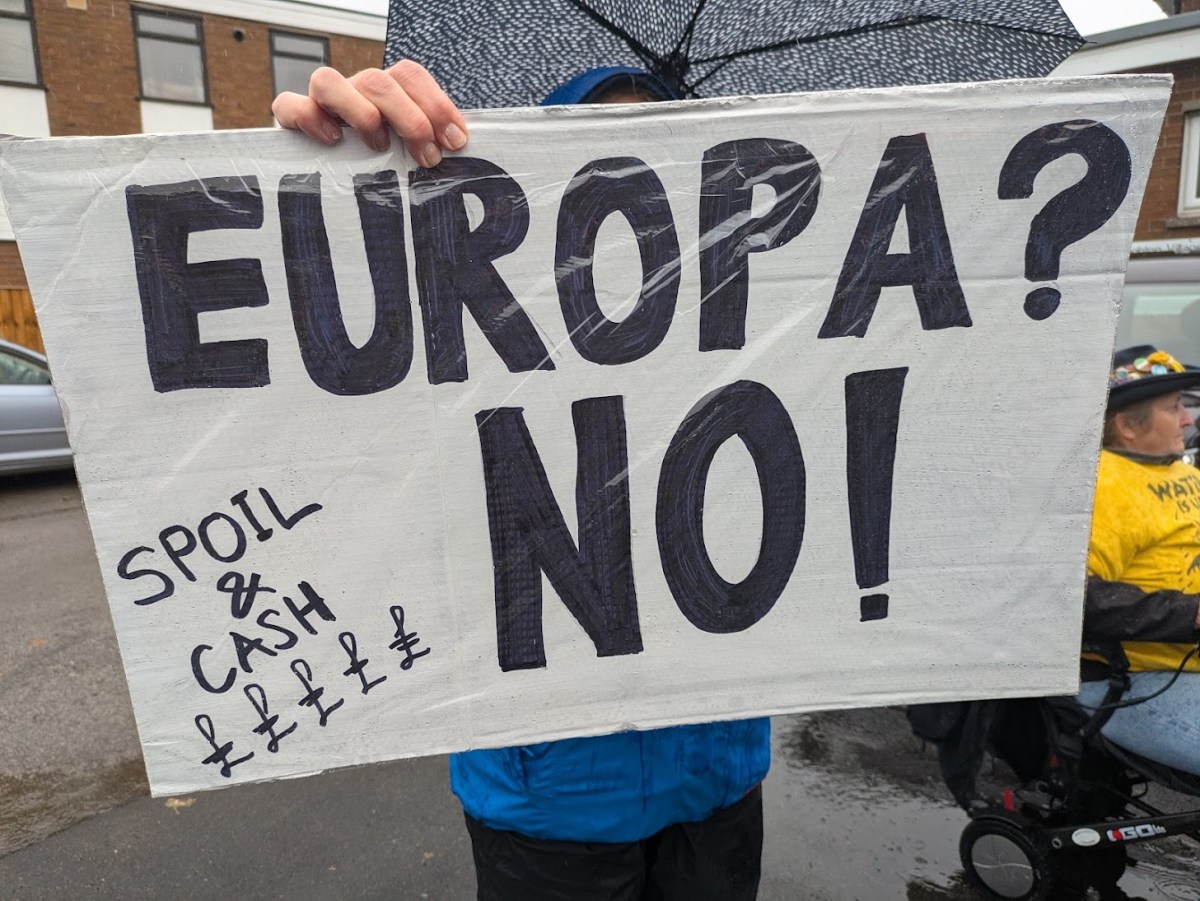
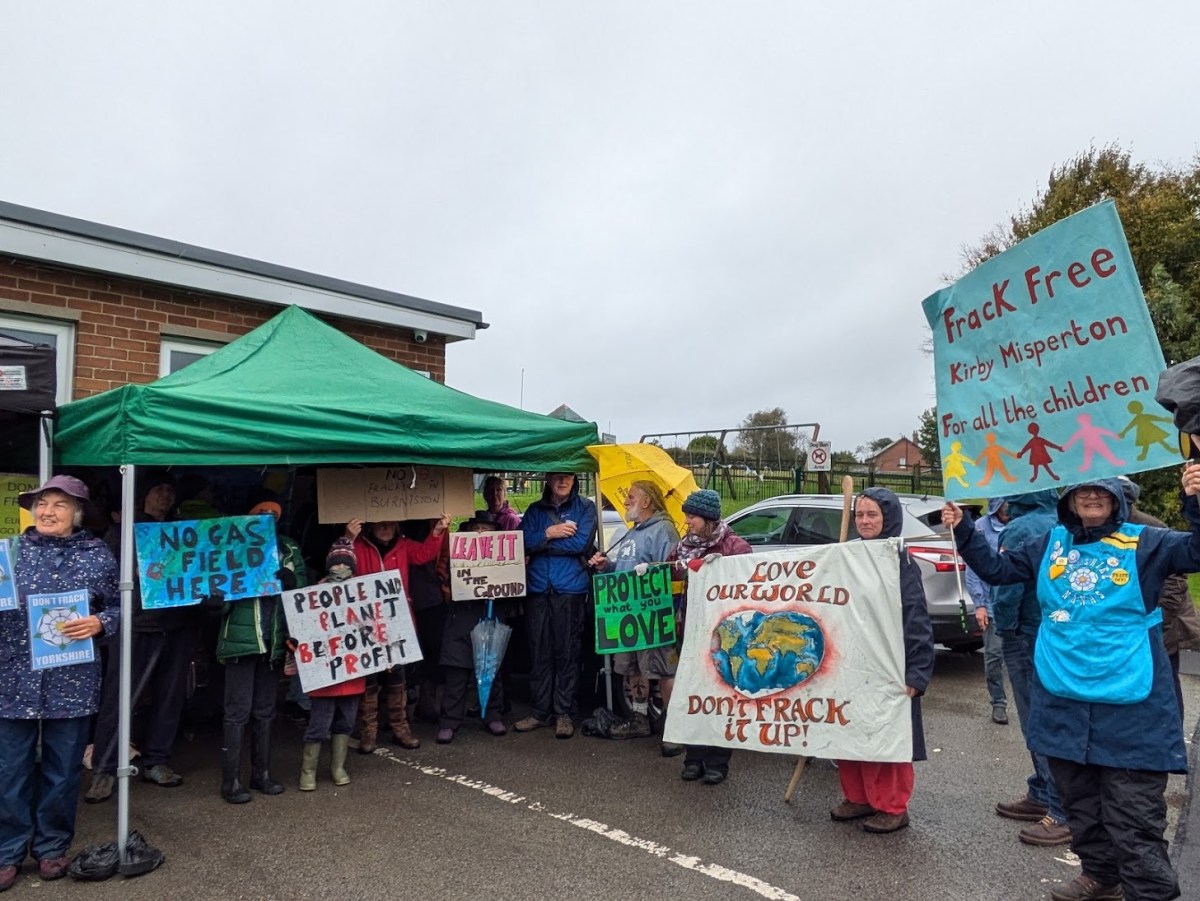
More than 100 people braved torrential rain to attend an information meeting and exhibition about plans for gas exploration at Burniston in North Yorkshire.
The event was organised by the company behind the scheme, Europa Oil & Gas.
Most people who attended were opposed or concerned about Europa’s proposals.
They were supported by environmental campaigners from the midlands and northern England, who had previously challenged onshore oil and gas projects.
Europa’s plans for Burniston are controversial locally because they include a small-scale fracking operation, called proppant squeeze. This aims to improve the flow of gas and involves injecting fluid and sand at pressures high enough to fracture rocks.
Local people said they were also concerned about the impact of increased heavy traffic, noise and lighting and the effects on wildlife, climate change and local tourism businesses.
Europa said it planned to submit a planning application for the Burniston site before the end of this year.
Key issues
- There could be three proppant squeeze operations on the Burniston well using up to 1,200m3 of fluid
- Gas extraction rates from Burniston could exceed the current biggest UK onshore field
- Gas extraction rates could be at least 6 million standard cubic feet per day (6mmscfd) and would be commercially viable below that
- Europa has challenged the ruling that the well pad needs an environmental impact assessment
- Five more wells could be drilled from the pad, including one going north towards Burniston
- A second wellsite could extract gas from the northern part of the field
“Fracking under another name”
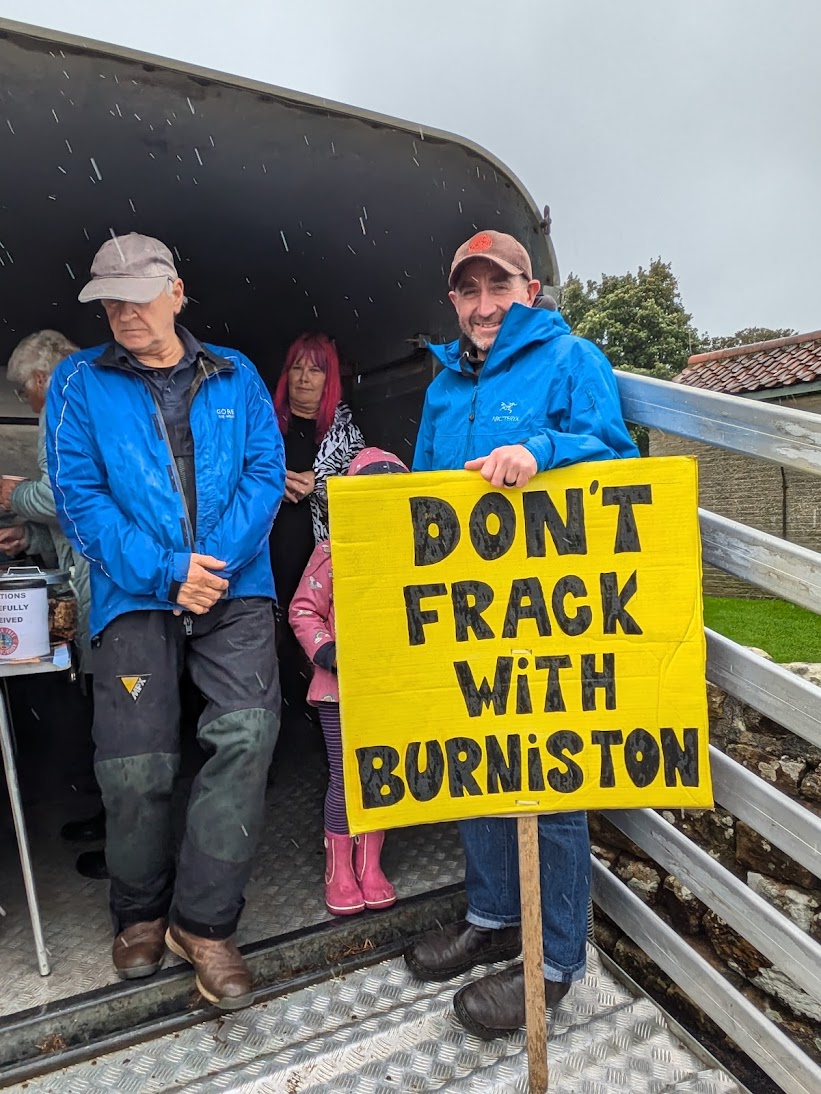
Residents accused Europa of using a loophole in the law, which allows small-scale hydraulic fracturing, despite a moratorium on fracking in England.
One resident said:
“This is fracking under another name”.
Steve Mason, a member of North Yorkshire Council and founder of Frack Free United, said:
“This is exploiting a loophole in the law. I am surprised it has taken this long.
“We need to challenge the minister to look at this. It would be easy for the government to close the loophole.”
Speaking at the exhibition, he said:
“Is this different from shale gas? No. They plan to pump 1,000m3 underground.
“When it gets to the point when these wells run out, what keeps the money coming in for Europa? More wells? More sites?
“Frack Free United is already having negotiations at a parliamentary level on proppant squeeze.”
The moratorium allows hydraulic fracturing to operations that use less than 1,000m3 of fluid per fracture stage or 10,000m3 in total.
Europa denied the loophole accusation and said low volume hydraulic fracturing was “well-established” in the oil and gas industry, “proven to be safe” and used for many decades in the UK.
Europa said it may do up to three proppant squeezes on the Burniston well, using a maximum of 1,200m3 of fluid. A single proppant squeeze would use up to 500m3, it confirmed. The fractures would spread 100m horizontally either side of the borehole and 20-60m vertically either side.
The company compared the Burniston proppant squeeze with high-volume fracking in England, suggesting it was much smaller.
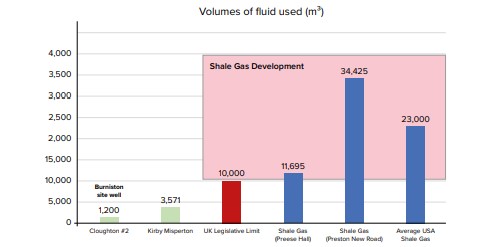
An exhibition panel showed that fracks at Cuadrilla’s Preston New Road shale gas wells used 34,425m3.
This is incorrect. Cuadrilla used a total of 3,869m3 in 17 main fracks in 2018 and 2,485m3 on seven main fracks and one mini frack in 2019.
The volume of fluid used in individual fracks at Preston New Road in 2019 ranged from 2.5m3 to 472m3.
Despite this, the operations caused multiple small earthquakes, including a record-breaking seismic event on 26 August 2019. This led to the immediate suspension of fracking at Preston New Road and later the moratorium in England.
Europa told us today that the chart showed the volumes that operators planned to use at Preston New Road and other sites.
The company said a proppant squeeze at the Wressle oil site near Scunthorpe in 2021 had not seen any seismic activity. Europa blamed geological faults for the Preston New Road earthquakes. It said there was no evidence of fault patterns at Burniston.
The Wressle proppant squeeze used 146m3, just over a quarter of the fluid volume that could be used in a single operation at Burniston. The Burniston proppant squeeze needs to use more fluid because the sandstone in the area yields gas less easily than at Wressle, the company said.
Faults around the Burniston well will be revealed only when Europa carries out 3D seismic surveys, expected next year.
Europa said it opposed onshore fracking for shale gas in the UK. Its chief executive Will Holland said:
“Europa’s never been looking for shale gas. That pad that we’ve secured to drill this well from, there’s a specific clause in it – we insisted on putting this clause in – that shale gas cannot be developed from that pad. We’ve got no interest in shale gas.
“I used to be a frack engineer. … I see the challenges involved in fracking onshore in the UK. That’s not something as a company we want to do.”
“I fear this is the start of something much bigger”
Europa said the Burniston site could have up to five wells producing gas for up to 15 years.
The company said it could also develop a site further north to extract gas from the rest of the reservoir that could not be accessed from Burniston.
Will Holland told us the Burniston well could recover about 50 billion cubic feet (bcf) of gas.
If correct, this would make it bigger than the UK’s current largest onshore gas site at Saltfleetby in Lincolnshire.
The company estimates that Burniston could produce gas at rates of up to 6 million standard cubic feet per day (mmscfd).
Mr Holland said:
“The well would be “very commercial at current prices at 6mmscf. Much less than 6 it is still commercial.”
He said appraisal of the Burniston well aimed to test the flow rate and volume. This would determine what the well density would be throughout the gas field and how many wells would be needed.
If the Burniston site went well, Mr Holland said, “there could be a phase two to target the northern part of the structure and we’d be extracting the gas from there”.
Asked what proportion of UK gas production could come from Burniston, he said he did not have that figure. Saltfleetby currently produces about 75% of UK onshore gas but this represents just 1.11% of total UK gas production.
Burniston’s potential contribution to UK gas production is a big part of Europa’s justification of the project. Asked if the well would have any significant impact on UK production, Mr Holland said:
“Every bit helps”
We asked “even if it’s very tiny?”
He responded:
“Yes, for sure,
“We’ve got lots in the southern North Sea that’s not been developed. Saltfleetby’s got more that could be developed. They’ve been thinking about another well that could be developed. And Wressle – the next horizon that we’ll be developing is a very gassy horizon which is why we’ve put a gas processing facility in place.
“So in my mind whatever conventional gas we could be producing domestically we should be producing domestically. It is the environmentally responsible thing to do.”
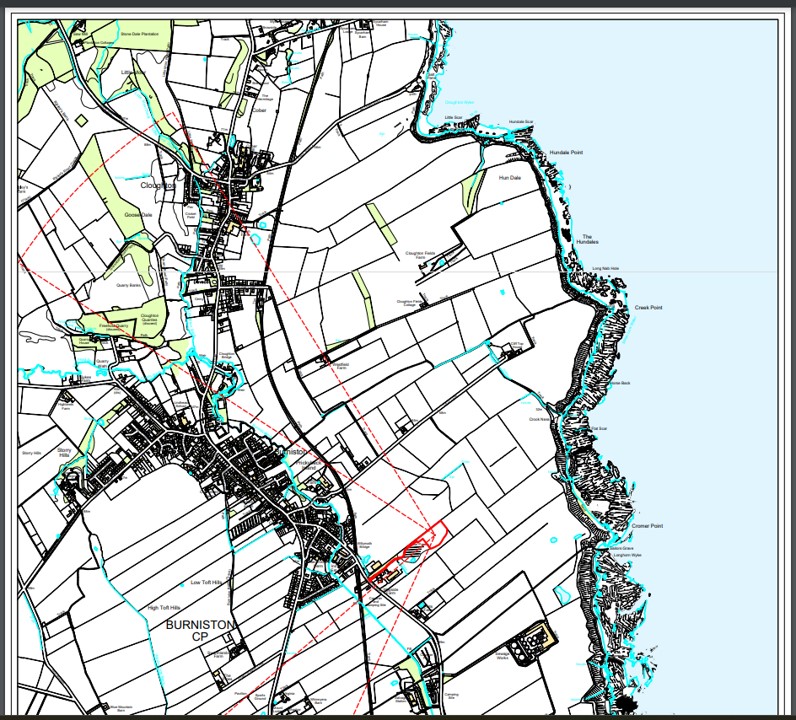
In the summer, Europa initially published a map showing two well trajectories from the Burniston site. This was later replaced by a map showing just the current well.
Mr Holland said:
“We weren’t sure which way to go, whether we’d be better to go to the north or to the south or south west. We decided to go to the south west.”
Asked if the northern well trajectory was a possible second well, he said:
“Potentially yes.”
Europa said it had looked at the site of the Cloughton-1 well, drilled further north in the 1980s. Mr Holland said:
“We consulted with the North Yorkshire Moors national park authority. They were very happy for us to extract the gas from under the park but because the [Cloughton] site is in the national park, their preference is to look for a different location and from a technical standpoint it didn’t make a difference whether we went for a different part of the reservoir or where we are at the moment.”
“Massive impact”
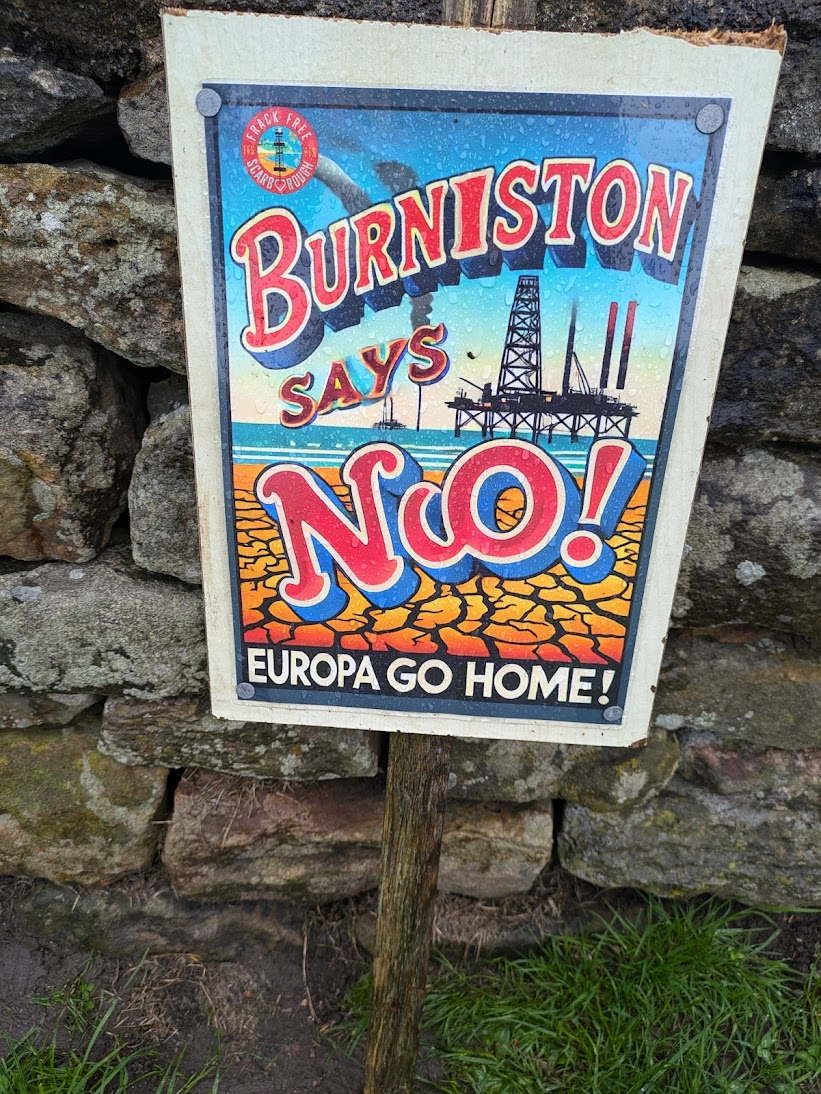
Europa said its Burniston proposals were not likely to have “significant environmental impacts”. Operations would take place over “a relatively short time”, estimated at 37 weeks, the company said.
But one resident at yesterday’s meeting said:
“There will be a massive impact. Anyone who is trying to sell their house now is losing their sale. This is affecting people all the way down the chain.”
Another said:
“It is delusional because of the impact on climate change and the crumbling cliffs nearby on the heritage coast. People do not realise how they would be impacted.”
Another said:
“I do not think there is enough information on the impacts we will see and what the unintended consequences will be for the environment.”
Another said:
“I’m concerned about how we’ll manage the traffic. We cannot handle the traffic we have at the moment.”
“Jobs are not going to local people”
Europa has said the Burniston well would create jobs and put money into the local economy. Asked how many jobs would be created, Will Holland said:
“Hard to say at the moment because we don’t really know what local people can provide us. We do know that we’ve had one company contact us to offer their services. So it depends on what there is available locally. There will obviously be taxi, cafes, hotels, pubs, catering. There will be people on site but they will be skilled gas technicians, rather than local people.”
One resident said:
“The jobs are not going to local people. This is going to benefit groups of men”.
Another said:
“It feels as if there is no benefit to the local people. But local residents will be affected by noise, potentially pollution and house prices. I wish they would go away.”
She then corrected herself and said:
“I wish they had never come”.
Challenge to EIA ruling
Last month, North Yorkshire Council ruled that Europa must carry out an environmental impact assessment (EIA) as part of its planning application for the Burniston well.
The company said it has sought to challenge this by seeking a dispensation from the government.
Alastair Stuart, Europa’s chief operating officer, said:
“We applied for a dispensation to the ministry and our application is going ahead. However, we will ignore the dispensation [if granted]. People in Burniston want an EIA so we are going to do one.”
Reaction
Towards the end of yesterday’s event, Will Holland said:
“We had a diverse mix of people who attended. Some concerned, some less concerned”.
Asked earlier about the reaction of local people, he said:
“I think it’s perfectly understandable. This isn’t their speciality and there’s been a lot of misinformation put out into the press, including from politicians who are saying things which are factually incorrect.
“So people are concerned about that. I can understand why they’re concerned about that. What we’re trying to do is say ‘come and talk to us and we can show you what the actual facts are. Then you can form your own view on the back of them’.”
A spokesperson for Frack Free Scarborough said:
“We were very pleased. We thought the turnout was amazing given the pouring rain, a real confidence boost for people who haven’t taken action until now.
“People who went into the consultation – undecided local residents and campaigners alike — did not appear convinced by Europa’s performance. There were notable errors and obfuscations in their campaign material, and if their material and verbal responses were intended to convince they seem to have done the opposite.
“Our general impression was that Europa are not wanted in the village.”
Miranda Cox, a campaigner who has spent more than a decade opposing Cuadrilla’s fracking plans in Lancashire, said:
“It is great to see such a good turn-out. But people are very concerned about fracking. It is so disheartening that we are here again.”
Sue Gough, a campaigner against a never-implemented frack at Kirby Misperton, also in North Yorkshire, said:
“It is heartening to see so many people here. I think it was a very successful event. They are not going to get away with this.”
One resident said:
“I am concerned. I do not know who will sort it out if anything goes wrong down the line. Who will pick up the bill. With climate change, things may happen that we have not anticipated and that worries me.”
Another resident criticised the meeting’s feedback form, which asked respondents to choose between continuing to import gas, generate UK gas supplies or other.
“It seems to be a choice between domestically produced gas and imported gas. There is nothing about sustainable options. The questions in the feedback form seem very directed.”
Another said:
“I just don’t feel they are being open about what the potential environment damage could be. The company may go away but we are here for the long term. Residents will pay the price for this even if there are no environmental consequences.”
Another said:
“I would like the company to give guarantees if things go wrong.”
- Europa’s exhibition and consultation is currently online
- DrillOrDrop report on how the King’s private estate did not respond to Europa’s approach over drilling on its land at Burniston
DrillOrDrop has closed the comments section on this and future articles. We are doing this because of the risk of liability for copyright infringement in comments. We still want to hear about your reaction to DrillOrDrop articles. You can contact us by clicking here.

 DRILL OR DROP?