People are being asked to comment on plans by Angus Energy to transport highly saline water extracted from other oil and gas sites to prolong production at a well in Surrey.
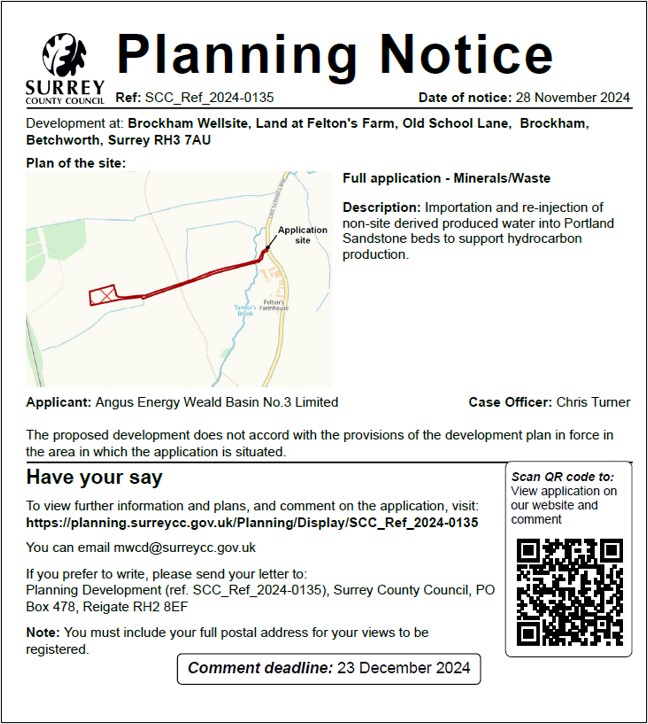
The company already has planning permission to inject liquid, produced alongside oil and gas at the Brockham wellsite, back into the local rock formation.
But it is now seeking consent to transport liquid from other suitable hydrocarbon sites in southern England and inject it at Brockham.
Surrey County Council opened a public consultation yesterday (28 November 2024) on a planning application submitted by Angus Energy.
The consultation runs until 23 December 2024.
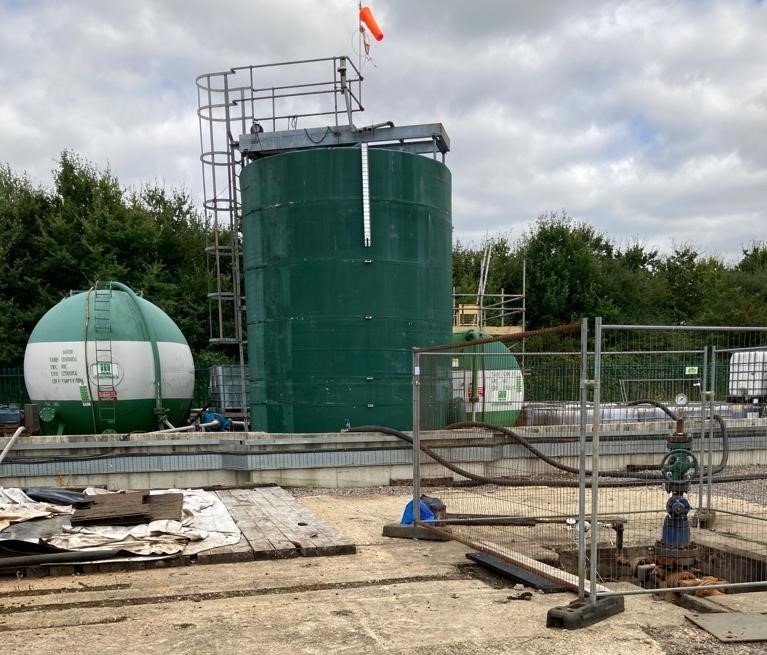
The Brockham site, between Reigate and Dorking, began producing oil in the late 1980s. Until this summer, extraction had been suspended for several years.
Details of the new proposals are included in a planning statement, which accompanied the application.
This document said reinjection of additional fluid from other sites was needed to increase the pressure in the Portland Sandstone reservoir and allow Brockham’s oil production to continue.
It said reservoir pressure had dropped at Brockham by about 500 psi (pounds per square inch).
At this pressure, oil production was “viable only for a limited period of time” and injection of the produced water from Brockham alone was not enough to raise the reservoir pressure, the statement said.
But injection of fluid from other sites into Brockham’s BRX3 well could restore reservoir pressure to 65-80% of the original, the statement said, and allow estimated production of another 300,000 barrels of oil.
The statement said fluid could come from two other Angus sites in the Weald: Balcombe and Lidsey, both in West Sussex. Neither are currently producing oil.
It also hinted that fluid could come from sites operated by other companies:
“If there is a need to acquire supplementary brine water either from other producing wellsites or manufacture brine water, the water will need to be of similar salinity specification.”
The statement said fluid with salinity of 50,000-80,000 ppm (parts per million) would be compatible with Brockham’s reservoir fluids. Formation fluid can also include naturally occurring radioactive material.
A maximum 150 barrels of fluid, or about 25m3, would be injected at Brockham in any 24-hour period, the statement said.
It said the proposal would result in up to two additional tanker visits to the Brockham site on six days a week “potentially for the remaining operational life of the wellsite”, estimated at 11 years. This could be up to 6,864 additional tankers visits to the site, with two journeys (in and out) per visit.
The statement said the tankers would be classed as OGV1 (up to three axles) or OGV2 (articulated vehicles or vehicles with four or more axles).
They would follow an existing route for heavy goods vehicles (HGVs), secured through a planning agreement, avoiding the village, the statement said.
It added:
“Such an increase in vehicle movements would be of a small scale and would not result in significant impacts on highway capacity along the specified HGV route.”
The planning statement also suggested the proposal could cut climate emissions:
“the reinjection of water into the BRX3 well would help enable the recovery of hydrocarbons from an existing wellsite, which would support the UK’s transition to a low-carbon economy and avoid offshoring the UK’s emissions by providing indigenous hydrocarbons and reducing the need for imported hydrocarbons, which from some sources, have a higher carbon footprint due to long distance transportation.”
It added:
“the proposed development has the potential to make a contribution to helping maintain the UK’s security of energy supply, by reducing the need for imported hydrocarbons”
Production restarted at Brockham in June 2024. Official data, released three months in arrears, shows that Brockham is currently producing on average about 25 barrels a day. This represents about 0.2% of UK onshore production and 0.01% of total UK oil production.
If the site were to extract another 300,000 barrels of oil, as Angus Energy has estimated, over 11 years, it would need to almost triple the production rate to nearly 75 barrels a day. At current production levels, this would still represent less than 1% of UK onshore extraction and just 0.02% of UK total oil production.
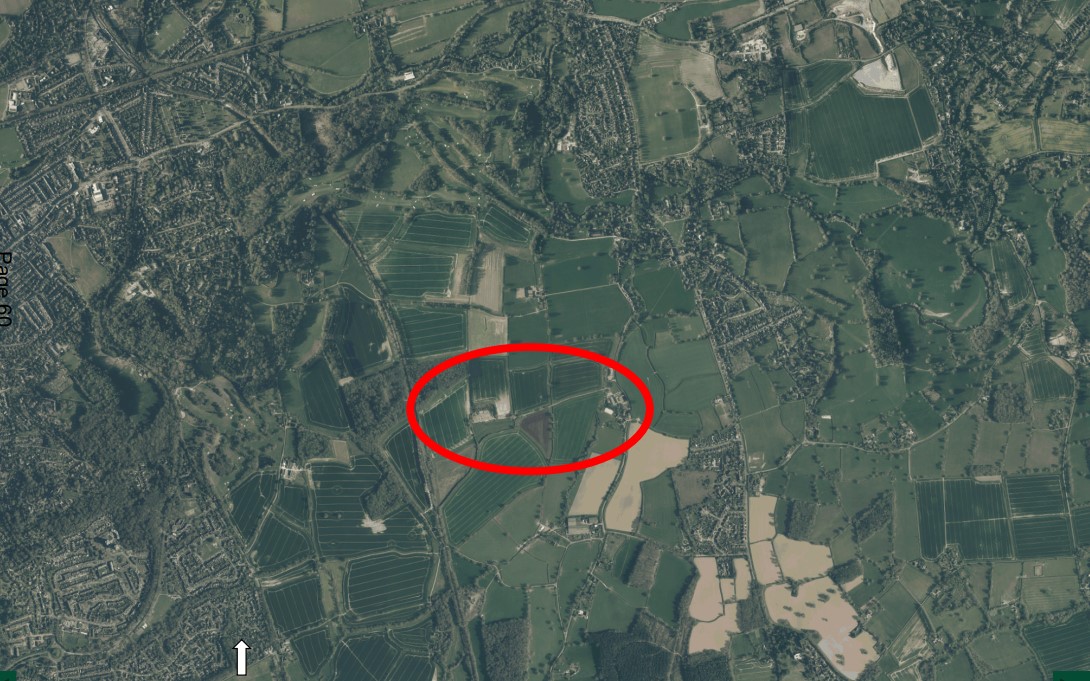
A key issue for the proposals could be the site’s position in the green belt. National planning rules state that mineral extraction is not inappropriate in the green belt provided it preserves openness.
The planning statement said the proposal would need no additional buildings, equipment or lighting. It “would result in a very small element of harm to the openness of the Green Belt”. But the statement added:
“The proposal would occur over a medium-term for a limited period. The harm to the green belt would be temporary and reversible. All buildings, plants and machinery constructed for any purpose would be required to be removed and the site reinstated in accordance with approved restoration details.”
The planning application is currently due to be decided by planning officers under delegated powers, rather than councillors at a planning committee.
Application details
Application: Re-injection of non-site derived produced water into Portland sandstone to enhance hydrocarbon production at the Brockham wellsite. Link
Reference: SCC_Ref_2024-0135
Applicant: Angus Energy Weald Basin No. 3 Limited (which holds an 80% stake in the licence)
Other Brockham investors: Terrain Energy (10%) and Brockham Capital Limited (10%)
Site address: Brockham wellsite, land at Felton’s Farm, Old School Lane, Brockham, Betchworth
Licence: PL235
History: Discovered in late 1980s. Site constructed in 1987. BRX1 drilled by BP in 1987 and found oil in Portland Sandstone.
Current planning permission for extraction: MO06/1294 (PL2022) extended in 2021 to May 2032- cease and site restored by 31 December 2036
Brockham wells:
BRX1 – plugged and abandoned
BRX2 – plugged and abandoned
BRX2Z – sidetrack off BRX2 – former production well now abandoned
BRX2Y – production well with permission to extract from the Portland Sandstone reservoir
BRX3 – sidetrack off BRX1 – used for water injection
BRX4 – planning permission granted in 2022 for reperforation and production for 12 years
BRX4Z – sidetrack from BRX4 drilled into the Kimmeridge clay and confirmed not to flow commercial volumes of oil
Nearest homes: within 500m
Distance from centre of Brockham village: 1.2km
Site size: 1.5ha
Distance from protected landscape:
- In the green belt
- 870m from the Surrey Hills National Landscape (formerly known as area of outstanding natural beauty)
- 2km from Mole Gap to Reigate Escarpment special area of conservation
- 11 ancient woodlands within 1km, the closest 190m away
Distance from cultural heritage:
- Two scheduled monuments within 2km
- 87 listed buildings within 2km
- Three conservation areas within 2km
- One registered park and garden within 2km
Water protection: Drinking Water Safeguard Zone but bedrock classed as unproductive aquifer
Nearest water course: 470m from Tanners Brook
Land classification: Good to moderate
Air quality: No air quality management areas or noise important areas within 2km
Public rights of way: 17 within 1km
Proposed operating and delivery hours: Set by condition 5 of planning permission reference MO/2021/2103 7.30-6pm Monday-Friday and 8am-1pm on Saturdays.
Employees: Currently three people “directly associated with the site”
Consultation: 28 November-23 December 2024
Consultation responses:
- Online: https://planning.surreycc.gov.uk/Planning/Display/SCC_Ref_2024-0135
- By email: mwcd@surreycc.gov.uk
- By letter: Planning Development (ref. SCC_Ref_2024-0135), Surrey County Council, PO Box 478, Reigate RH2 8EF
Determination: By delegated powers
DrillOrDrop will follow the application through the planning system and report on reactions to it.
DrillOrDrop has closed the comments section on this and future articles. We are doing this because of the risk of liability for copyright infringement in comments. We still want to hear about your reaction to DrillOrDrop articles. You can contact us by clicking here.
Categories: Regulation, slider

 DRILL OR DROP?