Planners are supporting proposals to tanker wastewater from oil wells in southern England to inject into site in a Surrey village to boost production.
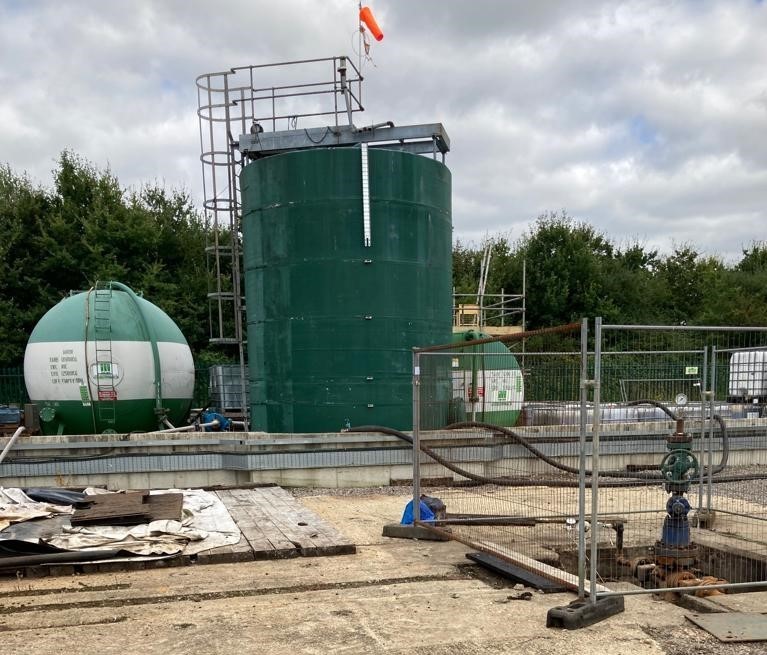
Angus Energy is seeking planning permission to import and inject the fluid, which is extracted along with oil, into the Portland sandstone rocks at Brockham, near Dorking.
It said it needs to inject the liquid, known as produced water, to support reservoir pressure and continue to produce oil at Brockham.
The company’s application will be decided by Surrey County Council’s planning committee on Wednesday 26 March. Details here
Planner support
A report by council planners, published today, backed the application:
“Officers consider that with the imposition of appropriate conditions where necessary the proposed development would not give rise to significant adverse environmental or amenity impacts and should therefore be approved.”
They added:
“No harm has been identified to the water environment, visual amenity, biodiversity, highways, heritage or residential amenity.”
The report recommended six conditions, including restrictions on when tankers could visit Brockham, and a legal agreement on the tanker route.
The permission, if granted, would last until December 2036.
Proposal
Angus Energy said Brockham was producing 120 barrels of liquid a day in June 2024. Of this about 40% was oil.
The reservoir pressure had dropped by about 500 pounds per square inch. This is thought to be less than 50% of the original pressure, the company has said.
It proposes to inject 25m3 of wastewater in any 24-hour period and estimates that this could produce 300,000 barrels of oil from Brockham’s BRX3 oil well.
The company already has permission to inject water produced from the BRX2Y well at Brockham. But it has said this not enough to raise the reservoir pressure and support oil production.
Freshwater is not suitable because injected water should have similar salinity to the rock formation to avoid swelling or mobilisation of clays and deposition of salts.
Angus said the waste would be from its other producing fields in the Weald Basin. These could include Lidsey (PEDL241) and Balcombe (PEDL244) in West Sussex. The company also operates the Saltfleetby A and B gas sites in Lincolnshire.
Tanker deliveries would be limited to four movements a day (two in and two out). Planners recommended that they would be allowed only from 7-8am, 9am-3.30pm and 6pm-7pm Monday to Friday and 8am-1pm Saturday.
Tankers would be required to avoid Brockham village by arriving from and leaving to the south of the site. Tankers would not be allowed to wait in Old School Lane or Bushbury Lane. Damage to local roads on the tanker route would be repaired by Angus Energy, the planners also recommended.
Objections and planners’ response
There were more than 40 objections to the proposal from individuals and organisations, including Mole Valley District Council, Weald Action Group, Save Surrey Countryside and Dorking Climate Emergency. There was letter in support.
The objections focussed on climate change, traffic problems, risk of pollution, seismic events and development in the green belt.
Climate change
Objections said continued extraction of fossil fuels should not be considered sustainable development and should be reduced or phased out. Additional oil extraction would result in higher greenhouse gas emissions, they said.
The planners responded that principle of mineral extraction at Brockham had already been established. The additional four daily tanker movements, which would be heavy goods vehicles (HGVs), would not conflict with climate policy in the Mole Valley Local Plan, they said. They added that the proposal had been judged not to be an Environmental Impact Assessment development. If it had been, Angus Energy would have been required to assess the emissions from production, transport and burning of the oil.
Wastewater
Weald Action Group (WAG) said the categorisation of wastewater was inconsistent and wastewater from injection operations may be inadequately defined. There was insufficient data on the salinity of water in the Weald Basin and a lack of research on the impacts of produced water in the subsurface, the group said. It added that there was a risk to groundwater from migration of toxic fluids and said injection wells were more likely to leak than conventional wells.
The planners said water reinjection was standard oilfield practice. They said Angus Energy would be required to monitor the site and report to the Environment Agency (EA) as part of the conditions for its environmental permit. They added that the EA had not objected to the planning application.
Green belt
The Brockham site is in the metropolitan green belt. Planning law requires there must be very special circumstances to allow development that would harm the openness of the green belt. Objectors described the justifications for the proposal as “contrived”. They said there were no very special circumstances to justify the proposal at Brockham.
The planners said in their report:
“The proposal constitutes inappropriate development in the Green Belt, however sufficient very special circumstances to clearly outweigh the harm to the Green Belt are considered to exist.
“Very limited harm to the openness of the Green Belt has been identified, and the impact would be for a temporary period until the cessation and restoration of the wellsite.
“Officers consider that with the imposition of appropriate conditions where necessary the proposed development would not give rise to significant adverse environmental or amenity impacts and should therefore be approved.”
They added:
“This application seeks to maximise the efficiency of a wellsite for which an existing permission exists. Whilst comparatively small in scale, the increased efficiency of oil recovery facilitated by this proposal is in line with objectives in relation to the extraction of indigenous sources of oil and their contribution to UK energy needs. Sufficient very special circumstances are therefore considered to exist which clearly outweigh the Green Belt harm of this proposal.”
Seismicity
Local people have expressed concern that water reinjection could cause seismic activity.
WAG said there was no explicit industry guidance on management or mitigation of geo-mechanical risks. It said the company had not modelled natural fractures from the target formation and there was no detailed seismic data with the application. Other objectors pointed to previous seismic activity in the area.
The planners said:
“Officers are … satisfied that the proposal would not result in land instability”. There had been no objections from technical consultees, and reinjection already allowed under existing permission, the planners said.
Radioactivity
Objectors expressed concerns about potential harm from radioactivity in the waste.
Planners responded that the wastewater was classified as NORM or Naturally Occurring Radioactive Material and regulated by the Environment Agency’s under the radioactive substance regulations
Pollution
Objections included concerns about contamination of the aquifer, risks to ground water, pollution problems for the future and a threat to air quality.
The planners responded:
“This operation is covered by the Environmental Permit, which determines whether the operation can be managed to minimise pollution”. They added: “it would be unreasonable to refuse the permission based on the potential for pollution arising from the operation.”
On air pollution they said:
“On the basis that the proposal would result in an additional 4 HGV trips to the site per day, no objection is raised in relation to air pollution.”
Management of Brockham
Objectors were concerned about Angus Energy’s track record at Brockham. The company drilled a well in 2017, which the county council said did not have planning permission. This was later sought and granted retrospectively.
Commenting on the company’s track record, the planners said:
“This is not a planning consideration”.
Production volumes
WAG argued that the site had a poor production record and there was no evidence to support the estimates of oil recovery
The planners responded: “The proposal would represent a commercial decision by the applicant”. They added that the principle of oil extraction had been established at Brockham and water reinjection was already taking place. They said:
“The commercial activities of the applicant are not considered to be material planning considerations.”
Economic reasons
WAG also said there were economic reasons why Angus Energy would want to dispose of wastewater from another site. There is a high cost to treatment of produced water.
The planners did not respond directly to this point.
Benefits
Objections said the social benefits quoted by Angus Energy did not justify ongoing impacts and increased risks.
The planners, quoting paragraph 244 of the National Planning Policy Framework, said great weight should be given to the benefits of mineral extraction.
Other impacts
The planners said the scheme would “not result in harm to visual amenity of surrounding neighbours”.
They said:
“On the basis that the proposal would be using the best roads available, the cumulative residual impact on the highway network would not be severe and the vehicular movements to the site and means of access would not have an unacceptable impact on highway safety.”
On noise the planners said “the proposal will only result in 4 HGV trips to the site and therefore there would be no material change to the noise environment”. They added: “In relation to noise and lighting, conditions are recommended to ensure the proposals do not lead to unacceptable noise or light pollution.”
On light and outlook, they said “the proposal would not result in an overbearing impact, harmful loss of light or outlook”
DrillOrDrop has closed the comments section on this and future articles. We are doing this because of the risk of liability for copyright infringement in comments. We still want to hear about your reaction to DrillOrDrop articles. You can contact us by clicking here.
Categories: Regulation, slider

 DRILL OR DROP?