A gas company that criticised campaigners for using the word ‘fracking’ for a well operation in North Yorkshire used the same term for the same process in correspondence with officials.
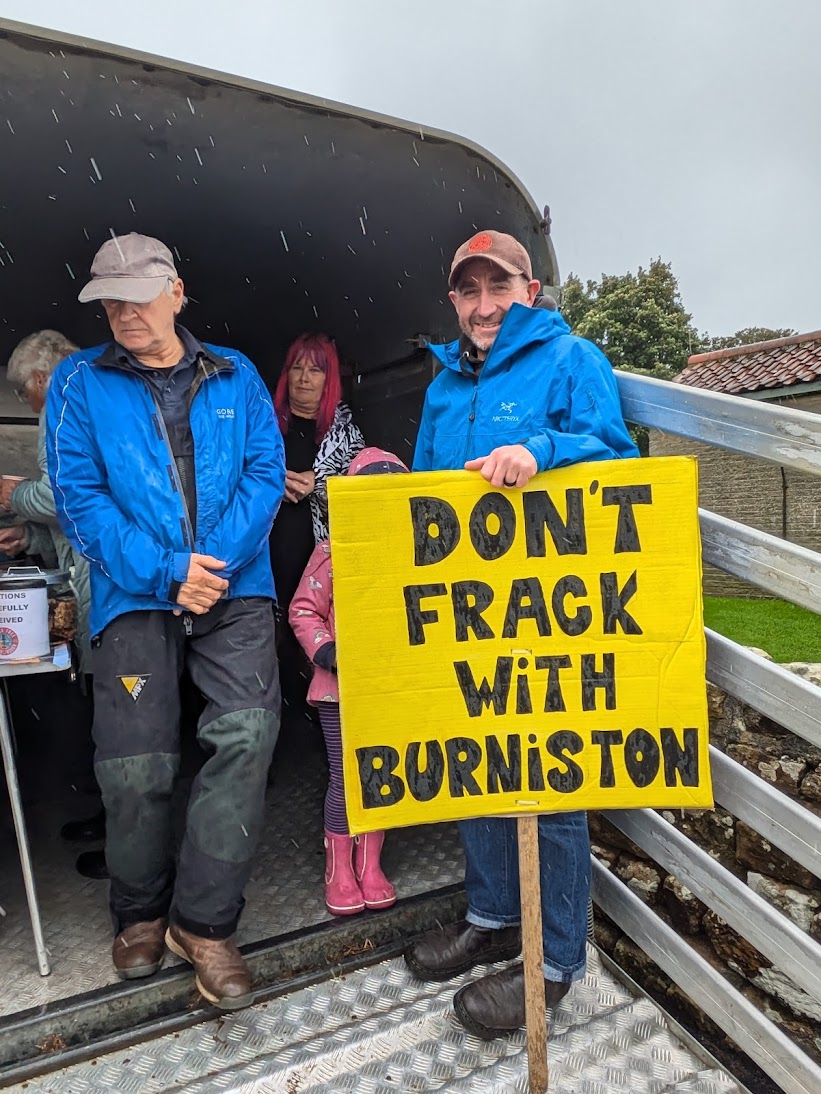
Europa Oil & Gas is seeking permission to drill for gas at a new site in Burniston, near the North York Moors National Park.
The proposal includes a proppant squeeze, a form of small-scale hydraulic fracturing. Liquid is pumped at high pressure to fracture rocks and increase the flow of hydrocarbons.
In its planning application, Europa accused local opponents of “a high level of misinformation” by referring to the Burniston proppant squeeze as ‘fracking’.
The company’s chief executive, Will Holland, also complained in a letter to The Guardian that opponents had been “misleading” for saying Europa wanted to carry out ‘fracking’.
Mr Holland said likening proppant squeeze to ‘fracking’ was the “equivalent to saying that a domestic cat is a tiger on the basis that they are both cats”.
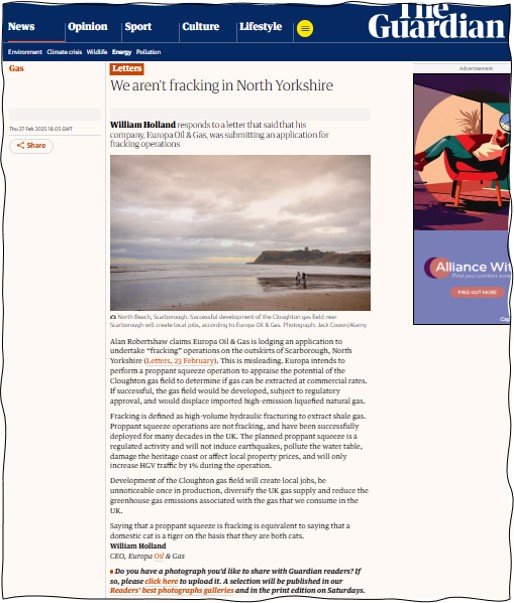
But in an email to the industry regulator last year, Europa referred several times to the planned proppant squeeze at Burniston as ‘fracking’.
The email, to the North Sea Transition Authority (NSTA), said Europa considered “there is no limitation on fracking” in the area.
It also said:
“fracking of the Namurian sands [the Burniston target reservoir] would not be considered as ‘Shale Gas’ but fracking of a ‘conventional reservoir’”.
The same email, released in response to a freedom of an information request, referred to the “proposed volumes of frack fluid”.
It also asked the NSTA whether it would support drilling a well “which would subsequently be fracked”.
Opponents of the Burniston plans have accused the company of “hypocrisy”. They said Europa’s accusations had tried to distract local people from scrutinising the details of what they said was a flawed planning application. (See section below: What local opponents said)
What Europa says
When DrillOrDrop asked Europa to respond to what looked like double standards, Mr Holland said:
“It’s a very good point and unfortunately it’s a bit of sloppy drafting on our behalf.”
“we’ve got some very experienced people who work for us at Europa, who have been around for a long time, longer than me, and they occasionally slip back into the old parlance and as I said it is sloppy drafting.”
Mr Holland said fracking referred to “absolutely everything” 15 years ago. He said you couldn’t drill a well in the UK without fracturing rock.
But he added:
“Nowadays, the word fracking has been, as in the Petroleum Act, applied to high volume, shale gas hydraulic fracturing. So, the word is now no longer relevant to anything else and that’s what’s banned. Nothing else is banned.”
He added:
“People … associate fracking with shale fracking that has lots of potential implications. So, as soon as you say that word, you are misleading people”.
In a short interview with DrillOrDrop, he used both ‘fracturing’ and ‘fracking’:
“It’s fracturing, it’s not fracking”
“We’re not fracking, which is high volume fracturing for gas in shale. We are doing conventional fracking.”
“We’re doing a very conventional hydraulic fracture.”
He said the proppant squeeze operation was “perfectly safe” and widely used.
“it doesn’t cause earthquakes, it doesn’t damage the heritage coast, which some people think will be, it won’t include the water table, it is a very highly regulated, well-understood process, which is used conventionally all over the world and in the UK as part of the oil industry.”
Mr Holland referred to letters by the energy minister, Michael Shanks, to local representatives in the Burniston area. In them, Mr Shanks said the proppant squeeze was not ‘fracking’. He stated that ‘fracking’ was defined in legislation:
“The Petroleum Act 1998 sets specific criteria to capture activities commonly known as ‘fracking’, which involve high-volume, high-pressure fracturing to extract shale gas, and how such activity is regulated.”
What the law says
Mr Holland and Mr Shanks are wrong about the Petroleum Act 1998. It has no legal definition of ‘fracking’.
The act sets specific criteria for ‘associated hydraulic fracturing’, a term introduced in the 2015 Infrastructure Act based on the volume of fluid used in the operation.
But the word ‘fracking’ does not appear in the Petroleum Act and it does not state that fracking is the same process as associated hydraulic fracturing for shale gas.
Mr Holland and Mr Shanks are also wrong that ‘fracking’ is banned.
There is a moratorium on associated hydraulic fracturing in England. The government takes a presumption against issuing further hydraulic fracturing consents, required before associated hydraulic fracturing can take place.
What regulators say
The mineral planning authority
The Burniston planning application will be decided by North Yorkshire Council, using its minerals and waste plan, which sets planning policy for the region.
The minerals plan has its own definition of ‘fracking’, which could be applied to the Burniston proppant squeeze:
“Fracking is the fracturing of rocks by injecting a pressurized liquid in order to extract oil or gas”.
The document, approved in 2022, refers to shale beds but also to other rocks of low porosity. It states:
“For the purposes of the Plan ‘hydraulic fracturing’ includes the fracturing of rock under hydraulic pressure regardless of the volume of fracture fluid used.”
In a footnote it added:
“In some circumstances hydraulic fracturing techniques can also be applied in the development of conventional gas sources, for example for purposes of well stimulation to increase the yield of gas.”
And the main text of the plan (5.129) said:
“it is considered that where hydraulic fracturing is proposed for the purposes of supporting the production of conventional gas resources, there is potential for this to give rise to a generally similar range of issues and potential impacts, although it is acknowledged that fracturing for stimulation of conventional gas production would be likely to involve generally lower volumes and/or pressures.”
Europa has confirmed it intends to inject liquid at pressures high enough to fracture rocks. It also said it would use up to 500m3 per hydraulic fracture stage.
The Environment Agency
The Environment Agency described a proppant squeeze as ‘fracking’ in a permit for the Wressle oil site North Lincolnshire:
“Hydraulic fracturing or ‘fracking’ is a technique that uses fluid, usually water, pumped at high pressure into the rocks to create narrow fractures which provide paths for the tight gas to flow into the well bore and to the surface.”
Operators who want to carry out a proppant squeeze must get approval of their hydraulic fracture plan. This sets out how companies will control and monitor the fracturing process. The document is agreed independently by the Environment Agency and the NSTA.
Given what Europa said about the widespread use of proppant squeeze, DrillOrDrop checked with NSTA about how many hydraulic fracture plans were submitted and approved in 2024. The regulator said:
“None. There were no applications and therefore no approvals.”
What local opponents say
DrillOr Drop asked Frack Free Coastal Communities, which represents people living in and near Burniston, to comment on Europa’s choice of language.
Chris Garforth of the group told us:
“Europa told residents six months ago in bold letters: ‘We will not be carrying out fracking at Burniston at any time neither in this application or any future applications‘. Link
“They went on to say that ‘fracking, or high volume hydraulic fracturing is the process of removing gas from Shale rocks and is currently banned in the UK’.
“They have been using this fabricated distinction to dismiss and patronise local objectors as lacking understanding and deliberately spreading misinformation.
“They hoped to distract us from scrutiny of their planning application, which is riddled with misinformation, contradictions, gaps in vital information, unsupported assertions and incomplete analysis. Their hypocrisy is now clearer than ever.
“Having reclaimed the commonsense understanding of ‘fracking’, we can move forward to confront the real issues – catastrophic climate change; the need to accelerate the shift from fossil fuels; and justifiable concerns about the potential health, noise, pollution, landscape, ecological, economic and physical impacts of Europa’s plans to create the largest onshore gas field in the UK underneath the homes and rural businesses that thrive in this fragile landscape.”
Why does this matter?
The government has committed to ban ‘fracking’, without explicitly stating what it means by ‘fracking’.
Dennis May, who has observed the UK onshore industry for more than a decade, said the F-word had become a “well-established and generic colloquialism for hydraulic fracturing operations”. It has been used by government, industry, campaigners and regulators, he said.
Mr May, who submitted the request which revealed Europa’s use of the word ‘fracking’, said:
“Until now this issue has just been semantic jousting.
“Now Europa has formalised proceedings by, in its Statement of Community Involvement, discrediting objectors to its planning application as ‘mistaken’ and ‘providing misinformation,’ for using an established term that is universally applied to operations, such as a ‘proppant squeeze.’
“Whether the proposed technique falls within the bounds of a certain colloquialism is not a material planning consideration. Equally, the company’s claim in its proffered evidence that ‘Fracking…is currently banned’ is both inaccurate and misleading.
“The letter from Energy Minister Michael Shanks to Alison Hume, MP, stating that ‘activities in the UK, including proppant squeezes are not fracking as defined in the Petroleum Act,’ is woefully ignorant of the fact that said Act neither carries nor defines the term ‘fracking.
“The real concern however, in this regard is that a government minister and his department, the proprietor of a supposedly independent regulator, have aligned themselves with groundless and inaccurate industry propaganda.”
DrillOrDrop has closed the comments section on this and future articles. We are doing this because of the risk of liability for copyright infringement in comments. We still want to hear about your reaction to DrillOrDrop articles. You can contact us by clicking here.

 DRILL OR DROP?