The campaigner who secured a landmark judgement at the Supreme Court on carbon emissions from onshore oil and gas has won a prestigious award.
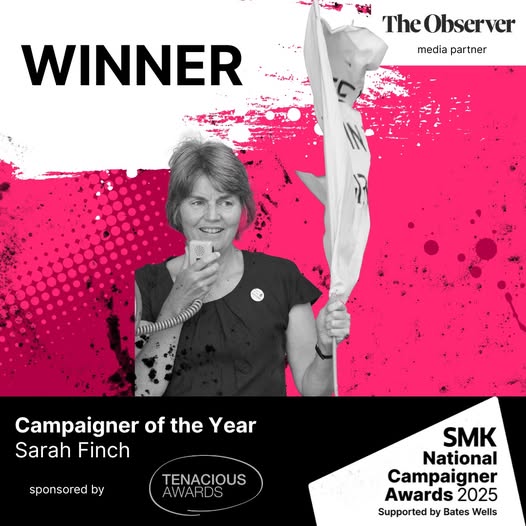
Image: Sarah McKechnie Foundation
Sarah Finch, who brought a five-year case on behalf of the Weald Action Group, was named campaigner of the year by the Sheila McKechnie Foundation.
The win was announced last night, the eve of the first anniversary of the Supreme Court judgement that decision-makers must take into account the carbon emissions from burning oil and gas.
Previously, planning decisions on fossil fuel production proposals had considered only the emissions from the extraction process.
Ms Finch’s case, which centred on the Horse Hill oil site in Surrey, went to the High Court, Appeal Court and eventually the Supreme Court.
She argued that Surrey County Council had acted unlawfully when granted planning permission for Horse Hill in 2019 without considering the combustion emissions from the oil.
On 20 June 2024, a majority of Supreme Court justices agreed with her. They quashed the Horse Hill planning permission and clarified the law on environmental impact assessment of fossil fuel developments.
What has become known as the Finch Judgement has had wide implications for other UK fossil fuel developments.
The Rosebank and Jackdaw oil and gas fields, which were approved by the Sunak government, were ruled to have been permitted unlawfully. The operators of these fields (Equinor and Shell) have said they will reapply.
Consent for the planned new coal mine in Whitehaven in Cumbria was quashed and the company behind it has said it would not reapply.
Two onshore oil fields, at Biscathorpe and Wressle, in Lincolnshire, also saw permissions overturned because decision-makers had not taken account of combustion emissions. The operator, Egdon Resources, is reapplying for planning permission at both sites.
The government published new government guidance yesterday on how combustion emissions should be assessed. DrillOrDrop report coming soon.
Sarah Finch told an environmental law conference last week:
“It is a huge victory but it is very vulnerable and we have to defend it.”
She told the Observer today:
“I thought it was a kind of tipping point, and after that, no more oil and gas could ever be approved. But the government has been making noises about wanting to approve Rosebank when it comes back.
“I do see it now as a kind of litmus test of whether my ruling has the effect that I hoped it would have, because I feel like if the government can look at the full climate impact of Rosebank and permit it anyway, then that’s really a big loss.”
The Weald Action Group, reflecting on the past year, said today:
“Our win goes a long way to help the government take the most important action there is – and refuse permission for new oil and gas. It will soon face the test of remaking the decisions on Rosebank and Jackdaw.
“Now that its revised guidance is published, Equinor and Shell will submit new, Finch-compliant Environmental Statements. These will outline the full extent of the climate threat the developments pose.
“In the case of Rosebank alone, it’s estimated that more than 200 million tonnes of CO2 will inevitably result from burning its oil reserves.”
Categories: Legal, Opposition, slider

 DRILL OR DROP?