Opponents of plans to drill and frack in a North Yorkshire village have criticised the “inappropriate” technology, “inadequate” risk assessments, missing, incorrect and inconsistent information and a failure to consider vulnerable people.
Europa Oil & Gas contacted DrillOrDrop about this article on 30 September 2025. We have published the company’s communication in full here.
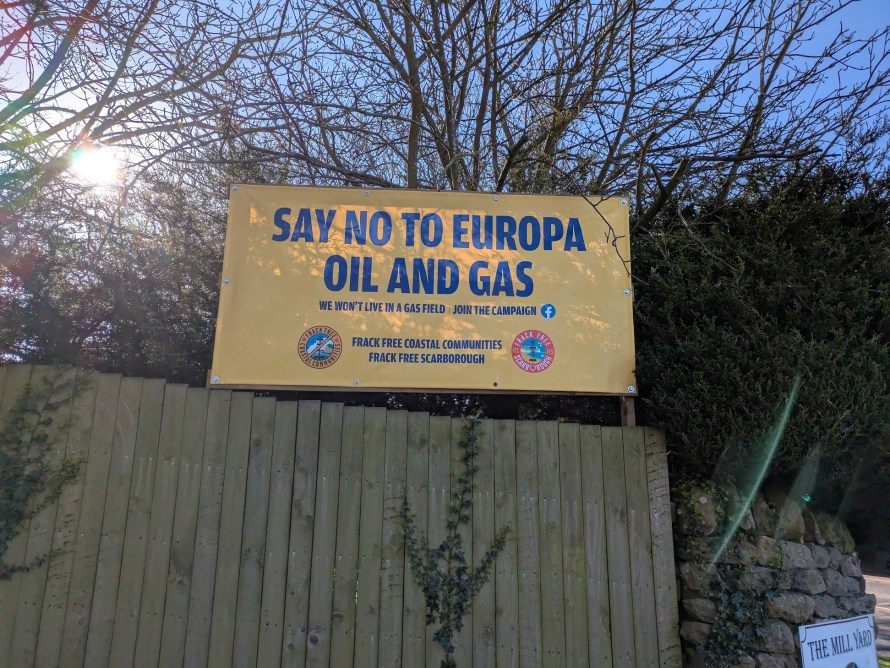
The local campaign group, Frack Free Coastal Communities (FFCC), said this week the proposal at Burniston on the Yorkshire heritage coast, carried a “high risk of unacceptable environmental impact on a sensitive agricultural and ecological landscape”.
It said Europa Oil & Gas, the company behind the scheme, had admitted its Burniston wellsite would cause air pollution, greenhouse gas emissions and carry environmental risk for the local population.
FFCC called for the strict enforcement of measures to control pollution and prevent environmental damage but it questioned whether official regulators were able to do this.
The group was responding to an application by Europa to the Environment Agency (EA) for an environmental permit.
The company has also applied for planning permission, currently being considered by North Yorkshire Council.
Fracking
FFCC described the proposed deviated well and frack, also known as proppant squeeze, as “inappropriate”. It said alternative well stimulation techniques were not discussed in the application and the data on the proposed frack was “inconsistent and inadequate”.
The group said:
“it is therefore not possible to reach an informed conclusion about the environmental safety of the proposals.”
FFCC said it was “not credible” for Europa Oil & Gas to claim that fracking induced seismicity would not happen at Burniston because the geology was different from other areas in England where fracking has caused earthquakes.
It said Europa’s environmental assessment failed to address the potential for increased seismicity at Burniston, the risks to unstable coastal cliffs and the long-term stability of the land.
It called on the EA to insist on a “proper mapping of the faults” near the drilling and hydraulic fracturing locations before a decision is made on the permit application.
Waste
The permit application suggests that Europa proposes to fracture rocks at four depths within the well, between 2,000 and 3,000 meters below ground level. Most of the waste from the fracking process will remain in rocks underground.
FFCC said:
“This implies that fracking waste will be located at various points within a 1km section below Barmoor Lane rather than the single location indicated in the original EPR application.
“This needs clarifying before a determination [of the permit] can be made.”
The group also questioned Europa’s claim that underground fracking waste could not travel upwards because there was no data on geological faults near the proposed site.
Flaring
Europa proposes to flare waste gas at Burniston. But FFCC said the company’s waste gas management plan did not analyse likely pollutants from flaring.
The group said potential emissions could include carbon dioxide (a major greenhouse gas), hydrogen sulphide (which smells of rotten eggs and can cause respiratory problems), nitrogen, volatile organic compounds, methane (from incomplete burning), nitrogen oxides, sulphur dioxide (contributor to acid rain), soot and carbon monoxide.
Flaring also caused noise and vibration, FFCC said.
“While flaring may be seen as a convenient method for removing surplus gases, it can cause significant disruption to local communities. Communities have raised concerns about health impacts of noise, light, and vibration from flaring, including sleep disturbance and anxiety – concerns which are justified in light of extensive peer-reviewed research.”
FFCC said the impacts of flaring would vary with wind direction and speed, which changes at Burniston over the year and with daily warming and cooling of the sea and land. It said:
“These variables have not been sufficiently taken into account by the applicant.”
The group asked the EA to require green completions (flareless) technology.
Europa proposes to use a shrouded flare, even though this is not regarded as the best available technology.
FFCC said the company had not published an assessment of the difference between the shrouded and enclosed flares or published a cost-benefit comparison.
The group also said it wanted to know what methods would be used to monitor the actual efficiency of any flare and what action would be taken if this fell below the expected value of 98%. It called for analysis of the different impacts of the shrouded flare and an enclosed flare.
Vulnerable residents and sites
FFCC said Europa Oil & Gas had provided no information on nearby residents, businesses and sensitive sites, even though this was publicly available.
It said 920 people lived within 1km of the proposed site and 2,785 within 2km.
The nearest home, Wayside Farm, had not been considered in the permit application, FFCC said, even though it was next to the site entrance. Most of the homes in Coastal Road, Bridge Close, Hawthorne Close and Burniston Gardens were less than 500m from the wellsite, FFCC said.
“Inevitably, many will be adversely affected by drilling and site activity noise, 24/7 light pollution from site floodlights, noxious odours and increased traffic fumes from extra HGVs and site machinery.”
Some people had already reporting fears of deteriorating physical and mental health if the scheme went ahead, FFCC said.
It said the most common age of residents in the nearby streets was 72 – much higher than the national average. 70% of the population of Burniston was over 70, making them vulnerable to the impacts of air, noise and other pollutions.
FFCC also identified more than 15 sensitive sites within 1km of the proposed wellsite that it said were not considered in the permit application.
These included a grain drying and storage operation, a garden centre that employs young adults with special needs, a coastguard station sharing the same access as the site and needing 24/7 access, an independent living scheme, the Cleveland Way national trail and ecological habitat next to the site which is used by great crested news, hares, bats, birds, badgers and pond life.
FFCC said:
“we are not convinced that sufficient EA processes and mitigation are in place to prevent significant physical and mental harm to the local population and extensive wildlife.”
Noise
FFCC said Europa had used only two locations for continuous noise monitoring. These were both south of the site and near the A165 coastal Road. It said:
“These locations and therefore the data they yield are not representative of the baseline levels of noise experienced in the vicinity of the site.
“We ask that the Environment Agency insist on a more robust set of data for baseline noise levels before determining the EPR [permit] application.”
Risk assessment
Europa’s environmental risk assessment accompanying the application was “inadequate”, FFCC said.
It was “far too reliant on written procedures being in place with no means of detecting whether or not they are being complied with”, the group said.
FFCC said risks judged to be “high probability” had been reduced to “not significant” if they had written procedures, training and maintenance schedules. But there was no mechanism for the EA to check whether procedures or schedules were adhered to
FFCC said its discussions with EA staff had suggested:
“It is up to the local population to monitor and report emissions, including odours.”
Monitoring
Proposed monitoring was inadequate to the task of alerting local people to potentially harmful impacts and protecting the environment, FFCC said.
The environmental permit information did not include the location of proposed groundwater monitoring boreholes. And no monitoring was proposed of existing boreholes that were used for domestic and agricultural water.
The 21-day gap between data collection and reports to the EA was “clearly not fit for the purpose of alerting local residents to unexpected changes”, FFCC said.
The group called for:
- Baseline and continuous water monitoring before, during and after operations
- Air quality monitoring
- Buffer zones between the site and sensitive areas
- Emergency response plans for spillages, well failure and groundwater contamination
- Restriction of some activities to avoid disturbing breeding wildlife
- Long-term obligations for site remediation
Missing information
FFCC said it was “alarmed” at what it called the “careless presentation of information” in Europa’s documents, published on the EA’s permit application web page.
It said the EA should have “accurate, complete and consistent data” to decide the permit application.
The group asked:
“How can we trust a company that cannot get its basic information and calculations right at this stage?”
FFCC said it had particular concerns about:
- “Very broad brush” geological data
- Inconsistencies about the depth of the target formation (variously described as 2,900m, 2,400m and around 2,000mbgl).
- Contradictory figures for the number of hydraulic fracture treatments (between one and up to four) and the volume of fluid (between 300 and 500 cubic meters)
- “Meaningless” dimensions of the mining waste facility where fracking fluid would remain underground
- The use of cold venting (ruled out in one document but not in another)
- Inconsistent delineation of the site (including the access road in some documents but not in others)
EA regulation
FFCC said:
“We have serious concerns about the ability of the Environment Agency to regulate the oil and gas sector effectively.
“Their over-reliance on industry operators to do their monitoring and reporting work for them and the reduction in funding available for environmental protection over the past 15 years do not fill us with confidence.”
The group added:
“It seems to us perverse that an agency which ‘strive[s] to make the right decisions today, for the people, wildlife and environment of tomorrow’ and which ‘put[s] the climate emergency at the heart of everything we do’ is tasked with facilitating a development that, on the applicant’s own admission in its EPR application, will cause air pollution, greenhouse gas emissions and environmental risk for the local population.”
The group added:
“Europa’s current plans for an appraisal well at Burniston is a precursor to their aspiration to develop the UK’s largest onshore gasfield”.
This was “totally out of keeping” with national plans to achieve net zero carbon emissions by 2050, FFCC said.
Consultation
FFCC also criticised the EA for failing to run an effective public consultation. Documents were missing, it said. A press release gave incorrect information. An invitation to a drop-in information event was not sent to all local households and a later apology arrived two weeks after the event.
Other concerns
FFCC also detailed other concerns including:
- Impacts on agriculture from soil contamination, airborne emissions, noise and light pollution, loss of productive land, industrialisation.
- Impacts on environmental stewardship schemes, aimed at enhancing biodiversity, covering land surrounding the proposed site
- Omission in the permit application of a borehole, which supplies farm and domestic water, 1.3km from the site and the risk of contamination from migrating fluid and gases, pollution of surface water and disruption of land drainage.
- Omission in the permit application of a grain drying and storage facility 300m from the proposed site. FFCC said it was at risk from airborne contamination and dust, VOCs and other odorous compounds. It called for an adequate buffer zone.
Categories: Regulation, slider

 DRILL OR DROP?