A leading geologist has warned that plans for lower-volume fracking in northern England could cause earthquakes as large and unpredictable as high volume operations.
Since 2019, the moratorium on fracking in England has prevented fracturing operations using more than a legal volume of fluid.
But similar processes are still allowed if they use volumes below the threshold of 1,000m3 per stage or 10,000m3 in total. Campaigners have called this a loophole in the law that should be closed.
A lower-volume fracture has been approved for an oil and gas site at West Newton in East Yorkshire. There are also proposals at Burniston in North Yorkshire, due to be decided in a fortnight, and at Wressle in North Lincolnshire.
Professor Stuart Haszeldine, of the University of Edinburgh, a multiple award winner and fellow of the Royal Society of Edinburgh, said today:
“There is a moratorium on high-volume fracking because of the risk of unpredictable earthquakes. But low-volume fracking can produce tremors that are equally large and equally unpredictable.
“The current loophole in the regulations means that unconventional oil and gas can be pursued using acid fracturing or small volume fracking under the guise of conventional exploration and production.
“Developers are probing to find exemptions from current rules. That means locations with sandstone or limestone reservoirs could be drilled and fractured with water and proppant to aid the production of onshore oil and gas, whilst earthquakes could be triggered or felt 15km away.
“The rules need to be more tightly written to safeguard residents against poorly understood effects, not simply hoping that developers get good outcomes.”
All forms of hydraulic fracturing seek to inject liquid and proppant into a well at pressures high enough to fracture the surrounding rocks. The aim is to increase the flow rate of oil or gas to the surface.
In a recent report, Professor Haszeldine said high volume fracking carried out by Cuadrilla in Lancashire in 2018 and 2019, triggered earthquakes. But some of these operations planned and actually used less fluid than the legal definition.
Fracking of the Preston New Road-2 (PNR) well in August 2019 injected a total 2,485m3 of fluid in seven separate stages, (an average of 355m3 per stage) – way below the threshold.
Those fracks triggered a 2.9ML earthquake, the largest fracking induced seismic event in the UK. There were reports of local damage from eight postcode areas.
Professor Haszeldine said:
“It is therefore clear from what happened at PNR, that “small” fluid volumes, injected for the purposes of fracking rock to produce hydrocarbons, can cause seismicity if the geological setting is susceptible and already stressed close to the point of fracture”.
Burniston
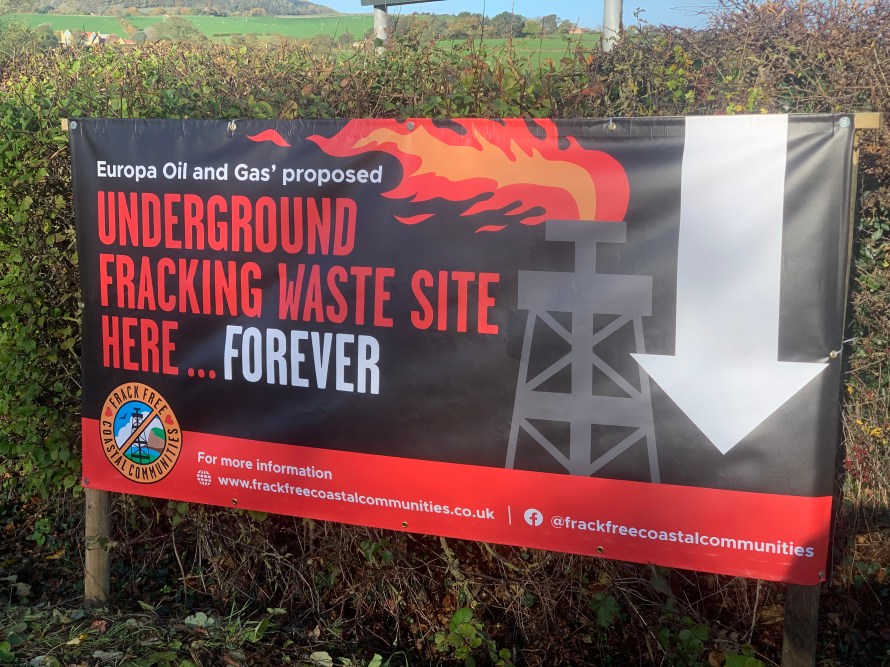
The fracking plans by Europa Oil & Gas at Burniston are expected to use 1,200m3-2,000m3 of fluid and 60 tonnes of proppant over four treatments, an average per stage of 300m3-500m3.
These volumes are below the legal threshold. But the predicted average of up to 500m3 is higher than the volumes used by Cuadrilla at Preston New Road in 2019, that caused the 2.9ML seismic event.
Europa has said the target rocks at Burniston are not shale and will behave differently from the Bowland shale in Lancashire.
But Professor Haszeldine said:
“in my view, the risk of seismicity induced or triggered from proposed operations at Burniston, cannot simply be ruled out.”
He added:
“fracking with lower fluid volumes (including proppant squeeze) is intentionally configured to modify fluid pressures within a deep reservoir. That modification of fluid pressure is intended to form new fractures in the reservoir rock, and so does carry risks of triggering an earthquake.”
The Burniston planning decision will be made before Europa has carried out a 3D seismic survey of the area. This is designed to reveal the presence of some faults and other geological structures and rock properties. Local opponents have called for the decision to be delayed until the survey is carried out.
Professor Haszeldine described as “illogical” the different treatment in the regulations of the various types of fracking (high-volume, low volume, matrix acidization and fracture acidization). He said:
“This may enable a regulator ban on fracking to be circumvented by developers who could define their stimulation of boreholes to avoid legal definitions.”
He proposed a definition recommended by other academics, based on treatments that increase the permeability of the target rock to more than 0.1 milli Darcies beyond a 1m radius of the borehole.
The UK government has promised to ban fracking. But there has been no definition of what it means by fracking and whether it would include lower-volume processes.
The professor’s report was commissioned by Friends of the Earth. The organisation’s climate campaigner, Tony Bosworth, said:
“The government has rightly committed to banning fracking. It has triggered earthquakes, blights our countryside, won’t cut UK energy bills, is deeply unpopular with communities and fuels the climate crisis.
“But there is still major uncertainty about how the ban will work and whether low-volume techniques such as proppant squeeze will still be allowed to go-ahead. A growing number of communities in England are already facing this threat.
“Now, one of the UK’s leading geologists is warning that the earthquakes caused by low-volume fracking could be just as large and unpredictable as those that hit Lancashire in 2019.
“Ministers must reassure communities by banning all forms of fracking – failure to act will undermine Labour’s credibility. And planning authorities should hold off on deciding fracking applications until the government’s position is clear.”
Categories: Opposition, Regulation, slider

 DRILL OR DROP?