
Anti-fracking campaigners gathered in York today for a Don’t Frack Yorkshire march and rally.
Organisers estimated hundreds of people from across the UK took part. Graham Martin, who helped organise the event, said:
“We were absolutely overwhelmed by the turnout today, which exceeded all our expectations. This shows that more and more people across Yorkshire are waking up to the threat of fracking to the countryside, rural jobs, tourism, the environment and climate change.”
Russell Scott, of Frack Free North Yorkshire, said:
“People are now realising that with the whole of Yorkshire covered in fracking licences, fracking is now on everyone’s doorstep.”

The rally outside York Minster. Picture: Frack Free North Yorkshire
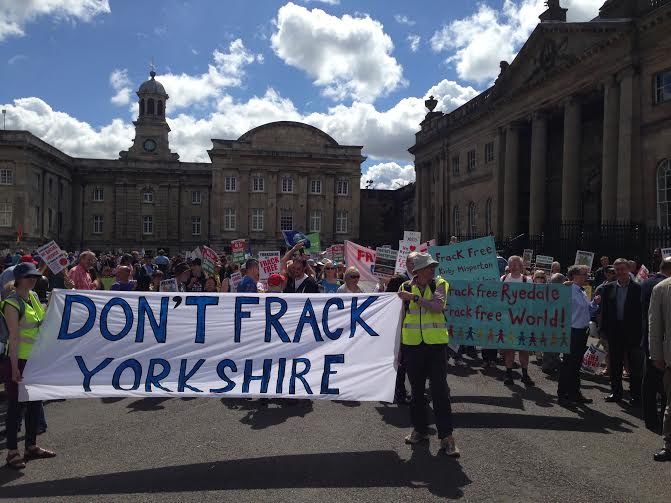
Picture: Adela Pickles
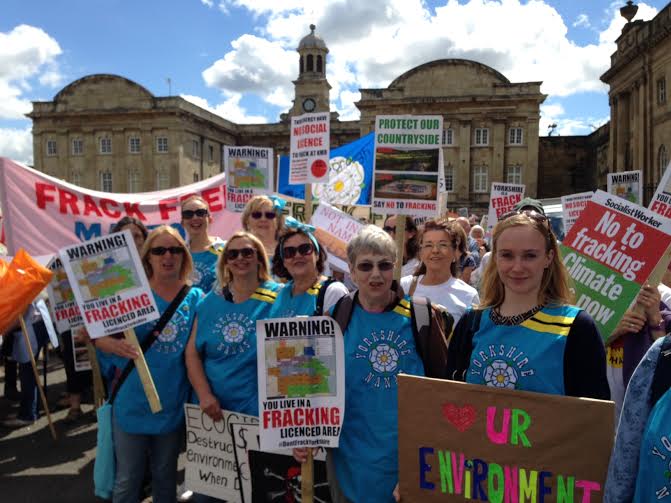
Members of the Yorkshire Nanas. Picture: Adela Pickles

Tina Rothery, of the Lancashire Nanas. Picture: Sally Brooks

Retired Yorkshire GP, Tim Thornton. Picture: Jules
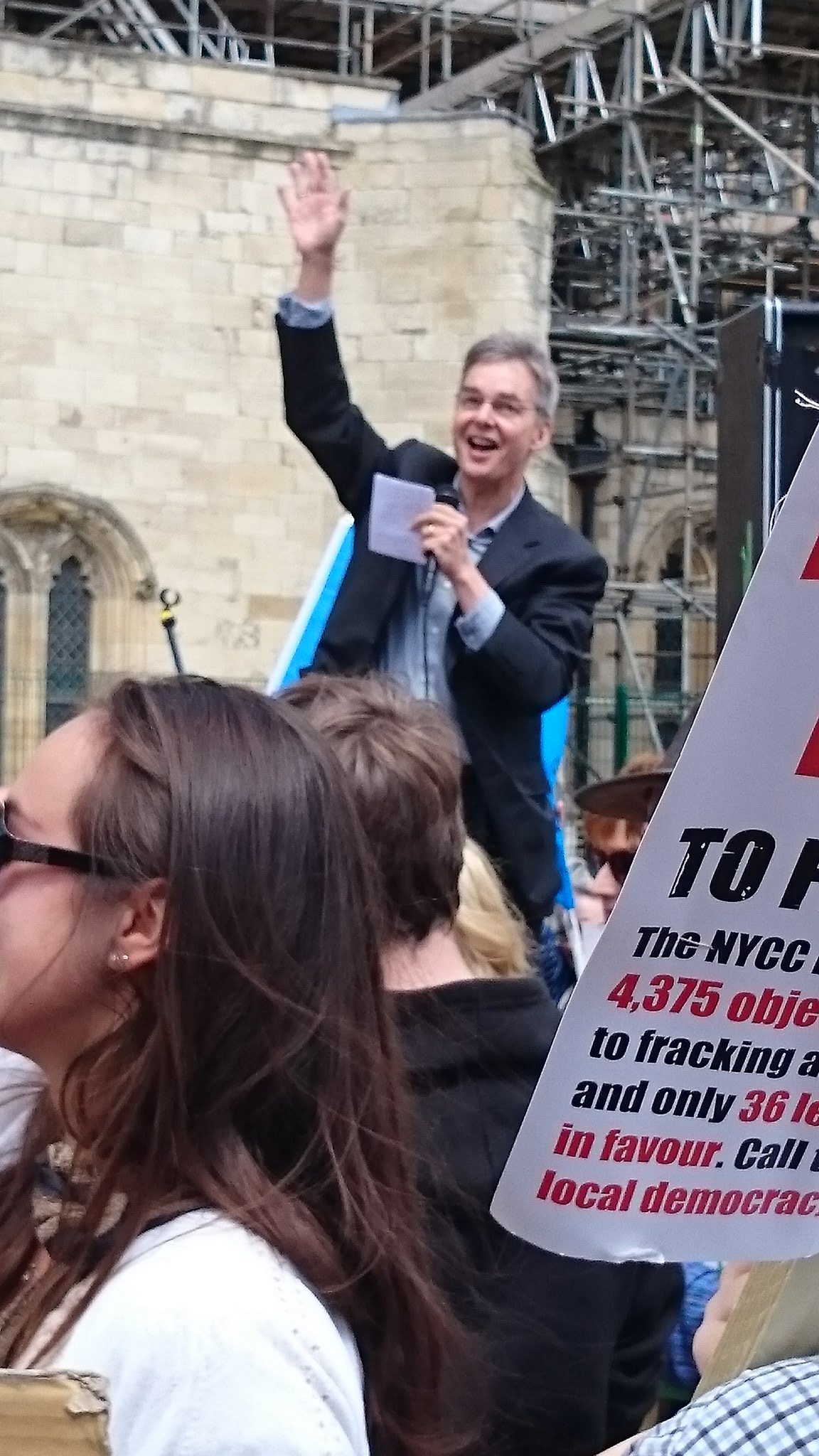
Former climate diplomat, John Ashton. Picture: Jules
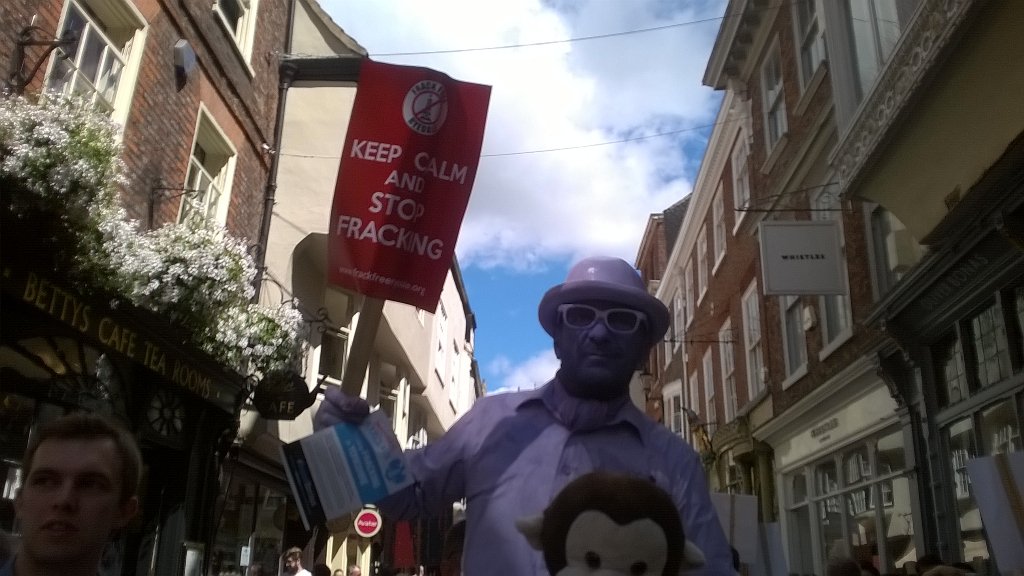
March through York. Picture: Frack Free Barnsley

Picture: Frack Free Barnsley
Updated 31/7/2016 to remove figure of 3,000+ attendance (quoted in Frack Free Ryedale press release) following comments by people who were at the rally.
Categories: Opposition

 DRILL OR DROP?
Quite impressive demonstration, there is clearly considerable opposition to fracking which obviously I feel is misguided. I suspect it will either take a determined government to push shale gas exploration forward or a serious deterioration in the UK’s energy supply situation (most likely a combination of both). The BBC report “…the stakes are high”. Exactly. How do we keep warm on a freezing cold, still night in winter, no solar, precious little wind? In the near term, renewables will just not cope.
If the government is prepared to set up the UK population by massively subsidising nuclear and fracking that does not constitute “lower energy bills” as promised by Mrs May. She May as well go on importing some gas from Norway while growing renewables which we know are the future so far as trying to save our planet is concerned.
You are forgetting that we can continue importing oil and gas. The USA is now swimming with more of the stuff than they need, and are already exporting some to the UK, along with Norway and others. (Not Russia, that is a fabrication). If we went ahead with fracking for shale gas, it would take 7-10 years before enough could be produced to make a difference to our energy supplies.
That would be US Shale Gas would it not Michael? What about the carbon footprint associated with the LNG process? Which could be avoided if we used our own? Russia is not a fabrication going forward – check Centrica.
The organizers were expecting more than 2,000 demonstrators, but based on pictures and sources more reliable than drillordrop.com it seems that the actual numbers were 1,000 at best. A whopping 50% disappointment on such a beautiful day. That certainly says something, doesn’t it? Let’s assume 300 of the 1,000 were from out of town. So 700 of the 5.3mn residents attended the protest, a paltry .01%. That’s pathetic by just about any standards. Perhaps the locals are beginning to understand that shale gas is safe, and will provide a big boost to the local economy. Hmmmmm.
Over 4000 formal letters of objection and 36 in support Hmmm
and why is that relevant? It wasnt a vote. Protests always get more letters of support than ‘pro’ in any consultation. How many were duplicates, or from Canada or New Zealand? (Quite a few)
where they have been well and truly fracked.. earth, water, animals, people, unborn children born deformed or died in womb..even animals have been poisoned by drinking surface water rising from fracked gas..and worse EVEN than the people dying of cancer including the workforce..people have been unable to insure or sell their houses.
Yes, Eileen. And 5.3 million who don’t care much either way, but just want reliable, affordable, practical energy to keep them warm and safe and to provide a good life. BTW, what is the anti-fracker plan for a comprehensive energy strategy that can achieve the goals of affordability, security, and lower carbon emissions?
Oh dear Mr Peeny! LOL to your “more reliable sources” – who were they?
Now, let’s just cast our minds back to Backing Fracking’s rally at Blackpool FC. Organised with “military” precision they managed to attract about 50 people from locations across the UK. Now THAT was pathetic – so pathetic in fact that they has to abort their planned march past the club and shamble across the road instead.
Even if there were only 1,000 in York that would still be about 20 times what we know to be the national pull of the pro-frackers.
So here’s a little challenge for you – find me any evidence you can that the frackers could muster a demonstration with anything approaching 1,000 people. Otherwise you have real just confirmed what we all knew – grass roots level support for fracking is non-existent (or to use your word “pathetic”). Hmmmmm.
BBC was the source to which I was referring, John. Not that they are necessarily all that reliable, but Drillordrop’s estimate of 3,000 was around 200% greater than any of the others that I saw in the press, and given Ruth’s biases this is exactly what you’d expect.
I would never attend a pro-fracking rally, John They are the domain of minority extremists. I don’t think it’s a smart move to hold pro-fracking rallies, because the people who are in favor of using the technology are not minority extremists, and many people who are in favor of fracking don’t even realize they are in favor of fracking, they just know that they want a warm house in winter, fuel for their stoves, and many of the other modern conveniences that natural gas affords them.
The point here was to try to inject a little truth into the journalism.
Well you need to be a bit more careful Peeny – the estimate of 3,000 was not Ruth’s – it seems to have come from a Press Release and was reported as a quote not Ruth’s own opinion, so your rather surly rudeness towards her would appear to have been unwarranted. You may be big enough to apologise – we’ll see won’t we?
I would agree that pro-fracking rallies are the domain of minority extremists – you only have to look at the rascals who turn up – they are right bunch of misfits and ne’er-do-wells. It is quite ingenious of you to claim that many supporters don’t even know they are supporters. I suppose desperate attempts to claim support are all you have left though. Good luck with that 😉
No, John, you’re wrong. I never suggested that Ruth estimated 3,000 (you obviously need to be more careful with your comments!). I do suggest that she do her homework more carefully, however, especially when relying on obviously biased sources. I think that when you publish a piece, you should fact check your sources Sorry that you disagree, but not surprised!
John, what is your energy plan for the country?
“I never suggested that Ruth estimated 3,000”
LOL Peeny, so who were you talking about when you wrote “Drillordrop’s estimate of 3,000”? oops!
My energy plan? Well it would include demand reduction, much greater investment in and development of renewables to create employment at the same time as mitigating the impacts of climate change, huge investment in development of domestic and industrial level electrical storage, judicious use and development of conventional sources (but only if CCS can be implemented at scale).
Oh and showing the frackers the door of course. We really don’t need them. If (as Cuadrilla have admitted) their impact is going to be too small even to lower prices in the UK there really is no point in messing up vast swathes of the country is there? (unless you are invested in which case you probably think there is, but that’s just greed not an energy policy).
BTW did you see the article on KKR and Samson? http://nypost.com/2016/07/29/kkr-looks-to-unload-fracking-firm-at-a-steep-discount/
You are correct. That was my error to suggest it was Ruth’s estimate. She based it on other (unreliable anti-frack) sources and has since removed it.
So, let me get this straight. The country is in an energy crisis with the grid running on the slimmest of margins. The government is having to reassure the public frequently that the lights will stay on during winter. Coal plants are closing at a rate of 4-6 GW per year, nuclear plans keep getting pushed back, and no one is building significant new energy generating capacity. At the same time, the UK pays some of the highest energy rates in Europe do to its many projects aiming to curb the use of fossil fuels and pensioners are dying from fuel poverty in the thousands each winter. Amidst this crisis, you want to initiate massive investments in renewables and storage? LOL, thank god you don’t run anything, John!!
I support renewables too John, but I also understand that they have played a major role in creating the aforementioned crisis. Re-initiating massive investment in renewable capacity would be suicidal. It would leave a massive hole in generating capacity, increase prices, increase reliance on foreign sources of energy, potentially increase air pollution, and discourage investment in practical energy generating capacity. I suppose the upside is that when the lights go out, John, no one will see your picture on TV or websites to remind them of how the country ended up in such a miserable and dangerous predicament.
You’d bet your country’s future on the evolution of a commercial -grade storage solution, John? Any thoughts on what the costs of that solution might be and how that might impact already high prices? How many pensioners would you be willing to kill to pay for it? And what kind of environmental damage would you be willing to tolerate to build massive scale storage, John? What are the probabilities that such a solution will be available when the country desperately needs it in three to five years, John, as coal plants continue to close?
Do you realize that replacing Hinkley’s production would require solar panels that take up more land than all of London? I think maybe 25% more if I’m remembering correctly, around 1% of the total land mass of the UK. Where are you going to site all of your capacity, John? Onshore will take up half the country, offshore is very expensive.
You might take a cue from the real world in formulating your strategy, John. Renewables are incredibly expensive which is why the Danes have canceled 5 massive wind farms. It’s why the UK put the halts to its generous subsidies. It’s why Germany has begun to do the same. Moreover, renewables are causing greater air pollution John. In Germany, carbon emissions are higher than when Energiewende began as the country has made up for the intermittency by bringing on more coal generation. In other parts of the world, renewables are putting low carbon backup sources of power out of business. See: http://www.nytimes.com/2016/07/20/business/energy-environment/how-renewable-energy-is-blowing-climate-change-efforts-off-course.html?_r=0
Renewables are limited in market penetration by their capacity factor, John. They do not provide a practical solution beyond that and that fact makes your plan completely untenable. http://thebreakthrough.org/index.php/voices/energetics/a-look-at-wind-and-solar-part-2
In short, your plan won’t work. It will bring pain, suffering, and death to large segments of the population while putting millions out of work. As your plan fails, it will require more and more reliance on foreign sources of energy supplied by coal and gas, which are more polluting and expensive than domestic gas. Your plan will be an environmental and humanistic disaster on a large scale. Other than that, it sounds great, John.
The UK doesn’t need to tap onshore gas, you’re right. As long as the country is happy with sourcing its gas (increasingly fracked gas) from overseas it can. It will pay higher prices of course, and it will lose any hope of energy independence or energy security, but I guess in your world that’s ok, right?
You do make me laugh Peeny – you talk about me betting my country’s future – I’m not as I don’t control policy, but I sure as hell can’t see what is so different about betting on mass storage, or development of alternatives compared to betting on being able to extract billions of TCF of shale gas and then to apply non existent CCS to just a part of its consumption. Just about every forward scenario has an element of uncertainty and risk about it – some though are not just grubby little schemes to make short term cash for a few brokers and carpet baggers.
As to your ludicrous question “What are the probabilities that such a solution will be available when the country desperately needs it in three to five years” What do you think the probability is that shale gas will be there in the UK to do that in 3-5 years? Let me tell you 0.0000%. Honestly you are quite ridiculous!
So what’s your plan Peeny? Make a quick buck by pumping fracking investments to your clients and then make a hasty exit?
And from the Tory Party “The Government should abandon Hinkley C – pursuing it in light of all the evidence of cost reductions in other technologies would be deeply irresponsible,” said Ben Caldecott, associate fellow, Bright Blue. “We need a new ‘Plan A’. This must be focused on bringing forward sufficient renewables, electricity storage, and energy efficiency to more than close any gap left in the late 2020s by Hinkley not proceeding. This would be sensible, achievable, and cheap.”
But let’s ignore the obvious and get taken in by a Wall Street “expert” with money to make – we all know how well that normally turns out don’t we?
In the words of Hilary Clinton Peeny, “Delete your account” x
“I sure as hell can’t see what is so different about betting on mass storage, or development of alternatives compared to betting on being able to extract billions of TCF of shale gas”
Really, John?
A little reality for you, then. Shale gas is a proven concept. Shale gas today provides 2/3 of America’s gas consumption. Shale gas is not a science experiment. Shale gas is 100% certain to exist in the UK, and wells have been drilled which prove that it can be extracted. We don’t yet know how much can be extracted, how easily, and how quickly, and this will determine its economic viability. But if we don’t get going on checking it out, we will run out of time and need to use foreign sources to fill the gap.
The other issue is that we don’t have to “bet” much of anything on shale. We just let the operators drill to see if it is viable. We don’t need to invest hundreds of millions of taxpayer funds to get at this energy.
But you want to invest in a science experiment in the hopes of finding a solution to support a form of energy generation that is naturally constrained at its capacity factor, is expensive enough without adding storage to the equation, and that hogs precious land resources.
I’m all for continuing to invest in renewables and storage, but not at the expense of a practical solution to the energy crisis. Renewables will not solve this crisis, not in the next five years, and probably never. Not with the help of demand response, not with storage.
As for grubby little schemes – you are a little naive to think that the wind/solar/storage industries are not full of the same capitalist pigs that inhabit the oil and gas industry. It might surprise you to know that people shift back and forth between these businesses all the time. So you might want to apply your Marxist rhetoric on your pixie dust-laden Green projects too!
You say, “What do you think the probability is that shale gas will be there in the UK to do that in 3-5 years? Let me tell you 0.0000%. Honestly you are quite ridiculous!” Well, John, let’s look at some real world facts before we pronounce this idea as “ridiculous” shall we? The Marcellus went from zero to around 4 billion cubic feet per day in five years, John. The UK consumes somewhere around 250 million cubic feet per day. I don’t think it is ridiculous at all, in light of the factual data, to assume that in 3-5 years that the UK’s onshore gas production could be making a real contribution. We can’t say how much, but there is certainly good reason to believe it could be substantial based on core sampling and early flow testing. But hey, I’m only relying on facts, John. And you’ve got pixie dust on your side!!
I agree with you that the chances of shale gas helping fill the gap are 0.00000% if we continue to not drill as we have the last few years. It is very difficult to extract shale gas without drilling. Hope may be a big part of your energy strategy, but I don’t believe that hope produces much natural gas, we need to get the drill out for that, John.
You didn’t explain how you would overcome some of the concerns I presented, John. How does your plan address the expensive nature of your generating capacity and the storage? How does it address land use? How do you extend renewables to supply a greater portion of the market than their capacity factor naturally allows? What do you do as renewables knock out low carbon alternatives like nukes and gas? What are your answers, John?
As to my plan, John. I’m pretty practical. I vote for building a diversified energy portfolio that takes into account costs. The UK has a massive resource under its feet to tap that could help produce a lot of relatively clean energy. I would advise to build more gas generating capacity as soon as we understand the nature of the shale gas opportunity. But it will also take investments in nuclear, and ongoing investments in renewables. The UK grew its renewable portfolio too fast and now it is dealing with some of the consequences. A more moderate growth plan is advisable, one that takes into account the natural limitations of that generating capacity, its costs, and the fact that a commercial-grade storage solution may never be viable.
There you go, John. No pixie dust needed!
Hballs, if you are going to continue using my first name in every sentence I think you really ought to tell us your real name so I can reciprocate.
HBalls, you say “We don’t yet know how much can be extracted, how easily, and how quickly, and this will determine its economic viability” but that is rubbish – what will determine its viability is the price of gas or oil in Europe. Things are really not looking good for you there Peeny unless your crystal Hball is just showing you what you want to see
We all know that “Renewables will not solve this crisis, not in the next five years” Peeny, but then again neither will shale. Peeny, Shale only has another 14 years before climate change treaties turn it into a stranded asset (unless you are advocating, HBalls, that the UK should simply ignore those treaties, or unless you know something about the development of CCS that the rest of the world does not Peeny). Funnily the alternatives don’t have such a restriction for obvious reasons HBalls.
No “Marxist rhetoric” here Hballs, I don’t have a problem with industry in general making money in exchange for creating something, I was calling it grubby because I believe it is a dirty response to a problem that it won’t be able to deliver on, but, Peeny, will cause a lot of harm and damage in the meantime. We only have to look, H, at the controversy surrounding the “frackmaster” to see how unqualified “experts” seem to have made a career and a shedload of money out of hyping this industry. That shouldn’t need to happen with a viable industry should it Peeny? You really don’t have to be anti-capitalist to find that unacceptable do you? Or do you perhaps approve of the Frackmaster Peeny? Heck, maybe you ARE the frackmaster?
Hballs, you go on to say “I don’t think it is ridiculous at all, in light of the factual data, to assume that in 3-5 years that the UK’s onshore gas production could be making a real contribution” What’s a “real contribution” to you Peeny? Using the IoD’s optimistic projections and their projected development scenario for 100 pads over 12 years, then shale gas might contribute almost a whole TCF of gas in its first 5 years of operation. That’s about 6 % of current UK gas consumption in that time. Excuse me whilst I recover from my excitement – no wonder shale gas is not expected to have an impact on pricing . You are just spouting rhetoric which has no basis in fact and YOU accuse me of only having Pixie dust on my side – at least I can do arithmetic Hballs.
There are clearly challenges in moving to a renewable solution Peeny, we all realise that, but don’t try to pretend that an industry that hasn’t managed to HVHF one well in the UK without a problem so far can magically ramp up to 40 well megapads without a hitch either (which is what that assumption of 1 tcf cumulative production after 5 years is actually based on Hballs).
We have choices to make, and polling clearly shows which choices the UK public supports and which they don’t Peeny. We are not going to be suckered in to this because some guy from the US spends his afternoons commenting on a blog you know. 🙂
So, what was your real name again, or should we just call you Mr Sockpuppet in future?
http://www.telegraph.co.uk/business/2016/07/31/texas-shale-oil-has-fought-saudi-arabia-to-a-standstill/
Interesting coment on well declines in this article.
Interesting comment too on wells per pad “Multi-pad drilling means that three wells are now routinely drilled from the same rig, and sometimes six or more.”
This would seem to suggest that IoD’s predictions of 40 wells per pad super pad are, to use our sock puppet friend’s analogy, based on fairy dust.
“You are correct. That was my error to suggest it was Ruth’s estimate. ”
I see you don’t have the grace to apologise to her though.
Still no apology to Ruth, Peeny? Not such a big man at all are we?
John, You have yet to address the shortcomings in your energy strategy. Pixie dust alone will not make your plan work. So, how are you going to resolve these issues? How many pensioners will you kill, John? Where are you going to get the remaining 60-70% of power, John? What happens if a storage solution is not found? What is the backup plan? Will you plan to just have the lights on a couple days per week? What happens when the country’s tax revenue base disappears?
My plan works. It is having immense success in other countries, particularly in the US. Shale gas is not the whole answer. I never claimed that it was. But it can contribute substantially to the mix and help deliver energy independence. And we will be using natural gas for decades, John. CCS or another technology, may help to reduce emissions. But even if it doesn’t, the UK won’t sacrifice the health and well being of its citizens to international treaties that would prohibit the use of its own natural resources.
You never said who you are Peeny? Something to hide?
The problem with your solution is that you frame the questions you purport to answer to avoid incovenient issues.
Shale probably “works” if all you want is cheap gas for a short while and don’t give a flying frack about its local, macro or environmental impacts.
When you posted one of your recent tirades you kept referring to “we” – as in:
“We don’t yet know how much can be extracted, how easily, and how quickly, and this will determine its economic viability. But if we don’t get going on checking it out, we will run out of time and need to use foreign sources to fill the gap.”
So tell us do you live in the UK then? I don’t think you do, so what is this “we” business? Perhaps telling us who you really are and where you live would give you a little credibility?
You haven’t explained why you think extracting less than 1tcf of gas in 5 years is “a real contribution”, and you haven’t apologised to Ruth for insulting her.
Do you know, I really don’t know what you are doing here.
John, I’m not going to date you, so I don’t think its important that you know who I am. And as much as you care to turn the discussion toward attacking me personally and calling me names, I would prefer to keep the discussion centered around the energy debate. I find it revealing that when you are pressed on your plans for an energy strategy that you are unable to respond with a practical plan, unable to answer questions about logical inconsistencies in your plan, and then you lash out at me personally.
As to well production figures, why don’t we take the discussion out of the theoretical sphere and refer to some hard empirical data? Here’s a recent study from the Marcellus. http://gswindell.com/marcell.pdf As you’ll see, the average well there is producing eur’s of 4.7 bcf. If we used the 100 well pad figure you have given (a miniscule footprint compared to any of your renewable scenarios FYI) and assume 10 wells per pad, that would produce approximately 4.7 tcf of gas assuming eur’s similar to the Marcellus. That would answer around 30% of gas consumption per your figures.
We can argue about potential well productivity in the UK. I believe, based on discussions with operators and geologists in the UK, that the EURs in the Bowland can be greater than they are in the Marcellus. The shale is over 10x as thick in the UK, is rich in organic content, fractures easily, and is at comparatively great depth which means pressures should be strong. Some will argue that the geology is more complex, and more faulted in the UK. But according to the experts with whom I speak, this is not necessarily the case. The Marcellus has a complex geology, so does the Woodford, and a number of other plays in the US do as well. They are layered with faults and folds. We won’t know until we try it, John, but the engineers and geologists with whom I have spoken are cautiously optimistic about prospects in the UK. This explains the high level of interest in the licenses despite all of the fearmongering and bad press associated with onshore gas thus far.
Are you going to even try to answer some of the glaring shortcomings in your plan, or are you going to resort to more personal attacks and try to deflect attention somewhere else, John?
Mr Sockpuppet – I’m afraid I didn’t take lessons on manners from people like you who insult people, refuse to apologise when they are shown to be wrong.
I am not going to rise to your bait except to point out that your understanding of the process and the scenarios that have been put forward for the UK seems to be very shallow indeed.
You state “As you’ll see, the average well there is producing eur’s of 4.7 bcf. If we used the 100 well pad figure you have given (a miniscule footprint compared to any of your renewable scenarios FYI) and assume 10 wells per pad, that would produce approximately 4.7 tcf of gas assuming eur’s similar to the Marcellus. That would answer around 30% of gas consumption per your figures.”
Er, no Mr S. 4.7tcf over the productive life of those wells (20-30 years?) would be on average between 5% and 8% of gas demand not the 30% you claim. The clue is in the word “ultimate”. 5%-8% isn’t THAT exciting if you look at the impacts over that time (unless maybe you are sitting in a different country making money from it?)
Now, surely you must be aware that the IoD proposed a development plan which suggested that there would be 40 wells per pad but by the end of 5 years only 30 of these pads would be online. (120 wells) Taking into account hyperbolic decline curves and applying these to the IoD’s projected EURs over 30 years of productivity, you can see that your suggestion that shale gas could make a meaningful contribution within 5 years (even if they got started in production tomorrow) is quite ridiculous. (see my previous figure)
Extrapolating from the figures in the IoD development plan, to reach 4.7 tcf if they got started in 2 years time would take them about about 12 years, at which point there are going to be some serious questions to be answered regarding climate change as it will then be 2030.
In fact if they start production (as opposed to their current attempts to be allowed to explore) within the next 2 years I’ll be most surprised.
But hey – carry on with your fantasies about a huge rapidly productive industry, drilling using fairy dust instead of rigs and hope rather than basic maths. At least you are keeping us all amused.
So, John, you cannot put forth a coherent and comprehensive energy strategy. At least we know your game now. You’ll just sit in the backseat and lob bombs all day long, tell everyone how evil they and their strategies are, whine about the oil and gas industry, but propose no viable alternatives. We have a name for people like you, but I won’t use it in this forum.
You evince very little understanding of that which you criticize, John. On one hand you say, “Er, no Mr S. 4.7tcf over the productive life of those wells (20-30 years?) would be on average between 5% and 8% of gas demand not the 30% you claim” and then in the next paragraph, in direct contradiction to this statement you later say, “Taking into account hyperbolic decline curves.” You’re completely out of control, my good man. You ramble on trying to make sense of things, but you don’t understand what you’re talking about. You don’t have a plan yourself, but you are happy to criticize everyone else despite the fact that you don’t have the knowledge to understand what they propose. You just don’t make sense.
Anyway, I don’t have a lot of time to continue right now so we’ll let this rest. You have been exposed. You don’t know what to do, and you don’t understand the industry you so vehemently oppose. You are blindly searching for answers, but none of the answers you have found are logical and/or practical. When faced with this reality, you begin name calling and lashing out like a petulant school boy. You are happy to criticize others who put forth viable plans, but can offer nothing of value on your own. [Edited by moderator]
“So, John, you cannot put forth a coherent and comprehensive energy strategy. At least we know your game now.”
I wasn’t aware that being the energy minister was a requirement for commenting on these issues Mr Sockpuppet!
“You’ll just sit in the backseat and lob bombs all day long, tell everyone how evil they and their strategies are, whine about the oil and gas industry, but propose no viable alternatives. We have a name for people like you, but I won’t use it in this forum.”
Isn’t that exactly what you are doing? You display no understanding of the situation here in the UK my anonymous little friend and your knowledge of how the industry might ramp up is amazingly sparse
“You evince very little understanding of that which you criticize, John. On one hand you say, “Er, no Mr S. 4.7tcf over the productive life of those wells (20-30 years?) would be on average between 5% and 8% of gas demand not the 30% you claim” and then in the next paragraph, in direct contradiction to this statement you later say, “Taking into account hyperbolic decline curves.” You’re completely out of control, my good man. You ramble on trying to make sense of things, but you don’t understand what you’re talking about. ”
Well you clearly haven’t understood the concepts of staged development (they can’t drill all those wells in one year) or the impact of initial production and decline rates on the cumulative amount of gas extracted over a given period. Your ranting shows that very clearly. Is it all a bit too complex for you?
“You don’t have a plan yourself, but you are happy to criticize everyone else despite the fact that you don’t have the knowledge to understand what they propose. You just don’t make sense.”
Rather then just telling people how stupid they are maybe you should try providing some information which demonstrates that you live in the real world and not some brokers office mainlining “pixie dust”?
“Anyway, I don’t have a lot of time to continue right now so we’ll let this rest. You have been exposed. You don’t know what to do, and you don’t understand the industry you so vehemently oppose.”
It rather seems as though you yourself have a problem or two in this area Mr Sockpuppet. For a start why not try reading and understanding what is put in front of you.
“You are blindly searching for answers, but none of the answers you have found are logical and/or practical.”
I think your problem is that you just don’t have the mental capacity to understand the multi-dimensional issues of time and productivity, so you are just lashing out with insults now because you have been made to look silly again.
“When faced with this reality, you begin name calling and lashing out like a petulant school boy. You are happy to criticize others who put forth viable plans, but can offer nothing of value on your own. Pathetic, John.”
Hello pot, meet kettle 🙂
Who are you again?
Another article on how expensive and non-competitive fracking is, John: http://www.telegraph.co.uk/business/2016/07/31/texas-shale-oil-has-fought-saudi-arabia-to-a-standstill/
Yes I read that Mr Sockpuppet – it’s interesting that it says
“Multi-pad drilling means that three wells are now routinely drilled from the same rig, and sometimes six or more.” and yet here we are expected to believe that Cuadrilla can start drilling 40 well super pads from the get go. Hilarious isn’t it, when they seem to have enough problems drilling just one well on a pad. 🙂
By the way posting multiple version of the same link is a bit spammy and very bad netiquette (but seeing as you refuse to apologise for your insults when even you have to admit they are unfounded, perhaps we should not be too surprised)
Believe what you like, John. I’ve heard of 20+ wells per pad, but I haven’t heard as many as 40.
You don’t have any answers do you, John? Just criticisms. You’re not a “do’er” you’re not a “thinker” you’re just a “criticizer”
No one can take you seriously. You know very little of the industry you criticize so heavily, so your arguments are weak an illogical. And you have no viable and cogent plan that could hope to provide an alternative to the oil and gas industry. You, my friend, are simply irrelevant.
So you admit that 40 wells per pad is more of your Pixiedust – thank you.
I’m not your friend Mr Sockpuppet, and there is nobody as irrelevant as an anonymous shill.
You never did say who you are, but that’s fine – if you don’t have the courage of your own convictions that tells us all we need to know. Why should anyone take YOU seriously if you hide behind an anonymous ID?
Come on Peeny – grow a pair. Who are you?
You are really, really, angry John. I’m sorry you’re having a tough time.
You say “So you admit that 40 wells per pad is more of your Pixiedust – thank you” I don’t remember saying that 40 wells per pad was part of the plan. Can you find that quotation for me, John? Or are you just making up more fibs?
Just more angry name calling, John? That’s all you have left at this point I suppose – so let it all out!
Mr Sockpuppet – I hate to break it to you, but its not YOU that makes the plan.
The 40 wells per pad has been repeated so often by the industry and its fiction factory that it now has the status of gospel here in the UK. It must be hard keeping up from where you are, but you could at least make an effort.
I would surmise that your difficulties stem from the fact that you are reading these comments through tears of rage, John. There is no other way to make heads or tails of your behavior.
You had made the comment that the 40 well figure was part of my “pixiedust” but this is patently false. I never represented that 40 wells would be run from a single pad, in fact I specifically quoted 10 wells per pad in my analysis. So, again, can you please once and for all back up a claim of yours with a fact? Can you please demonstrate where I have suggested that 40 wells will be run off of a single pad?
I’m not saying that it can’t be done, mind you. But the most wells I’ve heard of in a single pad is in the low 20’s. Perhaps the source to which you are referring considers a multilateral well to be multiple wells. In that case, 40 wells would be a low number.
Remember to calm down and breathe slowly before your next comment, okay John? Take a slow count to twenty.
Oh Mr Sockpuppet!
I would surmise that your difficulties stem from the fact that you have serious issues with the English language
What I actually said was:
“So you admit that 40 wells per pad is more of your Pixiedust – thank you.”
I didn’t say you claimed it – I said that the claim was just more of the Pixiedust you keep banging on about in that charming (LOL) way you have. The use of “your” there is the same locution as Shakespeare used when he has Hamlet say : “There are more things in heaven and earth, Horatio, than are dreamt of in your philosophy.” – Hamlet wasn’t referring to Horatio’s personal philosophy – he was referring to philosophy in general. See how good it is here Mr S? You even get an English lesson for free!
Now, then – try to remember you are dealing with the side of the Atlantic that uses English properly before you respond again – and maybe consider how sad it looks to see an anonymous shill ranting away about things he clearly hasn’t grasped.
You could always enlighten us by being brave enough to say who you are, or you can, of course, continue to be discourteous and brash under the cloak of anonymity.
I see you still haven’t apologised for accusing Ruth (wrongly as you were forced to admit) of making a false claim.
Remember to calm down and breathe slowly before your next comment, okay Mr S? I’d suggest that you take a slow count to twenty, but, on the evidence of your arithmetic capability so far here, I’m not sure you’d get there before you blacked out.
Nope. That won’t do it, John. Just like you try to slide out of all the other factual “mistakes” you’ve made, you’re trying to do it again. I’ll be held to what I say, but not to what others have said. I don’t hold you responsible for the whacked out lies that many of the anti-frackers spew.
Sorry Mr Sockpuppet.
Hard though it seems for you to understand you don’t get to decide how the English language woks any more than you get to decide how many wells per pad the industry is promising us here.
Of course I get that you are a bit out of touch – what with being in a different time zone and a few thousand miles away. 🙂
So who did you say you were my little braveheart?
You and Putin have a lot in common, John. Check out the Times story: http://www.thetimes.co.uk/edition/news/putin-tv-station-stokes-fracking-fears-mrk8qprlg
…Possibly not as much as you would seem to have in common with Benny from Crossroads Mr Sock Puppet
I can’t see the Times story as that nice Mr Murdoch keeps his tosh behind a pay wall and I prefer not to support him.
Let me help you then, John. This quote reminded me of you and some of your comrades! “Max Keiser, an American broadcaster who presents the Keiser Report with his wife Stacy Herbert, has said in broadcasts that “frackers are the moral equivalent of paedophiles” and fracking is giving British children cancer.”
Gosh Mr S – that’s a bit strong isn’t it – if anybody listened to Russia today you could see why Cuadrilla and their pals might be a bit upset! I very much doubt that HVHF fracking is giving anyone in the UK cancer as it hasn’t been done in any meaningful way here yet.
Wow, John. Unusually logical.
Wow my anonymous little chum. Typically inane.
Here’s some more, John, “During the discussion, Ms Herbert twice said Cuadrilla had been guilty of “dumping toxic waste off of [sic] Africa”. She appears to have confused Cuadrilla with Trafigura, which was accused of making thousands of people ill in Ivory Coast in 2006 by dumping toxic waste. “
So journalists sometimes make mistakes, or worse mislead. In other news bears are catholic.
Good plan John but it’s the time scale I’m worried about. You’ve obviously grasped the truth that “domestic and industrial level storage” will be needed, I presume you mean to cover the intermittent nature of most renewables….exactly. But your answer is “huge investment in development” which seems to me partially admitting we have a way to go before widely applicable systems are available. What’s the time scales..even that snake oil saleman from Tesla isn’t promising widespread production soon. As far as I can see the only other currently available form of storage would be pumped hydro. Storage facilities of this sort have taken 10 years to build in the UK and must be placed (probably) in areas of beauty. So in the end my guess is that for the next 15-20 years at least we will require “judicious use” of conventionals in considerable quantities.
Lastly can’t resist commenting on “messing up vast swathes of the countryside”, my first reaction to that is to think of the vast swathes of countryside that would be used by the onshore wind farms that would be required to significantly and economically increase the contribution made by wind. Similarly for solar farms. But that’s a cheap shot; actually it’s all a matter of cost versus benefits, we put up with (to varying degrees) electricity pylons, railways, motorways etc “messing up vast swathes of the countryside” because we’ve come to accept the cost/benefit balance. I guess from my side I think the cost/benefit balance for fracking is worth allowing initial exploration. We really don’t know how big a contribution shale gas can make until we allow initial exploration.
Thanks anyway for putting forward an alternative energy plan.
Yes Mark – there are clearly gaps to be filled, but that isn’t a good reason to accept the unacceptable. Humans are pretty good at finding solutions. I recall paying £400 for a 350Mb hard drive 20 years ago. I recently bought a 2Tb drive for £55. Remember Thomas J Watson from IBM who looked to he future and saw a world market for 5 computers?
As to the cost benefit of messing up swathes of countryside I rather suspect that that depends on where you live 🙂 This is of course the NIMBY argument (which is of course just one of many), but being a NIMBY is perfectly rational and laudable unless there is a very powerful public interest argument outweighing the local amenity and environmental issues, which as far as I am concerned this industry has totally failed to make.
John, i have known Ruth for a few years and i respect her journalism as do many in the industry, she is honest and not biased , i have even had comments removed from here by her but still say she is honest and on the ball. However there is no support for fracking other than those hired to do so or with vested interest, even within council planning committees.
We are against it and are as transparent as you could wish to be, whilst others like Chris Faulkner charmed hundreds of investors and major media companies into believing he had extensive experience in energy markets. It turns out he had none [edited by moderator] This says it all and he isnt the only one [edited by moderator]
Lets have a pro vs Anti meeting and see who turns up and what they bring to the table?
Now John that would be a thing wouldn’t it? But they don’t dare as it would go so badly for them – instead we have their excruciatingly embarrassing stage managed outings in Blackpool pubs. Hilarious though they are it’s all a bit depressing.
John, does the fact that Chris Faulkner was a charlatan make a halfpenny’s worth of difference to the truth or otherwise of the arument for shale or green alternatives. There are charlatans, and psychpaths in every walk of life from clergymen, through doctors, police, etc etc.
“John, does the fact that Chris Faulkner was a charlatan make a halfpenny’s worth of difference to the truth or otherwise of the argument for shale or green alternatives”
You know Mark, I genuinely believe it does make a difference to the argument, because he was welcomed here with open arms by the industry and promoted as a spokesperson for it because they were so desperate at losing the arguments that they would allow anyone to try to make any argument for them.
The local groups like FORGE also treated this guy like the Messiah and welcomed his involvement. For a while he was the face of the “success” of US fracking, giving press interviews, appearing on TV and being given a mantle of authority that it now appears he had to right to assume. Now far be it from me to pre-judge any court case but it would certainly appear that this idol had feet of clay, and it would be a bit convenient for the industry to pretend that he wasn’t really important to them, when he clearly very much was.
Of course, objectively he didn’t make any difference to the truth, but he certainly made a huge difference to what people’s perception of the truth was. That was the problem.
I will agree that there is at least one charlatan clergyman involved in this debate though.
Maybe get a duvet and cuddle up to your better half? There is no obviously in it. As for the lights going out, you can swallow that scaremongering every day of the week if you want. BBC reports haha
Not quite sure I understand your position on this – why is the demonstration ‘misguided’? Surely, in the presence of such opposition to govt policy, such demonstrations are entirely reasonable and necessary? Taking some of your other points: –
1. I’m thinking that, on the basis of your final sentence in particular, you believe that fracking is somehow necessary because it is the only solution to our current energy needs? If so, you have been drastically misinformed – I suspect primarily by the persistent misinformation and/or deceitful pro – fracking campaign which has been waged by the UK govt in recent years. There are many, many different potential solutions to our energy crisis – which include a mix of nuclear and renewables. Each of these have their own benefits and pitfalls -eg nuclear may be, in the long term, perhaps the most realistic option – but when you consider the length of time it will take to develop a coherent nuclear programme for the UK (the current debacle over the proposed new development for Hinckley Point is a perfect illustration – it could take 10-15 years for a new nuclear facility like this to get online), its hardly a solution in the short term.
2. Your comment that ‘renewables will just not cope’ is patently untrue – partly because it seems to be a reaction to further inaccurate misinformation about the nature of renewables. Solar energy, for instance, is one of the most effective forms of energy production yet discovered – and this is because of its vastly superior efficiency over fossil fuels. In practice this means that, unlike conventional fossil fuel based fuels such as coal, gas and oil, a solar powered energy installation does not need to be ‘on’ 24/7 in order to produce the required amount of power. In practice this means that solar panels installed on either the roof of a house or industrial complex do not need to be generating energy in times of restricted supply – such as at night or if the installation experiences a series of cloudy days – because the energy generated at the times when it is more active more than compensates. Just to give 1 illustration of this – some years ago the US military developed a series of solar powered batteries for use by US Marine corps operating in areas (eg remote parts of Afghanistan) where there were no conventional sources of electricity generation. When out in the field the troops only needed to use these batteries for an hour a day to provide enough electricity for their vehicles and other machinery for the rest of that day. That is the beauty of solar power – it is more than capable of providing sufficient energy for all of our needs without the need for a constant 24/7 supply of fuel as it would with conventional forms of energy production using fossil fuels. Hence the criticisms often applied to solar -such as their reduced performance on cloudy days or at night – are, in reality, irrelevant. Anyway, I’ve got a little bit off the point so let me return to the issue of fracking.
Whatever the reaction to renewables and other alternative forms of energy production (like nuclear), they all have 1 clear advantage over fracking – all of these are tried and tested technologies. Fracking, in contrast, is nothing more than a leap in the dark. The proposed fracking industry is in reality nothing more than a large scale experiment to discover a potential new source of energy. Like all experiments it has the potential to fail. Such experiments have no realistic place in any properly thought out strategy to secure the long term energy needs of a country. Just look at the actual developments in the proposed fracking industry if you want any firm evidence of this. eg the developments which are being proposed at present, and which anti-fracking campaign is opposing, relate to the exploration of potential fracking sites. The key word in that last sentence is ‘exploration’ – the licenses which have been awarded to date are not for permission to actually frack – but simply to drill a hole so that the engineers can determine whether there actually is any shale gas down there which can be commercially extracted. So, in practice, the current situation is that nobody knows yet whether the UK can develop a fracking industry because nobody knows yet whether there there is sufficient shale gas down there which can be extracted to create such an industry.
It is this aspect of fracking which is perhaps the most important – for it represents a significant step change from the sorts of thinking applied to every other energy industry the UK has developed. In all cases, whether we focus on conventional fossil fuel based industries like coal or oil or more modern technologies like nuclear, these industries were developed after decades of patient, properly conducted scientific research which identified not only the benefits but also the risks and the measures which needed to be taken to minimise those risks.
The development of the nuclear industry is an excellent example of this. Go into a modern nuclear power station today and the scientists and specialist engineers who run it will be able to tell you, in precise and minute detail, exactly how the process works, what the dangers are and precisely what procedures need to be taken to counteract those dangers. They could tell you, for instance, that there are several different types of radioactive substances used in the fission process, precisely (down to the last millisecond) how long those substances will remain radioactive and under what physical conditions those substances need to be stored and treated in order for the process to be safe. Following on from this, they will also be able to show you tried and tested procedures for dealing with the process if something should go wrong. It is this level and depth of scientific knowledge which, with any of our existing energy industries, was required before the development of a large scale industry could even be suggested. Compare this level of knowledge to the fracking industry and the result is truly frightening – eg ask the head of the UK’s nuclear power authorities how they would deal with a ‘problem’ in their process and they will be able to show you, as I have illustrated above. Ask the same question to the head of a fracking company or to the Govt department which supposedly has the authority to control that company’s operations and they will say something like ‘you don’t need to worry about that – it is very unlikely to happen’. Not one of our existing energy industries would ever have got off the ground if the companies concerned had presented such flimsy evidence or arguments. Almost every single Developed nation in the world – including large areas of the USA where the fracking industry started – have now banned this industry because of the poor quality of scientific knowledge which exists regarding it. Their view is that significant work still needs to be done before a properly thought out technology can be developed which will allow a fracking industry to develop safely and succeed.
Taking all these points into consideration, is large scale investment in an untried and tested technology and the development of an industry whose viability is yet to be established really going to solve our current energy problem? My answer to this question is emphatically No – we should instead focus on technologies and the development of industries, like renewables and, to a certain extent, nuclear, whose scientific viability has already been proven and its risks properly considered and accounted for. This will be the solution to our future energy needs.
Leedsjon1, fracking is hardly an untested technology, it now supplies (if I remember rightly) about half of all the gas and oil consumed in the USA and the costs of production have fallen dramatically. It is of course a newish technology in the UK where it is as yet untried. Sorry, I have a feeling that you don’t have a clue about what level of knowledge the fracking industry has any more than I do; but much of their knowledge comes from years of previous experince in the conventional oil and gas field. Shale exploration is basically I believe horizontal drilling and hydraulic fracturing added onto long established conventional processes. I suspect that the knowledge base needed for shale exploration including 3D seismic and the steerage of horizontal drilling is very complex indeed. In any event the attitude you take to shale development would have prevented any “dangerous” technologies developing, such as railways, cars, surgery etc. The US experience of drilling will be used here in the UK and INEOS has said they have hired experts in the field.
It’s worth noting that no technology is risk free (including fracking, health care, engineering, etc etc) , the nuclear scientists may be very clever and knowledgable but they didn’t prevent Fukashima or Three Mile Island. The issue is not making something risk free, it’s reducing risk and balancing risk versus benefit. As far as I can see fracking has a safety record which is as least as good as any other fossil fuel. Personally it’s a cost/benefit risk I’m very willing to take.
Your anecdote about the soldier’s battery is fun but I don’t think there’s a portable solar panel around yet that would power a heavy military vehicle for a day, note the windspan of the plane that recently completed a round the world solar powered flight. I suspect the idea that any factory doing heavy manufacturing could power itself with rooftop panels is untenable. Don’t mean to be a know-it-all but it might be worth looking at the late David MacKay’s book (something like “the future of energy, without the hot air”), he was a brilliant Cambridge scientist (and green enthusiast) and draws together a lot of the facts.
Just a few points to add in response to your comment:
1. ‘..much of their [fracking industry] knowledge comes from years of previous experience in the conventional oil and gas field’
The key term here is ‘conventional’ and this is also the central problem – fracking is, both by definition and its nature, not conventional. In fact I believe that according to at least 1 of the industry sector bodies set up to monitor and support the industry, fracking comes under the umbrella term of ‘Unconventional Oil and Gas Exploration’. The point being made here is that fracking represents a significant departure from the technologies and processes which have, as you quite rightly point out, been developed through many decades of previous experience in the conventional gas and oil industries. Just to illustrate this distinction with 1 example – conventional oil and gas exploration commonly takes the form of drilling several hundred metres under the sea in deep ocean water several hundred miles away from the nearest population centre. 1 of the risks with a land based fracking industry which has been widely acknowledged in every country in the world where it has been attempted is that, because of both the nature of the fracking process and the physical impacts it can create in the short term – eg small scale earthquakes, the use of highly toxic chemical elements to release the shale gas – the fracking operation must take place far away from inhabited areas. This is not a problem with conventional oil and gas exploration – since that takes place several hundred miles away from land. With a land based fracking operation, however, it is a whole new ball game. It is in this respect that the proposed new fracking industry for the UK is ‘unconventional’ – it represents a complete departure from anything ever attempted before. Even though the technology which it uses may very well have been used successfully in offshore oil and gas fields, it does not follow that the same technology will generate the same success when applied in close proximity to highly populated areas on land. For this reason I describe it as a ‘new and untested’ technology.
2. You make reference to the USA as a model of good practice in the fracking industry. This is interesting – in part because, in recent years, the USA has been one of the leading opponents of the continued development of this industry. Just to take a few examples to illustrate this further – in the last year the whole of New York State (ie not just New York City but the surrounding State as well) has banned it on environmental and public health grounds, a move which has been followed by many other States as well. In the past 10 years, the USA has been blighted with a spate of high profile bankruptcies involving fracking companies. This has been caused by the short term economics which the fracking industry relies upon – put simply, in contrast to conventional fossil fuel based industries like oil and coal, a single fracking mine has a very short shelf life – approximately 10 years. After this time, the shale gas reserves will have been completely exhausted (in the sense of their ability to exploited commercially) and, far from making money, that operation starts to lose money substantially as it becomes more expensive to both frack and repair/maintain the original installation (the process of fracking inevitably damages the well aquifer out of which shale gas is pumped over time by producing cracks to the well which, if left unrepaired, will leak highly toxic chemicals used in fracking into the local environment). As a result, the fracking companies suffer progressively increasing losses, not profits, as it becomes more expensive to maintain/repair the fracking wells than can be made by the money generated from selling the final product. It is this economic argument – as opposed to the environmental and public health concerns – which has been instrumental in changing US policy on fracking in the last few years. One of the concerns I personally have with the UK govt’s present strategy is that the economic arguments they present seem, to a large degree, to be based on the economics of the US fracking industry which existed when that industry was first developed – but that was nearly 30 years ago. The economics of the current fracking industry in the US show a very different picture – and this is why I oppose the UK govt’s current policy of trying to develop this industry over here. Put simply the economic data and arguments which our govt is promoting are decades out of date. The US today has developed the industry, seen the problems which it causes in the long term and are now having to work hard to deal with those problems. In addition, having learned from the mistakes they made in the past, they are actively developing alternative models of energy production – such as renewables – and progressively moving away from fracking as a viable form of energy production. In the UK, by contrast, our govt seems intent on chasing a dream which, while to a certain extent the US can be credited with inventing, they have realised has turned into a nightmare and are doing their very best to ditch.
3. The reason I included the example of the US military use of solar power (batteries for US Marines working in remote areas) was because what they achieved was exactly the thing you claim is impossible – the solar batteries they used successfully managed to power all of their equipment – including heavy military vehicles – for a day with just a single hour’s charge. In addition, there are now large industrialised areas of both the US and Europe (France, Portugal and Germany are 3 areas which spring to mind) where solar panels, developed onto a suitable industrial scale, have been used very successfully in manufacturing operations. 3 years ago Portugal announced that it had managed to provide sufficient electricity to satisfy the needs of the entire population from solar power installations alone. Similar, though smaller scale, developments have been reported in France and Spain. The key point I’m making here is that, far from being some sort of futuristic fantasy, the solar power technology available today is entirely effective as a viable source of alternative energy production.
I don’t want to labour things Leedsjon1 but sorry the idea that one hour of sunshine on a portable solar panel will power heavy goods vehicles is just science fiction. I’m no scientist but look at the size of the batteries in a Tesla car, they cover almost the whole area under the floor of the vehicle, then multiply that many times for the power needed to move say a lorry filled with cargo. What amount of juice would be needed to charge those in an hour, from portable solar panels. Only so much sunshine (heat energy) falls on a solar panel and that ultimately limits the electricity that can be generated in any given period.
David Mackay whose book I recommended calculated that it would indeed be possible to supply the UK’s electricity from solar but it would require 5% of the country be covered with solar panels, that’s over 4000 square miles and would require more solar panels than are currently in existence in the whole world. This is again because there is a theoretical maximum to the electricity that can be produced from even the most efficient panel because the sun only hits the panel with a certain average amount of energy. In other words, you can’t make sunshine hotter than it is. Of course this 4000 square miles of panels would be useless at night and would require back-up to keep the lights on.
Just to say that conventional drilling doesn’t necessarily mean off-shore drilling. It’s not widely known but there are small oil wells dotted all over the UK; the biggest is at Wych Farm in Dorset which has produced tens of thousands of gallons of oil over the years. It works by sending a horizontal pipe a few thousand feet deep, 7 kms out under the Dorset coast and into oil bearing strata under the Channel. A couple of others are at Bletchingley which is just by the top of the M23 and at Singleton in West Sussex. There is a new development close by Gatwick Airport which it is hoped will produce around 1000 barrels a day, but yet to be tested properly. By the way, the production of onshore oil in the UK in the Second World War is an interesting historical story in itself.
The economics of the shale industry is a complicated issue. It’s worth saying however that shale oil has been an economic Godsend in these troubled times. Shale has massively increased US gas and crude oil production and has much reduced the US dependence on imports. The increase in world supply combined with the increased efficiency of modern engines is the reason your petrol is 109p not 145p. Some companies have indeed gone bust, but mainly because they didn’t anticipate the fall in the price, associated with the Saudi’s understandable refusal to lower production in 2014. Actually if shale fails in the UK it will paradoxically probably be because the world is awash with LNG which is getting cheaper as US and Australia become big exporters from shale production and it’s cousin coal-bed methane.
A great read here: http://www.telegraph.co.uk/business/2016/07/31/texas-shale-oil-has-fought-saudi-arabia-to-a-standstill/
Mr Sockpuppet – you’ve already posted that link. Yawn.
In this article is states:
‘The majority of US shale fields are now viable at $60’.
‘US crude prices have fallen 20pc to $41 over the last six weeks ($39.82 today)’.
What’s great about producing something for $60 a barrel and selling it for $41?
Who’s footing the bill for this?
A lot of people had assumed that the entire US oil shale business would be put out of business at $80 oil. When you hear some operators say that they are producing at $2.50, that’s pretty interesting.
Some shale oil fields will shut down, but because the costs are falling so quickly, the industry is a lot more resilient than the Saudis or most others had thought. My guess is that if 60 pc are viable at 60, then maybe 35 pc or more are viable at today’s price. Drilling has begun to pick up so someone’s making money.
Regarding your interesting price – ‘with some poetic licence – claiming..’ aka with a sprinkling of fairy dust…
How can $60 be viable? I think the question is still who is paying the shortfall? Unsuspecting investors, tax payers?
‘ majority’ means more than half. According to article, the link posted by hballpeeney , of the 4.9 million barrels of tight oil produced yesterday in the US over half sold at a loss of around $20 per barrel. That is around $50 million dollars direct loss in 1 day from an Industry who have all the experience and equipment to do the job as cheaply as possible.
Supporters of UK shale criticise the US for poor operating standards, cutting corners, and promote the fact that would not be the case in the UK. Our ‘Gold Standards’ would not come cheap. If the US can loose $50 million dollars a day how much per day would the UK loose?
” the industry is a lot more resilient than the Saudis or most others had thought”.
Everyone knows the strength of OPEC which has had dominant global market share for decades.The Saudis must be quaking in their diamond encrusted boots.
The best indicator is the rig count, if it is falling there is a problem, if it is increasing someone is making money.
According to the article your statement will only apply to the minority. The majority have just lost the US another $50 million today.
Shortage of gas coming?
https://uk.finance.yahoo.com/news/centrica-estimates-point-low-british-155906180.html
“This is bullish for UK gas prices. The winter gas price could reach as high as 100 pence per therm if we have a very cold snap and liquefied natural gas or other sources do not come to our rescue,” a trader said.
Rough is very old and wells are starting to have significant problems. New gas storage required soon.
‘could’, ‘if’, ‘come to our rescue’, ‘a trader said’…hummm
“I think the question is still who is paying the shortfall? Unsuspecting investors, tax payers?” Allow me to help you understand the situation more clearly, Sherwulfe. Are you familiar with the term “capital markets”? Do you really not understand this stuff? Yes, unsuspecting shareholders lose their shirts when commodity prices go down. Of course, if they are truly unsuspecting, they have no business investing.
hballpeenyahoocom
I am very understanding of the term ‘capital markets’ as I am also familiar with the terms, ‘rip off’, ‘Ponzi scheme’ ‘fraud’ and ‘theft’. You say something is viable when produced at $60 a barrel but selling for around $40? – see your earlier comment.
I hope the investors take note of your latest post.
LOL, Sherwulfe. Big words you throw around, right? Ponzi, fraud, and theft. Let me ask you this, when you buy a stock in a company that produces oil or gas and the price of oil or gas subsequently goes down and you lose all or part of your investment, what fraud has occurred? The company didn’t misrepresent its business. And why would you call this a Ponzi? What proof do you have to support this bold assertion?
I never said that something was viable if produced at 60 and sold at 40. I challenge you to find evidence to support your contention. Lacking that evidence, I will put you in the same bucket as John Hobson and so many other anti-frackers. A lot of hot air, hype, and fearmongering, but nothing behind it. Best of luck!
Oh dear, read the article you declared ‘a great read’ 🙂
So, just to get this straight, you cannot demonstrate that I made this claim that you have attributed to me, correct?
Apologies, errata should read:
hballpeenyahoocom
I am very understanding of the term ‘capital markets’ as I am also familiar with the terms, ‘rip off’, ‘Ponzi scheme’ ‘fraud’ and ‘theft’. You say something is viable when produced at $60 a barrel (see your earlier comment), but (according to the article) is selling for around $40?.
I hope the investors take note of your latest post.
Hope that clears up that little misunderstanding :). Now, maybe we can get back to the question ‘who is footing the bill for this shortfall?’
http://www.bbc.co.uk/news/uk-england-york-north-yorkshire-36932517
http://www.itv.com/news/calendar/update/2016-07-30/hundreds-of-anti-fracking-demonstrators-march-through-york/
3,000+, 100’s or 1,000+ ?????
Probably 1000+ but they are not all local as the report said. The anti frackers clearly do travel around to support their cause.
Well TW – clearly we must be learning fro the pros – There were people amongst the Backing Fracking BFC “rally” bussed in from as far away as Yorkshire and Scotland
This event has been scheduled for quite a while and if it went as per normal busses will have been laid on from all around the country. It is completely pointless claiming thousands if none of the images show it. People will just think they are lying. If there was 3000 or 1000 then fair enough, but it is really weird not to put an image of it up if there were as that is sort of the point. It isn’t to hide your numbers, but to show them to everyone.
There is an image of it up on twitter, probably taken from up above, where someone has counted the heads in photoshop and counted around 160 people in the image. Granted, the image is cropped a little as you can see a few more people on some of the above images, but if anything another 30 or 50 were missing, not over 2700.
From the perspective of questioning journalism I don’t see why Ruth just prints the figures they claim and send to her. If Ruth was there and saw the 3000+ then fair enough, but then why didn’t she take any good photos of them? If she wasn’t there and they just sent her an email claiming that many then surely she should ask for some images to prove it before printing the number?? For example, the BBC is only saying 1000, and that number seems to have been self supplied by the organisers (who, lets face it, do have certain motivations to exaggerate). ITV on the other hand are saying a few hundred protesters, which seems to match all the images here.
If there really were just a few hundred then Ruth has been tricked by the anti fracking movement into printing deceptive information to their advantage and they should be ashamed of themselves, but at the same time Ruth has a responsibility to be accurate and not fact checking stories before running them would normally land a journalist in alot of trouble.
(Sorry if there were 3000+ Ruth, but if there weren’t then I think you would need to think long and hard about which sources you choose to trust).
From the photo. The width of the crowd is very narrow about 10-15 meters and the lenght is not that long to accommodate 3000 plus. Maybe typo from the article it is meant to say 1000+ and not 3000+.
My estimate from the photos and the way the crow pack in narrow rectangle shape is no more than 1000. Because if narrow with and long length the people in the back wont hear the speaker. Normally big crowd tend to spread themselves in radius form rather than rectangular.
There were a lot more people on the actual march through the city – not everyone stays for all the speakers, particularly if you’ve got kids in tow. And this photo you refer to shows but a small section of the crowd, so unless you were actually there, you’re just guessing from a couple of photos on a website, so why should we believe your armchair estimate at all? It’s clear you weren’t there, and are only to try and trash a very well-attended event in whatever way you can. See video posted later on.
People have counted the number in the photo and it is around 160. Add 50% to be kind and we are still very short of even 1000. People will always be suspicious when people claim larger numbers but convienienty fail to produce any images.
However, I would be inclined to believe that there were around 1000 to 1500 people there as that is the UK anti fracking groups upper bound and has not grown since 2010.
There are 10 hard core people who camp at the rig sites. This occasionally goes up to 15-25 and has on occasion reached 30. At the weekend their friends turn up and the numbers go to 30-50. This number has not changed in years. Nor have the weekend events at wellsites that typically happen once or twice per well where if a well lasts 2 months you might get one or two events where busses are put on and a fairly predictable number of around 150 turn up (300 if it has been well advertised and enough time given), spend the afternoon walking from A to B (usually including the wellsite and wherever the nearest main body of the public are) and then have usually gone by around 7:30pm. These are usually the events that include the lock-ons and people climbing on vehicles etc.
Then there are the main staged events, such as this. These usually spend a few months in preparation and are widely advertised for long periods and repetitively on social media as well as featuring prominently on the main anti fracking sites, plus the rally calls among mailing lists across the country’s anti fracking groups for people to please attend to bring the numbers up. These ‘main’ events historically have an upper limit at around 1500 people, which again has not grown much over the past half decade.
So I would have little difficulty believing that the event had around 1000 to 1500 there as that is the upper bound of the movement as seen numerous other times. However, if it was claimed that there were 5000 or more then I would be very skeptical.
However, I see that Ruth has changed the title of this piece which I hope she would not have done if there had been any evidence that 3000 had turned up.
Really it is very simple. Next time you have a protest where obviously you are protesting something and hence you are positioned on one side of an argument and therefore there is another side to the argument it should be pretty obvious that if there are thousands of people to have someone, anyone, take a photo of it. Because the first thing the other side of the argument will always do when any claim of numbers is made without a photo is to ask where the photo is.
“it should be pretty obvious that if there are thousands of people to have someone, anyone, take a photo of it.”
– or in the case of Backing Fracking about 50 LOL – no need for a wide angle lens for that lot 🙂
Whichever way you lot try to spin this Garry it is super-evident that the pros PR manufactured level of support is totally embarrassing compared to the genuine level of opposition from real people.
They won’t cope when they are not invested in and when subsidies are reduced. This is a deliberate policy. But if you think life with less fossil fuels
will be difficult try living without fresh water .
Try living without electricity, which means your central heating system will not work.
Please explain the subsidies you refer to and the reduction of these?
Eillen, there have been over 100,000 wells in the USA , haven’t noticed any dying from lack of fresh water, even in desert areas. Some daft early idiot cowboys didn’t line their wells properly near the surface and produced a few examples of contamination, it’s a fact however that you get idiot cowboys in any technology such as house building or car repair. You don’t stop building houses or driving because of these people, you produce robust safety regulation, apply it forcefully and reap the benefits. By the way there won’t be 100K wells in the UK, we’re too small and in the USA mineral rights including oil belong to the land owners who understandable invite in developers. In the UK mineral rights belong to the Crown so the economic benefits to the landowners depend on rental to the oil companies only. Also the initial geological surveys in the UK suggest that our shale beds are much thicker generally than in the USA so it is hoped we’ll get more output from each individual well which will harvest gas at a number of different levels, all incidentally well below the water table and below the level where there can be any leaching upwards.
There are plenty of alternative sources of energy – geothermal, wind, wave, solar – and the last thing we should be doing is opening up new fossil fuel sources. My dad was a petroleum engineer, I taught in medical schools for 20 years and have degrees in environmental science. We are not misguided or stupid, we are very well informed. So this one article may have overestimated the numbers? Where are the marches in support of fracking? Unbelievable the people who disparage those who turned out to protest while you are sitting complacently on your sofas sneering (and only as Anon). You should be thanking those of us who are willing to get out there to protect our health, our water, our air, no matter where they come from.
We have wind and solar, it doesn’t provide what we need when we need it. Wave is a long way off from providing any useful quantities – if ever. Geothermal – this is being looked at but is apparently quite expensive. Works in Iceland where they have an active volcano system and an awful lot of hot water at surface. Here I believe the best option is to drill two wells, frack between them and pump cold water down one and produce hot water up the other. But apart from being expensive I would have thought you would also object to this technique?
Germany is a good example of how far you can go with wind and solar. And lignite……
Thanks Paul, the idea that Germany is some ideal green producer is just nonsense, they rely on burning dirty brown coal in the winter, and have not, I believe, reduced their overall CO2 output over the last few years and have some of the most expensive electricity in Europe.
I dont see any relevance in how many people were there or not, or where they came from, that is the usual red herring side track to the issues, it avoids the issues and allows those who cant bear to see a legal peaceful protest go ahead without condemning them is any way possible. The point is that people protested against fracking because all statuary avenues have been shut off from them, it was peaceful they made their point and they went home, Should you not be praising them for a lawful peaceful protest? No, you just complain about the numbers recorded, damned if they do and damned if they dont.
the numbers of people there is a totally irrelevant red herring in my view. Please try to keep to the issues.
The point of the comments on this page is how many people attended and the accuracy of reporting the numbers. Why state 3,000 if less than 1,000 were there? What is the point of inflating the numbers other than to create a false impression? It may be that ITV & BBC got it wrong but it would be interesting to know where Ruth’s figure came from?
Paul – I think the post originally made the source clear. I imagine the reason why people exaggerate numbers is the same on both sides – Backing Fracking’s claims for numbers supporting their little get-togethers have been consistently ludicrous and never backed up by any meaningful photographic evidence. Perhaps the organisers were simply flattering the pro-frackers by emulating their tactics? 🙂
John – I have no knowledge of pro fracking events or who goes or why. The SOS will decide on the Cuadrilla appeals; Third Energy may go to JR; the planners have yet to decide on I-Gas applications, INEOS are due to submit a whole load of applications, several of the others being discused are not wells which include fracking. Lets see what happens. However whatever the results of all these are, the Government was elected with shale gas included in their manifesto (or at least their intentions were clear). The anti fracker in the Flyde did not win the seat; the Conservative did. It makes no difference how many turn up but lets get the estimates correct – otherwise you lose some credibility.
No Paul – it does make a difference – without a social licence this industry is going nowhere and York was a powerful demonstration of the fact that this licence does not and will not be granted. Sorry but that is the reality – it doesn’t really matter if it’s 1000 or 3000. What matters is its tens of times more than the paltry numbers of self-interested shills who tip up to support the industry.
We shall see. As I have said previously it makes no difference to me whether it goes ahead or not. But I hope the decisions (either way) are based on planning considerations and not scaremongering / swampy tactics etc. With or without UK shale gas the UK will continue to use a large amount of natural gas for electricity geneartion and heating for many years to come.
Don’t want to get picked up on my spelling again – “generation”
I was in York and have seen a video of the demo leaving the start point which gives a clear view of more than a thousand people (video is over 4 minutes long). The figure of 3000 hasn’t been reported anywhere else but here. There was some support from out if the area but this was the minority, most of us were from Yorkshire. It was a fantastically organised event and achieved everything it set out to do and more! Shoppers, business owners and tourists in the city engaged with us and heard our message. Try as you might pro-frackers, you cannot take this success away from us! (Ruth-your source hasn’t been quite accurate this time I think!)
I am, perhaps, an example of those who would certainly have been there had not circumstances beyond my control, ie family hopes for the day, prevented my attending. We are, after all, in the summer holidays when children (or in my case, grandchildren) at home have to be catered for – youngsters who cannot yet be expected to share the anxieties of informed adults concerning a future post-Brexit in which big business is rampant in lining its own pockets with the expected financial proceeds of shale exploitation.However, as has been pointed out, numbers are not as important as principles, although perhaps more headline-grabbing.
Okay, thanks for clarifying the numbers. Not trying to take anything away from those that chose to march. Nice to hear it went well.
Well I was at the rally and march and I would say there was over 2,000 people there. I am part of a anti-fracking group in South Yorkshire and there was only three people from our group who could make it. As has been said, people have other commitments or cannot afford to travel to York etc to take part. But when fracking comes to an area of the UK where they live, ou will see how many people will turn out then. Judge the numbers on how many people are willing to take peaceful action against fracking blighting their area, poisoning their water and fouling their air.
I just have one question for the pro-frackers…lets assume that fracking goes ahead, how long will it last when they make a mistake and contaminate somebody’s water supply? The frackers have NO social licence and NO room for error. It doesn’t matter how many people are against fracking, what matters is the day the frackers get it wrong and contaminate a water aquifer…on that day fracking is over FOR GOOD…then you will see a rise up bigger than the poll tax riots.
One thing we KNOW for SURE from the US and Australia is that ALL fracking wells FAIL and deform, some fail immediately, some fail after only a few months and some years, but they ALL fail eventually and the industry KNOWS this.
The FIRST time they mess up in the UK…it is GAME OVER.
Added to this the Climate Change committee has said quite clearly that shale gas in the UK can NEVER get to full production otherwise we miss our climate change act commitments and the UN backed Paris Climate emissions.
Fracking is methane and methane is a greenhouse gas 86 times worse than coal for warming the planet over a twenty year period, so it is not only dangerous, carcinogenic, toxic, radium radioactive, it will INCREASE global temperatures, renewable energy does NOT.
Knowing this, fracking is A) a fossil fuel that 97% of climate scientists say 80% MUST be left in the ground if we are to avoid global temperature rises and B) FINIISHED and almost dead altogether…when it is gone and renewable energy is keeping us warm, lighting our homes and replacing dirty fossil fuels, all of the people who are living in the past instead of looking to the future will be sitting at home thinking ”well I NEVER thought renewable energy would be able to do that? HMMMMMMMMM”.
Fracking is methane? What do you think natural gas is? How do you heat your home? Where does 50% of UK’s electricity come from?
OK so tell the 1000 million Chinese and the 1000 million Indians that they’ve got to curtail their economic development and increases in their standard of living by drastically reducing carbon emissions after the West has benefitted from profligate use of fossil fuels for the last 150 years. There are many languages spoken in those two countries but I’m sure they all have a suitable expletive reply. Stopping climate change is, in my opinion, probably impossible in spite of the Paris motherhood and apple pie promises. We have to think of ways of mitigating the negative effects and harnessing the positive aspects.