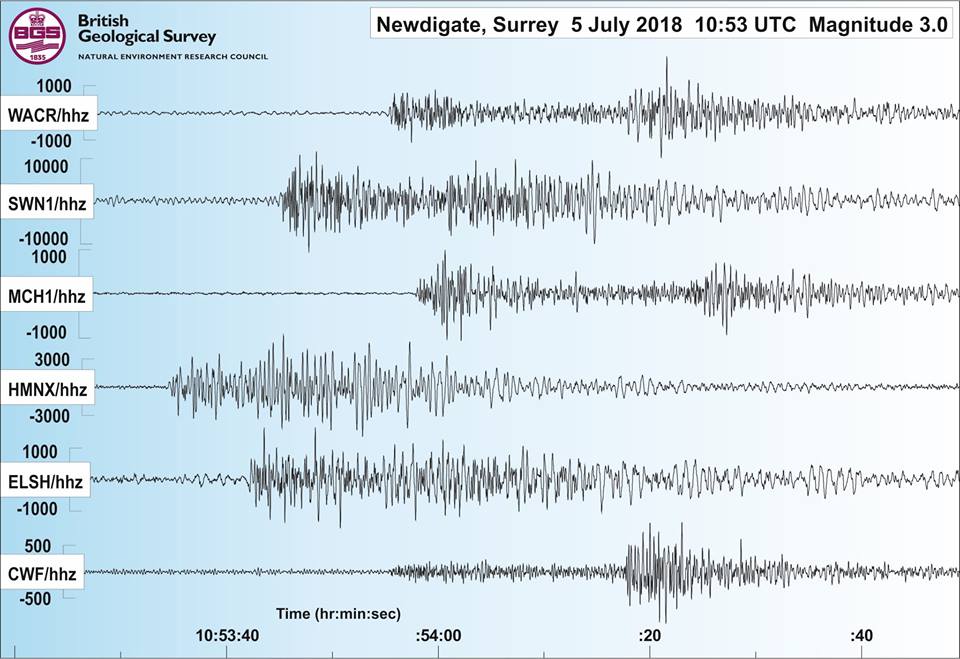
Charts measuring the 5 July 2018 earthquake at Newdigate in Surrey. Source: British Geological Survey
A group of senior geologists has called for an immediate moratorium on oil and gas exploration in the area of Surrey affected by 12 earthquakes in the past four months.
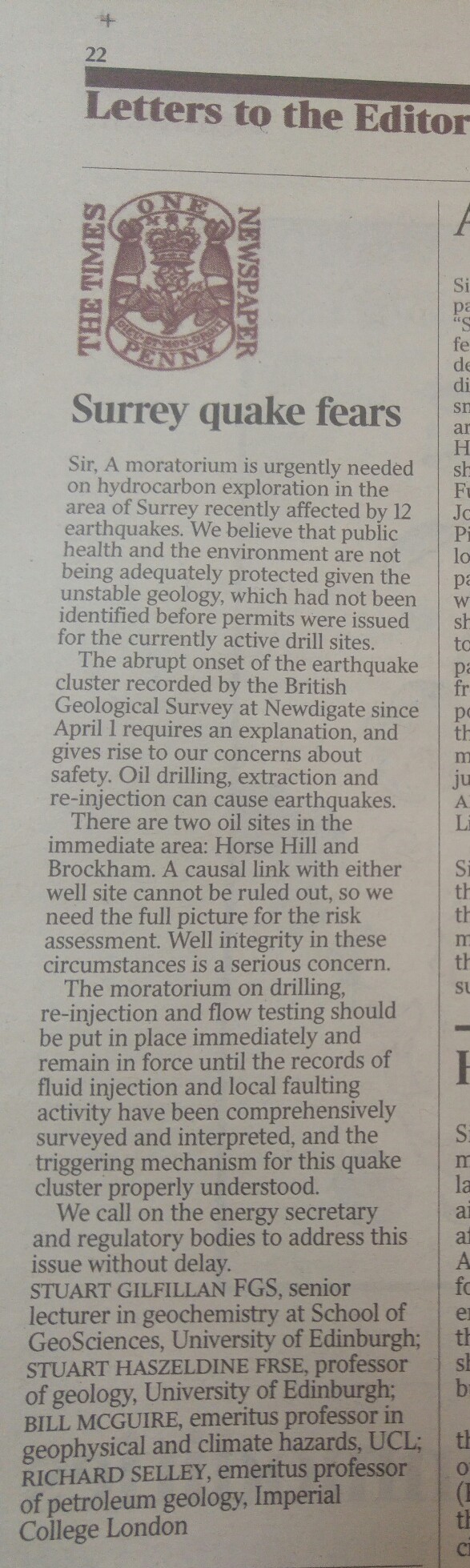
In a letter in this morning’s Times newspaper, senior lecturer Stuart Gilfillan and professor Stuart Haszeldine, both of University of Edinburgh, and emeritus professors Bill McGuire and Richard Selley, said:
“The abrupt onset of the earthquake cluster recorded by the British Geological Survey at Newdigate since 1 April 2018 requires an explanation, and gives rise to our concerns about safety.
“We believe that public health and the environment are not being adequately protected given the unstable geology, which has not been identified before permits were issued for the currently active drill sites.”
They have written to the Business Secretary, Greg Clark, and regulators of the oil and gas industry urging them to address the issue urgently.
The geologists said:
“Oil drilling and extraction, and re-injection in particular, can cause earthquakes.”
 There are two active hydrocarbon sites in the area where the earthquake cluster was felt: Horse Hill, operated by Horse Hill Developments Ltd, near Gatwick Airport; and the Angus Energy site at Brockham near Dorking.
Both companies have said there is no connection between their operations and the earthquakes (DrillOrDrop reports here and here).
Tests to assess the flow of oil at the Horse Hill site began after the start of the earthquake cluster.
This morning, UK Oil & Gas plc, the major investor at Horse Hill, said it was “very disappointed” that the four academics had issued the letter “prematurely”. UKOG said it hoped their motives were “purely scientific” but added “it appears otherwise as they have not been involved in the scientific investigation of the Newdigate tremors”.
The company added:
“The Horse Hill operator, Horse Hill Developments Ltd, was pumping at the Horse Hill site during only one of these 12 events. Pumping only started on 9 July 2018, following the first 8 tremors. Also, the Horse Hill oil well was shut-in all day on 18 July 2018.” Full statement by UK Oil & Gas plc on letter to The Times
At Brockham, Angus Energy’s managing director, Paul Vonk, said in an online interview last month:
“It is scientifically and physically impossible for us to have caused these tremors.” Link to Angus Energy comment on Surrey earthquakes
But the academics said today:
“A causal link with either well site cannot be ruled out, so we need the full picture for the risk assessment.
“The moratorium on drilling, re-injection and flow testing should be put in place immediately and remain in force until the records of fluid injection, and local faulting activity have been comprehensively surveyed and interpreted, and the triggering mechanism for this quake cluster phenomenon properly understood.”
In a statement issued this lunchtime by the campaign network, Weald Action Group, Professor Selley said:
“The location of the swarm close to two active fields suggests more than serendipity and merits investigation.”
Dr Gilfillan said:
“We know from existing borehole records that the drilling target is between 500 to 1000 metres below ground surface, and that is within the range of the latest depth estimates at which these earthquakes are believed to be occurring.”
Professor Haszeldine said:
“These earthquakes are unique and unprecedented events in the region, and seem to be increasing.
“I think the injection of acid and injection of waste waters may have caused uncontrolled consequences, which were not expected. This activity needs to be paused immediately, to understand what these companies are doing underground, and prevent any chance of leakage or earth tremors affecting people at the surface.”
New monitors
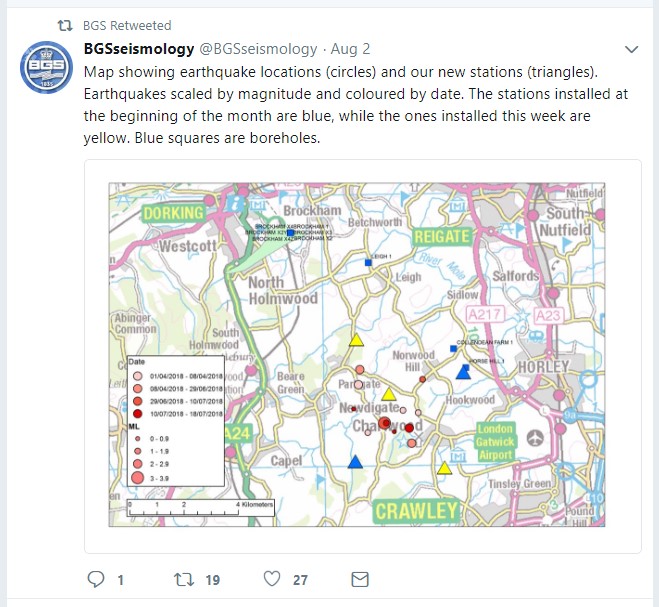
Tweet by the British Geological Survey on 2 August 2018 on new monitoring equipment
Last week, the British Geological Survey installed three extra sets of equipment to measure any future seismic activity in around Newdigate. This brings the number of monitors in the area to five.
The most powerful earthquakes in the recent cluster had a magnitude of 3 and most were said to be at a depth of about 1km. They were felt in places including Dorking, Newdigate, Horley and Charlwood in Surrey and in Crawley, West Sussex. Before April 2018, there had been no recorded earthquakes in Surrey for 50 years.
The Green MEP for the area, Keith Taylor, said:
“I welcome the British Geological Survey’s efforts to further monitor this activity and wholeheartedly support the call from geology and seismology experts for a moratorium on any oil and gas activity in the geological region until the results of any investigation are clear. The case for employing the precautionary principle is obvious.”
Increase in water injection

Extract from the latest OGA data on water injection at Angus Energy sites at Brockham and Lidsey in southern England
Also last week, the Oil & Gas Authority (OGA) released the latest data on the volume of injected water at the Brockham oil site. This showed an increase from 3m3 in March 2018 to 73m3 in April 2018. According to the OGA data, this followed several years of no water injection at the site. Link to OGA data page and data for Brockham
A local residents’ group, Brockham Oil Watch, told DrillOrDrop:
“The figure of 73 m3 reinjected at Brockham in April after an apparent long period of no or very low activity coincides with the onset of earthquakes in Surrey. This is concerning and any relationship between the two needs to be investigated further given that wastewater reinjection has been proven to be the main cause of earthquakes in the Central U.S., and that several experts we have been in touch with, including professors: Richard Selley, Peter Styles and David Smythe, indicated that it could be linked to the recent seismic activity.”
The OGA data is provided by the site operators. On 11 July 2018, DrillOrDrop asked the regulator what steps it took to verify data from operators. We are still waiting for a reply.
Brockham Oil Watch said:
“This is yet another example of a “gold standard” regulatory regime allowing operators to self-monitor and mark their own homework. There is no central database, the regulators hold data in disconnected systems that don’t allow for easy cross-referencing.”
DrillOrDrop also asked Angus Energy to comment on any relationship between injected water and earthquakes. The company has not replied.
The Brockham site is operating under an old-style environmental permit. DrillOrDrop reported this represented a regulatory loophole because the operator was not required by the Environment Agency (EA) to collect or maintain details on well stimulation or fluid reinjection.
Brockham Oil Watch said:
“A decade worth of reinjection data for Brockham held by the OGA is unreliable, whilst the HSE and the EA do not have any data at all, except for what Angus reported to the EA for period of Jan 2015-Jan 2016 in their re-permitting application documents.
“Even if the reported monthly totals were correct, much more detailed data is needed for analysis, including times and dates of reinjection, volumes per episode, applied pressures, exact destinations, etc.”
On Wednesday (8 August 2018), Surrey County Council is due to decide a part-retrospective planning application for the Brockham site. This includes a sidetrack well, drilled in January 2017 which the company said was covered by planning permission but the council said was not. DrillOrDrop background report. DrillOrDrop will be reporting on the meeting
Categories: Research

 DRILL OR DROP?
Ruth, why let science get in the way of your cause? Btw , why id you not report how many scientists reject this letter after it was sent around like a petition buy your activist colleagues? Since when do real journalists ignore science? This so called letter , which is really a petition, does not cite one specific let alone any fact. Yet somehow the timing is perfect. Ruth, you prove once again you are neither a journalist or independent.
Instead of wild speculation, what’s needed is a properly designed and monitored experiment. Gradually step up the injection rate and/or injection pressure and monitor for earthquakes. Similarly, increase offtake rate at the producer and see what happens. The BGS seismic monitors can easily detect events below human levels, so this could be done quite safely.
PS can someone paste the full letter from The Times, so that we can read it rather than pieces.
Hi Al
Ruth has added a scan of the letter in the main article – it should be there now.
Thanks. Another quote from The Times, reported elsewhere:
Brian Baptie, head of earthquake hazards at the BGS, told The Times: “Natural earthquakes tend to be a little bit deeper but it’s not unheard of to get natural earthquakes at those kind of depths. My feeling is that a natural cause seems more likely.”
“Earth tremors cease after oil extracted from Horse Hill!”
Now, that looks like a “causal” relationship to me (not-but we ignore that bit.)
Must be the pressure of all that oil down there, and when released the tremors cease. That must be the reason for the bigger pump being called for.
Goodness, this is fun. How to manipulate a share price on AIM and trouser a few quid! Or, “alternatively” to construct “news”. You have a point, Donald.
With reference to UKOG’s statement that “the Horse Hill oil well was shut-in all day on 18 July 2018.” What is the effect of shutting in a well? What is its purpose? If in this case it is to allow the pressure to build in the formation due to be tested, this could be viewed as a possible contribution to the stress on the faults.
If, on the dates of the earlier tremors, the well was similarly shut-in, the influence of shut-in pressure cannot be rules out as a contributing factor. We certainly cannot rule this out without access to the wellhead and downhole pressure records from Horse Hill. I think the “plugs” between zones are in this case are fitted with gauges. Any information from these should be made available to those investigating the tremors.
You are only going to build up the pressure back to its original value. Purpose is to see how well connected the reservoir is, in particular to measure permeability. If pressure builds up quickly then permeability is good. The pressure build up may also allow you to see discontinuities eg faults within the reservoir.
Gregor-it is quite easy to check what has been happening at HH, or not happening, for the last year or more. That may be a little more informative than speculating and saying “we certainly can not rule this out”, or suggesting a causal link.
Interesting how my tongue in cheek remark brings forth such a result.
Just perhaps, if the pressure was so great they could have not bothered with a pump?
I’m sure the BGS will have their own views on others thinking, from a distance, they know better. And wonder-why?
Why didn’t these so called geologists cite any scientific evidence? The companies have.
Hmm. No earthquakes for 50 years. The oil and gas industry starts re-injecting waste water nearby. 12 earthquakes in four months. This does not prove a link, but it makes one look very possible. Therefore the only responsible decision is to establish a moratorium. If the government ignores this call from eminent professors, then it will be because of lobbying by their masters in UKOOG.
https://www.getsurrey.co.uk/special-features/local-oil-company-angus-energy-14988544
But Ruth: “A causal link with either well site cannot be ruled out.”
The above sentence is meaningless.
There are water wells and gatwick airport near the recorded zone !!!
Shouldn’t we be worried about that as well?
April
You are right, it should be that a causal link has not been ruled out. If a causal link cannot be ruled out, then it must have been ruled in (having been ruled in following an in depth investigation ).
Plus, to say it has not been ruled out needs clarifying in the light of any investigation carried out ( listing other factors that have or have not been ruled out).
The truth of the matter is – we do not know, so it needs investigating to find those elusive causal links.
Likewise, Angus should be careful about saying the tremors are nothing to do with them, it should be that a causal link has not been ruled out yet but … – and then quoting the information they have supplied.to say that the probability is low.
Why have these scientists have ruled out any other cause when there are so many other possibilities! Is climate change not a consideration? This is the hottest summer in recorded history (globally)!!!
Well if it’s down to climate change we need to stop using fossil fuels pdq, don’t you think…?
Amanda – Yes. Absolutely. Hopefully, we are moving towards that day but we are not there yet. The fact is onshore drilling leaves less of a carbon footprint than importing.
Not using fossil fuels at all leaves even less of a footprint, we really don’t need to desecrate anymore land by carving it up with the potential for water contamination. There’s plenty coming out of the ground off-shore and elsewhere, we need a massive push for renewables, perhaps the oil and gas investors could divest their hard earned savings away from fossil fuels and into renewables to help speed things along… yes? And I for one would be absolutely delighted to see our beautiful countryside covered in wind turbines, I find them beautiful and saw loads of them whilst I travelled through France on a train. It made my heart happy to see them. Bring on wind, solar, hydro and geothermal power. Bring on less consumption of material goods, reuse, recycle, repurpose, repair.
Amanda
Yes…I would agree. But always easy to use oil from somewhere else without the inconvenience it causes than produce it locally and fully understand the consequences.
That was not the case with the coal industry, where consequences were there for all to see ( if you lived there ). Now it’s just a bit of imported Russian Coal!
Maybe the professors should have argued for a moratorium on oil use in the Weald.
“Not using fossil fuels at all leaves even less of a footprint …There’s plenty coming out of the ground off-shore and elsewhere, we need a massive push for renewables”
Yes I agree we need a massive push to renewables but why do you want to increase the carbon footprint by going with “off-shore and elsewhere”??? I don’t see your point. I see the contradiction. That makes no sense but a selfish one.
Yes I have agreed with you: We need to stop using fossil fuels. And there is no question that we need a massive push for renewables.
But why do insist on wanting for a larger carbon footprint by going “off-shore and elsewhere”?
This just seems very selfish.
So why in 2017 did we import just over 50,000 tonnes of crude but export almost 46, 000 tonnes? Why don’t we keep what we’ve got and import less?
https://www.gov.uk/government/statistics/dukes-foreign-trade-statistics
The calculation is not as not simple as adding the transportation carbon costs if you are comparing imported conventionally sourced fuels with home sourced unconventional.
You must add the “carbon footprint” of unconventional extraction (think rocks not pools of oil/gas) plus the massive energy cost for the highly salinated water containing Naturally Occurring Radioactive Materials and a cocktail of pollutants safely.
Sorry.
My answer to Martin also addresses your comment Adam. (Cut and pasted) – I got the information from govt statistics page 77 from this document which you can find here https://assets.publishing.service.gov.uk/government/uploads/system/uploads/attachment_data/file/729403/Ch3.pdf
As I’m not an expert in reading import/export figures perhaps I’m misreading the tonnage but it still doesn’t explain why we export almost as much as we import. If it’s because we don’t produce a particular grade of oil so we have to import it, it makes a mockery of the argument that we need to dig more out of our own soil to provide energy security/independence don’t you think as we’d still need to import the stuff we don’t have in our own soil? The argument that it has less of a carbon footprint if we dig it out closer to the point of use also falls flat on it’s face here too, as if we don’t have the stuff we need in our own soil we still have to import the same quantities we do now!
Amanda
Its an interesting question re why we export so much crude oil while we have net imports.
But there are a number of points to consider.
1. There are few crude oil pipelines coming into the UK directly to refineries. The key ones are the forties pipeline which delivers its product to Grangemouth, and the Norpipe system which lands at Teeside. The bulk of Norwegian imports are via the Norpipe line.
2. Other production is via Sullom Voe or offshore tanker loaded fields. In these cases the oil is in tankers and therefore can be sold anywhere in the world (wherever the best price is ) or where the best for it with the respective refineries. Hence that oil is exported unless it is sold to English Refineries (as Grangemouth is happy with what it gets from the Forties pipeline, topped up if required by tanker)
It is worth noting that UK oil production offshore is almost exclusively Scottish.
However, onshore oil is almost exclusively produced and used in the UK (and that will be England ) as the production from Wytch Farm (and the Weald ) goes to Fawley, and the production from the Lincolnshire / Notts Fields sets off to various onshore refineries by road or rail.
There is a section in the link below re import dependency.
Click to access UK-Dependence-on-Imported-Hydrocarbons-Insight-32.pdf
The hot summer really has no bearing on the april ‘events’, but in terms of re-injection of produced water and other well fluids on public water supplies, there is a potential vector: A hot summer and subsequent low pressure in the aquifers used for public water extraction, can cause an increase in the quantity of deeper water drawn into these important aquifers, often through leaky faults in e.g. the Wadhurst clay. Many faults in the weald have a substantial downthrow, (imagine an underground cliff) and can allow quantities of liquid to pass between different permeable rocks at the faults. Read e.g. the BGS/EA report on the “Physical properties of minor aquifers…….” for this information
If produced water passes back up the outside of the casing into one of these connected permeable areas and the pressure gradients and direction of slope are favorable to this, produced water could travel both from North to South and vertically in this area.
Bear in mind that some re-injection pumps for ‘conventional ‘ wells are rated at 5000 or 6000psi (some U.S. shale fracking is at 7500psi).
The pressure in the target formation as a whole may be decreasing as less is put in than was taken out, but locally, injecting into the relatively impermeable shale formations may create a dramatic pressure gradient close to the injection well.
They stopped fracking near Blackpool for lower seismic events. Now this Government wants to support further onshore oil and gas exploration and despite these Gold Standards, we haven’t seen seen any evidence of external monitoring of reinjection activity and whatever is happening at Horsehill., It’s a self-regulating industry. So when us locals say anything nobody listens, when eminent scientists say anything then someone in Government and the county Council’s is going to start squirming as they are accountable for letting it happen
And we can start by leaving any deposits in the ground in situ.