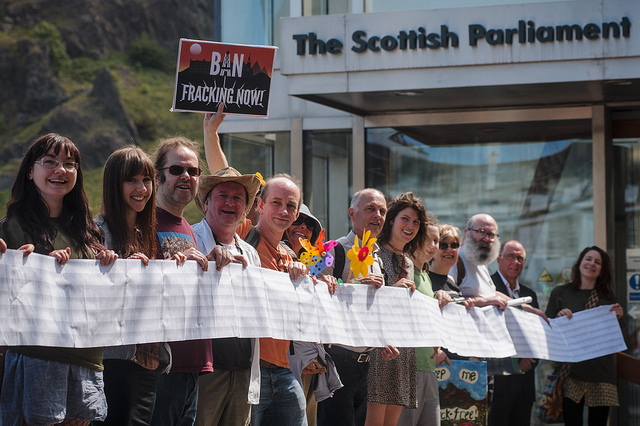
Opponents of fracking calling for a ban, 31 May 2017. Photo: Friends of the Earth Scotland
People have three more weeks to give their views on the Scottish government’s policy not to support fracking.
A consultation invites comments on the predicted impacts of the policy on the environment and business. There is also an opportunity to comment on the effects if fracking were allowed to go ahead.
The final policy is expected to be finalised in spring 2019.
The Scottish government introduced a moratorium on fracking for shale oil and gas and coal bed methane in January 2105.
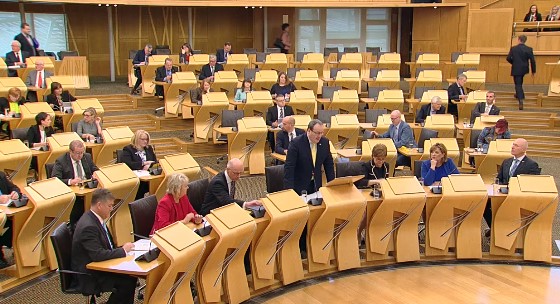
Scottish energy minister, Paul Wheelhouse, announcing government policy on unconventional oil and gas at Holyrood
A four-month initial consultation in 2017 attracted more than 60,000 responses, the vast majority opposing fracking.
In October that year, the Scottish parliament voted in favour of the Scottish government’s preferred position to not support the development of unconventional oil and gas.
To be finalised, the policy requires a strategic environmental assessment (SEA) and a business and regulatory impact assessment (BRIA). Both are the subject of the current consultation, which continues until 18 December.
Environmental impacts
The 304-page SEA concluded:
“Allowing unconventional oil and gas development in Scotland, could result in significant negative effects on the environment, even when taking account of existing regulation and consenting processes.”
It said there could be harm to air and water quality, climate factors, public health and safety, biodiversity, the setting of historic sites and the character and quality of landscapes.


The Scottish government’s policy to not support the industry would avoid these environmental impacts and any cumulative effects, the SEA said. It would result in significant positive environmental effects across all of the SEA topic areas.
The SEA also looked at the effects of a single pilot project. This would have much lower environmental impacts than the development of the industry but there was still potential for significant effects it said, depending on the location of the project site.
Measures to mitigate harm – such as monitoring, best practice techniques and carbon offsetting – would help to reduce the risk and severity of effects. But it was likely that environmental impacts would remain, the SEA said.
The assessment added:
“The Scottish Government considers the development of an onshore unconventional oil and gas industry in Scotland would make achieving its energy and climate change commitments more challenging.
“Whilst acknowledging the important role of gas in the transition to a low carbon energy future, the addition of an onshore unconventional oil and gas industry would not promote our ability to meet our greenhouse gas emissions targets or objectives in relation to protecting and enhancing the environment”.
Impacts on economy, business and regulators
The BRIA concluded:
“The total economic impact of unconventional oil and gas is estimated to be relatively low, and is not comparable to the current offshore industry in Scotland.
“While an unconventional oil and gas sector in Scotland could provide important benefits to Scotland’s petrochemical sector and provide a cost-effective gas supply for local energy networks, and increase security of supply, particularly for high energy use industries, the scale of production in Scotland would be relatively low in comparison to European or international gas production and would be unlikely to have an impact on global gas supply prices, and therefore on consumer energy costs.”
The assessment said the Committee on Climate Change had warned that emissions from production of unconventional gas and oil would need to be offset through cuts in emissions elsewhere in the economy.
It also said communities, particularly those in areas where fracking was likely to take place, had yet to be convinced there was a strong enough case of national economic importance, when balanced against risk and disruption.
The Scottish government’s policy would provide certainty to industry and communities, the assessment said. It could improve investment opportunities in some sectors and could benefit the supply chain if the unconventional oil and gas sector targeted different resources.
On the costs of the policy, the assessment said the total cumulative spending in Scotland of the industry had been estimated at £2.2b up to 2062. The unconventional gas and oil industry had been estimated to add £1.2bn to the Scottish economy or 0.1% to Scottish GDP per year over the lifetime of the industry.
At its peak, the industry would support 1,400 jobs, including indirect posts, the assessment said. Cumulative additional tax would be 1.4bn to 2062. There could also be losses of fees, land rents and charges to some public bodies.
Allowing fracking to go ahead could provide feedstocks for chemicals and manufacturing, reducing costs and avoiding the need to import. But these benefits had not been quantified because of uncertainties, the assessment said. There was unlikely to be any impact on domestic or global energy prices.
A pilot project would increase understanding of the resource and its impacts but it would require funding by the project partners, the assessment said. Typical onshore exploration costs were £0.5m-7m and projects could take two years to plan.
Community opposition
Community councils, the most local tier of elected representatives in Scotland, are raising money to ensure their voice is heard in the consultation.
They are seeking £2,000 to pay Sir Crispin Agnew QC and Mothiur Rahman to make their case. Both lawyers represented Concerned Communities of Falkirk and nine Falkirk Community Councils at the public inquiry in 2014 into Dart Energy’s plans to drill for coalbed methane at Letham Moss, near Airth.
Maria Montinaro, of Concerned Communities of Falkirk, said:
“We feel it is important for Community Councils to not let go of the slack at these final stages where the draft “Strategic Environmental Assessment” (SEA) of the effective ban policy is now out to public consultation.
“Scottish communities still don’t have a legally robust ban on fracking that they can be confident will remain in place for the foreseeable future.”
Links
Strategic environmental assessment
Business and regulatory impact assessment
Scottish government position statement on unconventional oil and gas
Categories: Politics

 DRILL OR DROP?
Dead on Arrival. RIP (fracking dreams for Scotland). Fossil Fuel fans can console themselves with the new BP developments west of the Shetlands with the Clair Ridge field promising up to 120,000 barrels a day. Where there’s oil there’s usually gas as well. The North Sea is getting a reboot.
4335 days to go
https://www.bbc.co.uk/news/uk-england-kent-46334763
??
Philip P – 12 years according to the IPCC report, then mass starvation in Africa….people moving now; would you wait?
“Between 2009 and last year, about 6bn barrels of oil were produced, yet only 1.2bn barrels were discovered. Drilling has fallen to all time lows.”
Yes, it’s getting a reboot-170,000 people have been booted out of jobs in the last few years.
Once again, a selected anti view of the subject manufactured to distort the picture.
What is happening, is that the majors are abandoning their fields but privately backed organisations believe there is still money to be made eg INEOS currently negotiating with ConocoPhillips for around $3b of it’s N. Sea assets..
Well, its the sixth fracked Sunday of 2018 November 25th and what do we see here today? Well it seems the paunch and judith sock puppet travelling circus show is still frightening the children and throwing the baby out of the pram rather than actually discussing anything.
Claire Perry has rolled out the standard smear fear strategy about personal threats, just before she is due to talk to the public, interesting that, we have seen that before haven’t we? And central government and local activists seem to be continuing to smooth the way for their Big oil and Gas paymasters, in spite of local and wider objection and refusal, so no change there.
I wondered what to do today, another song, a poem maybe, or just let the fracking industry PR hot deskers drown Drill or Drop in streams of empty meaningless invective to anything and everything as per usual?
Something that has emerged from the WW1 armistice 100th anniversary has raised some interesting questions however. And that ois James Corbett (see the Big Oil videos for the truth about how Big Oil and Gas gained their power over the weakest in governments) and others about the causes and secret history of the causes and manipulation of events that led to the First World war and its post war legacy.
This has moved the First World War machinations into a far more interesting perspective and indicates just how secret pressure groups manipulate public opinion to achieve a particular agenda.
We are often accused of that popular epithet of “conspiracy theory”, but as i have said before, that term was a psyops term secretly spread around by the CIA to quell comments about the JKF assassination from reaching any public independent thought about all the gaps in the official assassination story, so rather than address those this term “conspiracy theory” accusation became used to quell any discussion whatsoever.
It was quite clever, since then from that point on, no one wanted to be called a “conspiracy theorist” even if there was a conspiracy, and that is used very widely now as an intended put down and attempt to insult and intimidate any independent thought on almost any subject, fracking and Big oil and Gas included.
But what if there really are conspiracies? Are we so afraid of the epithet that we dare not say anything that would illicit such an epithet?
Are we that easy to control? Are there conspiracies to manipulate us about fracking and its associated avoidances of the word today, and what are the consequences of the failure to examine such activities in the light of truth and not be put off by some weak and transparent epithet designed to stop anyone from speaking out against anything?
These are links to James Corbett’s World War 1 documentaries that shows that so called conspiracies were indeed perpetrated against the public daily and perhaps makes us consider, looking at the world situation now, what exactly is being done now that can be quite justifiably be called a “conspiracy” though the truth may be more that business and corporations only have an obligation to make profit, and they have no other consideration, none at all, and people are just a means to an end and to be rail roaded if they get in the way of the prime directive, that of profit at any cost.
The WWI Conspiracy Part 1
( https://www.youtube.com/watch?v=tclAbWvBt70 )
—
The WWI Conspiracy – Part Two: The American Front
( https://www.youtube.com/watch?time_continue=4&v=x-5kWX7rYuU )
—-
After World War I (1/2) | DW Documentary (WW1 documentary)
( https://www.youtube.com/watch?v=35KIztppzBY )
—-
The WW1 Legacy
How & Why Germans Bought Hitler’s Pitch
( https://www.youtube.com/watch?v=uCu7IT81gh8 )
If you have time today or later, do watch these documentaries and consider perhaps that if such machinations were perpetrated on the worlds people over 100 years ago, and looking around at similar events in the last 100 years and today, what is being done in the name of truth a d freedom today that does indeed fit the term “conspiracy” or more accurately, “manipulation”.
As always, don’t take my word for anything. Do your own research,
James Corbett also produced a documentary about how all wars are fabricated to enable either political or corporate agendas and the supposed causes were often not even true events?
I put the links in parentheses so they don’t overwhelm the DoD site, just click the links and they will open in your browser.
Have a good sixth fracked Sunday and i hope you all spend today with family and friends and maybe if you get a chance to watch these documentaries, consider what is being done in our name today particularly in the present invasive fracking situation and ask yourself what the ultimate agenda is and who is responsible for attempting to dumb us all down and intimidate us from even asking the right questions?
http://www.dailystar.co.uk/news/latest-news/744519/Weather-forecast-UK-Met-Office-snow-winter-Christmas-London-Manchester-Birmingham
https://www.dailymail.co.uk/news/article-6425533/Britain-braced-worst-winter-2010.html
Time to switch on your Gas Central heating phil…
This is me mentioning the word “conspiracy” for you just to keep you interested…
Tripe on Sunday exclusive “Country braced for snowmageddon as weather forecasters predicts winter is colder than summer!”
Just mentioning the word “mirrors” for you kish, just in case you forget how they work again?
“There’s no such thing as bad weather – only the wrong clothes.”…..
Tell that to the millions in fuel poverty in the U.K…
So Fracking is going to reduced to cost of gas to the U.K. consumers then is it Kish?
YES 100%…
At the moment expensive imports of LNG have hit a new high…LNG is twice the cost of piped Gas and peoples energy bills are going up and up as I’m sure you’ve experienced.
Huge tax revenues from U.K production from onshore Gas will enable the Government to keep its promise on an energy price cap
Not much wind again today and Coal is being burnt on the back of this…
So we should take responsibility for the energy we use, produce our own enabling a secure supply, bills down and reducing CO2 emissions by not importing more Gas…
https://www.theguardian.com/business/2018/nov/02/number-of-uk-households-in-energy-debt-rises-by-3000000
Click to access Committee_on_Fuel_Poverty_Annual_Report_2018.pdf
‘At the moment expensive imports of LNG have hit a new high…LNG is twice the cost of piped Gas and peoples energy bills are going up and up as I’m sure you’ve experienced.’
Time for the pro frackers to get on with protesting about how much home grown cheap North sea gas we export. People will not be happy to hear we are exporting as much as we import in LNG.
If you are frightened about gas security why give huge amounts away?
Ahhh John because if Energy security was a serious issue for U.K. Gov they wouldn’t allow us to operate with minimal gas storage compared to other major European countries. Yet again (deliberately) the sick man of Europe
Just a quick reminder on what’s going on in the real world,
“The UK has significant remaining petroleum reserves. The OGA’s estimate for proven and probable (2P) UK reserves is 5.7 billion
boe. On the basis of current production forecasts1, this could sustain production from the UKCS for another 20 years or more.”
“A higher estimate of 20 billion boe is considered reasonable given the upside potential reflected in possible reserves, contingent resources in producing fields and contingent resources on other discoveries currently on unlicensed acreage.”
Click to access uk-reserves-and-resources-31-october-2017.pdf
UK Energy Minister Claire Perry said: “The North Sea is crucial for the UK’s energy security and helping businesses maximise economic recovery there is an aim for this government.
“Aided by the innovative use of technology developed in the UK and a strong UK-based supply chain worth £1.5 billion, this will allow the North Sea to continue to be a hub for the high-skilled, well-paid jobs at the centre of our modern Industrial Strategy.”
By 2035 renewables will be producing 180 TWh of electric generation whereas gas will only be producing 40 TWh.
After 2025 our import requirements will be dropping
Click to access Updated_energy_and_emissions_projections_2016.pdf
I know it’s hard for pro frackers to accept but the North sea oil and gas fields are real. I kid you not.
Click to access NorthSeaMap2013-071713Ads.pdf
The North sea map may not be consistent with the flat earth model.
John it’s no good posting a map for Kishney, he cannot find his backside with both hands with or without a map.
I did my research and find that James Corbett is ‘a vigorous skeptic of climate change and the IPCC’….. https://rationalwiki.org/wiki/James_Corbett
Probably not directly crembrule, but gas produced in the UK is taxed in the UK. Gas produced in Norway is not.
UK tax can be used for all sorts of things-including easing energy poverty. Or we can just pay it to Norway and they can add it to the $1 trillion plus Sovereign Wealth Fund to spend on what they want, for Norwegians. A rather daft way for the UK to be giving overseas aid.
That basic exercise has been explained to you numerous times. Wonder why you keep ignoring it?
How’s Sterling doing? You can work that factor out for yourself.
Make your minds up chaps.
Personally I go with Martins appraisal ie no change to consumer pricing as extracted gas will be sold in the European markets to the highest bidder, just as it is now.
So whilst there is tax take that will disappear into the austerity black hole and those in fuel poverty will not directly benefit.
crem you do not mention the big positives of producing our own Gas ie:
+ Security of Supply
+ Reduced CO2 Emissions
+ Huge tax revenues to the Government to maintain an energy price cap
+ Increased Employment
+ £Millions spent with local business
You focus on cost to the consumer? If that was your only reason, price… How would your energy bill look if shale Gas was in the system already and had a 9% reduction with green subsidies removed?
https://www.theguardian.com/business/2018/oct/07/fog-of-brexit-has-had-massive-bearing-on-energy-bills-supplier
Wholesale gas prices spiked to their highest level in at least 10 years as the country was hit by a cold weather snap dubbed the beast from the east in February, while the heatwave felt across the country this summer has also led to higher than usual demand for electricity.
Academics said British demand for electricity rises 350 megawatts (MW) for every degree the temperature rises above 20 degrees Celsius, a frequent occurrence in recent weeks, while lower wind speeds curb power output from the country’s wind farms.
https://www.theguardian.com/business/2018/oct/07/fog-of-brexit-has-had-massive-bearing-on-energy-bills-supplier
Just wanted to counter your weak argument about fuel poverty. My pleasure btw.
Kishy, you keep coming back with the same ole rubbish; we have blown this one out of the water already:
1. We do produce our own gas already – small industry just off the coast….
2. Fuel poverty is just poverty and cannot be ‘cured’ by shale. In fact the negative affects of shale will drag more money away from the people who need it thus driving more into poverty i.e. this who cannot afford to pay for food, energy and essentials.
3. Small issue of climate change and migration due to mass starvation; coming to a city near you, very soon.
4334 days to go….
Crembrule – nice the way you try and discount any benefits from taxing gas. Should we abandon taxrs altogether seen as the just ‘disappear into an austerity blackhole’
The main use for tax for UK gas would be to help recover the subsidies they’re given in the first place. It’s a moot point as fracking on UK soil (for gas) is unlikely to run into profits for the foreseeable future.
Philip C – well with all of the subsidies given to the oil industry is I’m surprised Norway, Qatar, Saudis etc haven’t bankrupted themselves
https://www.newsinenglish.no/2018/02/05/norway-is-now-the-richest-in-the-world/
Well done the U.K for supporting Norway buying all that Gas from them while here in the U.K we have enough Gas for decades right under our feet…
Dixie Matre, a teacher and a British ex-pat, has given birth to two children in Norway. Her experiences could be described as downright luxurious compared to American medical standards. She received routine no-cost check-ups with midwives, took aqua aerobics classes to naturally ease pelvic pain, and her hospital rooms came standard with a bed big enough for her and her husband to share with their new family and, as in the case of her second child, and an en-suite bathroom with a large bathtub where she could labor naturally.
She, like other Norwegian mothers, was also given a choice of government-mandated maternity leave options: either 100 percent pay for 49 weeks plus holidays, or 80 percent pay for 54 weeks. And once she and her husband went back to work after their youngest son, Elias, now 2, was born — dads get government-mandated parental leave also — he was enrolled at a government-subsidized nursery school that employs its own cook who bakes bread and cooks organic meals for the children.
https://ijr.com/norways-standard-u-s-lags-far-behind/
“enough Gas for decades right under our feet” … unproven and unlikely. Norway’s gas does not come from under its feet. Do catch up.
I’ve done over 60 working trips to Norway, don’t worry I know where it comes from…
In Layman’s terms imagine how much it costs to extract Gas from The North Sea and piping it all the way to the U.K, now imagine the cost of drilling on land for Gas then piping it a couple of hundred metres into the U.K Gas network…
You know where it comes from then. So why the attempt at deception? Now consider the cost of drilling thousands of wells, including many duds, and covering England in a lattice of interconnected pads, getting gas out of those minuscule cracks in the shale formations which you have to endlessly puncture to keep the flow rates up (and due to the output per well only having a productive life of a few years). Starts to make piping from a North sea reservoir look positively attractive.
Why are you highlighting the cost of drilling wells?I don’t think you understand the costs involved both financially and to human life by operating in the North Sea.
Once the wells have been drilled and the subterranean manifold and pipework installed the only visible presence will be a couple of manholes in a field quietly producing Gas into the network for years.
The UKCS and Norwegian production is on the decline so we will have to source our Gas from further afield.
Your naivety is stunning Kisheny.
But we don’t live in Norway Kish.
Norway has a Government with social conscience unlike the U.K. Our Government like to grease the palms of business and the rich with tax breaks.
Norway’s Social Democracy should be an athema to a righty tighty capaitalist like you Kish. Are you turning to the dark side? Next you will be advocating those crusties right to peaceful protest.
For the first time in 20 years the Norwegian government is opening up a new oil frontier in the Arctic.
We will show the court that oil drilling in the Arctic is not only deeply immoral but also violating Article 112 of the Norwegian Constitution that says that the State shall ensure for everyone, including future generations, the right to a safe and healthy environment.
https://www.peoplevsoil.org/en-GB/peoplevsarcticoil/the-people-vs-arctic-oil-court-case/
Norway beat back an unprecedented lawsuit by environmental groups that sought to curb oil drilling in the country’s Arctic waters.
https://www.bloomberg.com/news/articles/2018-01-04/norway-beats-back-lawsuit-seeking-to-curb-arctic-oil-drilling
I agree, but you’ve changed the subject.
https://www.theguardian.com/money/2018/nov/25/homeowners-trapped-solar-panels
Let’s see how France are getting on with paying huge sums to subsidise intermittent renewables???
“Support for renewable energy … will be increasingly financed by a tax on fossil fuel consumption,” the environment ministry said in a statement.
Rioting in the streets…
https://www.google.co.uk/amp/s/www.express.co.uk/news/world/1048456/france-riots-fuel-tax-protests-death-toll-emmanuel-macron/amp
https://www.google.co.uk/amp/s/mobile.reuters.com/article/amp/idUSKCN1C21DL
Their policy is sound Kisheny. The Carbon Tax is adding just 4 cents a liter to fuel costs. And there are other factors in the mix causing unrest. If the petroleum majors were passing the recent price drops in oil on to the customer then overall prices would have been going down.
In May, an online petition calling on the government to reduce gas prices garnered more than 900,000 signatures
More than a quarter-million French people took to the streets on Saturday (Nov. 17) to protest a rise in fuel prices tied to the government’s new carbon tax.
Increase taxation to pay EDF for expensive intermittent renewables?
https://www.google.co.uk/amp/s/mobile.reuters.com/article/amp/idUSKCN1C21DL
https://qz.com/1468345/frances-fuel-protests-show-how-poor-people-can-bear-the-cost-of-fighting-climate-change/
Your prolific posts to save your job are a credit to you. Again, your belief system dis-empowers you so you cannot face the reality of your future;sad.
Foot in both camps Gas and offshore wind turbines…
That is why being in both these industries I don’t have to read the Guardian to have an opinion…
But you don’t like wind turbines…is this a double entendre?
Reading is good for you Kishy, it broadens the horizons…plus there are some good alternative jobs advertised in there for you…….
So you broaden your horizons reading someone else’s opinion to form your own. Maybe that’s why you’ve never posted anything original from personal experience…
Of course no one noticed that the economics suddenly disappeared into a black hole, when the argument was lost!
Oh yes we did.
What this country does with taxes crembrule is up to the electorate. If they don’t like what is done, then they change those responsible. That is why people voted in large numbers for Brexit.
Strange, when an election campaign is underway many call for business to pay more tax so individuals pay less but get better services. The argument that the individual pays more but gets no better services doesn’t look like a vote winner. Maybe that’s why the Fylde is still Tory?
Grangemouth is at the centre of Scotland’s petrochemicals industry. The oil related industries are a major source of employment and income in these regions. It is estimated that the industry employs around 100,000 workers (or 6% of the working population) of Scotland.
If Sir Jim couldn’t ship in American shale Gas by product ethane In am sure Ineos would have moved it’s operations out of Scotland.
Scotland’s economic future?
https://www.google.co.uk/amp/s/www.bbc.com/news/amp/uk-scotland-44321209
Nicola has sat on the fence about shale Gas in Scotland initially saying there is an outright ban on fracking, when really it was pr gloss with a moratorium in place leaving the door open purposefully to allow it at a future date.
If the SNP are serious stop stalling and after the latest consultation make your minds up…
It’s a simple no-brainer. If we are trying to reduce our dependence on fossil fuels for the sake of the earth’s climate for our grandchildren’s grandchildren (and only a fool would disagree with that) we MUST cease fracking altogether NOW – and put resources into renewables.
By producing our own Gas and reducing imported Gas we will reduce our CO2 emissions…
I see you are from the 100% renewables camp, so please explain how this can be achieved today in 2018???
We do produce our own gas; waste is the key – don’t burn gas to make electric, insulate all homes, no need for imports, no need for shale (not that there is any anyway; all stop I believe).
oh and by the way, best not export what we have if it is needed so much…….
Sherwulfe – as you know the only time we export is as a result of LNG passing through out networks or in summer when we don’t have the capacity to store gas produced from non-swing reservoirs. So following your argument through – are you in favour of the UK increasing its storage capacity? If so I think there’s quite a lot of salt that we can dissolve to create storage sites if you have no objections