Two new wells planned for the UK’s newest onshore oil production site are likely to be stimulated by proppant squeeze, a small-scale hydraulic fracture.
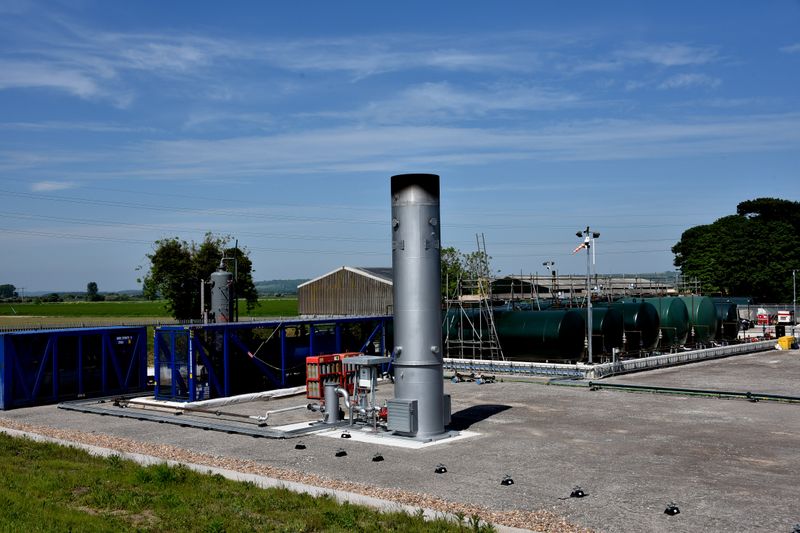
Egdon Resources, the operator of the Wressle site in North Lincolnshire, revealed the news in information published today on a Facebook group.
The company, now owned by Texas-based Heyco Energy, said it hoped to drill up to two new production wells to reach different parts of the oil reservoir. It said:
“It is expected that both producing wells would be subject to a proppant squeeze operation”.
A proppant squeeze is designed to increase the flow of oil into the well from surrounding rocks.
Egdon carried out a proppant squeeze on the existing well in August 2021.
It said this “remediated the near-wellbore formation damage and increased the permeability of the near wellbore oil-bearing formation”.
The company described the operation as a success and said today it had enabled “the high oil production rates since that date”.
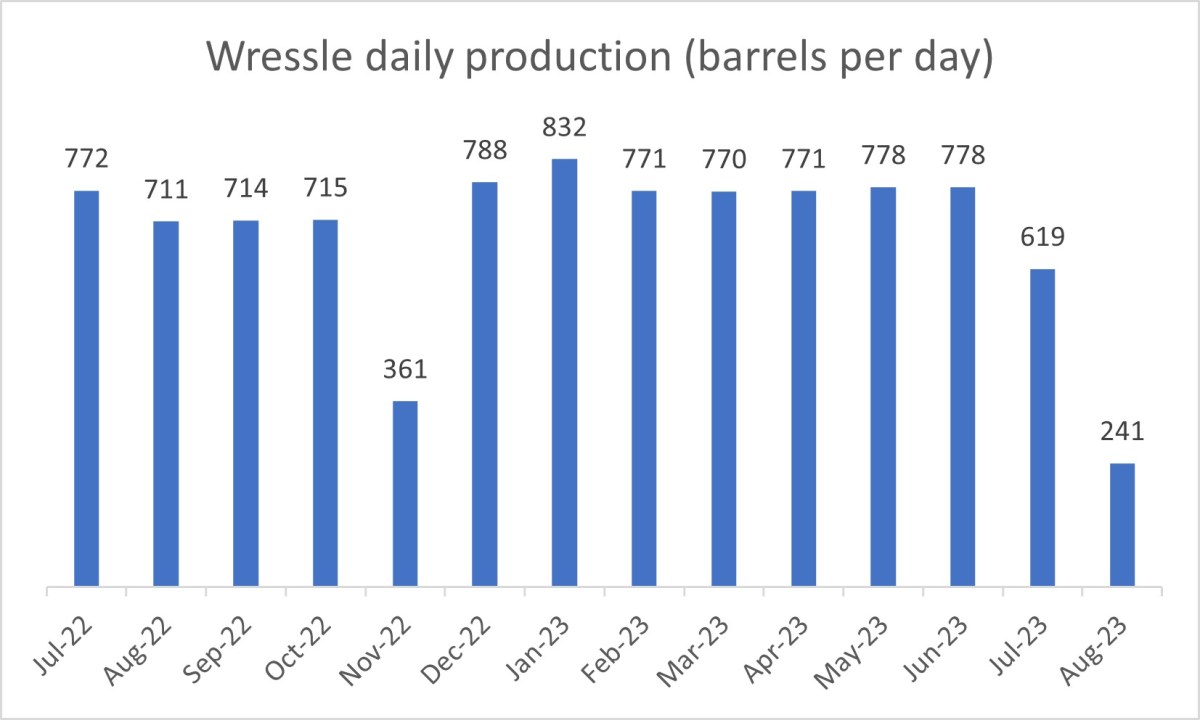
The existing Wressle well began formal production in July 2022. In the 14 months for which official data is available, the well produced an average of 687 barrels of oil per day. The oil has been taken by tanker to a refinery on Humberside.
Wressle has been the second biggest UK onshore oil producing field, after Wytch Farm in Dorset, for all but one month since formal production began. A workover in August 2023 (the most recent month for which data is available) reduced it to seventh in the UK onshore rankings. Its average contribution to UK onshore oil production has been 5%.
In the 2022 proppant squeeze, Egdon said it injected 146 cubic meters of gelled fluid and 17.3 tonnes of ceramic pellets into the well.
The Environment Agency regarded it as “small scale hydraulic fracturing activity”.
Proppant squeeze is not covered by the current moratorium on associated hydraulic fracturing in England because it uses less fluid than the statutory definition of 1,000m3 per fracking stage.
But the operation will need a hydraulic fracturing plan (HFP), which outlines that Egdon would do to minimise the risk of earth tremors and how the process would be monitored and controlled.
The HFP must be approved by the Environment Agency and the North Sea Transition Authority.
Water injection well
Egdon also said today an additional well may be needed to inject water produced from the rock formation during oil production.
The existing Wressle well began producing water during July 2023, Egdon reported earlier this year.
Produced water can be expensive for oil companies. The water is often salty and can be radioactive. It must either be treated or injected back into the formation.
Since July 2022, total water production has been 231m3. A flare at Wressle burned more than 5,000ksm3 (thousand cubic meters) of gas produced alongside the oil.
Consultation
All three new wells proposed for Wressle will need planning permission from North Lincolnshire Council and a bespoke environmental permit from the Environment Agency.
Egdon said it was in the process of preparing the applications. It said it hoped to submit the planning application in January 2024.
As part of the application process, the company said it was launching its own consultation. This will run from Monday 27 November to Sunday 24 December 2023.
The company said there would be information online at Egdon-community.com/wressle-consultation and at a public drop-in event on Tuesday 28 November 2023, from 2pm-7pm at Broughton Village Hall, 59 High Street, Broughton DN20 0JX.
At the time of writing, the online information was not available.
Egdon’s consultation does not replace the formal public consultation which will be organised by North Lincolnshire Council after the planning application has been submitted. This will allow people to comment directly to the council’s planning department.
- Union Jack Oil, which as a 40% stake in the Wressle licence, reported on 8 November 2023 that the Wessle well was back in production following the installation of a downhole jet pump

 DRILL OR DROP?
So, what has been done at this site already successfully, will be done again.
How “exciting”?????? Or, just how anticipated.
A reminder of how easy it is to cause earthquakes and well damage from relatively small hydraulic fracturing operations.
https://www.gov.uk/government/publications/preese-hall-shale-gas-fracturing-review-and-recommendations-for-induced-seismic-mitigation
Interesting report which concludes that “there is no reason for Cuadrilla to stop fracking, if it takes precautions”.
It caused me to look for recent evidence of tremors. Since we are NOT currently fracking these can clearly NOT be attributed to anything other than normal causes. Lo and behold. In the last 60 days….
http://www.earthquakes.bgs.ac.uk/earthquakes/recent_uk_events.html
It must therefore be difficult to attribute certain specific tremors to fracking when they occur all the time anyway. The report hedges its bets accordingly.
I’m therefore still of the opinion that the possibility of a big damaging earthquake is unlikely enough to stop us from the possibility of accessing 50 years of gas.
‘It must therefore be difficult to attribute certain specific tremors to fracking’
Of course you may be lucky enough to frack without causing an earthquake although the 2 we have fracked proves that unlikely.
Fracked wells deplete fast so constant drilling is required. They need to be in close proximity to each other to share natural resources and infrastructure. The potential risks of the cumulative effect of multiple wells is way to great. The possibility of big damaging earthquakes would have been very real.
One well would have to be drilled and fracked every day for 15 years to produce enough gas to replace half future UK gas imports, according to new study for Friends of the Earth.
What nonsense from FOE. How on earth have they decided that UK would try to replace half future gas imports from on shore? Usual strawman twaddle.
But, nice of them to admit that UK future gas imports are going to be very large! Rather defeats their overall agenda, doesn’t it? These very large imports will come from where? Middle East-suspect. Russia-no. USA-yes, from FRACKING!!! Norway-probably, but most in Europe will be wanting that.
Well, that is geothermal in the bin, also. Looks like there ain’t going to be much left……..
If the precautionary principle is continued to be followed the wind turbines that have been known to explode need to be removed, post haste, and the solar panels and EVs that have been know to spontaneously combust need to go as well. As for those E scooters, goodness how did they every get allowed? Electricity distribution? Well, that is littered with reports of death and destruction, so it is going to be a bleak winter.
I have the answer: HIBERNATION.