Campaigners have restarted a legal challenge against a council which ruled that plans to expand the Wressle oil production site do not need a detailed environmental study.
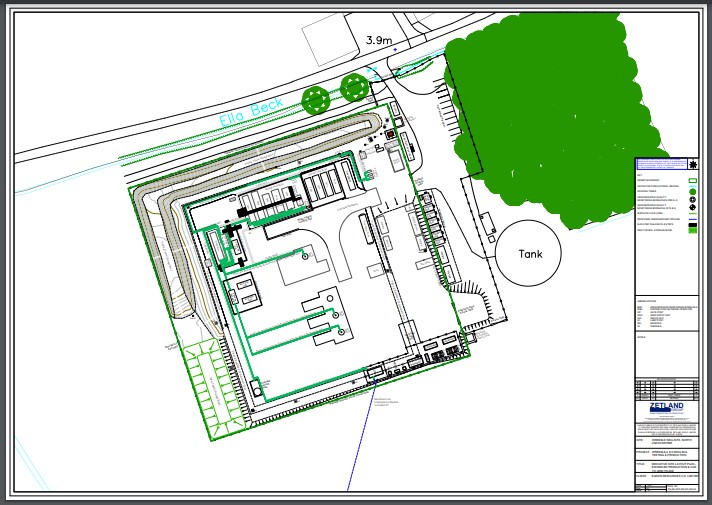
Original proposals to add two new wells to the site near Scunthorpe were quashed in November 2024 after the threat of legal action, following a landmark judgement at the Supreme Court.
Then, North Lincolnshire Council conceded that the planning permission it granted for Wressle expansion was unlawful because it failed to consider carbon emissions from burning oil or gas from the site.
But now the council has again told the Wressle operator, Egdon Resources, that a new application would not need an environmental impact assessment (EIA). This means that the application can be considered without an assessment of the combustion emissions, also know as downstream or scope 3 emissions.
Egdon had said in its second EIA screening request in February 2025 that greenhouse gas emissions from the expansion would not have a significant impact and no EIA was needed.
“Scientifically flawed” decision
Today, the campaign group, Fossil Fuel Free Lincolnshire (FFFL), argued in a legal letter to the council that the impact from greenhouse gas emissions from an expanded site would be significant and should not be dismissed.
The pre-action protocol letter said that in reaching the screening decision the council failed to interpret environmental regulations correctly. It also failed to assess properly the overall impact of the project, to the point of being “scientifically flawed”.
The letter called on the council to withdraw the screening decision and conclude that the proposed expansion should be subject to an EIA.
A spokesperson from FFFL said today:
“According to Egdon’s reports, this site will produce nearly 1 million tonnes of CO2e.
“In the middle of a climate crisis, dismissing that quantity of greenhouse gas emissions as ‘insignificant’ is clearly misguided.
“If Egdon and other oil and gas developers are allowed to make this excuse for every new project, where does it end? These emissions add up. Together, they are the major force driving climate breakdown.
“We can’t keep pretending each cut doesn’t matter — this is death by a thousand cuts, and science demands that we do better. We trust the council will reconsider and reverse their decision so that this issue can be subjected to proper public scrutiny.”
The quashing of the initial expansion application last year relied on the landmark Finch judgement, issued by a majority of Supreme Court justices.
This ruled that the planning applications for fossil fuel production applications must consider downstream emissions as part of an EIA.
The Finch judgement also made it clear that people had a right to participate in decisions about the environment. This increased the democratic legitimacy of the decisions and would raise public awareness of environmental issues, the court said.
Leigh Day solicitor Julia Eriksen, who represents FFFL, said:
“Last year, campaigners in Lincolnshire were successful in their challenge against the Wressle expansion, highlighting that granting the planning application without an EIA was no longer acceptable following the Finch judgment earlier that year.
“However, a review by North Lincolnshire Council has concluded that greenhouse gas emissions from the development would be insignificant and that no EIA is required again. Our client is arguing that the conclusion on ‘significance’ was flawed and failed to properly consider the impact of the emissions on the climate.”
Detailed grounds
FFFL has challenged the EIA screening decision on five grounds. It said the council:
- Failed to take into account a number of criteria in deciding whether an EIA was required, contrary to the EIA regulations
- Misinterpreted the relevant guidance for evaluating the impact of greenhouse gas emissions and the question of “significance”.
- Incorrectly concluded that projects that amount to less than 5% of the UK’s carbon budget will not have a significant effect on the environment.
- Failed to have regard to the cumulative impact of the existing emissions from the current well site at Wressle in addition to the proposed two new wells.
- Deprived the public of the ability to meaningfully participate in decision-making and scrutinise the environmental impacts of the project.

 DRILL OR DROP?