Plans to carry out a lower-volume hydraulic fracture at the West Newton-A oil and gas site in East Yorkshire look likely to get the go-ahead.
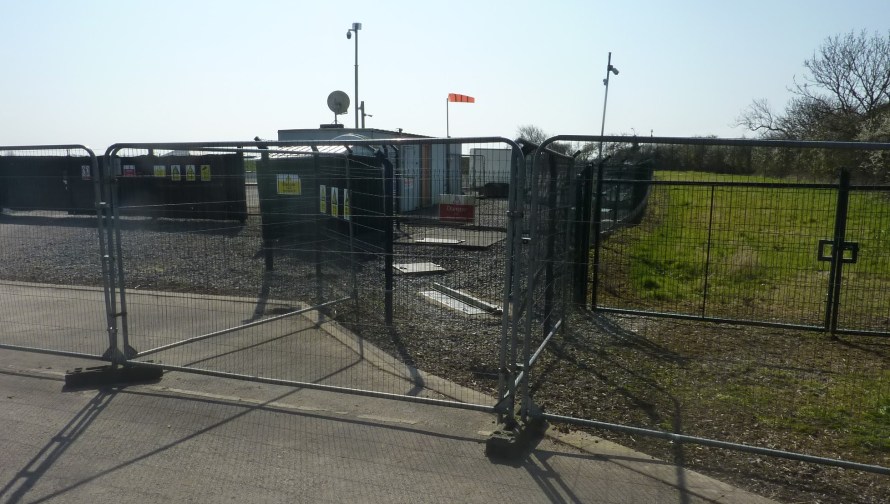
The Environment Agency has said it is minded to approve proposals by Rathlin Energy to inject oil-based fluid and proppant into the target reservoir at pressures high enough to fracture rocks.
The process is designed to improve the flow of oil and gas from the A2 well at Fosham Road, Marton.
A final public consultation on a variation to the environmental permit is now underway and runs until 9 September 2025.
Kathryn Richardson, area environment manager for the Environment Agency in Yorkshire, said:
“We have carefully considered all the documents, as well as the consultation comments, and currently can’t find any reason to refuse the variation application.
“I’d encourage interested parties to view the decision document and send us their comments.
“We will make our final decision once we have reviewed the responses to this consultation.”
People can respond to the consultation online or by email to pscpublicresponse@environment-agency.gov.uk or by contacting the EA on 03708 506 506
Stimulation, proppant squeeze or fracture?
The application and EA documents describe Rathlin’s proposed operation as well stimulation. At other existing and planned sites, such as Wressle in North Lincolnshire and Burniston in North Yorkshire, the same process has been called proppant squeeze.
The draft revised permit for West Newton has 25 references to stimulation and none to proppant squeeze.
But the EA’s decision document said stimulation was also known as low volume hydraulic fracturing, proppant squeeze or mini frack.
It confirmed that the fluid injection would be above fracture pressure. It also said the difference between fracking and reservoir stimulation was the smaller quantity of fluid used.
If approved, the fracturing operation at West Newton would be carried out once, pumping 60-70m3 of fluid and 12.4 tonnes of sand into the Kirkham Abbey Formation at a depth of about 1.7km, the EA said. The maximum daily permitted volume of fluid would be 85m3. This would include the volume of fluid for a diagnostic fracture injection test.
The process is expected to create fractures up to 30m high, the EA added. It also said that between 50% and 70% of the fracturing fluid was estimated to remain underground.
A section of the EA decision document on hydraulic fracturing (page 9) used identical words to a report commissioned by Rathlin Energy from the geological consultancy, Outer Limits (page 31).
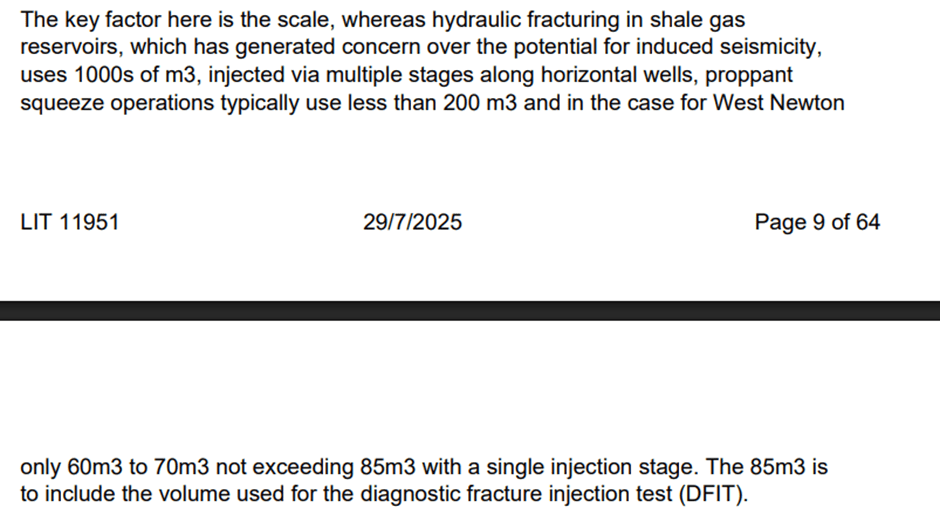

Rathlin’s proposal is not covered by the current moratorium on associated hydraulic fracturing in England. This has a presumption against hydraulic fracturing that uses more than 1,000m3 of fluid per stage or 10,000m3 in total. A campaign is underway to widen the scope of the moratorium to lower-volume hydraulic fracturing.
The EA also confirmed that the West Newton-A operation would need an approved Hydraulic Fracturing Plan before work could start (see EA responses below).
Concerns
An earlier consultation raised a wide range of concerns about the West Newton-A plans. These included:
- Induced seismicity leading to earthquakes and/or fault movements
- Seismic predictions based on modelling
- Lack of a hydraulic fracturing plan or acid stimulation plan
- Groundwater contamination
- Site liner not fit for purpose
- Production of naturally-occurring radioactive material (NORM)
- Lack of information on MO-1V Breaker fluid
- Use of oil-based gelling fluids
- Increased traffic and noise
- Application was not accessible, lacked clear and concise information or had missing or contradictory information
- Process is not compatible with the UK’s net zero ambitions or climate change action
- EA capacity to regulate the site
- Onsite chemical storage and mixing
EA responses
The EA responded in its decision document to many of the concerns. The responses included:
Earth tremors: The EA said the North Sea Transition Authority (NSTA) was responsible for regulating seismicity. But the EA said: “We are satisfied that the changes in this variation do not increase the potential for tremors”. It added:
“Low level hydraulic well stimulation can generate micro seismicity however, the proposed activities pose a very low risk with respect to seismic risk.
“The proposed activities are at the lowest end of the pressure spectrum associated with conventional hydraulic fracturing and are therefore unlikely to induce any seismic movements in the area.”
The EA added:
“Low level reservoir stimulation has no past record of causing seismicity which has only been associated with large scale, high volume hydraulic fracturing of shale gas formations.”
But it did not acknowledge that fracturing by Cuadrilla at Preston New Road in Lancashire induced earthquakes after injecting volumes of fluid as low as 142m3.
The report for Rathlin Energy said there was a 99% probability that seismicity caused by the operation would not exceed a maximum magnitude of M0.8. This would not be felt by people nearby, the report said. It also said the installation of local seismicity monitoring arrays was not warranted.
Hydraulic fracture plan: The EA said this plan must be submitted for approval at least two months before the start of the lower-volume fracture. It must include a summary of the planned operation, maps showing local faults, information on historic seismicity, a risk assessment of induced seismicity, processes to identify vertical and horizontal extents of fractures, steps to assess and mitigate fractures beyond the permit boundary or outside the target formation, measures to monitor seismicity and proposed reporting during and after fracturing.
Acid stimulation: The EA said an acid stimulation plan was not needed because Rathlin Energy did not propose to use acid stimulation.
Groundwater: The EA said: “We are satisfied that measures can be taken to ensure that the fracturing fluids do not migrate from the target formation”. It said the proposed fracture did “not present a significant risk to groundwater”. It said the upward movement of fracturing fluid from the Kirkham Abbey Formation would be limited by the overlying Fordon Formation of anhydrite and halite.
Liner: The EA included an improvement programme which it said was intended to ensure the liner’s integrity was maintained and necessary improvements made (see Conditions below)
MO-1V Breaker fluid: The manufacturer of this chemical had claimed confidentiality to restrict publication of the composition. But the fluid had since been removed from the application, the EA said.
Oil-based fluids: The EA said Rathlin Energy had argued that oil-based fluids would be used because water-based alternatives had previously damaged the Kirkham Abbey Formation. It said the formation had readily accepted these fluids but returned them slowly, which appeared to restrict the flow of gas.
Pollution and human health: The EA said: “We are satisfied that this facility will not cause significant pollution or harm and that it will provide a high level of protection for the environment as a whole”.
Management plans: The EA said it was satisfied with the application’s hydrological risk assessment, waste management plan, odour management plan, noise and vibration management plans and ecological impact assessment.
Traffic and noise: The EA said it was not responsible for regulating traffic. But it said it was “extremely unlikely” that the proposal at West Newton-A would increase traffic movements.
Regulation: The EA said it would regulate the site with continual assessment of plant operations and environmental performance. Regulation would include site inspections, onsite audits, assessment of how Rathlin Energy monitored emissions, requirements that breaches of emissions limits were reported and the investigation of complaints.
Climate change: The EA said it could not consider energy policy when determining a permit variation application.
NORM: The EA said the management of radioactive materials was regulated under a radioactive substances permit.
Conditions
The draft permit requires the approval of a hydraulic fracturing plan before work can start.
It also included conditions that set limits on the maximum daily discharge of fracturing fluid, the discharge rate and the surface injection pressure. Conditions limit emissions from a gas flare during well testing and production and from gas engines. They require monitoring of substances in groundwater and emissions from stock tanks.
The EA also required an improvement programme for West Newton-A. This included approval of a secondary and tertiary containment plan and work to ensure the integrity of the site’s impermeable liner.
Categories: Regulation, slider

 DRILL OR DROP?