A revised official report on plans for gas drilling and fracking in Burniston, North Yorkshire, was published today ahead of next week’s decision meeting.
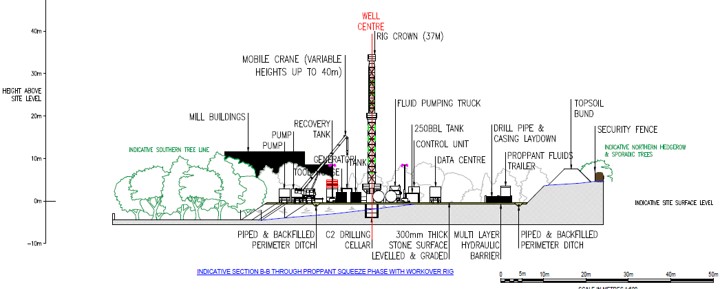
The document, by planners, was an update of a previous report for councillors, who had been due to vote on the proposal in January 2026.
There were 1,484 differences in the new document. But the vast majority were formatting changes and corrections of typographical mistakes.
The key recommendation to approve the planning application by Europa Oil & Gas with conditions remained the same.
A few errors pointed out by opponents of the scheme have been corrected. Other points raised in criticism of the first report remain unchanged.
Chris Garforth, of the local campaign group, Frack Free Coastal Communities, said:
“It’s good to see that at least some of the errors and gaps we have been pointing out have been corrected. But confusion remains over whether the company intend to restore the site or to retain equipment there for a follow-on project to develop a gas field. And although the erroneous reference to the development as ‘exploration’ has been corrected, para.10.159 still cites planning guidance for gas exploration proposals to defend their lack of assessment of the climate impacts of future production of gas from the site.
“Officers are asking the planning committee to take at face value everything the company has said in the application – even while acknowledging the numerous representations calling the quality and accuracy of the company’s information into question.
“They are also asking the committee to accept the company’s assurances that there is no risk of earthquakes or health impacts when they have presented no evidence to support those claims and in the face of clear scientific and historical evidence to the contrary.
“It’s disappointing the the council are not arranging a visit to the site for the 12 of the 15 members who did not visit in January. This would have been an opportunity for them to see the site and its surroundings as local residents and visitors see it, not the distorted description given in the planning application. They will not, however, be able to ignore the visible and vocal opposition to the application on display outside their meeting at Scarborough Town Hall on Friday 24th. April.”
The application to drill an appraisal well near the heritage coast and carry out lower-volume fracking will be considered by North Yorkshire Council’s strategic planning committee on Friday 24 April 2026 at 1pm at Scarborough Town Hall.
What’s changed?
Earthquake risk
The new report acknowledged concerns that official organisations had not commented on the risk of seismic events caused by lower-volume fracking (paragraph 3.4).
The planners accepted that neither the industry regulator, the North Sea Transition Authority, or the Department for Energy Security and Net Zero, had responded to the consultation on the planning application.
But the report said:
“Neither is a statutory consultee, and national planning guidance does not require a planning authority to delay a decision pending responses from non-statutory consultees. Their guidance is advisory rather than regulatory.”
Many objectors mentioned the lack of detailed geological information in the application on seismic risk. They questioned whether the planning authority could adequately assess these risks without it.
Europa has said the survey would be carried out only after a approval of the application.
The new report added a submission from Friends of the Earth on the seismic risks of lower-volume fracking (paragraph 7.41). Professor Stuart Haszeldine, professor of geology at the University of Edinburgh, stated that these operation could trigger earthquakes.
But the report did not refer to a recent cliff fall a short distance from the proposed well site. The risks to these cliffs had been raised by many objectors to the application.
Europa previously said the borehole would take a south westerly route inland, away from the cliffs. The company said:
“Consequently, the proposed development will have no impact on the cliff stability, during the construction, drilling, testing and restoration phases.”
Bonds
The new report also referred to calls from objectors for a bond to secure the restoration of the site.
But the report added:
“it is not considered this is necessary as the authority would have enforcement powers if the restoration was not completed to the required standard and any other issues such as a pollution or safety incident would be dealt with through other regimes.”
The report said its position was supported by the National Planning Policy Framework, which states that bonds should be sought only in exceptional circumstances. The report saidL
“it is not considered that this site is an exceptional circumstance due to the type and nature of the development.”
“The wrong form”
The new report referred for the first time (paragraph 3.3) concerns from some objectors that Europa used the wrong form and validation checklist when it submitted its planning application.
In January 2026, a retired geologist reported to the council that crucial geological information was missing because the form for oil and gas applications had not been used.
But today’s report said that form, though still shown on the council’s website, was “no longer supported through the planning portal”. The report said:
“it is considered that the form used by the application is the correct and up to date version for validation purposes.”
The report also said the validation checklist, which the geologist said should have been used, did not require any additional categories of documents than that used by Europa. It added:
“the geological material submitted is considered satisfactory for the purposes of determining the application”.
Air quality and waste water
The new report added that local planning policy stated that proposals involving hydraulic fracturing should be accompanied by an air quality monitoring plan and health impact assessment (paragraph 10.26).
The authors said:
“The policy is not prescriptive in terms of what a health impact assessment would require, however it is considered that what we would expect from a HIA has been covered under various amenity assessments throughout the application.”
A new paragraph 10.27 refers to a local policy that covers waste water and restoration.
Other changes
The new report made the following other changes:
- Corrected paragraph 4.7 to include “National Cycle Network Route 1 (Scarborough to Hayburn Wyke (Cinder track – former Scarborough to Whitby Railway line) is approximately 360 metres to north west of the site”. The previous report said there were “no national trails or national cycle network routes within of near the site”.
- Change of “exploration” to “appraisal” (paragraph 10.6).
- Change of “construction” to “drilling” (paragraph 10.35) in a discussion about the impact of different phases on the local landscape.
- Revision of table in paragraph 10.66: “Drilling borehole and completion” has been moved from the “Timescale” column to the column headed “Description of phase”
- Replacement of “will” by “would” in paragraph 10.109 in the sentence: “No trees, hedgerows, scrub, neutral grassland or woodland boundaries would be impacted by the works.”
- Deletion of “offsite” in the section on biodiversity net gain (paragraph 10.114). The new report now reads that “with suitable onsite enhancement of hedgerow and area habitats” the statutory minimum biodiversity net gain can be achieved by the development.
- The author, Amy Taylor, is named Principal Planner in the revised report.
- The duration of both initial well testing and proppant squeeze (lower volume fracking) in condition 7 on phasing has been changed from two weeks to one.
- In condition 22 ,the addition of “prior to the commencement of the development ” to the requirement for a vibration monitoring scheme. The reason for the condition has also been changed to “This is a pre-commencement condition and is required given the particular circumstance and imposed to control the impact of vibration generated by the development in the interests of residential amenity and the North York Moors National Park.” The previous report said this condition as “In the interests of residential amenity and in accordance with the local plan.”
What hasn’t changed or hasn’t been added
- The revised report (paragraph 1.2) continues to refer to more than 1,400 objections. The local campaign group, Frack Free Coastal Communities (FFCC), has stated there are now more than 1,600 objections.
- Paragraph 2.1 still includes the phrase “retention of equipment”. FFCC has said this is contradicted in the application, where some documents said the site would be restored, while others said equipment would be retained.
- Paragraph 10.159 still refers to policy on gas exploration, even though the Burniston proposal is for appraisal.
- The report does not mention that Burniston Parish Council and FFCC have made formal complaints about the way North Yorkshire Council has handled the application.
Updated 18/4/26 to include change on the national cycle network route 1 (see section headed Other changes.
Categories: Regulation, slider


