The government said today it would deliver its promise to ban fracking by outlawing the issuing of new onshore oil and gas exploration licences.
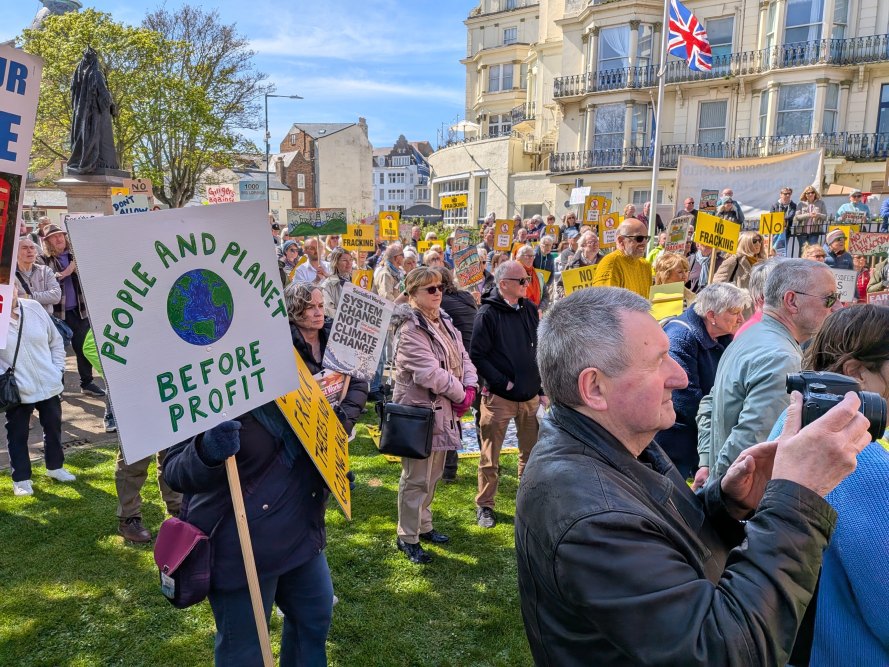
Photo: DrillOrDrop
The news has disappointed environmental campaigners, who had called for an outright ban on all forms of fracking.
Friends of the Earth said the measure, in the Energy Independence Bill, failed to meet Labour’s manifesto commitment to “ban fracking for good”.
The bill, published today, would not stop lower-volume fracking operations, which some scientists warn carry equally large and unpredictable seismic risks.
It would also not remove existing licences in onshore shale gas areas, such as Lancashire and Lincolnshire.
Fracking – the injection of liquid at pressures high enough to fracture rocks – is highly controversial in the UK.
Operations by Cuadrilla in 2018 and 2019 caused earthquakes felt by people living across the Fylde region near Blackpool.
A moratorium, in November 2019, introduced a presumption against associated hydraulic fracturing in England, defined as fracks that use more than 1,000m3 of fluid per stage or 10,000m3 in total.
But the moratorium did not cover operations using lower volumes of liquid. Campaigners have described this as a legal loophole and said it should be closed.
Permission has been granted for a lower-volume frack at the West Newton-A oil and gas site in Holderness, East Yorkshire. An appeal is imminent on refusal of plans for a similar operation at Burniston, near Scarborough in North Yorkshire.
The text of the Energy Independence Bill did not mention a specific ban on any form of fracking.
There was no reference to the fracking process, the current moratorium or permitted lower-volume fracks.
A government background document on the bill said:
“we will show climate leadership by implementing our manifesto commitment to not issue new licences to explore new oil and gas fields, including delivering our commitment to ban fracking.”
It added:
“we will implement plans to not issue new licences to explore new fields (in England), including those which could be used for hydraulic fracturing for shale gas (‘fracking’).”
There had been hints in September 2026 that the existing moratorium would not be turned into a formal ban.
The energy minister, Martin McCluskey, speaking in a parliamentary debate on fracking, said:
“The [Energy Independence] Bill was announced in the King’s Speech and will meet our commitment to not issue new licences to explore new fields—onshore and offshore—including those that could be used for fracking for shale gas. That will deliver on our commitment in law to ban fracking.”
He also rejected the idea of extending the moratorium to lower-volume fracking operations. His argument, rejected by campaigners and some scientists, stated:
“Low-volume hydraulic fracturing has been happening in the UK for decades. It has been used not just in respect of oil and gas but in the water industry and geothermal. In that time, there has been no clear evidence that it induces seismicity that can be felt on the surface.”
Friends of the Earth’s energy campaigner, Danny Gross, said:
“Ending new gas and oil licences is extremely welcome, but this bill falls a long way short of delivering on Labour’s manifesto pledge to ban fracking for good.
“It won’t affect areas that are already licensed and leaves a gaping loophole in the existing fracking moratorium – one that companies are already exploiting to push ahead with new projects.
“One fracking scheme has already been granted approval, and more applications are in the pipeline. Just yesterday, Europa Oil and Gas lodged an appeal against the refusal of its planning application for a low-volume fracking project in North Yorkshire.
“The threat is real and growing. And the Bill still leaves communities across the country exposed to the threat of fracking.”
- DrillOrDrop will update this article with further reaction as we get it.