The site at the centre of a landmark legal challenge is seeking to produce more than 600,000 tonnes of oil over the next 20 years, releasing about two million tonnes of greenhouse gas emissions.
But the proposal at the Horse Hill site in Surrey would be “not significant” for climate change, the company behind the scheme has said.
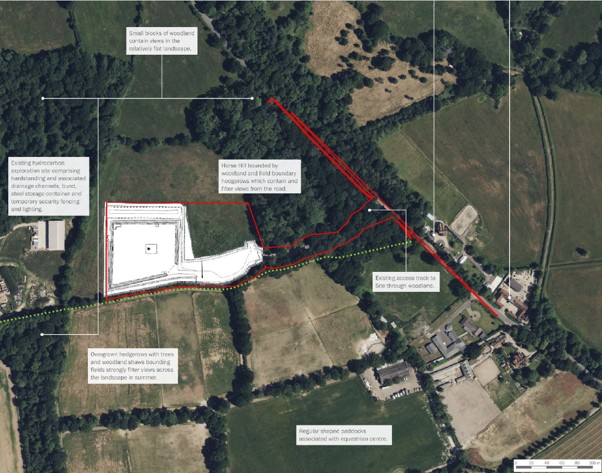
Source: planning application SCC ref 2018/0152
The Supreme Court quashed similar plans for Horse Hill, near Redhill, nearly two years ago (20 June 2024).
In what became known as the Finch Ruling, the justices decided that the consent from Surrey County Council was unlawful. They said the council should have taken account of carbon released from burning oil produced at Horse Hill, known as Scope 3 emissions.
Because of the ruling, Horse Hill has produced no oil since November 2024 and permissions at other sites have been quashed.
But UK Oil & Gas (UKOG), the parent company of the site operator, is now asking for the original plans to be reconsidered.
An application to Surrey has been published online and a consultation is open until 13 July 2026.
The company seeks consent for four new production wells, bringing the total at Horse Hill to six. The plans also includes long-term oil production, as well as new oil processing area, tanker loading facilities and a water reinjection well.
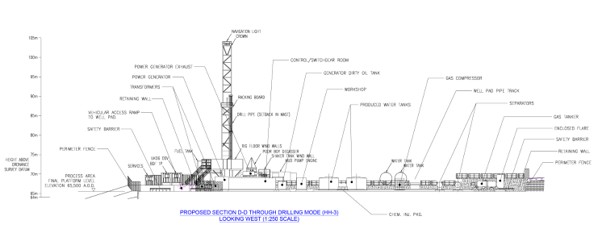
Source: planning application SCC ref 2018/0152
New information
UKOG has submitted 59 new documents, including an assessment of the likely production and greenhouse gas emissions from the expanded site over the next 20 years.
According to the application, Horse Hill could extract up to 678,693 tonnes of oil from 2027-2047. This could bring its total lifetime production to over 700,000 tonnes.
The new production would release up to 2,329,150 tonnes of carbon dioxide equivalent (tCO2e), the application has estimated.
UKOG said:
“It is concluded that while the Horse Hill development is a net contributor to the greenhouse gas inventory, it is compatible with UK policy to achieve net zero by 2050. The Horse Hill development is therefore considered to be ‘not significant’ in terms of impact on climate change.”
The application said maximum oil production estimated at Horse Hill represented 0.1% of UK future oil demand from 2027-2047 and 0.8% of projected new future development production.
UKOG said the worst-case predicted carbon emissions from Horse Hill represented 0.05% of the projected UK carbon budget for 2027-2047 and 0.0014% of a global net zero strategy from the International Energy Agency.
The company said peak oil production at Horse Hill was expected in 2028.
In that year, greenhouse gas releases from the site would be 586,391 tCO2e. This would be equivalent to 11.5% of emissions in Surrey and 1.5% of total emissions in south east UK, UKOG said. On a global scale, it was equivalent to 0.005% of emissions, the company said.
UKOG said:
“In a global context, the future contribution of Horse Hill is largely negligible.”
It argued in the application that importing oil “may well have significantly higher unit releases”. It said this was because of transport emissions from imported oil and “variations in standards and operating practices”.
It added:
“The availability of production from the Horse Hill wellsite is likely to provide a lower carbon intensity alternative to other potential sources, particular [sic] in relation to imports.”
The company also said:
“The Proposed Development will help provide the security, stability and core resilience called for by energy policy in 2026.”
Before the Horse Hill permission was quashed, official data showed the site produced an average of 281 tonnes of oil per month. This was 0.7% of the 39,256 tonnes a month at Wytch Farm, the largest onshore oil field in the UK.
In 2023, the last full year of production at Horse Hill, UK onshore oil production was less than 2% of total UK oil extracted.
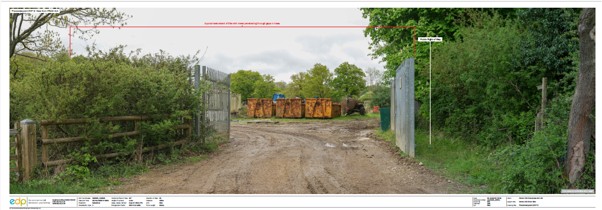
Source: planning application SCC ref 2018/0152
Comments
Comments can be made on the Horse Hill plans online, by email to mwcd@surreycc.gov.uk or by letter to Planning Development (ref. SCC Ref 2018/0152), Surrey County Council, PO Box 478, Reigate RH2 8EF. Comments must include a full postal address for views to be registered. The deadline for comments is 13 July 2026.
DrillOrDrop will report on other key issues on this application and on responses from opponents.
Key dates and details
September 2019: Horse Hill expansion and long-term production approved by Surrey County Council Details
October 2020: permission implemented
June 2024: permission quashed by the Supreme Court Details
December 2024: Surrey County Council requested further information for a new application Details
Site area: 2.08ha to increase to 2.8ha
Previous production: 24,000 tonnes before 2020; 16,000 tonnes 2020-2024
Wells: current HH-1 and HH2/2z wells to be increased by four new production wells, to make six production wells and one new produced water production reinjection well
Proposed phases of work:
- Well site modification and construction of five new drilling cellars to accommodate four new production wells and one new produced water reinjection well. New platform for oil processing, storage and tanker loading on land to east of the wellsite.
- Well management and drilling: Drilling of four new hydrocarbon production wells, aking a total of six in total and one new produced water re-injection well
- Production and well management: Installation of oil processing, storage and tanker loading facilities to enable export of oil from site for 20 years
- Plugging, abandonment and decommissioning: Removal of all surface production equipment, followed by plugging and abandonment of six production wells and water reinjection well
- Site restoration and aftercare: Removal and disposal of all bunding and stone surfacing, followed by regrading of soils and subsequent aftercare and monitoring
Categories: Industry, Regulation, slider


