Households are facing higher energy bills because the UK is not electrifying fast enough, government advisers warned today.
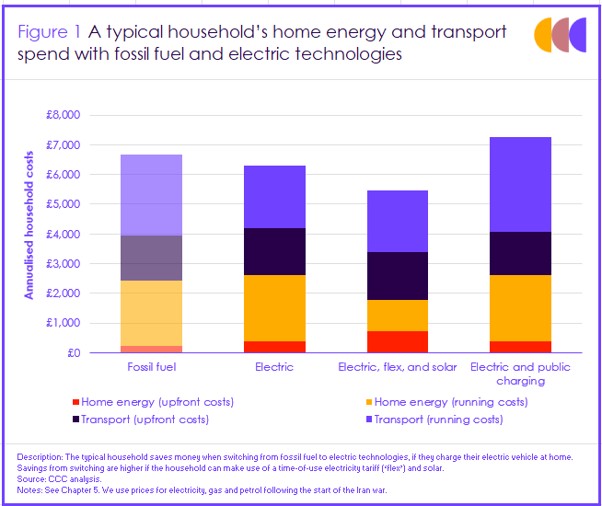
The Climate Change Committee (CCC) said new analysis showed that since the start of the Iran war households with gas boilers and petrol cars saw energy bills rise almost four times more than those with heat pumps and electric vehicles.
A typical household could save around £1,200 a year today by combining an electric vehicle, a heat pump, solar panels and a time-of-use tariff, the CCC said. This rises to around £1,900 for some rural homes.
The warning came in the CCC’s annual assessment of government progress in reducing emissions. Link to report
Nigel Topping, the CCC’s chair, said:
“The cost-of-living crisis continues to put pressure on households, with people paying the price of another fossil fuel price shock, so close to the crisis in 2022.
“The transition to clean electricity is not happening fast enough.
“Government support to accelerate the shift to electric vehicles and heat pumps is critical, not only to keep our climate targets within reach but to unlock savings. At this moment of political uncertainty, any weakening of current positions risks slowing these transitions, undermining investment and the long-term consistency businesses need.
“This is about more than targets, it’s about cleaner air, energy security and shielding the economy from fossil fuel shocks.
“Ultimately this is about putting money back into people’s pockets.”
Mr Topping said new drilling in the North Sea, promoted by the Conservatives and Reform UK, would not benefit UK households:
“There’s no price benefit to the economy because the price take is set for internationally traded commodities.
“And [there would be] a relatively small amount of jobs, particularly compared to some of the big renewables projects that we’re seeing.
“the real route to energy security is not from marginal drilling decisions, but through electrifying the economy, which is why we’re really focussed on that, on lower and stable costs and cheaper household bills.”
He added that additional North Sea oil production would have no more than a “marginal impact on climate” because production from the basin was expected to decline by 90% by 2050. He said:
“There’s an argument that the lifecycle emissions of [North sea] gas are slightly lower than LNG but there’s also an argument that creating infrastructure creates its own demand.”
Friends of the Earth’s head of policy, Mike Childs, said:
“With lives currently at risk from extreme heat, this report is a stark reminder that the government is still not doing enough to tackle the climate crisis.
“The huge impacts on people, nature, farming and the economy are undeniable. That’s why the warning from the government’s own climate advisers – that the UK is not cutting emissions fast enough – must be front of mind for anyone seeking to become the next Prime Minister.
“That means going further and faster to help families, especially those on lower-incomes, switch to clean technologies such as heat pumps and electric vehicles, while supporting industry to run on affordable, homegrown renewable energy.
“They must also prevent high-carbon developments such as Heathrow expansion, uphold the commitment to not issue any new oil and gas licences, and ban all forms of fracking for once and for all.”
Emissions fall
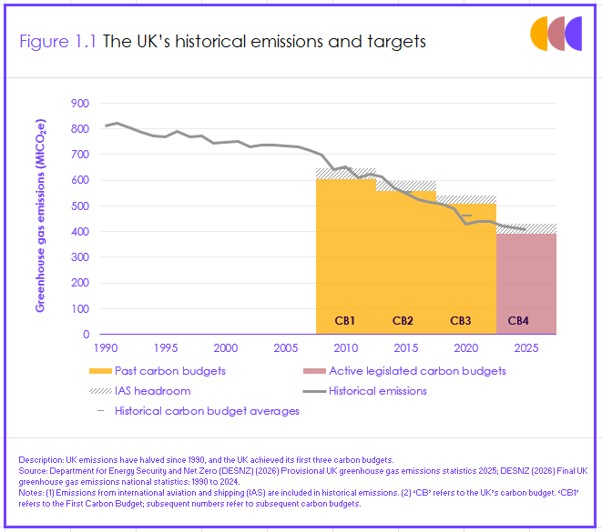
The CCC said UK overall emissions fell 1.8% in 2025.
There had been good progress in some areas and the UK was on track to meet the fourth and fifth carbon budgets, it said.
Nearly one in four new car sales were now electric, the report said. A record amount of new renewable energy was contracted in the latest auction, and peatland restoration had increased by 26%.
But progress had slowed in other areas.
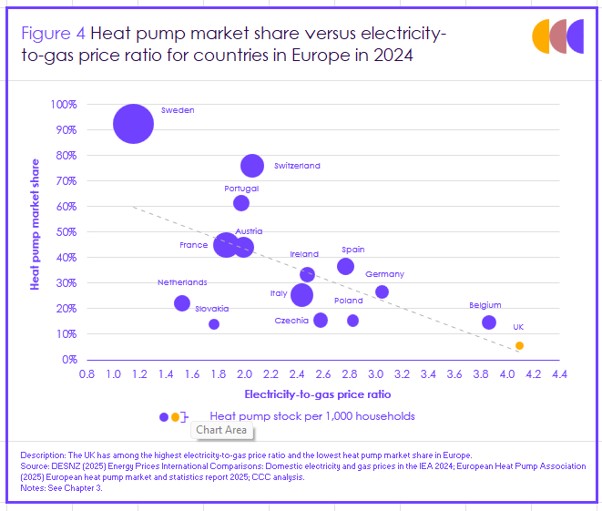
Heat pump installations in existing homes rose just 7% in 2025, compared to 56% the year before.
The share of electricity in industrial energy use also fell slightly last year.
The CCC said:
“This is leaving people exposed to fossil fuel price shocks and puts later carbon budgets at risk. The government needs a more ambitious plan to electrify these key parts of the economy, including further action to reduce the cost of electricity.”
Recommendations
The CCC added that only 58% of the required emissions reduction to reach the UK’s 2030 nationally determined contribution is covered by credible plans, or those with some risk.
The CCC has recommended:
- Make electricity cheaperthrough measures such as removing remaining policy costs from electricity bills.
- Enable a more rapid transition to electric vehicles, by, for example, expanding affordable charging infrastructure.
- Accelerate the installation of heat pumps in buildings by cutting costs, removing barriers, and supporting low-income households.
- Deliver on industrial electrification including speeding up grid connections to remove barriers for businesses electrifying operations.


