The UK energy minister has suggested that lower-volume fracking does not have the same earthquake risk as hydraulic fracturing for shale gas.
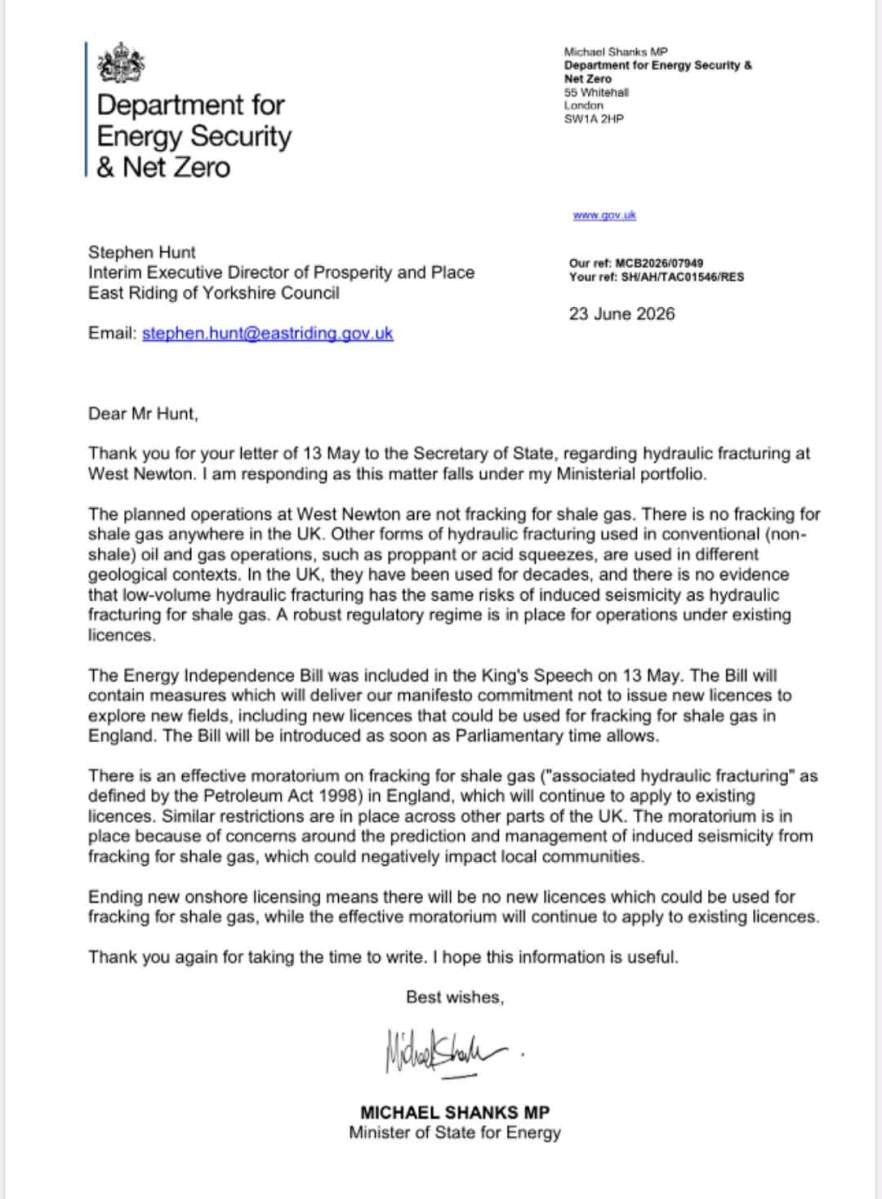
Michael Shanks, who kept his post in the Burnham government reshuffle this week, said in a letter to East Yorkshire Council:
“there is no evidence that low-volume hydraulic fracturing has the same risks of induced seismicity as hydraulic fracturing for shale gas”.
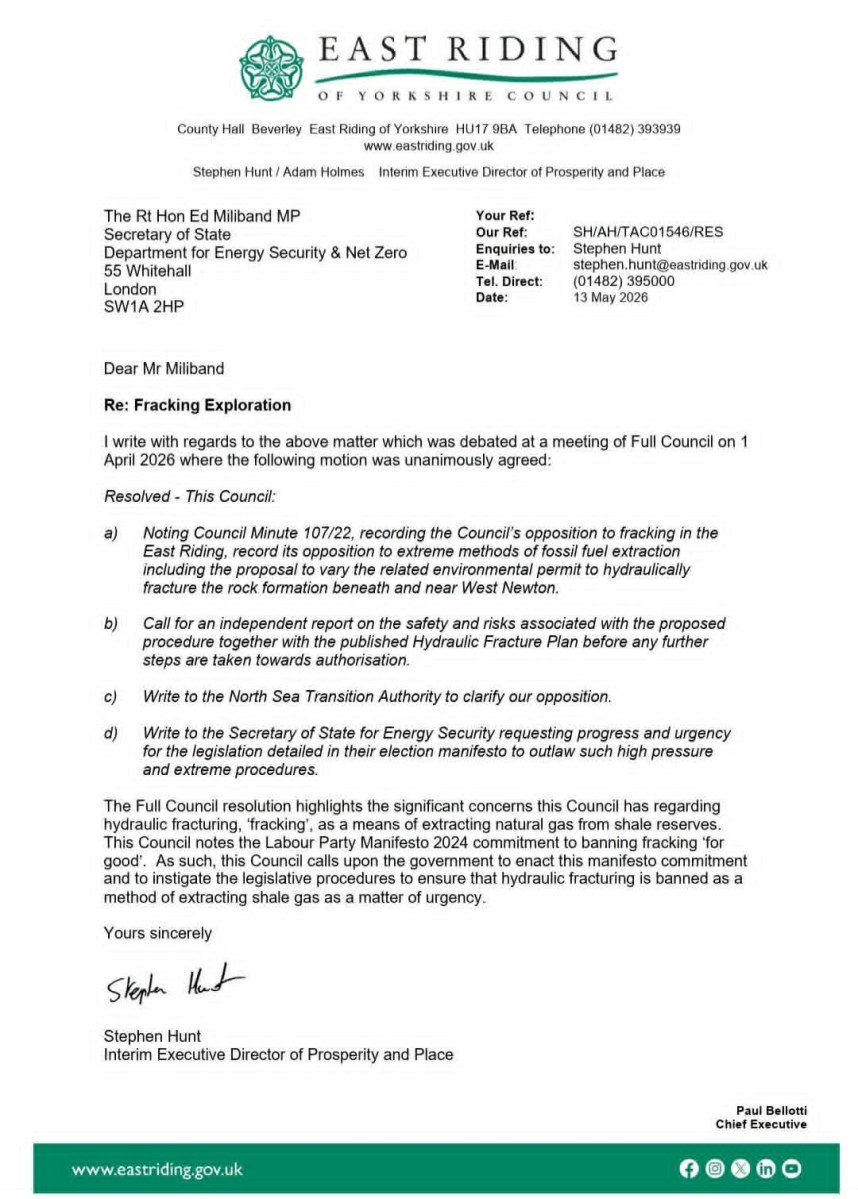
Mr Shanks was replying to the council after members voted unanimously to oppose fracking in their county.
They resolved that the council should write to the energy secretary urging him to outlaw what they called “such high pressure and extreme procedures”.
Their vote recorded opposition to plans for lower-volume fracking at an East Yorkshire site at West Newton, in Holderness. Councillors also called for an independent report on the safety and risks associated with the West Newton operation.
In his reply, Mr Shanks said there was an “effective moratorium” on fracking for shale gas in England.
This was introduced in 2019 after fracking for shale gas at Preston New Road caused multiple small earthquakes.
The moratorium prevents fracking in shale using volumes of fluid of 1,000m3 per stage or 10,000m3 in total. It does not prevent fracking using lower volumes, including that planned at West Newton.
Briefing documents confirmed earlier this year that the Energy Independence Bill would deliver the government’s manifesto promise to ban fracking. But they did not specify which operations would be included in the ban.
Campaigners have said all forms of fracking should be outlawed. They have called this a legal loophole that is exploited by oil and gas companies.
Opponents of lower-volume fracking have pointed out that the Preston New Road fracks in 2019, which caused the UK’s largest fracking-induced earthquake, used lower volumes of fluid than the limit set in the moratorium. The Preston New Road volumes were also lower than proposed proppant squeezes at Burniston, in North Yorkshire, refused planning permission earlier this year.
Mr Shanks’ comment on earthquake risk may also contradict recent work by Stuart Haszeldine, the professor of geology at University of Edinburgh.
The professor’s analysis has concluded that the absence of high-volume hydraulic fracturing subject to the UK moratorium does not mean earthquake risks can be ruled out.
His work has focussed on a series of earthquakes in Surrey, which began eight years, and have been linked by some academic researchers to oil and gas operations.
In a recent report, Professor Haszeldine said:
“In my opinion, there is now a substantial body of evidence linking the 2018–2019 earthquake sequence in the Horse Hill and Newdigate area with oil production activities at Horse Hill.
“This includes the temporal relationship between production activities and earthquake occurrence, together with subsequent academic analyses published since the issue was previously considered by regulators.”
Separate studies by Robert Westaway, of Glasgow University, and Matthew Fox, of University College London, have shown pressure diffusion from oil, gas and water production can trigger earthquakes.
Mr Shanks did not refer in his letter to Labour’s manifesto commitment to ban fracking. But he did say forms of hydraulic fracturing in non-shale oil and gas operations, such as proppant squeeze or acid fracking, “had been used for decades”.
The Weald Action Group, which opposes oil and gas development in southern England, responded:
“We are fighting this. There is no evidence that supports his [the minister’s] statement that it has been used for decades.”
- A campaigner in East Yorkshire is seeking to bring a legal challenge against the lower-volume frack at West Newton.
Categories: Politics, slider, Uncategorized


