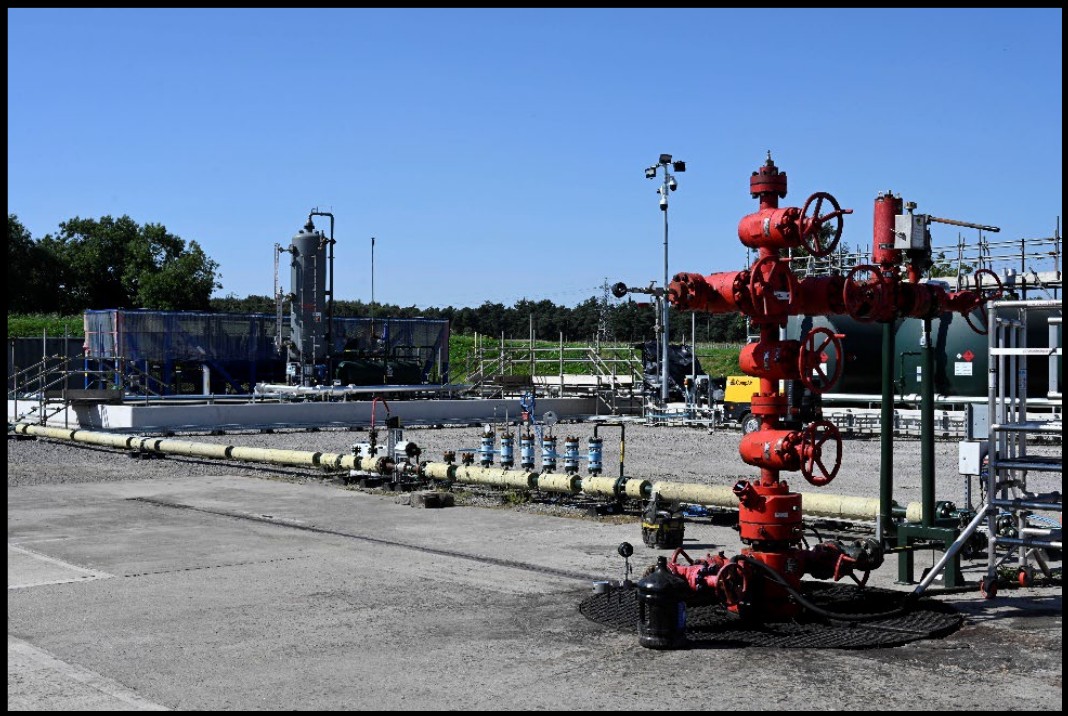
Campaigners have criticised another oil operator for a “flawed assessment” of the climate impact of drilling and production plans.
Methods used in an application for expansion of the Wressle oil field in North Lincolnshire have been condemned in a public consultation as “unscientific wishful thinking” and of failing to comply with the latest guidance.
Objectors have said the Wressle scheme should be refused planning permission.
Earlier this week, DrillOrDrop reported calls for rejection of an expansion scheme at the Horse Hill oil site in Surrey, partly because of the way carbon emissions had been estimated.
At both Horse Hill and Wressle, developers have claimed the impacts on climate change would be “insignificant”, despite the release at each site of more than a million tonnes of damaging carbon pollution.
Key criticisms have centred on how the companies assessed the significance of greenhouse gases resulting from burning the extracted oil or gas, known as downstream or scope 3 category 11 emissions.
The Wressle operator, Egdon Resources, estimated in a revised application, published in May 2026, that the expanded operation would produce an extra 1 million+ barrels of oil over 15 years and an additional 5.264 billion cubic feet of gas.
Egdon predicted that the site would release more than 1 million tonnes of carbon dioxide equivalent (tco2e), most of it through scope 3 category 11 emissions.
Campaigners have argued there is no space in the global carbon budget for any new fossil fuel developments or expansion of existing sites if the world’s temperature increase is to remain within the legally-binding limit of 1.5C.
Egdon had been granted permission in 2024 for two new production wells and lower volume fracking.
But the approval was later quashed following the landmark Finch Ruling at the Supreme Court.
This was a successful challenge brought by Sarah Finch and the Weald Action Group, which required decision-makers to take into account the scope 3 category 11 emissions.
“All eyes on Wressle”
The decision on the Wressle scheme, to be made by North Lincolnshire Council, could be the first fossil fuel production application in England to be made using the Finch Ruling.
Other applications have been withdrawn (Biscathorpe), postponed (Waddock Cross in Dorset) or faced requests for more information (Rosebank and Jackdaw).
The Weald Action Group (WAG) said in its response to the Wressle application:
“All eyes will therefore be on North Lincolnshire and the decision will be closely scrutinised, as its approach could set an influential precedent for future decisions on similar projects.”
Fossil Fuel Free Lincolnshire (FFFL) told DrillOrDrop:
“Once again at Wressle, the oil and gas industry claims that the emissions from a single development are insignificant when set against global carbon budgets.
“That misses the point entirely.
“The remaining carbon budget is disappearing fast, which means every tonne of emissions counts. The claim that one more oil and gas development won’t make a difference is ludicrous – especially as they say it every time!
“Each new development locks us into fossil fuels and adds to global emissions.”
FFFL said:
“We’ve presented robust legal and planning arguments showing why this proposal should be refused, backed by national climate policy and North Lincolnshire’s own Green Future Plan. The planners have both the evidence and the policy framework they need. Now they just need the courage to resist industry pressure and make the right decision.”
Lincolnshire Climate Commission told us:
“Limiting the worst impacts of climate change requires a rapid reduction in fossil fuel use across all sectors, not the expansion of oil and gas production that extends reliance on fossil fuels.
“The UK’s long-term energy security depends on accelerating the transition to renewable energy and improving energy efficiency, rather than continued investment in new fossil fuel extraction and associated infrastructure.
“We urge decision-makers to ensure that the Wressle planning application is assessed in light of the UK’s climate commitments and the wider, long-term public interest.”
Lincolnshire climate campaigner, Amanda Suddaby, said in her formal response that Egdon Resources had failed to “provide a transparent or robust assessment of the project’s full lifecycle greenhouse gas emissions or their significance.”
She said the proposal would extend the original 15-year production life of Wressle:
“this application represents a material extension of fossil fuel extraction that is not consistent with the basis on which the original temporary permission was granted, nor with current national and local policy requirements relating to climate change.”
Key points
“Unsound and inadequate environmental statement”
Opponents of the Wressle expansion have outlined in formal responses to a public consultation what they said were numerous flaws in the environmental statement (ES) that accompanied the planning application and included the climate assessment.
FFFL said in its response:
“The ES is logically unsound and legally inadequate. On that basis alone, permission for the proposed development should be refused.”
The group said North Lincolnshire Council should not give Egdon “yet another bite at the cherry” by asking for a further revised environmental statement. It said:
“The most robust and cogent response would be to refuse permission”.
“Contrary to latest guidance”
Several responses argued that Egdon had not complied with the latest guidance on assessing climate impacts.
WAG said:
“We consider that the assessment does not comply with EIA Regulations 2017, the Department of Energy and Net Zero scope 3 supplementary guidance, or the Institute of Sustainability and Environmental Professions 2022 guidance regarding assessing greenhouse gas emissions and evaluating their significance.
“Nor does it refer to the 2025 International Court of Justice Advisory Opinion on the Obligations of States in respect of Climate Change or the 2024 proposed revisions to the National Planning Policy Framework.”
“Ignored latest forecasts”
Several responses also stated that Egdon’s environmental statement did not consider the most up-to-date forecasts of the remaining 1.5C aligned global carbon budget.
WAG said:
“There is zero space in the remaining 1.5C aligned global carbon budget for any new fossil fuel developments or expansions to existing sites; and a massive excess of emissions from existing oil, gas and coal infrastructure which will now need to close before the end of its economic life.
“The 917,999 tco2e of scope 3, category 11 emissions from an expanded Wressle development would be additional, cumulative and hence contribute to the further exceedance of the 1.5C global carbon budget. As such, and based on established guidance, these emissions should be considered as significant for the climate.”
Amanda Suddaby said:
“The development of new fossil fuel extraction is fundamentally incompatible with the UK’s climate obligations and with Paris-aligned 1.5C pathways which are essential for maintaining a habitable planet and avoiding runaway climate breakdown triggers.”
“Insignificant impact” – “scientifically-flawed”
Egdon Resources assessed the significance of the category 11 emissions at Wressle as a percentage of overall global carbon budgets and in relation to emissions reduction pathways published behind paywalls by the fossil fuel consultancy, Global Energy Outlook.
The company said:
“while the unmitigated, worst-case effect is moderate adverse, the overall assessment concludes that the effect is minor adverse when viewed in the context of global mitigation trajectories.”
Lincolnshire Climate Commission described this conclusion as “scientifically flawed”.
FFFL said:
“This startling conclusion is entirely without rational foundation.
It said:
“The reasoning for how an acknowledged significant adverse effect can become ‘not significant’ in the absence of any mitigation is demonstrably flawed.”
FFFL added:
“All the factors … point to a major adverse impact, given the project [is] being assessed as a fossil fuel project which locks in emissions because it adopts a business-as usual or do-minimum approach to compliance with global mitigation trajectories (themselves unscientific).”
FFFL said of the company’s assessment approaches:
“Neither is an adequate approach to contextualising the significance of the project’s emissions since neither allows for the project’s contributions (or lack thereof) towards the achievement of net zero to be clearly understood.”
Professional judgement “unscientific wishful thinking”
Egdon Resources concluded that the scope 3 category 11 emissions would have a moderate adverse effect, reducing to minor adverse when “professional judgement” was applied. The company referred to guidance from the Institute of Sustainability and Environmental Professions (ISEP).
But the ISEP guidance on ‘professional judgement’ states this must be based “on available guidance, policy and scientific evidence”.
FFFL said:
“The so-called ‘professional judgement’ reducing the moderate adverse effect … to a minor adverse effect is unmoored from any available guidance, policy or scientific evidence. It is unscientific wishful thinking.”
FFFL added:
“It is self-evidence that the GHG [greenhouse gas] emissions from the proposed development would have a significant effect on the climate and that the effect would be major adverse, applying the ISEP guidance and the supplementary guidance.”
“Failed to assess cumulative effects”
The supplementary guidance, published by the UK government after the Finch Ruling, states that global emissions reduction pathways should be “inherently cumulative” so that they can function as a cumulative assessment of a project’s climate effects.
FFFL said pathways used by Egdon were “not inherently cumulative”.
They relied on “abstract projections and modelling of reducing demand for fossil fuels over time rather than real world data and implemented policies”, FFFL said.
FFFL described the Egdon pathways as “untethered from the reality of existing, consented and planned projects.”
FFFL said the company failed to “carry out a proper assessment of the cumulative effects of the proposed development in relation to other planned and permitted fossil fuel projects”.
WAG said:
“By not considering forecast emissions from already existing and approved oil and gas projects it fails to place Wressle’s scope 3, category 11 emissions within a global cumulative emissions context.”
Amanda Suddaby said it was “mathematically unsound” to argue that any single development was insignificant in the context of a larger overarching budget.
She said:
“Treating any source individually rather than additionally is to misunderstand the nature of the mitigation problem: emissions from all sources must be rapidly cut, with no scope for additional fossil fuel extraction”.
She added:
“The drop in the-ocean argument has been rejected by courts around the world, and by the government”.
“No substance to substitution argument”
Egdon suggested that demand for oil would be met from alternative sources if Wressle expansion did not go ahead. It said the sources could include imported oil, resulting in additional emissions from transport and different regulatory standards.
UK government guidance requires developers to provide evidence of substitution if it relies on this argument.
WAG and FFFL said no evidence of substitution had been provided and the argument should be disregarded.
FFFL said:
“Egdon purports to rely on alleged substitution and a reduction in the need for imports into the UK, that is inappropriate and unlawful.”
Lincolnshire Climate Commission said:
“Global oil markets do not operate on a one‑in, one‑out basis. Additional production from small fields such as Wressle adds to total global supply, increasing global emissions. This conclusion is consistent with independent climate‑energy research and the position of the UK Climate Change Committee. The substitution argument should therefore be given no weight in the planning balance.”
“Contradicts local climate plan”
Several responses said Wressle expansion would contradict local climate policies.
The North Lincolnshire Council Green Future Programme aims to create a “cleaner greener and more sustainable North Lincolnshire”, with its own commitment to net zero in operational emissions by 2030.
Amanda Suddaby said estimated emissions associated with Wressle expansion were approx 200 times greater than the council’s six-year carbon reduction target. She said:
“This highlights a fundamental inconsistency between the council’s stated climate ambitions and the continued approval of new fossil fuel developments”.
Lincolnshire Climate Commission said:
“Approving further oil extraction at Wressle would directly contradict these strategic aims, undermine the Council’s stated commitment to a “cleaner, greener and more sustainable North Lincolnshire,” and increase the very climate and nature risks the Council has pledged to reduce.”
Categories: Opposition, slider


