Expansion of the Wressle oil site near Scunthorpe would result in more than one million tonnes of climate-damaging greenhouse gases, documents have revealed.
But the developer, Egdon Resources, has said the proposal would not have a significant impact on climate change.
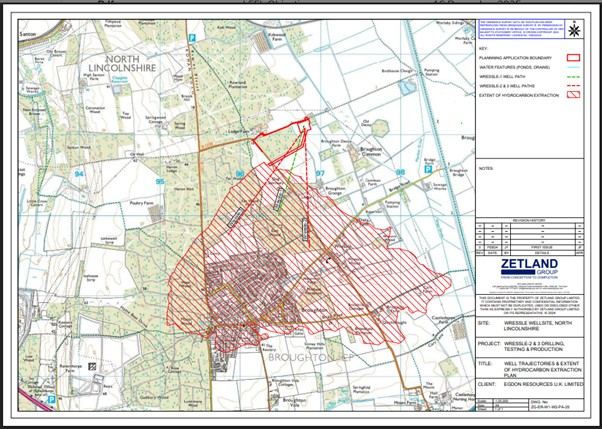
Source: Egdon Resources application
The expansion would produce an estimated extra 1 million+ barrels of oil over 15 years. Gas produced alongside the oil would be an additional 5.264 billion cubic feet.
The figures were published in a new assessment of the climate impact of the plans.
Egdon first submitted the proposal in March 2024 for two new wells, lower-volume fracking, 15 years of production and a 600m gas pipeline.
An approval by officials at North Lincolnshire Council in September 2024 was quashed in a legal case brought by a local campaigner.
This followed the landmark Finch ruling at the Supreme Court, which required decisionmakers to take account of the greenhouse gas emissions from the use of onshore oil or gas production.
Egdon had previously said the plans did not need a detailed environmental impact assessment (EIA).
But the company agreed earlier this year to voluntarily submit a slimmed-down version of an EIA, looking at just climate change, socio-economic impacts and cumulative effects.
Emissions estimates
Egdon’s consultants, Bureau Veritas, has estimated that at worst the greenhouse gases from the project would amount to 1,007,731 tonnes of carbon dioxide equivalent (tCO2e).
More than 90% of the total, 917,999 tCO2e, would be from burning the oil and gas produced at the site, known as scope 3 category 11 emissions.
The remaining emissions, mainly from the production process, are estimated to total 89,732 tCO2e.
The climate assessment said:
“Overall, the Proposed Development is not expected to result in significant adverse effects on climate change, and the assessment demonstrates that emissions and climate risks have been considered in a proportionate and robust manner, consistent with relevant guidance and best practice.”
On the scope 3 category 11 greenhouse gases, the assessment said:
“While these emissions represent a very small proportion of global emissions, it is recognised that climate change is highly sensitive to cumulative emissions.
“Taking into account the global and downstream nature of these emissions, their lack of direct control at the project level, and their consistency with broader decarbonisation pathways, the effect is … considered to be minor adverse overall.”
The assessment estimated that at peak annual production, the scope 3 category 11 emissions would represent, at worst, 0.00033% of the remaining global carbon budget.
This would indicate a moderate adverse effect, the assessment said. But it concluded that the effect was “minor adverse when viewed in the context of global mitigation trajectories”.
The scope 1 and 2 emissions and scope 3 excluding category 11, were also considered to be “minor adverse following mitigation”.
These emissions, compared with UK carbon budgets) ranged from 0.0009% (seventh budget) TO 0.002% (sixth budget).
Other assessments
An updated ecological impact assessment on the Wressle plans said there would be no significant impacts on air quality affecting internationally-important wildlife sites on the Humber Estuary.
It also said there would be no “significant adverse effects” on sites of special scientific interest at Broughton Far Wood, 210m away from the well site, and Broughton Alder Wood, 600m away.
The socio-economic impact assessment concluded there would be “moderate to major beneficial effects” for employment and economic performance in civil engineering, mining and quarrying industries.
On cumulative effects, the assessment said:
“No long term significant effects identified and no greater [impacts] than for the proposed development in isolation”.
Public consultation
People and organisations can now comment on the new documents, either online (go to bottom of application webpage and click submit comment button), by email to planning@northlincs.gov.uk or in writing to the Development Management team, North Lincolnshire Council, Church Square House, 30-40 High Street, Scunthorpe, DN15 6NL, quoting PA/2024/275.
The application’s website lists the closing date for the consultation as 30 June 2026.
DrillOrDrop will report on reaction to Egdon’s climate and other assessments.


