A company’s assessment of the climate impact of oil production at Horse Hill in Surrey is flawed and any permission based on it would be unlawful, campaigners said today.
They urged Surrey County Council to refuse plans by UK Oil & Gas plc (UKOG) to revive extraction and drill extra wells at the site near Gatwick Airport.
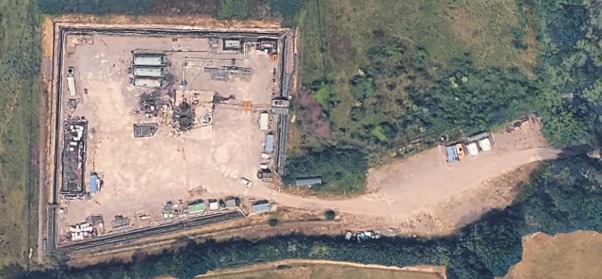
An earlier permission for the scheme had been quashed in a landmark ruling by the Supreme Court more than two years ago.
The court decided that Surrey County Council should have taken account of carbon emissions from burning oil extracted at Horse Hill, as well those released in the production process.
The site has been suspended since October 2024. But UKOG is now seeking to reinstate the permission. Part of the application is a new estimate of the climate impact of the plans.
Environmental campaigner Sarah Finch, who successfully won the Supreme Court challenge, on behalf of Weald Action Group, said today the company had used the wrong guidance in assessing greenhouse gas emissions.
“The application should have assessed the emissions from Horse Hill oil on a global basis, taking into account the emissions from other existing and committed fossil fuel projects. It failed to do so, so I believe allowing the project on this basis would be unlawful.”
She added:
“The Weald Action Group defeated the previous application for Horse Hill oil production in the Supreme Court, so it is depressing to have to do it again!
“Once again the oil company has failed to recognise the impacts of this project to produce oil for 20 years. The science is clear. Any new oil and gas production will bust our chances of keeping global heating within safe limits.”
UKOG said it expected to extract more than 600,000 tonnes of oil over 20 years at Horse Hill. The company estimated this would release two million tonnes of carbon emissions, which it described as “insignificant”.
Friends of the Earth, which supported Ms Finch in the Supreme Court case, argued today that two million tonnes could not “realistically be described as insignificant”. The organisation said:
“Scientists are clear that there can be no new fossil fuel projects if global climate goals are to be met.”
Both Ms Finch and Friends of the Earth argued that the way UKOG assessed carbon emissions from Horse Hill was “out of step” with the Supreme Court ruling and did not follow government guidance or UK international climate obligations.
Friends of the Earth’s interim head of legal, Katie de Kauwe, said it was “disappointing” that a new application had been submitted and the organisation would stand with the Weald Action Group in opposing it.
She said:
“Fossil fuel companies continue to profit from the climate crisis they are driving, while ordinary people pay the price.
“This June was England’s hottest on record, putting lives, livelihoods and nature at risk. Such extreme weather is going to get worse and more frequent if governments do not take the action necessary to phase out fossil fuel projects.
“Approving Horse Hill would be a backwards step that we cannot afford to take.
“Oil drilling in Surrey will do nothing to help the cost-of-living crisis. It is clear that the UK’s continued reliance on fossil fuels leaves households exposed to volatile global markets, as the recent crisis in the Middle East has shown. The route to lower bills, greater energy security and a safer climate is a rapid transition to renewables.”
Friends of the Earth also submitted updated evidence warning of earthquake risks associated with the proposal.
A report for the organisation, by Stuart Haszeldine, professor of geology at University of Edinburgh, concluded that earthquake risks could not be ruled out if production resumed. He recommended enhanced monitoring and assessment before any future production began.
A swarm of more than 150 small earthquakes centred on Newdigate, near Horse Hill, in 2018-19. The majority of participants at a workshop of experts decided the swarm was not related to operations at Horse Hill.
But more recent research has concluded that oil operations could trigger earthquakes. Links here and here
Professor Haszeldine, who disagreed with the workshop conclusions, said today:
“In my opinion, there is now a substantial body of evidence linking the 2018–2019 earthquake sequence in the Horse Hill and Newdigate area with oil production activities at Horse Hill.
“This includes the temporal relationship between production activities and earthquake occurrence, together with subsequent academic analyses published since the issue was previously considered by regulators.
“I have not identified evidence that additional work has been undertaken to assess or mitigate future seismicity risks associated with renewed production activities. In my view, enhanced baseline monitoring, together with regular and frequent ongoing monitoring of seismicity and both tophole and downhole well pressures, should be undertaken before and throughout any further production operations.”
Categories: Opposition, slider


