Gas drilling and lower-volume fracking near the North York Moors National Park should not go-ahead because of flaws in the official environmental assessment, a consultation has revealed.
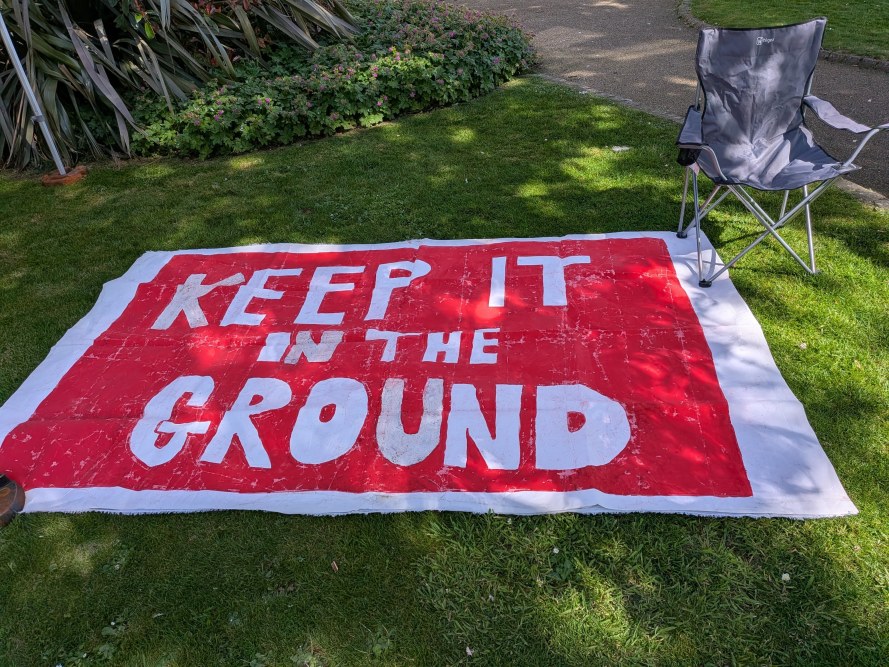
The Environment Agency (EA) has said it is minded to grant an environmental permit to Europa Oil & Gas for the proposal at Burniston, near Scarborough.
But participants in a final public consultation urged the EA to withdraw its draft decision. They said the EA should refuse or defer the permit until issues had been fully addressed through “robust, site-specific and independently verifiable evidence”.
The EA’s draft decision document, published on 3 August 2026, has been criticised for containing incorrect, inconsistent, incomplete and missing information, a DrillOrDrop analysis has found.
There are also concerns that it relies excessively on information that would be supplied after approval and that permit conditions were being proposed to overcome a lack of information about environmental risk.
“Questions unanswered”
Burniston Parish Council has asked the EA to reconsider a dozen issues and urged it to organise a village public meeting to listen to local concerns, before making a final decision.
The council’s chair, Richard Parsons, said in a consultation response:
“Burniston Parish Council do not consider that the current draft decision provides sufficient reassurance that the proposed activities can be carried out without unacceptable risks to groundwater, the wider water environment, air quality, local communities and the sensitive environment surrounding the site”.
Cllr Parsons added:
“Many of the questions still have not been answered, leaving too many doubts and a lack of any factual evidence that proves the environmental safety of this community.”
He said:
“The draft decision has not yet demonstrated that this high threshold has been met. Crucial information, that should clarify many of the questions that have remained unanswered by the applicant, remains unavailable, despite this project having already been in the public domain for well over two years.”
The EA has a responsibility “to be satisfied that the proposed activities can be carried out without causing an unacceptable risk to people or the environment”, Cllr Parsons said.
He said:
“If the Environment Agency cannot presently determine, from the available evidence, whether groundwater, air quality and other environmental receptors will be adequately protected, then the legal and technical basis for granting the permit should be reconsidered”.
The local campaign group, Frack Free Coastal Communities (FFCC), called on the EA to withdraw the current draft decision. It said the EA should require Europa to provide the outstanding technical information identified throughout the the draft decision, fully reassess this information and make it publicly available. There should also be a further public consultation.
It said in its consultation response:
“FFCC submits that the Environment Agency has not yet demonstrated that the statutory requirements for granting the proposed environmental permit have been satisfied. …
“Our principal concern is not that the Environment Agency has necessarily identified the
wrong environmental risks.“Rather, it is that the Agency repeatedly concludes that those
risks have been adequately assessed whilst simultaneously acknowledging that
significant elements of the environmental evidence remain unavailable and will only be
provided after the permit has been granted through a series of pre-operational conditions.”
Planning permission for the Burniston proposal was refused by North Yorkshire Council earlier this year. Europa has said it is considering an appeal. The environmental permit is separate from the planning process.
Incorrect and unclear information
Europa intends to use a lower-volume form of fracking to release gas at Burniston from the primary target, the Carboniferous sandstones. The company has said it plans four fracking treatments, each pumping 300m3-500m3 of fluid into the reservoir at pressures high enough to fracture rocks.
The EA described this operation as a proppant squeeze or reservoir stimulation and referred in the draft decision to “squeezing a small volume of oil-based fluid” into the formation (p4, Reservoir Stimulation).
We asked the EA for confirmation that oil-based fluid would be used in the proppant squeeze and what the regulator meant by “small”.
The EA told us
“The reference to the use of an oil-based fluid is a typographical error.
“No oil-based muds or fluids are proposed to be used at Burniston (Cloughton-2), and this will be corrected in the final version of the decision document.
“As no oil-based fluid is proposed, questions relating to the proportion of oil-based fluid injected are not applicable. The correction does not alter the assessment of the proposed operation.”
We asked for clarification about whether the final document would refer to a “small volume” of any fluid used in the proppant squeeze. If that wasn’t the case, we asked again how the EA defined “small”.
The EA replied:
“We can confirm that the final decision document will not refer to a “small volume” of any fluid used in the proppant squeeze. The reference to oil-based fluid was included in error and will be removed from the final decision document.”
At the time of writing, the EA has not corrected the references in the draft decision document, which remains open for consultation until 23 September 2026.
The draft permit also referred incorrectly to plans to “stimulate oil production”. The Burniston proposal is for gas appraisal, not production.
No 3D seismic survey
The EA acknowledged in its draft decision document that Europa had not yet carried out a 3D seismic survey around the proposed wellsite.
It commented that this was “unusual”. But it said 2D surveys covering the site and 3D surveys to the south and west provided “sufficient information to enable a decision to be reached”.
This has concerned some consultation participants.
Burniston Parish Council said:
“the lack of any such data means that no one knows, with any certainty the construction of the land below us and the effect hydraulic fracturing will have. Europa Oil and Gas Ltd have not provided the data and appear to expect the Environment Agency to make crucial decisions on the environmental impact of the process without providing the evidence.
“As there is no current seismological data in this application, the effect cannot be predicted. No-one knows if the land at the site and surrounding it, subject to the environment licence application, is suitable nor what harm may be caused.”
One consultation participant said:
“Because the applicant has failed to provide a robust seismic risk assessment that rules out threats to nearby residential structures, it is unsafe to grant this permit.”
One participant said:
“I ask the EA to explain how it has established that the geological structure is sufficiently understood to permit a high-pressure proppant squeeze.”
The EA has said no proppant squeeze would be authorized in the secondary targets, the Kirkham Abbey and Brotherton Limestone, because insufficient information had been provided by Europa.
But one participant asked:
“If the geological information was insufficient to permit stimulation of the secondary formations, I ask the EA to explain why it considers the geological and geo-mechanical information sufficient to establish safe fracture containment within the primary Carboniferous sandstone targets.”
Europa told DrillOrDrop it was waiting to see whether it got planning permission through an appeal before arranging the 3D seismic survey. The company also confirmed that no investor was in place to pay for the 3D survey. Europa announced nearly a year ago it was seeking investment of about £800,000 to fund the 3D survey.
The company also said the EA had set a pre-operational measure in the permit (8) which requires the verification of local fractures and faults through the drilling process.
Another consultation participant recommended the EA delay the permit decision until a hydraulic fracture plan (HFP) was published for Burniston. This is required before any form of fracking is carried out onshore and aims to predict and mitigate any induced seismic activity.
The participant told the EA:
“I urge you to insist on seeing the Hydraulic Fracture Plan before making a final decision on this application and to carefully examine the fundamental information it contains to determine its environmental acceptability.”
Chris Garforth, chair of the FFCC steering group, said:
“We are concerned that the EA is prepared to issue the Environmental Permit without having seen evidence of faults / geological structures around the well bore and fracking sites. It seems crazy to us that the EA can tell them it’s fine to go ahead and drill, then collect the data from the drilling which will show whether or not it is safe to frack.
“Reading the decision document and the draft permit, it is clear that the EA is prepared to issue the permit and for Europa to carry out the first phase of the development (drill the well) before Europa draw up a plan for monitoring seismicity, or provide an updated Gas Waste Management Plan (Schedule S1.3B in the draft permit) – both of which are major concerns for the local community and on which they sought assurances in the EA’s consultation last year on the Environmental Permit application.
“The EA even admit that the absence of 3D data is ‘unusual’ but that has not stopped them from saying it’s safe to go ahead and drill.
“The timescales indicated in the Schedule also suggest that there could be several months delay between (a) drilling and (b) fracking and testing, giving the lie to the bland schedule of phases set out in the planning application.”
See more details on the HFP at the end of this article.
Behind closed doors
Professor Garforth said his group was also concerned about lack of transparency on the seismic survey:
“By the time Europa do carry out the seismic survey, the data/data analysis will not be in the public domain nor subject to public scrutiny.
“They will only do the survey if they get planning permission (i.e. after a successful appeal), by which time the EA is already likely to have granted them an Environmental Permit.
“The NSTA, which will consider the Hydraulic Fracture Plan, does its work behind closed doors without the public consultation and scrutiny required of planning authorities and the EA.”
Burniston Parish Council has also raised concerns about openness.
It said:
“The reasoning, evidence and uncertainties must be transparent.”
It said the EA should:
- Make evidence supporting the draft decision publicly available
- Clearly identify significant assumptions
- Explicitly acknowledge uncertainties
- Publish responses to substantive objections
- Make monitoring data accessible to the public
- Consult the public on any future variation of the permit
Several substantial responses to the public consultation are not accessible to the public because they were sent as attachments and not published online.
Uncertainty
One consultant participant said:
“[the] Draft decision seems premature as underlying uncertainties have yet to be resolved”.
FFCC said “numerous important matters remain outstanding”. It said these issues were “not matters of adminstrative detail. They relate directly to the environmental
risks that the permit is intended to regulate.”
“FFCC accepts that pre-operational conditions are an established and valuable feature
of the environmental permitting regime. They enable regulators to secure final operational
details before activities commence.“However, FFCC submits that such conditions should not be used to postpone the
assessment of matters that are fundamental to determining whether the statutory tests for
granting a permit have been met.”
Burniston Parish Council said the permit should “not depend excessively on information to be supplied after approval” (see also 3D seismic survey and HFP).
The council asked the EA to identify every matter that remains to be addressed after the permit is granted and explain why that information was not required before the draft decision was made.
It said the EA should not rely on modelling, predictions and monitoring by or interpreted by the operator. The council called for the publication of independent verification and results.
The council said:
“The site is located in a sensitive coastal area, close to residential communities and important environmental and landscape assets. In such circumstances, uncertainty should not be treated as evidence that no risk exists.
“Where there are credible uncertainties concerning groundwater, geological pathways, well integrity, emissions, waste management and the consequences of the proposed stimulation operation, the Environment Agency should apply a genuinely precautionary approach.”
Another consultation participant raised Europa’s estimate that 50%-70% of fracture fluid would remain in the rock formation. The participant asked:
“how has the EA demonstrated that retained fluid cannot migrate through natural fractures, previously unidentified faults or artificially created fractures into other formations or groundwater-bearing strata?”
Inconsistency
One consultation participant complained about inconsistent figures for the height of the permitted fractures.
In the draft decision document, the EA said the fractures would range from 65m-80m vertically.
But elsewhere in the document, the EA said the proppant squeeze was designed to extend 85m above and below perforations in the wellbore.
FFCC said the EA concluded that groundwater risks were acceptable but, at the same time required, additional monitoring and hydrogeological information before operations could start.
The group added:
“Similarly it [the EA} concludes that geological risks are acceptable whilst acknowledging that detailed fault mapping and verification can only be completed following drilling and the submission of a future Hydraulic Fracturing Plan.”
Specific concerns
Burniston Partish Council and Frack Free Coastal Comminities identified other concerns including:
Groundwater pollution risk: The EA must explain clearly how it had resolved its earlier objection because of an unacceptable risk of groundwater pollution. It must also demonstrate how it was satisfied that the well would provide adequate protection through the operational life and after abandonment.
Uncertainty over fracking: The EA should demonstrate that it had adequately assessed the likely extent and orientation of induced fractures and issues including the possibility of induced seismicity and fractures interacted with natural faults.
Lack of baseline data: Before any work began, the EA should ensure that robust, independent and publicly-available baseline monitoring was undertaken on surface and groundwater, methane, air quality, naturally-occurring geological contaminates.
Methane emissions: The EA should not assume emissions will be negligible because the operation is described as temporary.
Flaring waste gas: Flaring proposals during testing and production failed “to meet strict modern interpretations of minimising environmental waste”. The parish council said:
“The public should be able to see the evidence on which the Environment Agency has concluded that the proposed controls are sufficient.”
Waste management: The council said no waste management plan should rely on assumptions that have not been adequately tested against actual geological and operation conditions at the site.
Groundwater monitoring arrangements: The council said these had been insufficient defined so “the public is being consulted on a permit without being able to assess whether the monitoring system will be capable of detecting pollution promptly.”
More on HFP and 3D licence commitments
Europa told DrillOrDrop that local faults and fractures would be confirmed through the HFP to “verify that there are no material changes to the conceptual model before any proppant squeeze operations are authorised”.
The company added:
“A 3D seismic survey is required under the Hydraulic Fracture Plan and will be carried out before any proppant squeeze operation is conducted, ahead of that operation and assuming planning and other permissions are granted.”
DrillOrDrop has established that an HFP does not require a 3D seismic survey. The EA told us:
“There is no formal requirement in legislation or guidance for a 3D seismic survey to accompany a Hydraulic Fracture Plan.
“A 3D seismic survey is typically used to characterise geological structures at depth and can form part of the wider evidence base used to support the assessment of the subsurface. “However, while the Hydraulic Fracture Plan requires sufficient information to demonstrate the geological setting, faulting, and fracture behaviour at depth, it does not prescribe how this information must be obtained. As such, the use of a 3D seismic survey may support the Plan, but it is not a specific statutory or regulatory requirement.”
The Burniston 3D survey is a work commitment in Europa’s licence agreement for PEDL343 with the NSTA.
The NSTA told us operators could choose when to carry out licence commitments. It also said:
“It is important to note that commitments can be varied depending on the circumstances of the individual licence/field.”
In 2018, a legal challenge on licence commitments ruled that PEDLs were private contractual licence and that clauses or conditions could be changed if the parties agreed. In the Burniston case, the condition of a 3D survey could be removed if Europa and the NSTA agreed.
Categories: Regulation, slider

 DRILL OR DROP?