The Burnham government has confirmed it will not ban lower-volume fracking.
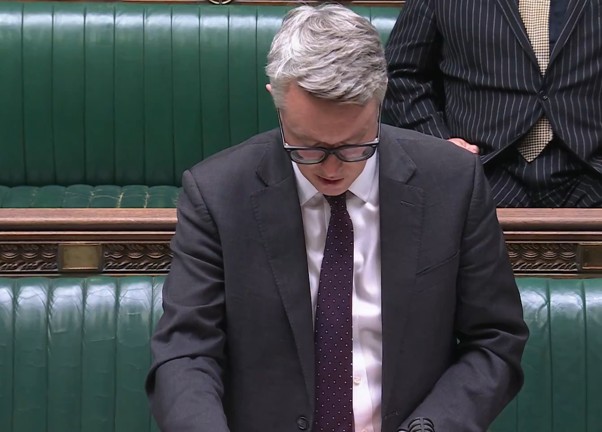
In one of the new administration’s first public statement on the subject, junior energy minister Martin McCluskey said there was a distinction between the promised ban on fracking for shale gas and low volume hydraulic fracturing techniques which would still be allowed.
The minister was closing a backbench parliamentary debate, which called for a total ban on fracking.
He said of lower-volume techniques, such as proppant squeeze:
“This is not the same as hydraulic fracturing for shale gas extraction. This is not associated with the same safety issues.”
Like fracking in shale, operations like proppant squeeze also inject fluid at pressures high enough to fracture rocks to increase the flow of gas.
But they are not prevented by the current moratorium on fracking in England because the volume of fluid they inject is below the legal threshold (more than 1,000m3 for a single fracture stage or 10,000m3 for an entire operation). Opponents have described the threshold as a legal loophole that is being exploited by oil and gas companies.
Operators are currently seeking to carry out lower-volume fracking at three sites in England: Burniston in North Yorkshire, West Newton-A in East Yorkshire and Wressle in North Lincolnshire.
Mr McCluskey told MPs:
“There is no clear evidence that [lower-volume fracking] induces seismicity that is felt on the surface.”
He added:
“Low volume hydraulic fracturing operations are routinely used on conventional oil and gas operations. They target different types of rocks, create fractures close to the wellbore and are typically short single stage operations, as opposed to the continuous fracture characteristic of shale gas fracking.”
The minister said the Energy Independence Bill would meet the government’s commitment not to issue new exploration and production licences, both on and offshore, including those that could be used to frack for shale gas. He said:
“That will deliver on our commitment in law to ban fracking.
He added:
“There is no loophole and no hidden route by which shale gas fracking can resume.
“The effective moratorium remains in place and the government will not issue new onshore licences in England, including those that could be used for fracking for shale gas. That is a reassurance, that communities across the country are entitled to hear.”
Opposition
The Lib Dem Claire Young, who opened the debate, urged the minister to commit to defining fracking by its purpose and its effects, not by what she described as “an arbitrary measure of fluid used”.
She said:
“Proppant squeeze is just hydraulic fracturing at lower fluid volume.
“The intent is identical, fracking. The technique is identical. A company injects fluid at high pressure to fracture rock and release the gas inside, but because the volume is lower, the law treats it as something else entirely and waves it through.”
She also called for a ban on all forms of fracking.
“This government has been in power for two years and yet I see no indication that a full ban is due.
“It seems that this government is not taking decisive action to stop all fracking activity.”
Alison Hume, the Labour MP for Scarborough, whose constituency includes Burniston, said:
“There is strong evidence to suggest that small-scale fracking carries the same risks as large scale operations, particularly around seismicity.”
She said:
“Unless the government acts boldly and closes the loophole communities across the country, such as those in West Newton and Burniston, will have fracking operations on their doorstep.
“These communities love where they live. Don’t they count? It doesn’t matter to them, whether it’s a mini frack or the full-scale version.
“The net result is the same: drill pads, drill heads, gas flare and noise, 24/7 lights during the exploration stage and continuous HGV lorry movements.”
She added:
“Unless we legislate to ban all forms of fracking in our upcoming Energy Independence Bill, then our fracking ban will be symbolic rather than material.
“We have a unique opportunity to show climate leadership. We have an opportunity as a government to stand up to the frackers, to make our legislation watertight to safeguard the natural environment.”
Other arguments
Reform’s Richard Tice said it was “dogmatic and stubborn” to ignore what he called the “most valuable economic treasure of shale gas”. He said companies had already invested more than £200m in the potential for UK onshore shale gas. This proved, he said, that they believed the reserves were “very considerable”.
But the Lib Dem’s energy spokesperson, Richard Foord, said:
“There is a real danger that investments in fracking will be a catastrophic mistake as the fuels, the facilities and the resources become stranded assets.”
Labour’s Phil Brickell said:
“Fracking became a symbol of a political establishment refusing to listen to communities and refusing to recognise where public opinion had already moved.”


