The assessment of the climate impact of expansion at the Horse Hill oil site in Surrey contains “multiple errors and misleading and irrelevant information”, campaigners said today.
The Weald Action Group, which won a landmark Supreme Court ruling on greenhouse gas emissions, said the assessment, submitted by the developer, made “spurious claims” and failed to comply with the latest guidance.
The flaws led to the “false conclusion” that the climate impact was “not significant”, the group said. It added:
“This is incorrect and must be disregarded”.
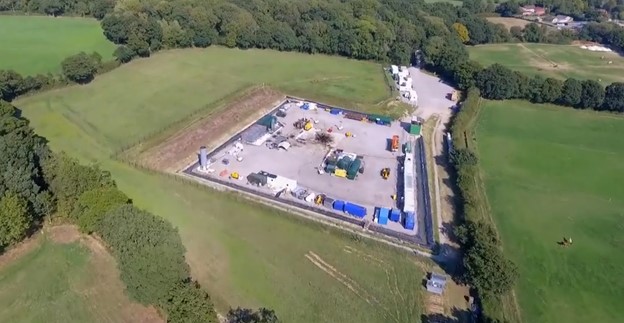
Weald Action Group (WAG) has called for evidence that the assessment was written by an appropriately qualified practitioner”.
The assessment estimated that four new production wells and extraction of more than 600,000 tonnes of oil over 20 years, would result in more than two million tonnes of greenhouse gas emissions. But it stated that the emissions would not be “significant for the climate”.
Kirsty Clough, of WAG, said:
“The oil company’s assessment of greenhouse gas emissions and climate impacts is fundamentally flawed. Had they done the job properly, they could not have avoided concluding that the effects on the climate would be highly significant. The Council cannot grant permission on the basis of such a deficient assessment.”
In its response to Surrey County Council, submitted today, WAG said:
“The technical competency of the consultant who prepared the assessment of climate significance is in question.”
The document was apparently prepared by an air quality consultant.
WAG said the job requires “a broad knowledge of UK climate mitigation policy, in the context of international obligations, to be able form a judgement of significance”.
It said:
“We question whether an air quality consultant would have the relevant technical skills and expertise … to undertake a robust GHG [greenhouse gas] and climate impact assessment.”
It added:
“A lack of competency is observative in the numerous shortcomings and inaccuracies.
“In particular, the author has failed to draw on relevant available guidance, policy and scientific evidence”.
WAG said:
“We urge Surrey County Council to raise the issue of technical competency with the applicant. Specifically they should be required to provide evidence that the assessment was written by an ‘appropriately qualified practitioner’.
“Multiple flaws”
The climate assessment focussed on the emissions resulting from burning Horse Hill oil, known as downstream or scope 3 emissions. The Supreme Court ruling now requires these emissions to be taken into account when deciding fossil fuel proposals.
WAG said its analysis found the Horse Hill assessment was “flawed in multiple ways”.
The group said the assessment failed to comply with:
- new government guidance on assessing the effects of downstream scope 3 emissions
- Town and Country Planning (Environmental Impact Assessment) Regulations 2017
- Institute of Sustainability & Environmental Professionals’ Guide to assessing greenhouse gas emissions
WAG said the assessment failed to regard the government guidance as a material planning consideration, even though a developer and climate expert agreed in a separate project that it should be.
The Horse Hill assessment also failed to describe the state of the climate, WAG said.
Scientists have forecast that the maximum amount of carbon we can emit and stay within the legal limit of 1.5C temperature rise is 130-170 gigatonnes of carbon dioxide (CO2). This volume of CO2 will be breached in a few years, the group said.
It added:
[This] “conceals the true state of the climate and how little time, if any, we have left to prevent global average temperature rise exceeding the 1.5C limit.”
WAG said the assessment further failed to assess the actual impact of 2 million tonnes of greenhouse gases on, for example, human health, biodiversity, land, soil water, air and climate. This is required by the Environmental Impact Assessment Regulations, it said.
There were also “multiple errors and misleading and irrelevant information” about projected UK oil production and demand and global energy and climate scenarios, WAG said.
It said the assessment implied that new domestic oil production was needed to meet a shortfall in demand up to 2050 and to bolster energy security.
WAG said this “presents a false picture of future oil demand and its relationship to domestic production and shows a lack of understanding of energy markets”.
There was also a “spurious” claim, WAG said, that oil from Horse Hill would substitute for imported oil, which may have a higher carbon intensity.
WAG said no evidence had been provided and the claim should be disregarded:
It said the assessment made unfounded claims that oil from Horse Hill would remain in the UK, even though more than 80% of domestically produced oil and gas is exported. The group said:
“There is no guarantee that oil from Horse Hill will remain and be used within the UK.”
The assessment failed to place Horse Hill greenhouse gas emissions in a global cumulative context of all current and approved fossil fuel projects, WAG said. An estimate in 2022 forecast the emissions from these projects amounted to 936 gigatonnes of CO2.
The group said:
“The significance of the scope 3 emissions arising from the Horse Hill development should … have been assessed relative to the available space in the remaining 1.5C aligned global carbon budget, once the emissions from existing and committed fossil fuel projects (the cumulative effect) have been accounted for. The developer has failed to do this.”
WAG added:
“There is no space in the rapidly dwindling 1.5C global carbon budget for any new fossil fuel developments, and a massive excess of emissions from existing oil, gas and coal infrastructure which will now need to close before the end of its economic life.
“Any emissions from the Horse Hill oilfield development will be additional, cumulative and hence contribute to the further exceedance of the 1.5C global carbon budget.
“On this basis, the scope 3 emissions arising from the Horse Hill development must be deemed significant in terms of their climate impact.”
- Weald Action Group said it would be submitting further objections, including on seismicity and earthquake risk.
Categories: Opposition, slider

 DRILL OR DROP?