Residents in a Yorkshire Wolds village have asked the prime minister for help in their opposition to local gas drilling plans.
Foxholes parish council and the community campaign group have written to Andy Burnham outlining their fears about proposals by Egdon Resources to explore for gas on the edge of their village.
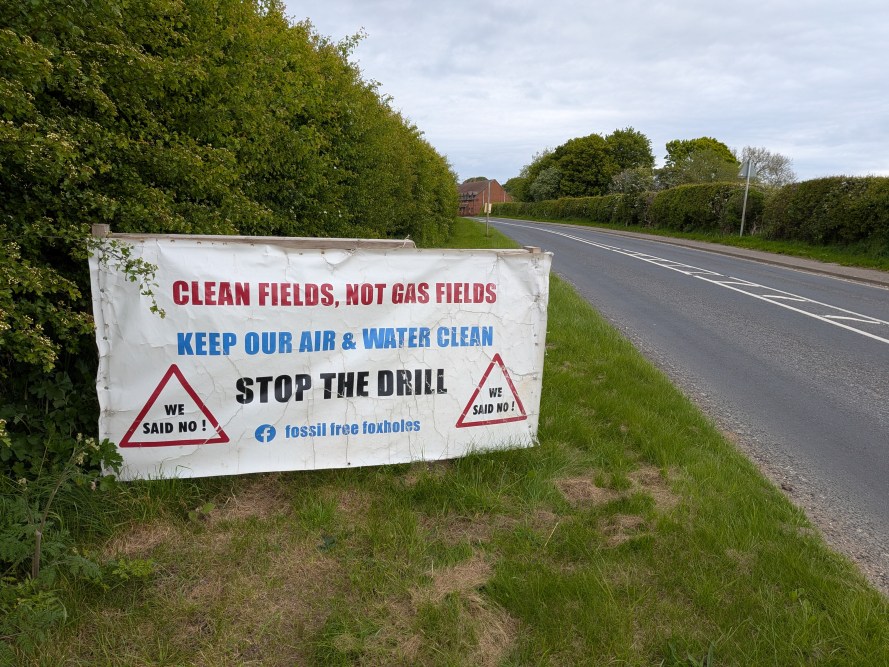
The application seeks to drill through a principal chalk aquifer that supplies water to 900,000 people. The proposed site is in a productive farming area. It is also near the soon-to-be designated Yorkshire Wolds National Landscape, which will give the area the protection and status of a national park.
The letter said Egdon’s application, to be decided by North Yorkshire Council, has raised concerns about strategic water resources, food security, climate change, nature recovery and economic resilience.
It said these were national concerns:
“The Yorkshire Wolds are a remarkable natural asset. Protecting them should be a shared national responsibility.”
It added:
“While this is a local planning application, we believe it raises issues of wider national importance concerning water security, climate resilience, food production, nature recovery and the future direction of energy policy”.
The letter’s signatories, David Eddy, chair of Foxholes with Butterwick Parish Council, and Laura Bell, campaign lead of the Drawing a Line in the Chalk campaign, asked Mr Burnham to:
- Ensure nationally-important groundwater resources, chalk streams and agricultural landscapes received appropriate protection in planning and environmental decision-making
- Ensure that the most up to date scientific evidence was properly considered where development could affect strategic water resources
- Clarify how further fossil fuel exploration was being reconciled with commitments on climate change, nature recovery, food security and resilience
- Meet representatives of the parish council and Drawing a Line in the Chalk campaign
The letter, published online today, welcomed the principle, supported by government, of empowering communities and ensuring that local voices were heard in decision-making:
“We … respectfully ask that it is applied to communities such as ours, where residents are seeking reassurance that decisions affecting essential natural resources are being made using the best available evidence and with proper regard to long term consequences.”
The letter said the protection of water resources from the Yorkshire Wolds chalk aquifer “must be considered a matter of national resilience”.
It also said:
“The Yorkshire Wolds are also a highly productive agricultural landscape. The farms and food businesses that operate here contribute to the nation’s food supply at a time when the Climate Change Committee has highlighted the growing risks that climate change poses to food security and the need to strengthen resilience across our food system.
“Protecting the natural systems that underpin agriculture, particularly clean and reliable water supplies, healthy soils and functioning ecosystems is therefore not simply an environmental concern. It is an issue of economic resilience and national security.”
Mr Eddy and Ms Bell said:
“Residents are not opposed to a secure energy future, although renewables are clearly the way forward here. They are asking that decisions made today do not compromise the water, landscapes, food producing capacity, ecosystems and tourist activity upon which tomorrow’s generations will rely.”
They added that Egdon’s estimates suggested the expected gas resource at Foxholes was the equivalent of six days UK gas use in winter:
“Hardly energy security, particularly given it will be sold on the international markets.”
They said:
“Communities are entitled to ask whether new fossil fuel exploration in environmentally sensitive locations is consistent with wider commitments on climate change, biodiversity recovery, water resilience and long-term energy strategy.”
They said local concerns about the proposal included:
- Has the latest geological and groundwater evidence been fully incorporated into decision-making?
- Have the risks to the principal chalk aquifer, including contamination pathways, been adequately assessed?
- Are the full climate implications of fossil fuel extraction being properly considered?
- Do existing planning and permitting regulations protect sufficiently nationally-important water resources, landscape and ecosystems?
The letter stated:
“The issue is not simply whether one exploratory well proceeds. It is whether our planning and regulatory systems are sufficiently robust to protect the natural assets upon which communities, businesses, agriculture and future generations depend.
“In order to enable communities to engage fully with such planning applications, we need to ensure that within the planning process the most up-to-date scientific data is also made available to those affected by the planning applications to create a level playing field.
“And that equality of representation is further supplemented by increased time at the public planning committee meetings where applications are to be heard.”
Categories: Opposition, Politics, slider


