Delays to a low-volume frack at an oil and gas site in East Yorkshire could “waste” more than half a million pounds, the operator has warned. But the controversial operation, scheduled for this month (November 2026), is reportedly not ready to start.
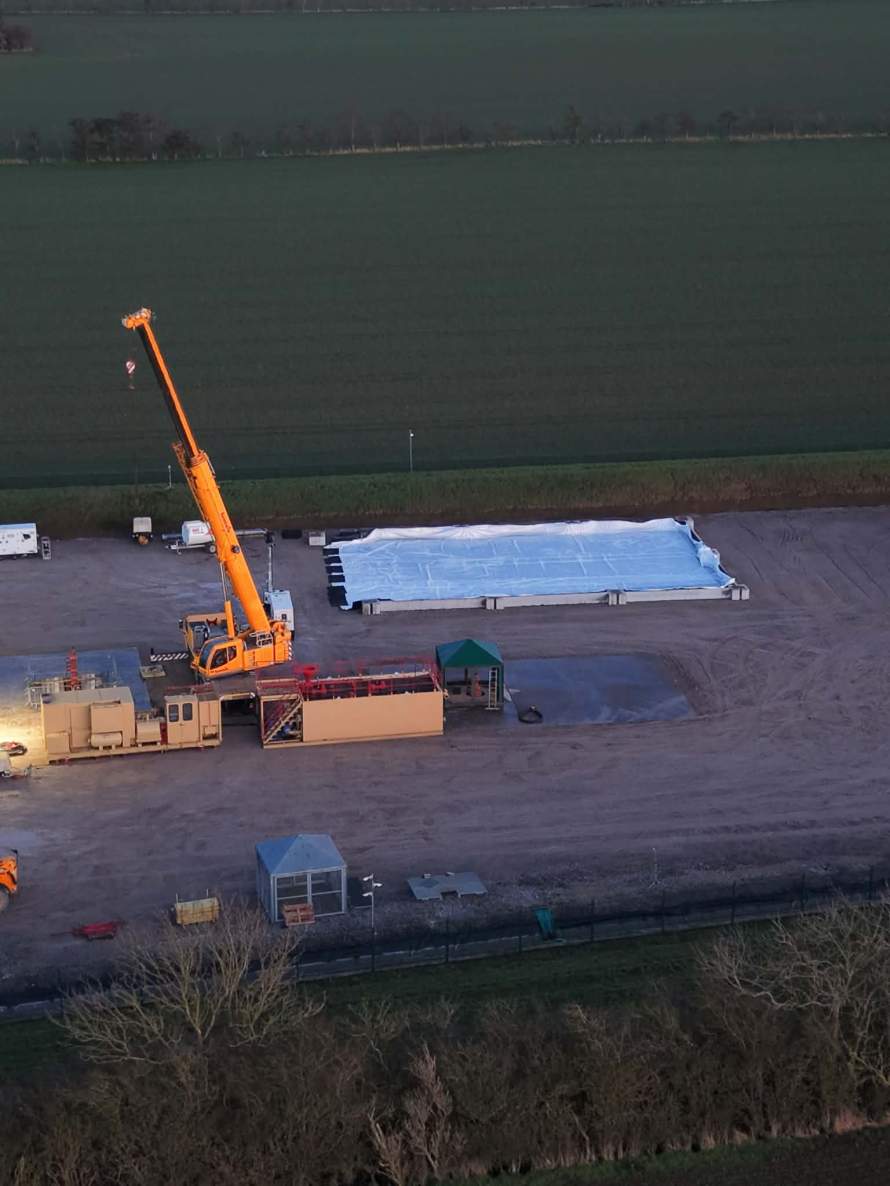
The news emerged at the High Court in London today, where an environmental campaigner sought to overturn consent for the fracture at West Newton-A.
Peter Lomas, from Hornsea, also asked for more time for his challenge against the Environment Agency (EA) and an interim injunction to stop fracturing at the site until the case was resolved.
Rulings on the injunction and whether Mr Lomas’s challenge can go ahead are expected on Monday morning (30 November 2026).
“Threat to licence”
Rathlin Energy proposes to carry out a single low-volume hydraulic fracture into the Kirkham Abbey Formation, 1.7km below ground.
The company said the aim was to re-establish the permeability of the reservoir and allow the commercial exploitation of the well by allowing gas and hydrocarbon fluids to flow at economic rates.
It claimed West Newton was the one of the UK’s largest onshore discoveries, with a reservoir estimated at 38.5 million tonnes of oil and gas.
Rathlin told the court any further delay to the fracture and a well test would waste £548,000, spent on equipment, chemicals and contractors.
The company also said it could lose the West Newton licence if it failed to meet a June 2027 deadline for the work. This could put at risk £70m of previous spending and incur £2.5m of costs to abandon the West Newton wells, it said.
But Estelle Dehon KC, for Mr Lomas, said recent correspondence sent to the court had revealed that the project was not ready to start because of a planned change in operating techniques.
She said the EA would have to decide whether to allow a proposed stimulation gun to be used in the fracture and consider whether a variation to the environmental permit was needed.
Ms Dehon said:
“It is not a position that regulatory hurdles have been cleared. … The project is not ready to go”,
Ms Dehon added that Rathlin had bought the chemicals and appointed contractors in September and October 2026, without asking the court to expedite the claim. The cost was a risk the company took by investing in the project, she said.
Last week, a partner in the West Newton project, Union Jack Oil, informed the EA and the industry regulator, the North Sea Transition Authority (NSTA), about changes to the fracture programme, including the use of the stimulation gun. It also served a formal notice on Rathlin for what it said was a default under the joint operating agreement.
Gwion Lewis KC, for Rathlin, told the court the company needed time to undertake the work and analyse the findings of the well test:
“any further delay beyond the delay we have already encountered would cause us very substantial prejudice. … That would be a disaster for my client.”
But Ms Dehon said the company had assumed the NSTA, which manages oil and gas licences, would not grant an extension if Rathlin missed the deadline.
She said:
“Rathlin has in the past sought approval from NSTA for extension of deadline for a work programme and been granted that extension.”
She said there was also no evidence before the court for how long Rathlin would need to analyse the results of the well test.
She added:
“Any wider concerns that Rathlin might have in relation to delay can be addressed by ordering expedition of the claim [by Mr Lomas].”
“Unlawful approval”
The EA was accused at today’s hearing of unlawfully approving a variation of the West Newton permit to allow the low-volume fracture to go ahead.
Ms Dehon said the operation would open up the reservoir and allow the fossil fuels to be used, releasing greenhouse gas emissions.
But she said the EA had breached its responsibilities under the Environment Act for controlling pollution by failing to seek any information on the effects on climate. She said there was no information in the permit variation on greenhouse gases emitted from burning oil or gas from West Newton, known as downstream emissions.
“It appears the EA did not consider the downstream greenhouse gas emissions to be relevant or that any further information was required in relation to them.”
Matthew Dale-Harris, for the EA, described this argument as “without merit”. He said the Environment Act did not impose a specific legal duty on the EA to assess downstream emissions.
Mr Lewis, for Rathlin Energy, said a 2024 ruling by the Supreme Court, which required planning decisions to take account of downstream emissions, did not apply to environmental permitting.
Ms Dehon said the EA had also acted unlawfully by issuing the permit variation before it had reviewed the hydraulic fracturing plan.
She described the plan as a “critical document”, which assessed the risks of seismicity induced by fracking and of fracturing creating pollution pathways. But the EA failed to take into account the views of the NSTA, the regulator responsible for induced seismicity, she said.
Mr Dale-Harris said the EA was entitled to use its scientific judgement to reach a conclusion on seismicity without consulting the NSTA.
Mr Lewis said there was no statute that required the EA to consult the NSTA.
Ms Dehon also told the court that the EA had failed to discharge its obligations under the Environmental Permitting and the Water Framework Regulations.
She said for a lawful decision to be taken, the EA needed to identify groundwater bodies, understand their status and identify environmental objectives for groundwater in a particular river basin.
But she said the EA made a mistake in the permit variation decision document by stating there would be an “indirect input” into the groundwater, when in fact there would be a direct input of hazardous substances.
The EA also provided insufficient information for the public to take part in a consultation, she said.
Mr Dale-Harris, for the EA, described the error as “immaterial”. It did not cause anyone to misunderstand what was being proposed, he said.
Mr Lewis said the frack plan carried no risk to drinking water and no pollution risk. He said it would be “physically impossible” for fracturing fluids to reach the surface or contaminate the drinking water aquifer.