Fracking for UK onshore oil and gas hit the headlines again during 2025.
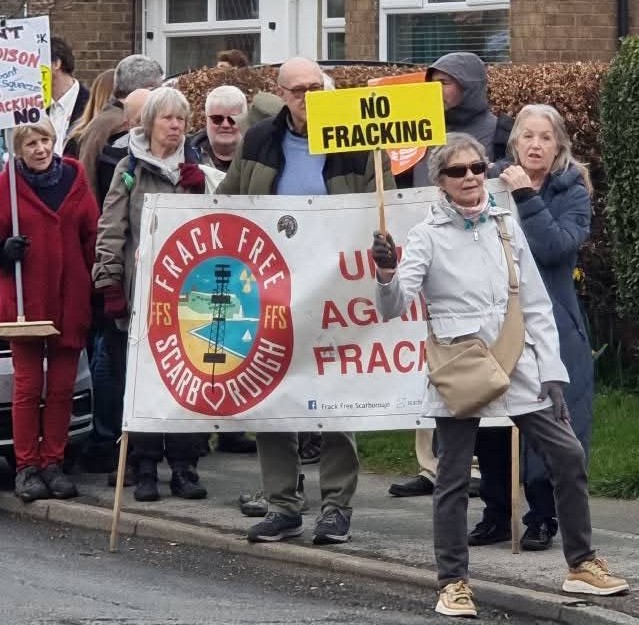
Photo: Pete Hamilton
Burniston
The year opened with the announcement by Europa Oil & Gas that it expected to submit imminent plans for proppant squeeze, a lower-volume form of fracking, at Burniston in North Yorkshire.
The company repeatedly denied that its operation, part of proposed gas appraisal, was fracking. But a freedom of information request revealed that Europa executives used the ‘frack’ word in correspondence with regulators.
A legal opinion by Estelle Dehon KC concluded that the proposed Burniston operation did qualify as fracking, under a definition in the North Yorkshire minerals plan.
More than 1,600 formal objections have now been made against the Burniston planning application. DrillOrDrop analysis earlier in the year revealed that fracking was in the top eight reasons to oppose the scheme. The leading five were then climate change, traffic and road safety, landscape impact, noise and threat to wildlife.
Local people were disappointed that the North Yorkshire Moors National Park – close to the proposed site – did not object.
But all the local councils opposed the scheme, including Reform UK-controlled Scarborough.
A parliamentary petition launched in Burniston collected more than the 10,000 signatures, requiring the government to reply. MPs accused ministers of an inadequate response.
Frack Free Coastal Communities criticised the Burniston proposal for “inappropriate” technology, “inadequate” risk assessments, missing, incorrect and inconsistent information and a failure to consider vulnerable people. Europa repeated that it was incorrect to refer to the Burniston project as fracking.
The definition debate centred on a letter from the energy minister, Michael Shanks, which claimed lower-volume fracking was “commonplace” in the water industry.
But an FOI request revealed that 15 water companies and the Environment Agency either had no records of the process or had not used it on water wells in the past 20 years.
The Department of Energy Security and Net Zero withheld the source of the minister’s claim. This is now the subject of a complaint to the information commissioner.
More recently, Mr Shanks said the government’s proposed ban on fracking in England was unlikely to include lower-volume operations. The statement came during a parliamentary debate, led by Burniston’s MP, Alison Hume. She had previously warned that a legal loophole that allows lower-volume fracking would prompt multiple fracking applications.
There is no public date yet for the decision on the Burniston planning application but there are suggestions it could be in late January or early February 2025. Local people hope the meeting will be in Scarborough. See also Policy changes.
More frack plans
- Egdon Resources and its US owner, Heyco, announced they wanted to frack what they called a giant shale gas field around Gainsborough in Lincolnshire. Heyco’s claims of potential gas production have been questioned
- Rathlin Energy announced plans for reservoir stimulation, also a form of fracking, at West Newton in East Yorkshire. So far, nothing has happened.
- Planned expansion of production at Egdon’s Wressle oil site in North Lincolnshire included lower-volume fracking. The work still needs planning permission.
- The Reform-led Lancashire County Council said it had no plans for fracking in Lancashire, despite the party’s energy spokesperson and deputy leader urging oil and gas companies to “get ready for fracking”
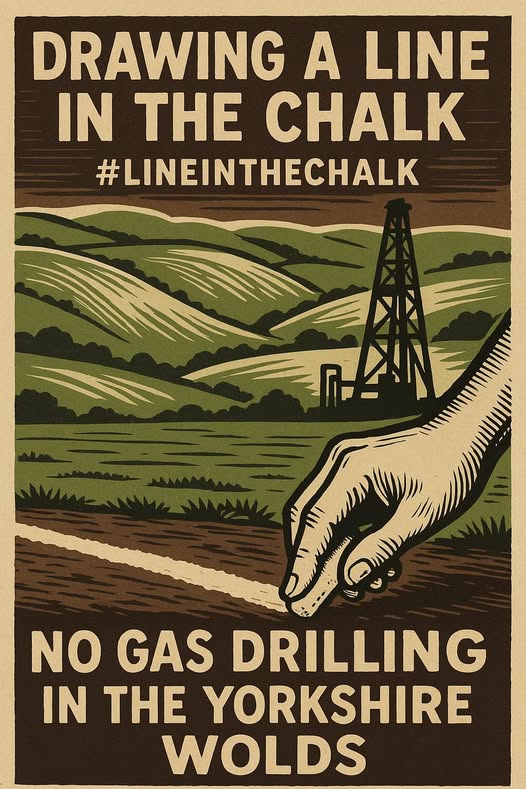
New plans: Foxholes
In February 2025, Egdon revealed plans to drill for gas at a new site in the village of Foxholes, between Bridlington and Scarborough.
Details were released in May 2025 at a drop-in meeting for residents. The planning application was published in August 2025.
Unlike Burniston, the Foxholes proposals did not include any form of hydraulic fracturing.
North Yorkshire Council ruled that the scheme did not need a detailed environmental impact assessment.
Within a week of the application’s publication, Foxholes residents rejected the Egdon proposals. The parish council voted unanimously to object and a survey of villagers found that 90% were against the plans.
A briefing document by the council raised concerns about the risk of contamination to the chalk aquifer. Other objections centred on public health aspects, noise, light, traffic, seismicity, climate change and impact on farming, community and landscape.
The planning and environmental permit applications both had public consultations.
No date has yet been set by North Yorkshire Council for the Foxholes decision.
Other sites
- Cuadrilla’s Elswick gas site in Lancashire got a five-year extension of its planning permission but so far monthly production has been below 20ksm3.
- Production at the Keddington oilfield in Lincolnshire resumed after more than a year’s gap. The site has planning permission for a step-out well.
- Proposals for a new sidetrack production well at the Whisby oilfield in Lincolnshire went before planners again – three years after they were previously approved.
- Egdon sought to expand its suspended Waddock Cross site in Dorset. A decision is likely to be delayed because ministers are to rule on whether an environmental impact assessment is needed.
- Residents in Balcombe in West Sussex lost their case at the Court of Appeal to overturn planning permission to flow test Angus Energy’s oil well.
Abandoned plans
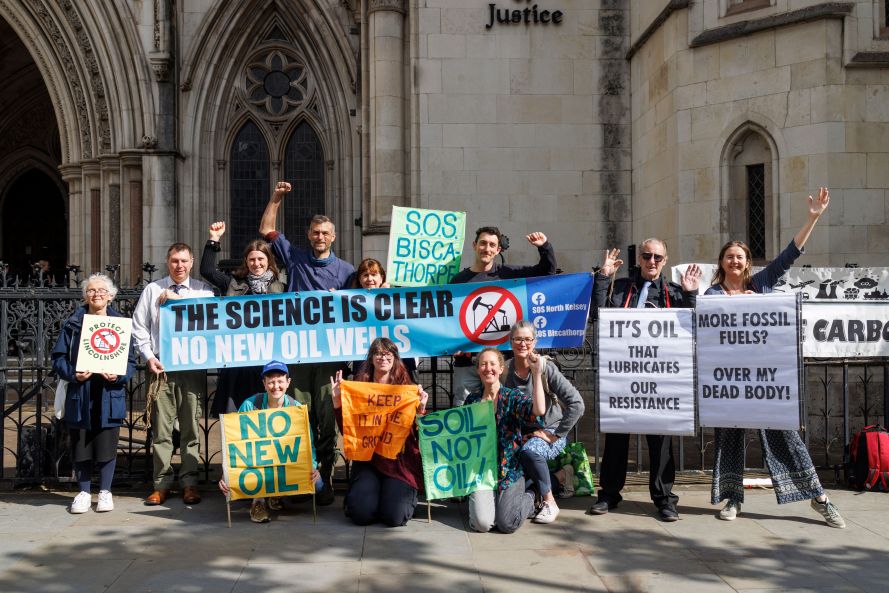
Biscathorpe
Plans for long-term oil production and new drilling at Biscathorpe in the Lincolnshire Wolds were shelved in December 2025.
The surprise announcement came five months before a planning inquiry was due to consider whether to overturn a refusal of planning permission.
The Biscathorpe operator, Egdon, said the decision to withdraw was based on the “wider fiscal, policy and commercial developments”. It also referred to a strengthened planning duty to conserve areas of outstanding natural beauty, like the Wolds.
Campaigners have spent more than 10 years opposing the Biscathorpe plans. They welcomed the company’s announcement but said they were disappointed that their evidence and arguments on climate change would not now be examined in public at the inquiry.
Dunsfold and Broadford Bridge
Plans to drill for gas at Loxley, near Dunsfold in Surrey, were also abandoned this year.
A subsidiary of UK Oil & Gas plc (UKOG) announced it was giving up the licence, PEDL234, which also includes the Broadford Bridge site in West Sussex.
Campaigners in Dunsfold said they were delighted that the licence had been relinquished. They described the UKOG plan for gas exploration and appraisal as “inappropriate and unsuitable”.
UKOG revealed in a later official report that it had given up PEDL234 because of “financing and regulatory issues”.
See more on Broadford Bridge in Clean-up delays.
Clean-up delays
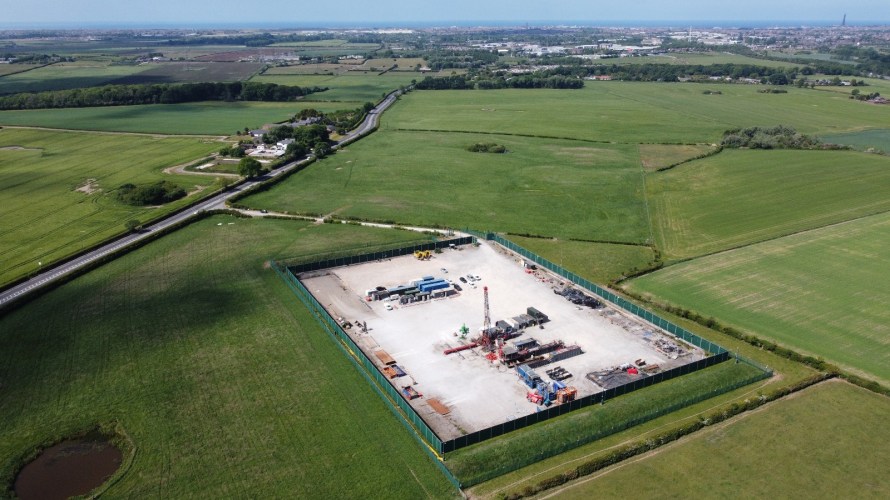
Cuadrilla’s frack site
Cuadrilla failed to meet the 2025 deadline to restore its fracked shale gas site at Preston New Road near Blackpool in Lancashire. It did abandon the site’s two horizontal wells during the year but not on time.
Days before the restoration deadline, the company sought another two years to do the work.
But councillors refused an extension of planning permission. There’s no evidence that the refusal will ensure the work is carried out any more quickly.
Broadford Bridge
Officials took enforcement action over delays to clean-up the Broadford Bridge oil site in West Sussex. The action by the county council was against the operator, a UKOG subsidiary, and the landowner.
The site, which has been dormant since 2018, was refused an extension of planning permission in 2024.
The county council told DrillOrDrop in December 2025 the start of clean-up was “imminent”. We’ve not seen any evidence that work has begun to plug and abandon the wells.
Other sites
- Wells were abandoned at Star Energy gas sites at Barton Moss in Salford and Doe Green in Warrington
- Campaigners in North Yorkshire warned landowners of the risks of liability for clean-up if they hosted oil and gas sites
The Finch ruling
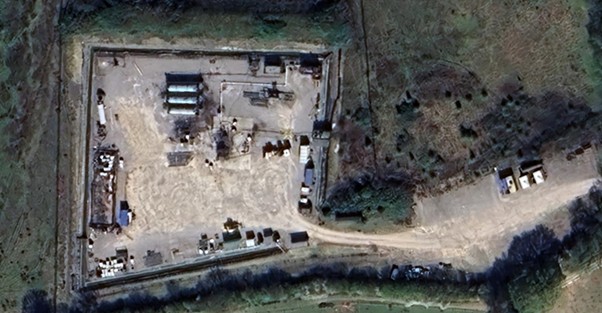
2025 saw more repercussions from the landmark Supreme Court ruling in the case won in 2024 by campaigner, Sarah Finch.
Her legal challenge successfully required decisionmakers to consider the carbon emissions from the combustion of fossil fuels, as well as those from the production process.
The decision quashed the planning permission at the oil site at the centre of the case, Horse Hill, near Redhill in Surrey.
A year on, in June 2025, there was no date for site clearance of Horse Hill. In December 2025, promised key details for the resubmission of the Horse Hill planning application had not been delivered. Surrey County Council said the information was now expected in the new year.
Because of the Finch ruling, West Cumbrian Mining withdrew its application for the first UK deep coalmine for 30 years. The company took a case to a corporate court under investor-state dispute settlement (ISDS)
Also in 2025, Sarah Finch was named campaigner of the year by the Sheila McKechnie Foundation.
Policy changes
The government published draft changes to planning policy that could have big implications for onshore oil and gas sites.
The proposed revision of the National Planning Policy Framework, which shapes decisions on planning applications, removed a key requirement for decisionmakers.
If the changes go through, mineral planning authorities would no longer need to give “great weight” to the economic benefits of oil and gas development when considering planning applications. Previously, this clause made it difficult for campaigners to oppose schemes successfully.
The revisions are now out for public consultation until March 2026.
Friends of the Earth called for a delay to the decision of the Burniston application to ensure it was decided under the correct policy.
The government repeatedly said it would ban fracking but has not stated precisely what it means by fracking and when the ban could come in. Lower-volume fracking now looks unlikely to be included.
Ministers also said there would be no new onshore oil and gas licences.
Warnings
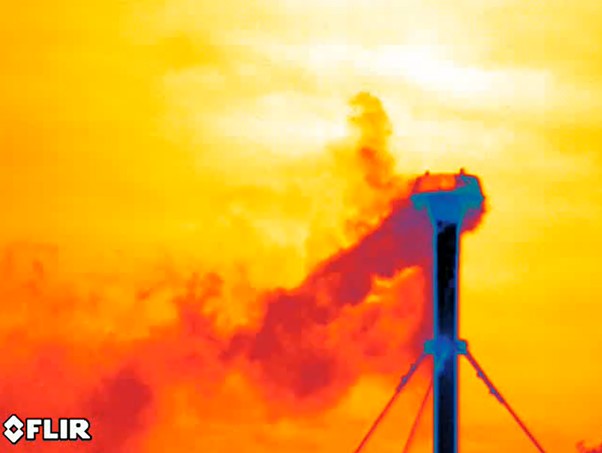
- Campaigners called for tougher rules on methane releases from onshore oil and gas fields
- The MP for the West Sussex village of Balcombe, where Angus Energy plans to test oil flows from a well, called for the licence to be revoked over water contamination fears.
- A group of scientists said fluid injection at the Brockham oil site in Surrey could cause earthquakes.
Company news
- Europa and Egdon Resources recently sought £6.5+m to fund the Burniston gas scheme in North Yorkshire.
- UKOG issued delayed annual accounts in October 2025 after suspending trading in March. The accounts showed a £35m drop in the value of the company’s oil and gas assets.
- UKOG later raised money for its hydrogen plans.
- Europa announced a deal to pay 4.5% of gross revenue from the Wressle oil site to a Canadian investor in return for US$500,000.
- West Newton considered bitcoin mining in East Yorkshire.
- Angus Energy continued negotiations on its loans.
What to watch in 2026 – DrillOrDrop’s look at some of the key events expected in the next year

 DRILL OR DROP?