A formal complaint has been made against the Environment Agency (EA) over the way it has handled plans for gas drilling and lower-volume fracking at Burniston in North Yorkshire.
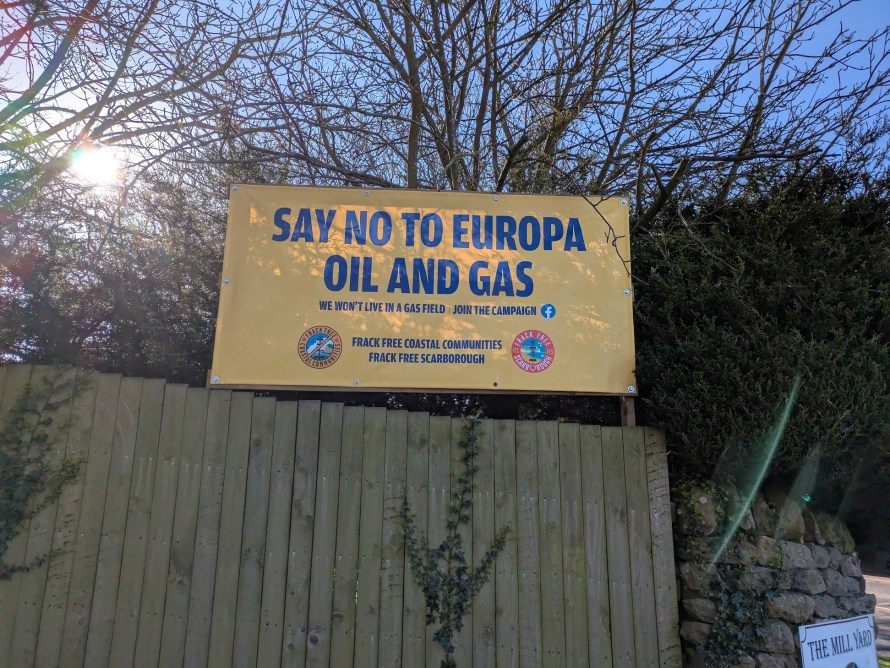
The complaint, by campaigner Dennis May, said the EA had provided “inaccurate, inconsistent and contradictory information”.
He called for the withdrawal of the current consultation on a draft decision by the EA to grant an environmental permit for the site.
He also said there should be a review of onshore oil and gas permitting in England and the EA should establish scientific definitions that were then universally applied.
The EA has been criticised locally and nationally for the Burniston draft decision document, published on 3 August 2026.
Yesterday, Friends of the Earth formally objected to the decision. Last week, DrillOrDrop reported on concerns that the draft decision document contained errors, uncertainty and missing information.
This morning, the EA announced on its website that the Burniston permit consultation, due to end on 26 September 2026, would close instead 25 days later on 21 October 2026. There was no explanation about why the consultation had been extended.
DrillOrDrop asked the EA why it had delayed the closing date. We have received no response.
“Not acting in the public interest”
Mr May, a member of the Nottinghamshire campaign group Frack Free Misson, accused the EA of failing to act in the public interest and of regarding the public consultation as “a mere formality, irrespective of evidence”.
In his complaint, submitted last week, he said:
“The EA has conveyed inaccurate, inconsistent and contradictory information to the public.”
He said the EA had “aligned with misleading, confected, and conflated terminology employed by the applicant”, Europa Oil & Gas plc.
He also said the EA had failed to remain impartial and had “fallen short of its stated aims to provide information correctly, clearly and in a professional manner”.
Mr May added:
“It is disappointing a statutory regulator has allowed the applicant to set the standard of its discourse with the public. In this, the EA could be seen as acting under the influence of lobbyists and thereby not in the public interest.”
He concluded:
“It is a reasonable expectation for a statutory regulator to demonstrate a consistent and structured scientific approach to the processes it oversees; such is clearly not evident in this case. A recognisable and structured taxonomy, containing terms with robust definitions is a primary requirement.
“Given this evidence, the current consultation should be withdrawn while a review of onshore oil and gas permitting is conducted, with the aim of establishing robust, scientific definitions and parameters, set by the regulator and universally applied.”
The Environment Agency has said it will respond to the complaint within 20 working days (approximately 16 October 2026). DrillOrDrop will report on the response.
Details
Mr May’s complaint focuses on three main areas:
Inconsistent and contradictory information
The complaint gave examples from the draft decision document and draft permit including:
- Contradictory information on the type of hydraulic fracturing fluid to be used
- Contradictory information on which formations would be fracked
- Misidentification of the purpose and targets of the permit application
- Inconsistent and contradictory use of terms to explain the proposed fracking process
Mr May said:
“Such a lack of accuracy and precision in terms of identifying both target formations and the nature of the fracturing fluid is a failure to correctly and professionally convey the most basic of information, a fundamental requirement of any public agency.”
Incorrect and misleading information
The complaint said the draft decision document and draft permit contained incorrect and vague terminology. It said:
“EA propagated and/or failed to amend both incorrect and misleading information regarding the scale of intended operations along with a misconception of the terms ‘conventional’ and ‘unconventional.’”
It accused the EA of being “party to a PR exercise, a role which a statutory regulator should not be involved in”. The complaint added:
“The use of vague, undefined terms is unscientific and thereby inappropriate.”
Mr May said:
“The granting of permits should be undertaken impartially, in a logical, scientific and evidence-based manner. Appropriate terminology should also be framed around a recognisable taxonomy so based, not adopted to suit the whims of an applicant’s PR campaign. To do otherwise could compromise the EA’s position in enforcement proceedings.”
Lack of definition and denial
The complaint also said the EA’s responses to an earlier consultation, summarised in the draft decision document, continued to “perpetuate the lack of definition, misleading information and denial that the target formations are unconventional”.
Mr May said this included:
- Lack of distinction between well and reservoir stimulation
- Arbitrary use of the term proppant squeeze across well and reservoir stimulation
- Claims that seismicity [earthquakes] occurred in previous shale fracks because of the use of “far higher injection volumes” compared to what is proposed at Burniston
On the third example, Mr May said this was not based on fact because the quantities proposed at Burniston were similar stage volumes to those used in fracking at Cuadrilla’s PNR2 well in Lancashire in 2019 that led to earthquakes and a moratorium on associated hydraulic fracturing in England.
He said the EA had:
“adopted a position whereby it is relying upon what has proven to be ineffective shale gas legislation, with thresholds which have never been attained, as a datum upon which to base its assessment of risk.”
EA under fire
The Burniston complaint is the second current challenge to the EA on its permit process in the onshore oil and gas sector in England.
In East Yorkshire, another campaigner, Peter Lomas, is seeking a judicial review of the decision by the EA to grant a permit variation allowing lower-volume fracking at the West Newton-A site.
Yesterday, we reported that Mr Lomas had also applied to the High Court for an interim injunction to stop the fracking operation at West Newton until his legal challenge with the EA had been decided.
Categories: Regulation, slider


