The Environment Agency (EA) has amended its much-criticised assessment of gas drilling and lower-volume fracking at Burniston in North Yorkshire.

The EA has corrected what it described as “drafting errors” in two key documents on an environmental permit.
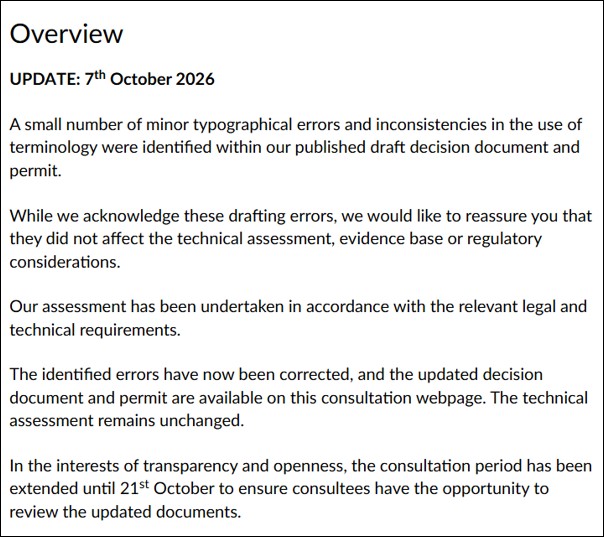
It has now acknowledged “a small number of minor typographical errors and inconsistencies” and published revised versions.
However, analysis by DrillOrDrop has identified at least 58 changes in the updated draft decision document and more than 20 in the draft permit.
Many other local concerns about the documents remain.
The permit process at Burniston is the subject of an official complaint against the EA. The documents have also been strongly criticised by residents and campaigners, the local action group, Frack Free Coastal Communities, and Burniston Parish Council.
The EA was accused of inaccurate, inconsistent, contradictory and missing information. It was urged to withdraw its draft decision to approve the permit.
But the EA said its technical assessment was unchanged, despite the errors in the original documents.
DrillOrDrop will report separately on reaction to the revised permit documents. The environmental permit is a separate process from planning permission, which was formally refused for the Burniston proposal in May 2026.
Changes
DrillOrDrop used the EA’s list of changes (p3) to the 92-page draft decision document. We found:
- At least 50 unique amendments
- At least a third of pages (30) had amendments
- Two pages each had at least five changes and another page had at least four
- One section comprising five-and-a-half pages had at least15 amendments
In the 30-page draft permit, again using the EA’s list of changes, we found:
- At least 20 unique amendments
- At least a third of pages had amendments (10)
- One page had four changes, all in one section
- Another two pages each had three changes
The EA’s lists of changes refer to additional amendments to key terms that had been made throughout both the draft decision document and draft permit.
These, and many of the listed amendments, are not always easy to find in the revised versions. We found:
- Page numbers in the list of changes did not always match the pages in the new draft decision document
- Some amended paragraphs were numbered in the list but not in the document
- Some terms listed as amended throughout the draft decision document appeared in different forms in the list and the original document
- Some terms listed as amended throughout the draft decision document did not appear in searches of the original
Some of the amendments were basic corrections. These include the use of the term “oil-based” fracturing fluid and the naming of the target rock formation as within the Kirkham Abbey Formation.
Other amendments were more complicated and potentially contentious, particularly about the proposed lower-volume fracking operation.
Fracking
The term fracking appeared in the EA text in the original draft decision document but was removed from this section in the revised version.
“Fracking” has been used by residents, at least once by the would-be Burniston operator Europa Oil & Gas and by the EA in the permitting process for another site. A legal opinion by a KC has confirmed that the Burniston operation qualified as fracking.
The revised draft decision document now widely refers to the proposed operation as proppant squeeze. But most references in the document to “proppant fluid” have been replaced with “hydraulic fracture fluid”. A new definition has been added for “carrier fluid”, also called hydraulic fracture fluid.
The EA’s revised draft decision document continues to state that a “small” volume of hydraulic fracture fluid would be used at Burniston. We previously asked the EA to define “small”. It said “small” would be removed from the revised document.
The draft decision document also retains the statement that high -volume associated hydraulic fracturing, currently subject to a moratorium in England, “typically involves the injection of thousands of cubic meters of fluid”.
The EA does not give an example of a fracking site using this volume of fluid.
The most recent high-volume fracks in England were at Preston New Road in Lancashire in 2018 and 2019. Both operations induced multiple earthquakes. The 2019 fracks, which led to the moratorium, used a total of 2,485m3 of fluid in seven fracking stages, with an average volume of 354m3 per stage.
Europa Oil & Gas has said it intends to use 300m3-500m3 per stage (p25) with up to four stages. This would potentially use a total volume of 2,000m3.
Extended consultation
The EA has said “In the interests of transparency and openness” it has extended the consultation until 21 October 2026.
But DrillOrDrop understands local organisations are calling for more time to review the updated documents. We will report on any further change to the consultation period and to reaction to the EA’s revisions.
Categories: Regulation, slider


